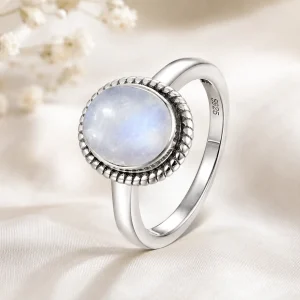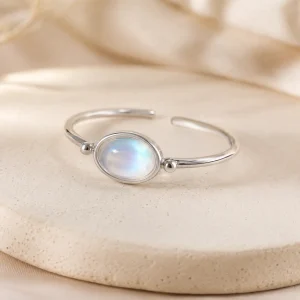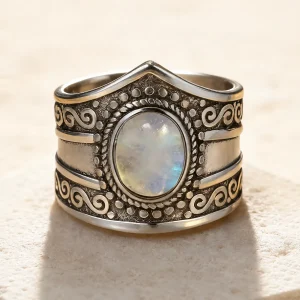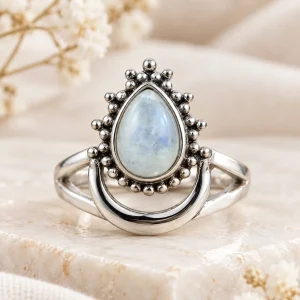


Description
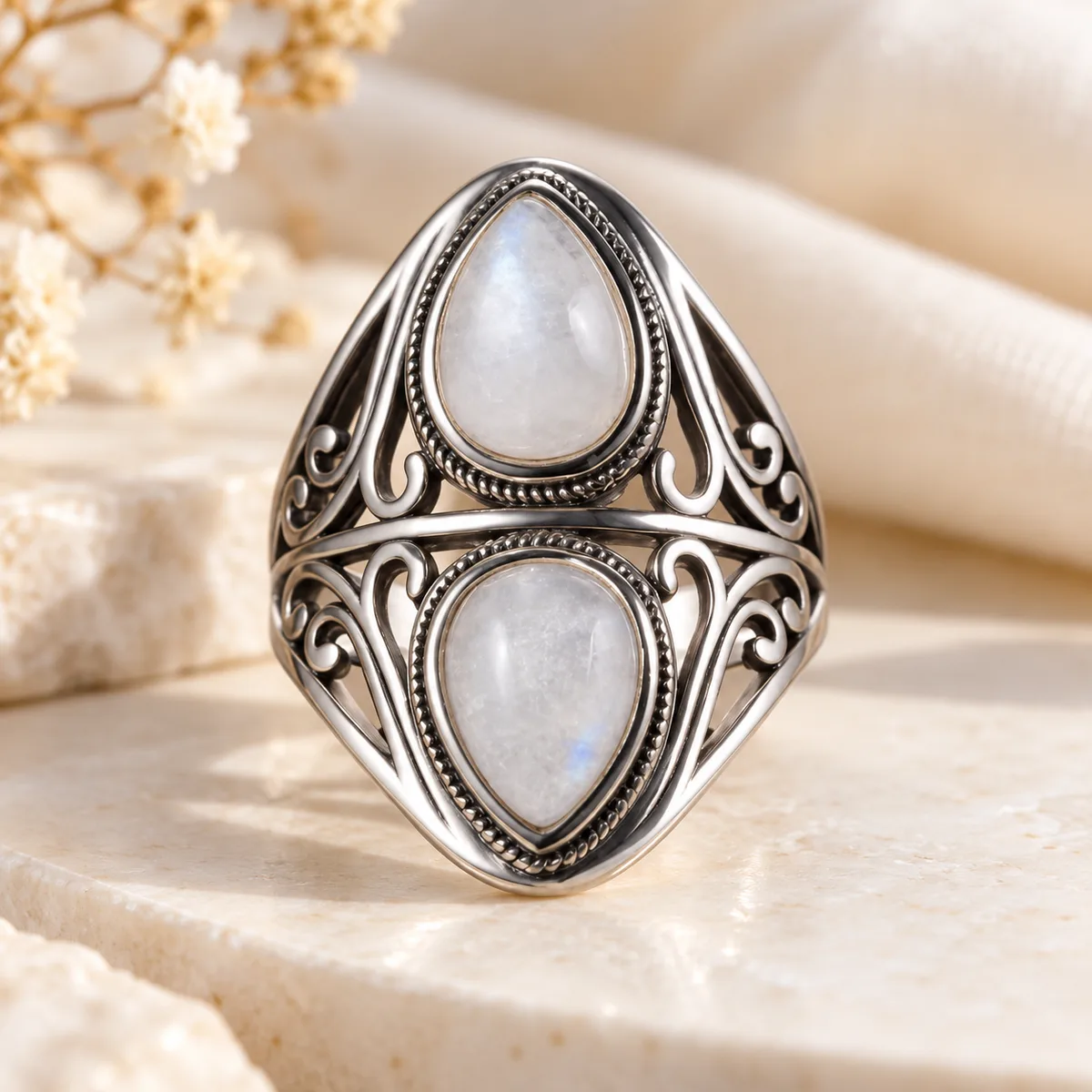
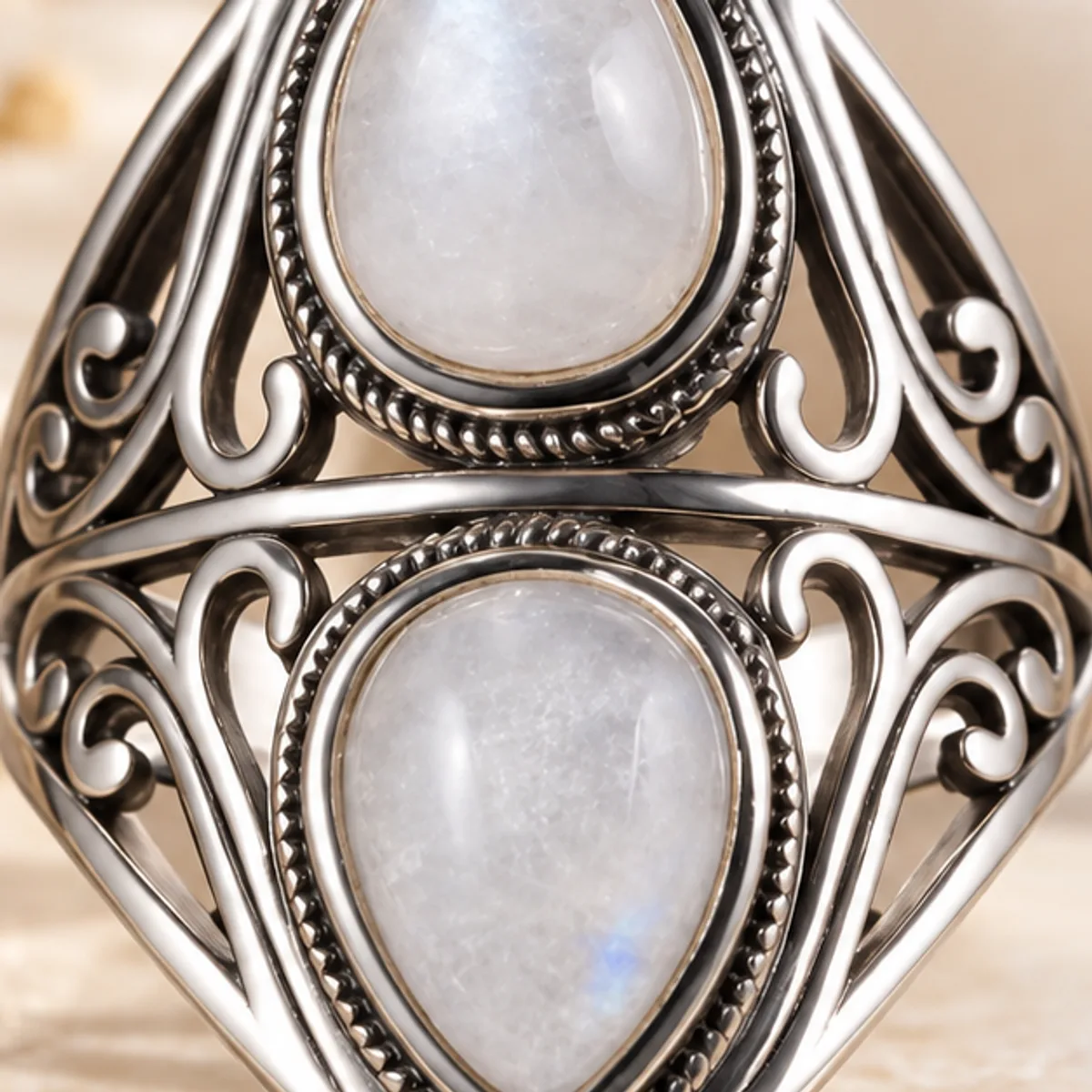
Two teardrop cabochons, set head to tail, and between them a body pierced with scrolls. It is a ring with two centers instead of one, and that is what makes it unusual.
Two stones, and how they are arranged
Head to tail means the point of one faces the rounded end of the other. Arranged that way, the two drops nest instead of colliding, and the whole thing forms a long diagonal shape across the finger rather than two separate blobs. Set them the other way, point against point, and the ring would look like an accident. This is the kind of decision that takes ten seconds to make and determines everything.
Two stones also means two chances that they will not match, and that is the honest difficulty of this model. Moonstone varies: one cabochon can be bluer, another whiter, and on a single ring the difference shows. I therefore pair them before setting rather than taking two from the same box, and I accept a slight difference of tone but not of veil intensity. A pair where one stone lights up and the other stays dull is a pair I set aside.
Both stones are held by closed bezels, which on a teardrop matters more than usual: the point is the fragile part of that shape, and a bezel covers it completely. Between and around the bezels the body of the ring is pierced with scrolls, which lightens a piece that would otherwise carry a lot of metal for a silver ring.
It is a ring that reads on the diagonal, so it wants a finger with a bit of length: the middle finger or the index, rather than the little finger. Worn alone, always, because its outline is already complicated. The other rings are here, and the size guide will spare you an exchange.
- Two teardrop moonstone cabochons, set head to tail, paired before setting.
- 925 sterling silver hallmarked S925, two closed bezels, openwork scrolled body.
- A long diagonal shape across the finger, worn alone.
- US sizes 4 1/2 to 10, that is 48 to 62 mm. Shipped in two weeks.
The specifications
- Stone
- Real moonstone (adularia), two teardrop cabochons
- Origin
- India
- Metal
- 925 sterling silver, S925 hallmark
- Setting
- Two closed bezels, no glue
- Shape
- Stones head to tail, openwork scrolled body
- Finish
- Oxidized silver, crests rubbed back with a cloth
- Sizes
- US 4 1/2 to 10 (48 to 62 mm)
- Gender
- Women
- Brand
- Melissa Moon
Pairing two moonstones
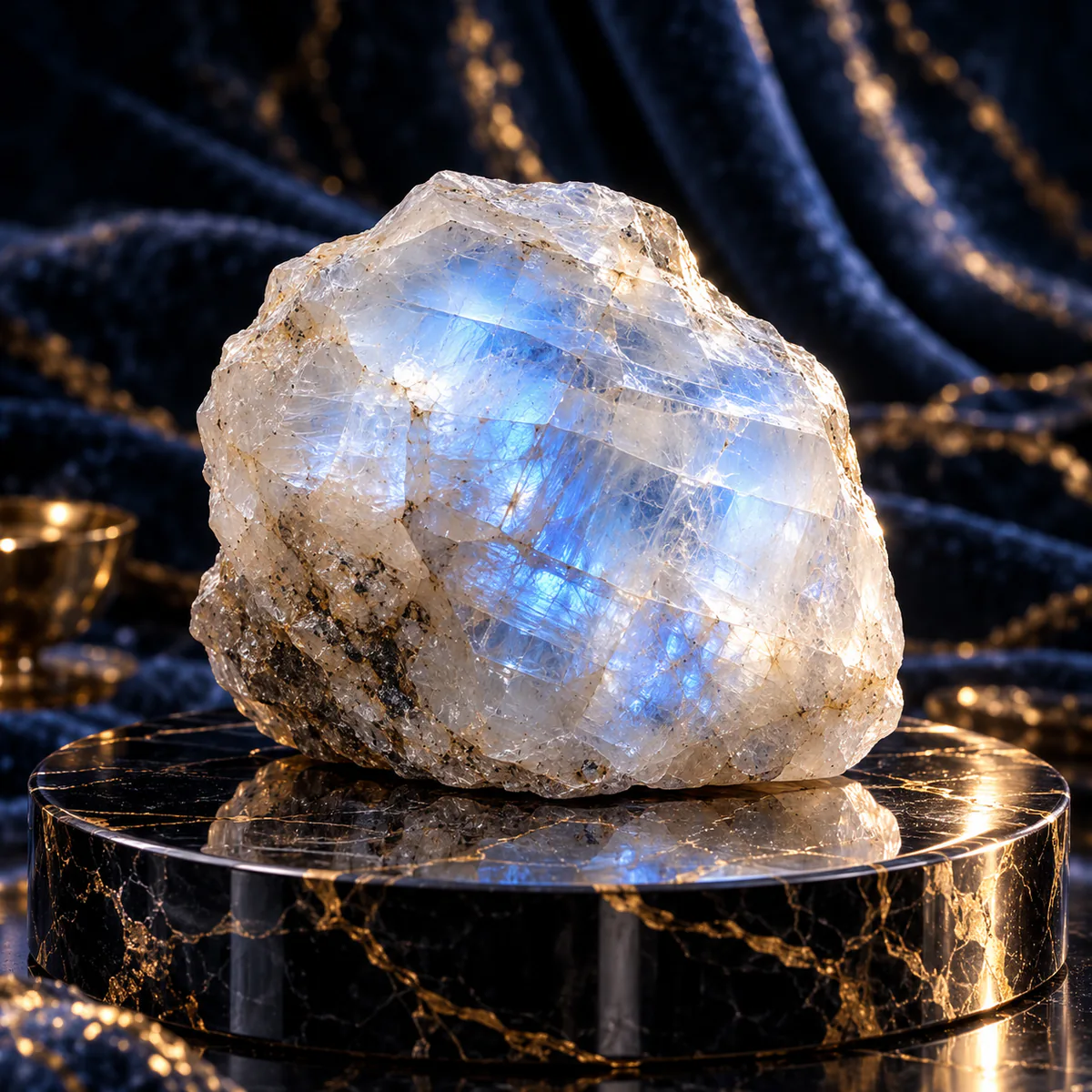
With a transparent stone you pair on color. With moonstone you pair on the veil, because that is what the eye actually sees. Two cabochons can be the same shade of milk and behave completely differently under the same light, one showing a wide blue sheet and the other a narrow streak. Side by side on one ring, that gap is what people notice, and no amount of good setting hides it.
The practical consequence for you is that the two stones on your ring will not be identical, and should not be. A pair that matched perfectly would almost certainly not be natural moonstone. A small difference of tone is the signature of a real material, and it is the one irregularity I never try to correct.
I pair moonstones by turning them together in front of a window for a minute. There is no instrument for this, and I have never found anyone who had one.
No salt, no ultrasonic tank, no hot water: moonstone is a feldspar, and all three damage it for good. With two stones there are simply twice as many edges to protect, and a moonstone chips where it is knocked. Lukewarm water, a soft cloth, and the ring comes off before the shower and the housework. The detail is in cleaning a moonstone piece, and the safe methods in caring for it without harming it.