


Description
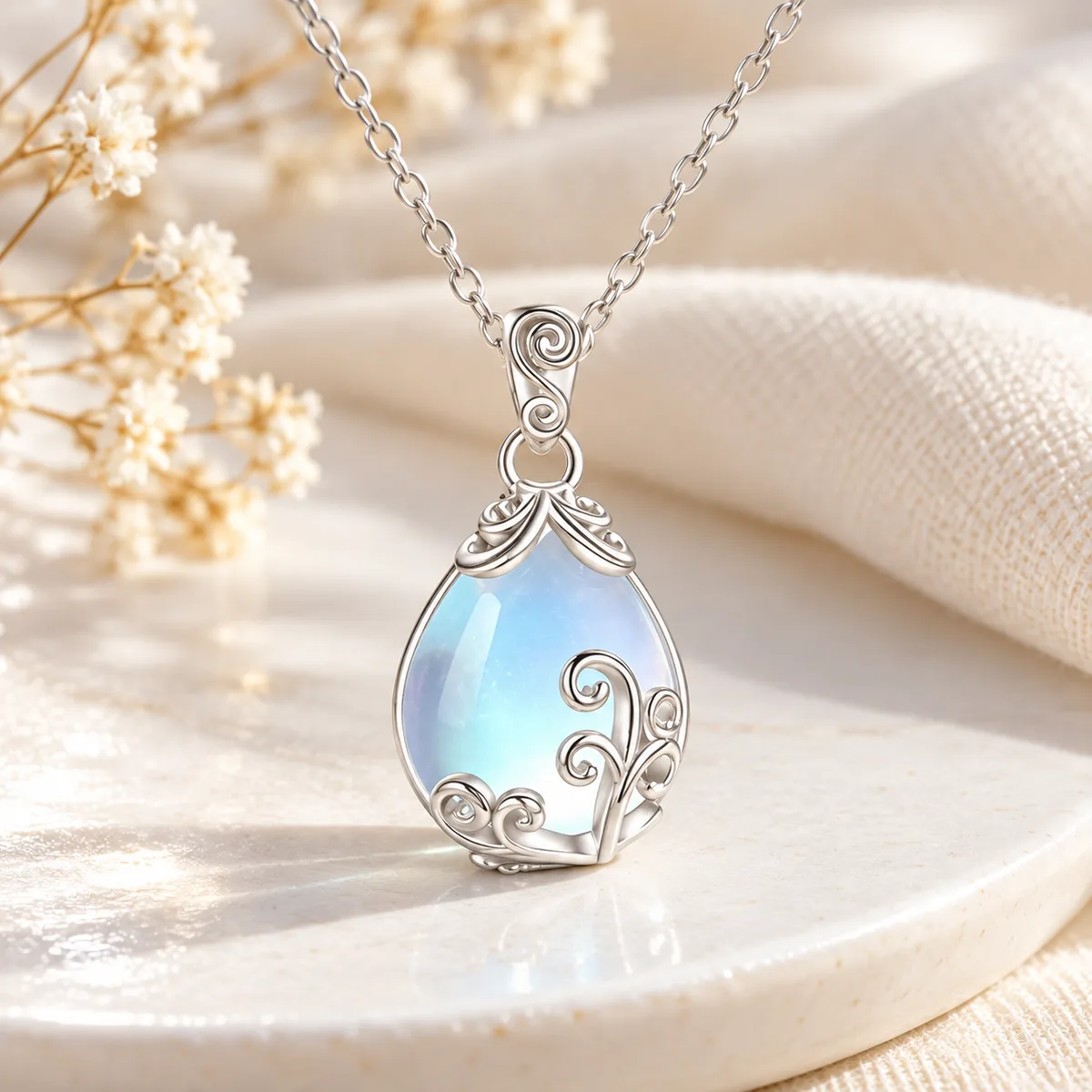
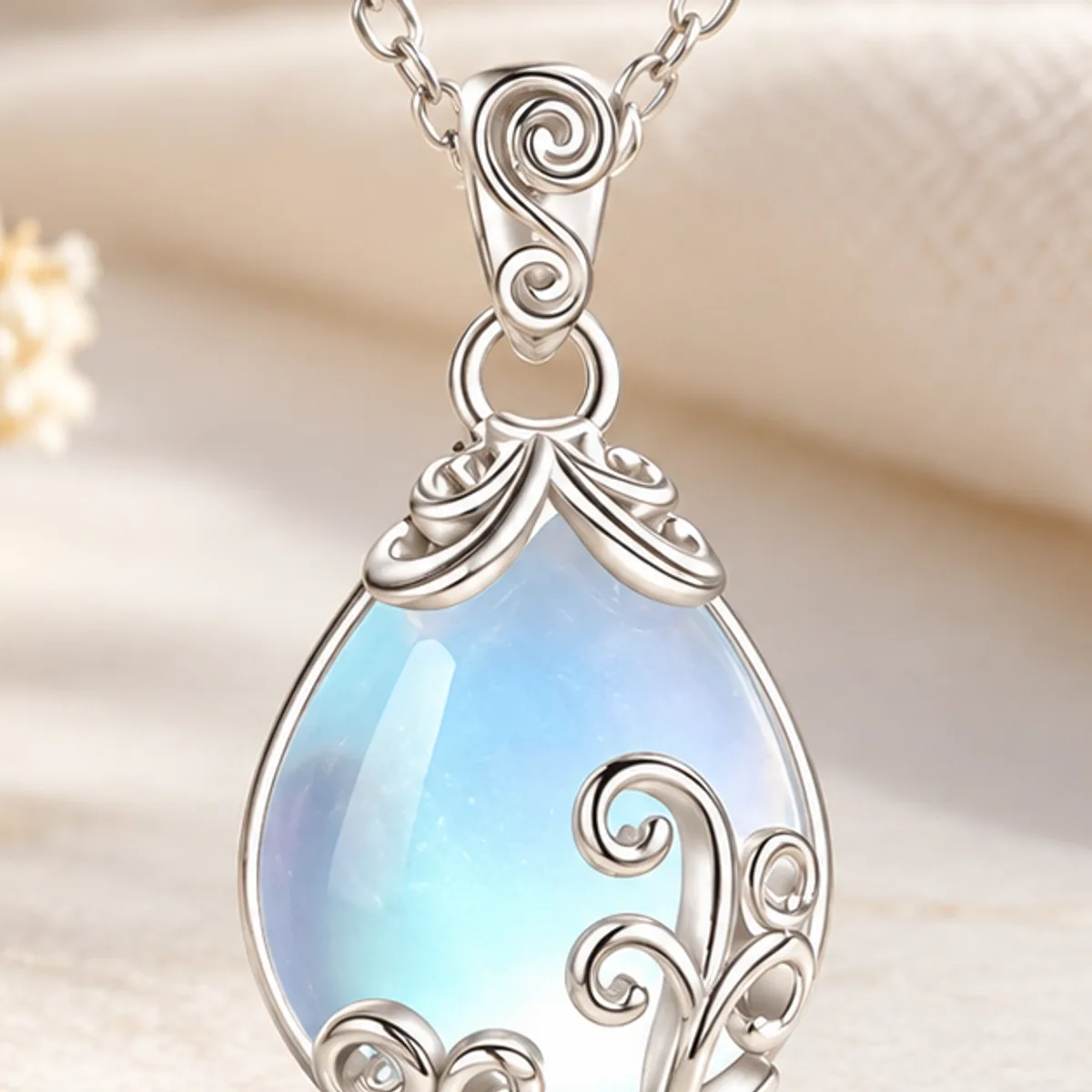
A moonstone teardrop enclosed in a frame of silver scrolls that wrap around it without touching it. The frame runs lower than the stone and finishes in a point.
A frame that extends the stone
The composition rests on that extension. The scrolls start at the bail, frame the drop on either side, meet below it and continue for a few millimetres before ending in a point. The pendant is therefore longer than the stone, and that extra length, made of space and thin metal, lengthens the line of the neck without adding weight.
The space around the drop has a second function. Light reaches the stone from the sides and from underneath, and not only from the front. On a pear cabochon, where the adularescence concentrates towards the wide part, that side lighting noticeably widens the range of angles over which the veil is visible. A solid frame would have done the opposite.
The scrolls are oxidized in their hollows and rubbed back with a cloth on the crests, which makes them readable at normal distance. Without that contrast, an ornament of fine coils becomes a grey mass as soon as you are thirty centimetres away, and all the work disappears.
The stone is mounted in a closed bezel with no prongs and no glue, the metal raised over the point of the drop. Moonstone chips on impact, and a pendant that swings knocks into things more often than you would imagine. The other necklaces are here, and what a moonstone necklace says was written for the people giving one.
- Real moonstone, pear cabochon, blue veil fading towards the point.
- 925 sterling silver hallmarked S925, scroll frame extending below the stone.
- Open frame: light reaches the stone from the sides, so the veil shows over a wider angle.
- Adjustable chain from 40 to 45 cm. Shipped in two weeks.
The specifications
- Stone
- Real moonstone (adularia), pear cabochon
- Origin
- India
- Metal
- 925 sterling silver, S925 hallmark
- Setting
- Closed bezel raised over the point, open scroll frame, no glue
- Shape
- Teardrop within a scroll frame that ends in a point below
- Finish
- Silver oxidized in the hollows, crests rubbed back with a cloth
- Sizes
- Adjustable chain 40 to 45 cm, lobster clasp
- Gender
- Women
- Brand
- Melissa Moon
Oxidation is what makes fine work visible
A frame of thin scrolls polished bright is invisible past arm’s length. Every coil reflects the same light as its neighbour, the eye finds no edge to hold onto, and the whole thing reads as a pale blur. Darkening the hollows restores the shadow the metal cannot cast on its own, and suddenly the drawing is legible from across a room. This is the single most useful trick in silversmithing and it is almost never explained.
It also means this piece has a maintenance rule that the plain models do not: the dark is the design. Clean it like bright silver and you will not damage anything, you will simply erase the work. If it ever does go uniform, any bench jeweller can re oxidize it in a few minutes, so it is a reversible mistake, but it is worth not making.
Polished fine scrolls disappear at arm’s length. The dark in the hollows is not dirt, it is the drawing.
No salt, no ultrasonic tank, no hot water: moonstone is a feldspar, and all three damage it for good. For the oxidation, one rule on top: no silver dip and no polishing cloth on the scrolls. Dirt collects between the coils, so a soft brush with lukewarm water once a month. Cleaning a moonstone piece and caring for it without harming it cover the rest.