

Description
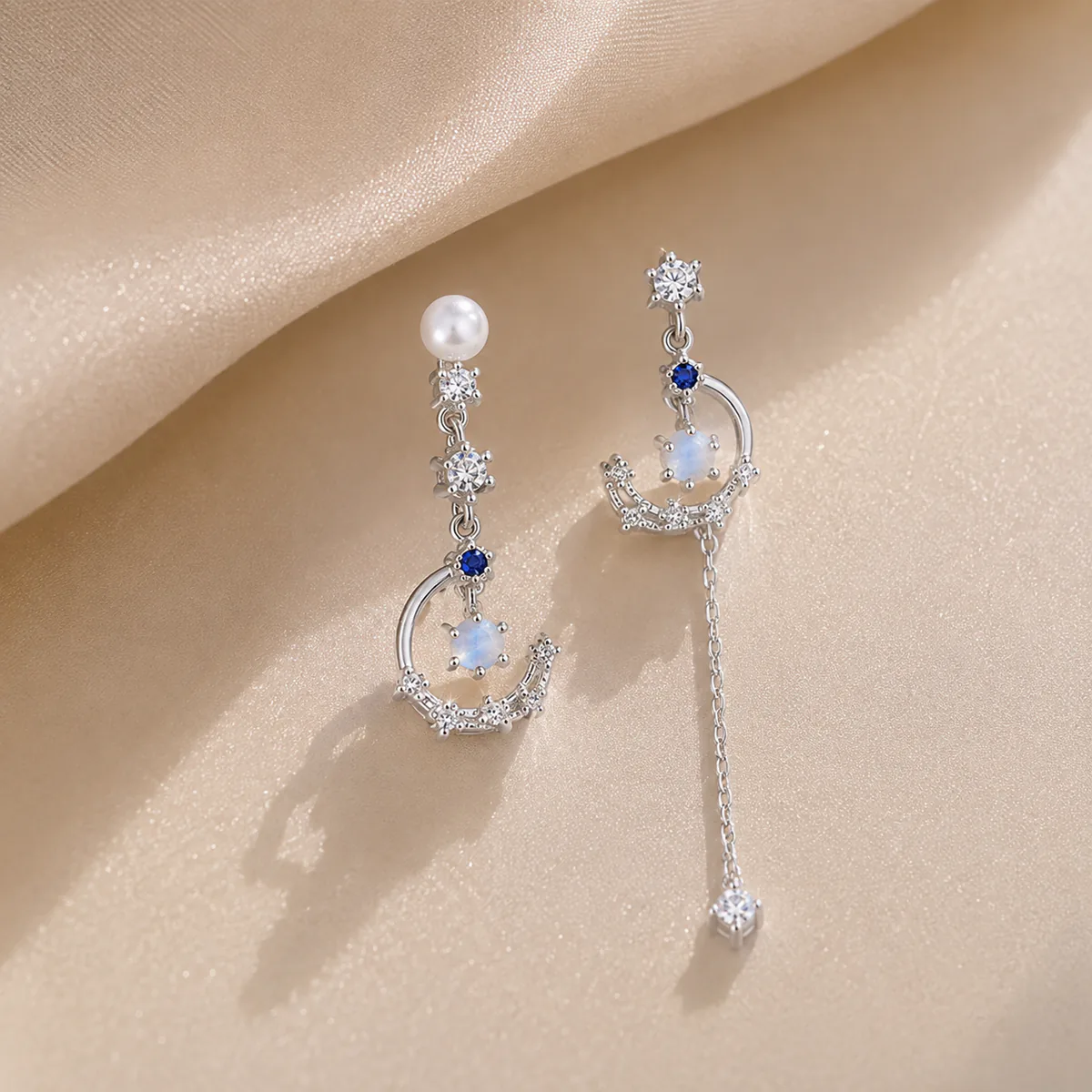
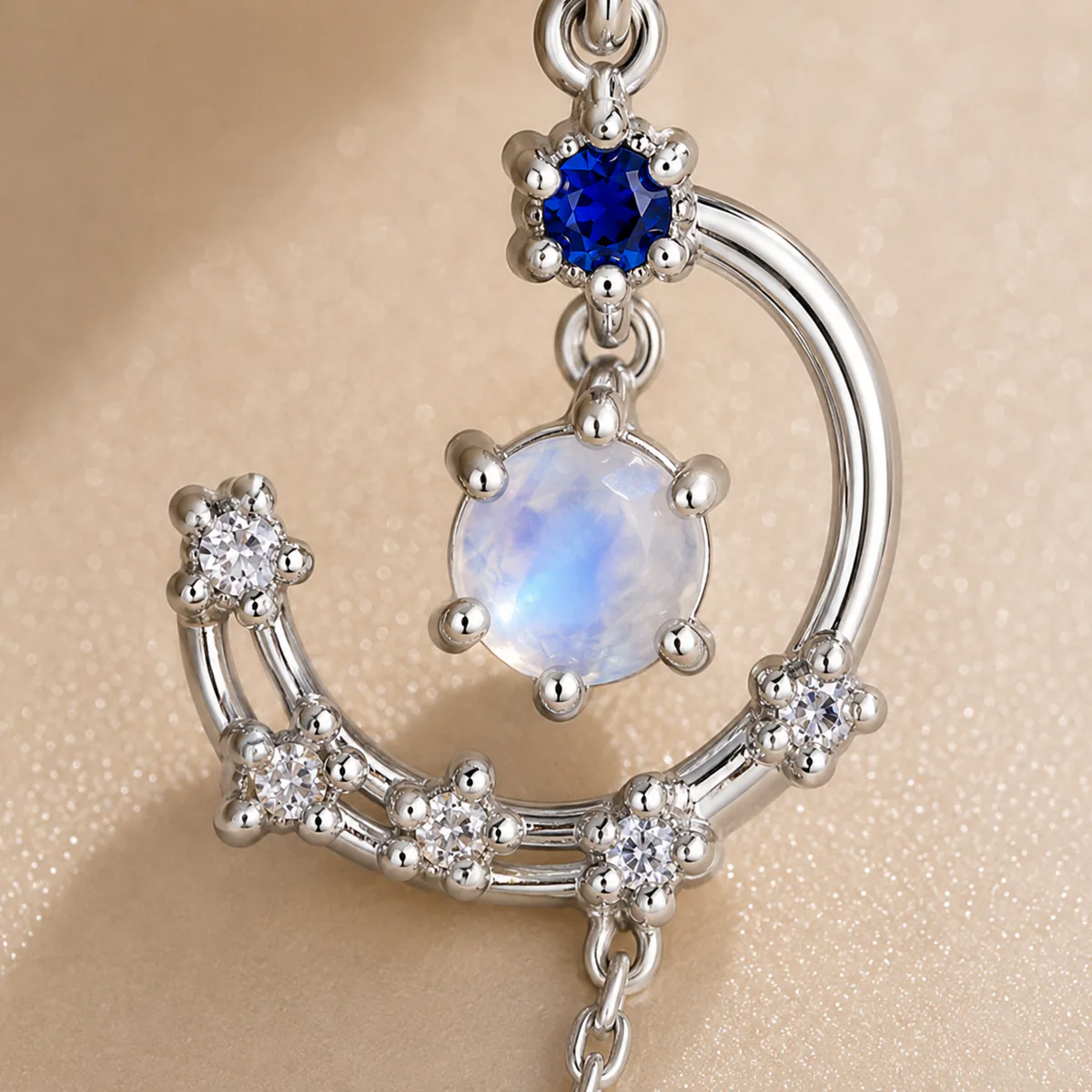
Two long articulated earrings, linking a white pearl, small clear stones, a deep blue stone and a paved crescent holding a moonstone. On one side the assembly stops there; on the other, a fine chain carries on further down. They are not identical, and that is deliberate.
A pearl, which is to say the most fragile material in the catalogue
The white bead at the top of the earring completely changes the care rules for this piece, and you need to know it before wearing it even once. A pearl is not a stone: its surface is made of very thin layers of nacre, and that nacre is attacked by anything acidic.
The list is short and final: perfume, hairspray, styling spray, cream, acidic perspiration, cleaning product. These are not distant enemies, they are exactly the substances that land on an ear when you are getting ready. A pearl placed at the top of an earring sits in the direct path of a cloud of hairspray, and the effect does not show on day one: the nacre loses its lustre gradually, goes matte, then pits. It cannot be brought back.
Hence the strictest rule in the whole catalogue, and it costs nothing: jewellery last, always. You do your hair, you put on perfume, you wait for everything to dry, and only then do you put the earrings on. In the evening you take them off first, before the makeup remover, and you run a soft dry cloth over the pearl. This precaution holds whatever the exact nature of the bead: a cultured pearl and a nacreous imitation both present a layered surface, and cosmetics damage them alike.
Five joints per earring
Here is this model’s particularity. Look at the construction: it is not one single piece, it is a run of elements linked to one another by small rings, five or six per earring. That is what gives these long earrings their main quality, movement: each element moves independently of the others, and the whole thing sparkles continuously instead of staying fixed.
It is also what decides how they will wear out. On an articulated piece, it is neither the stones nor the settings that give way: it is the rings. Each one is a simple loop of wire closed up, each works with every turn of the head, and one alone opening is enough for the entire lower part to disappear. Look at them once a month in good light, watching for a visible gap between the two ends of a ring, and have them soldered if you care about these earrings: it is a matter of minutes at a jeweller.
Second consequence, more everyday: an articulated earring tangles with everything lying around. Dropped into a dish with other pieces, it catches, and it is while untangling it that you twist the rings and bend the chain. Store them flat, separated, in a pouch. The shop’s other earrings are here.
Two different earrings, again
As on the shop’s other drop model, the pair is deliberately mismatched: one side stops at the crescent, the other carries on with a fine chain, from choosing which way round to adjusting over the first few days, and all of it applies here.
One point does get added, peculiar to this model: the difference in length between the two sides is far more marked, so the difference in weight is too. Alternate the sides from time to time rather than always making the same lobe carry the chain. And like any hanging chain, this one catches hair: wear it on the uncovered side.
A word on the stones, finally. The deep blue of the small accent stones is not that of a moonstone: those are synthetic stones cut with facets, like the small clear ones paving the crescent, and I prefer to write it down. The moonstone is the pale cabochon lodged in the hollow of the crescent: it chips on impact rather than scratching, but here it is well sheltered by the metal around it.
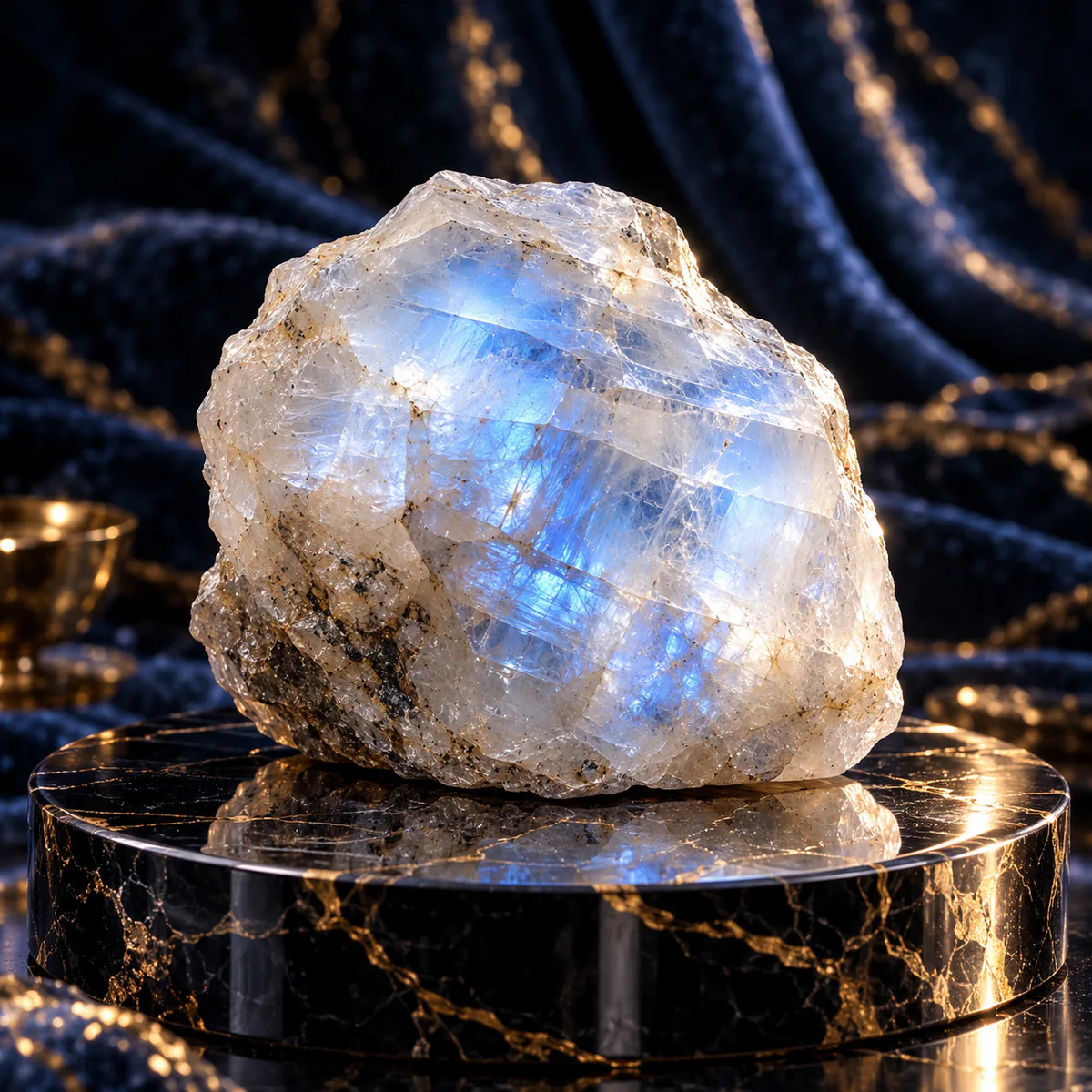
Crystal healing tradition lends moonstone correspondences tied to cycles and intuition, and I have kept for further down a stubborn superstition attached to pearls. I will go no further: none of it is demonstrated and no piece of jewellery heals anything. Separately, I have gathered what tradition lends this stone and what each colour changes.
- Long articulated earrings, mismatched pair, pearl at the top and paved crescent at the bottom.
- The pearl imposes the strictest rule in the catalogue: perfume and hairspray first, jewellery after, always.
- On an articulated piece, it is the rings that give way, never the stones.
- Delivered in two weeks with a cotton pouch, a handwritten note and a care card.
The specifications
- Stone
- Moonstone, small cabochon set in the hollow of the crescent
- Other elements
- Nacreous pearl, clear and blue synthetic stones
- Metal
- 925 sterling silver
- Construction
- Articulated elements linked by rings, mismatched pair
- Fastening
- Post and butterfly back
- Gender
- Women
- Brand
- Melissa Moon
Why a pearl, when it is the worst possible place
Putting a pearl right at the top of an earring is, technically, a bad idea: it is the exact spot where hairspray lands, and nacre is what tolerates it least. I know that and I kept it anyway, so I may as well explain why rather than let it look like an oversight.
At this scale, nothing else works at the top of the composition. A metal bead would be too bright and would crush the cabochon lower down; a clear faceted stone would duplicate those on the crescent; a translucent stone would disappear against the lobe. It had to be something white, matte, opaque and soft, and nacre is about the only material that ticks all four. So I chose rightness over durability, and the trade-off is a slightly more demanding care instruction. The rest of the shop is here.
I chose rightness over durability. It is a trade-off, not an oversight, and it is paid for in thirty seconds a day.
No salt, no ultrasonic tank, no hot water: all three damage the moonstone for good, and the ultrasonic tank would additionally destroy the pearl and tire the rings. On this model, the rule that outranks the rest is the pearl’s: nothing acidic, nothing perfumed, nothing cleaning. No jewellery dip, no silver cloth on the pearl, no soaking. A soft dry cloth after each wear is enough, and for the metal only, lukewarm water and a drop of mild soap, drying carefully around the rings. Take them off before the shower, the pool, sport and the night, and store them flat and separated: an articulated earring tangles and gets twisted while being untangled. The detail is in cleaning a moonstone piece, and the safe methods in caring for it without harming it.