


Description
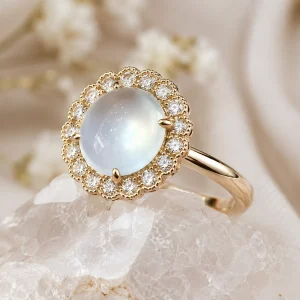
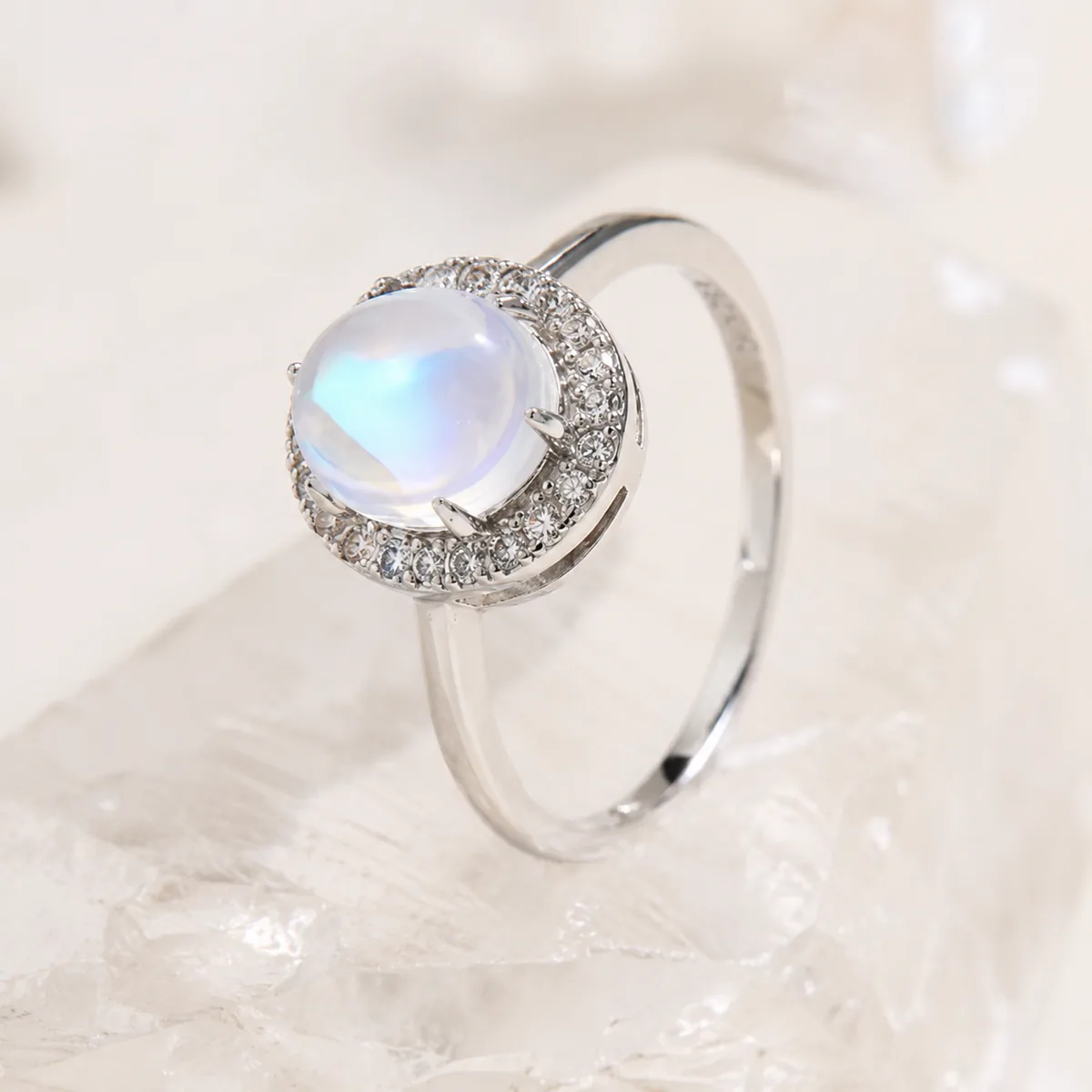
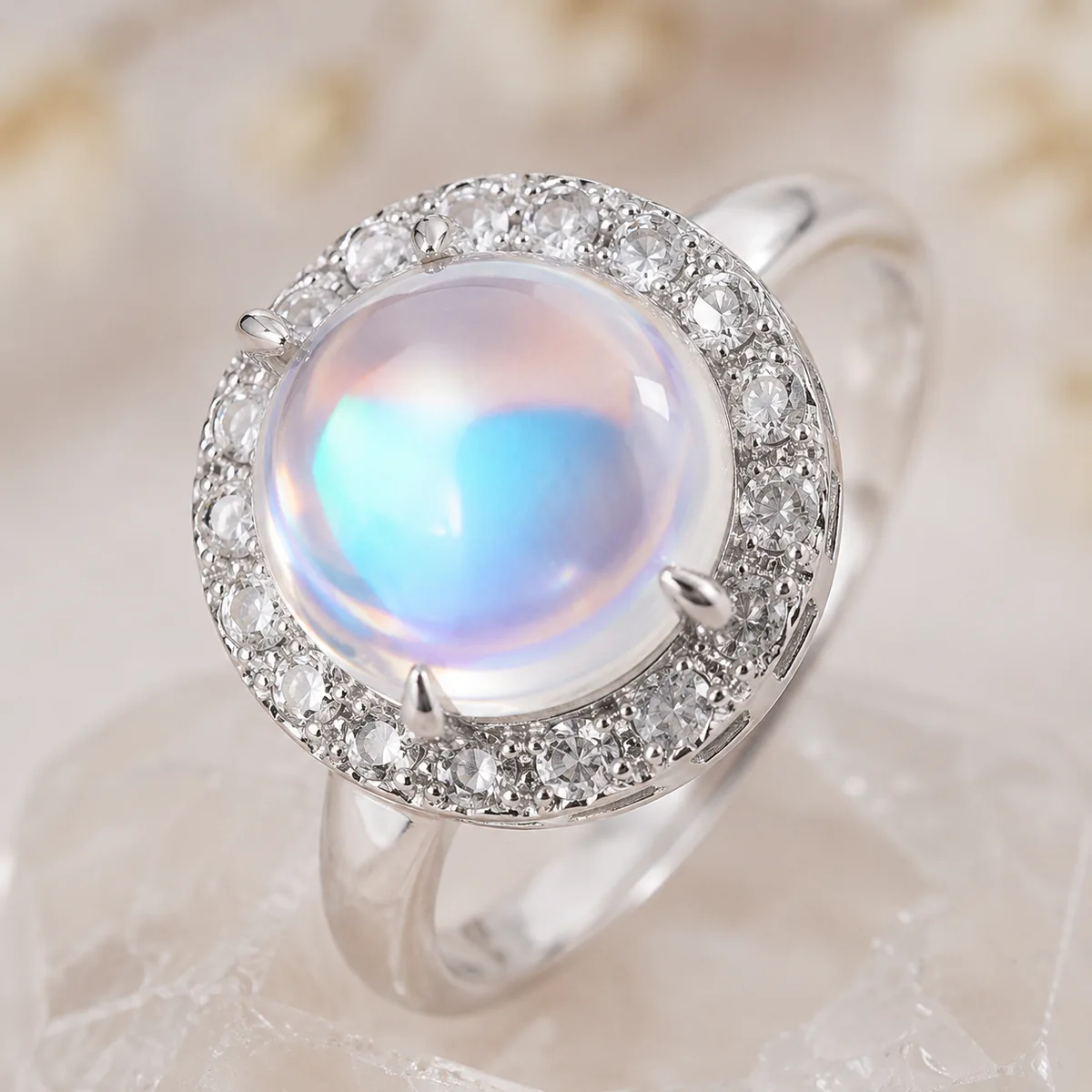
It is the most limpid stone in the catalog. A round cabochon you look through rather than at, crossed by a blue that seems to come from deep inside, held by four fine prongs at the center of a crown of small clear stones. It is the one you choose when you want to see into the stone and not only at its surface.
Not all white moonstones are alike
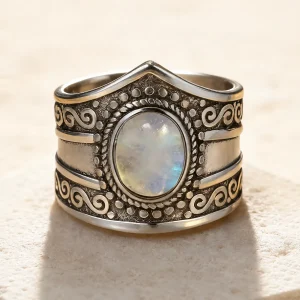
This is the classic variety, adularia, the one the other shades vary. But that single name covers two rather different stones. There is the milky white, opaque, with a silky surface, the one found on wide worked mountings. And there is this one, translucent, almost limpid, where the sheen does not settle on top but rises from within, like mist caught in glass. The second is markedly rarer than the first, and transparency is one of the six criteria I judge a stone by.
The mounting follows that choice. Four minute prongs only, placed on the diagonals, and an open gallery under the cabochon: on a stone you look through, closing the metal underneath would amount to putting a black backing behind a stained glass window. Light has to be able to come in from below. Around it, a halo of small clear stones set in an outline bordered with beading, and a band that splits as it approaches the head before closing again under the finger. Everything the shop offers in white is here, and the other rings are there.
Under a spotlight, the halo takes over
Now the nuisance of this kind of mounting, and it is not where you expect it. Under hard artificial light, the halo crushes the stone. The small stones of the outline are faceted: they throw back the light of a spot violently, whereas the cabochon throws nothing back, it diffuses. Under a restaurant ceiling light or a desk lamp you will therefore see a ring that sparkles around a stone that looks dead. In daylight the balance reverses completely and the center takes the lead. It is not a fault of manufacture, it is the nature of the two materials, but it is better to know it than to believe you have a poor stone on the evening it arrives.
Two reservations of use. The prongs are fine and should be checked once a year with the tip of a fingernail: a stone that moves is a stone that will fall out. And moonstone has perfect cleavage, it chips on impact without scratching for all that. The sizing guide will also save you a return.
What tradition says, kept apart
Crystal healing tradition makes moonstone a stone of cycles, of intuition and of the return to calm; it is said to accompany periods of change rather than to bring them about. I will go no further: none of it is demonstrated and no piece of jewelry heals anything. Separately, I have gathered what tradition lends it and what each color changes.
- Translucent white moonstone, adularia, a blue that rises from within rather than from the surface.
- 925 sterling silver. Four fine prongs on an open gallery, halo of small clear stones, split band.
- At its best in daylight. Under a spotlight, the halo takes the upper hand.
- Sizes 4½ to 10. Delivered in two weeks, with a cotton pouch, a handwritten note and a care card.
The specifications
- Stone
- White moonstone (adularia), round cabochon cut, translucent body
- Halo
- Small clear stones in bezel settings bordered with beading
- Metal
- 925 sterling silver
- Setting
- Four prongs on an open gallery, no glue
- Band
- Split as it approaches the head
- Sizes
- 4½ to 10
- Gender
- Women
- Brand
- Melissa Moon
Why I keep two whites in the catalog
Because they do not address the same people. The milky white is warm, it marries worked mountings, and its sheen reads from a distance. The translucent white is cooler, quieter, and you have to come close to it: it is a stone that rewards whoever looks. Many shops do not distinguish the two and sell everything as white moonstone, which is why people sometimes receive something other than what they thought they had ordered.
A word on the open gallery while we are here. On the opaque cabochons in the catalog I prefer a bezel setting that closes everything in: light from below serves no purpose and the metal protects better. Here it is the opposite, and it is the only case where I accept losing in protection what I gain in clarity. The rest of the shop is here.
A translucent stone does not photograph well and does not sell easily. It is nonetheless the one I would keep if I had to keep only one.
No salt, no ultrasonic tank, no hot water: moonstone is a feldspar, and all three damage it for good. The ultrasonic tank is all the more to be banned here since it makes the halo stones vibrate in their seats. Lukewarm water, a soft cloth, and careful drying between the small stones, where soapy water likes to linger. On a cabochon this transparent, fingerprints show more than on a milky stone: a wipe with a dry cloth gives it back its clarity. The detail is in cleaning a moonstone piece, and the safe methods in caring for it without harming it.