

Description
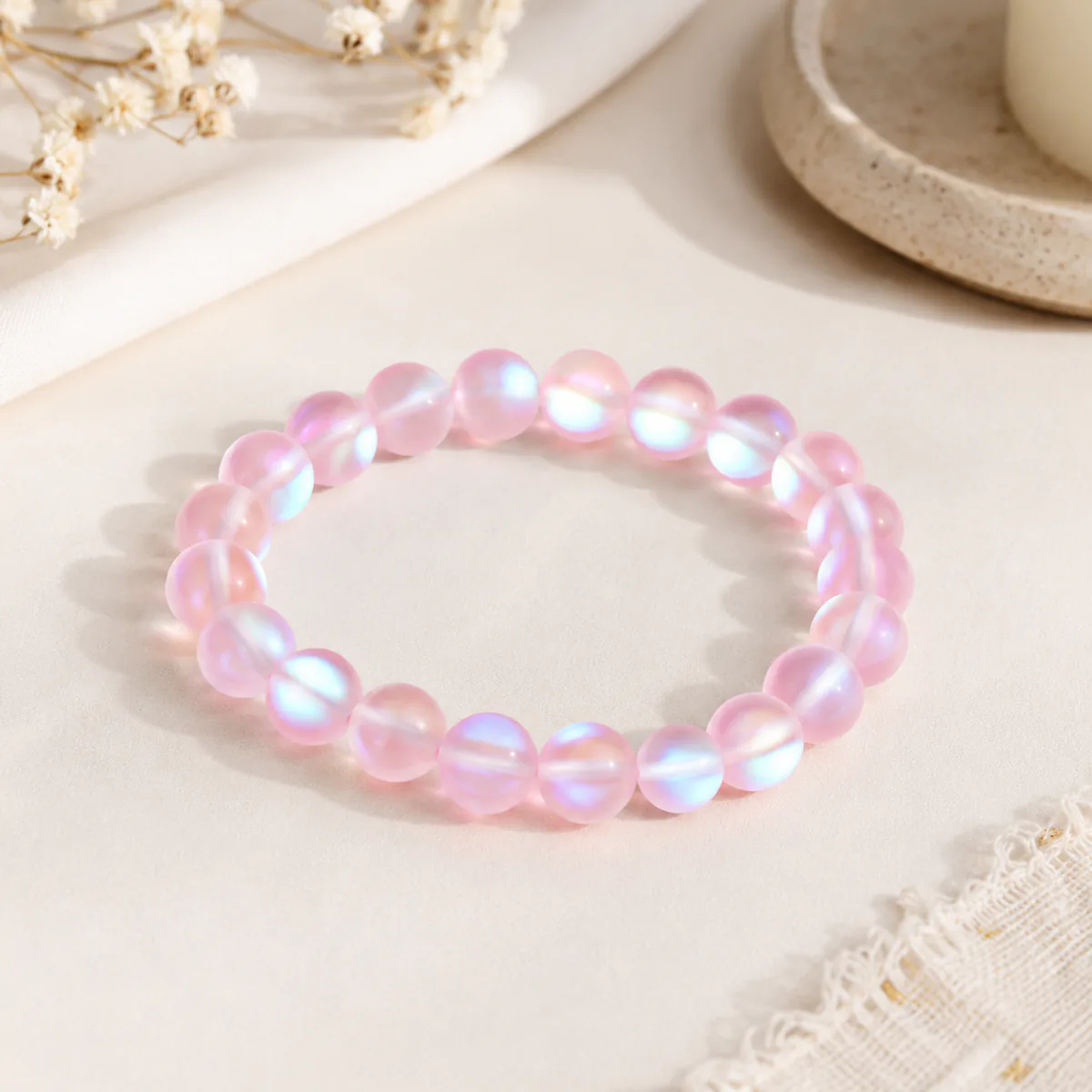
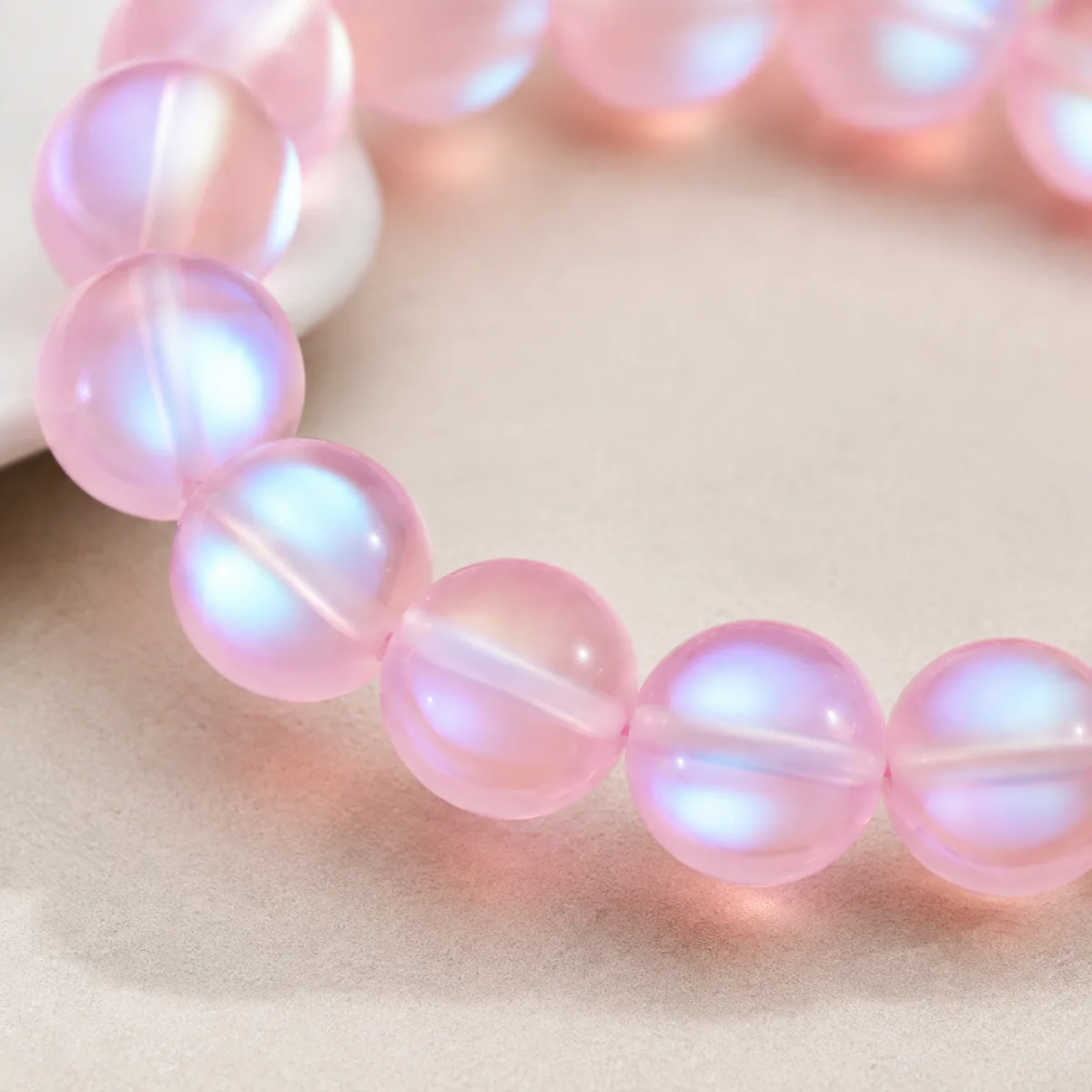
It is the only frankly colored piece in the shop. Round beads of a pale, translucent pink, each crossed by a bluish glow rising from the center, strung on a stretch cord with no metal at all. Nothing discreet here, and that is deliberate.
A color that does not go unnoticed
The rest of the catalog plays on whites, greys and milky blues. This bracelet is the exception: its pink is clean, readable from a distance, and the translucency of the beads makes it brighter than an opaque stone of the same shade. The cool glow crossing each bead contradicts that warm pink, and it is that small disagreement which gives the bracelet its character.
The format is that of the classic bead bracelet: round, polished, threaded on a stretch cord, with no clasp and no spacers. It goes on one-handed in three seconds and comes off just as fast. The shop’s other bracelets are here.
Wearing it stacked, and what that implies
It is the model in the catalog that most calls for stacking: on its own it is very visible; alongside two or three plainer bracelets it becomes an accent. But stacking has a technical consequence nobody writes on product pages, and it deserves thirty seconds of attention.
Stacking bracelets means putting stones of different hardnesses in permanent contact. Two bracelets side by side rub against each other with every movement of the arm, far more than the beads of a single bracelet rub against one another. If you wear this one with a quartz, amethyst or carnelian bracelet, all around 7 on the hardness scale, those are the stones that will mark yours, and not the other way round.
The counter is simple: stack with stones of comparable hardness, or slip in a bracelet of wood, seed or fabric beads, which acts as a shock absorber between two stone bracelets. I have gathered elsewhere the pairings that work and those to avoid, where this question comes up every time.
What translucency lets you see
Here is this model’s particularity, and it belongs to pale, transparent beads. You can see the cord through them. On a bracelet of opaque beads, the elastic is invisible from the first day to the last; here it shows in the drill hole of each bead, and it shows more and more with time, because a pale elastic darkens and yellows as it ages.
It is not a fault, it is a consequence of the material, and it even has an advantage: you see the end of the cord’s life coming, which never happens on an opaque bracelet, where the elastic gives without warning. When the cord looks distinctly darker than on day one, it is time to have it restrung, which a jeweler does in ten minutes. Reckon one to three years depending on how often you wear it, and put the bracelet on by rolling it over the hand rather than stretching it to full width: that is what decides how long it lasts.
These beads are also sensitive to impact like every one in the catalog: moonstone chips rather than scratching, and it is the beads underneath that knock against table edges.
Crystal healing tradition associates pink stones with gentleness and calming, and files them on the side of the heart rather than the emotions. I have put those correspondences apart further down. I will go no further: none of it is demonstrated and no piece of jewelry heals anything. Separately, I have gathered what tradition lends this stone, what each color changes and what is said about which wrist to choose.
- Round pink translucent beads, crossed by a bluish glow. The only frankly colored piece in the catalog.
- Stretch cord, no clasp and no spacers. Goes on one-handed.
- When stacking, mind the hardnesses: a quartz bracelet will mark this one.
- Delivered in two weeks with a cotton pouch, a handwritten note and a care card.
The specifications
- Stone
- Pink moonstone, round beads
- Look
- Translucent, internal bluish glow
- Assembly
- Stretch cord, no clasp and no spacers
- Number of beads
- Varies with wrist size
- Wrist sizes
- 14 to 20 cm
- Gender
- Women
- Brand
- Melissa Moon
The only bracelet I do not advise wearing on its own
It is rare for me to say that of a piece in the catalog, but this one gains a great deal from company. Worn alone on a bare wrist, its pink is the only visible element and it pulls the whole gaze; set beside a white or grey bracelet, it becomes a punctuation mark and the whole wrist gains in balance. It is the opposite of what I advise for the bangle or the matte bracelet, which stand on their own.
On this kind of bead, what I look at when opening a batch is the regularity of the diameter more than the color. A bead slightly larger than its neighbors does not show on a dark bracelet; on a pale translucent pink it jumps out, because light passes through and underlines the slightest difference in size. The rest of the shop is here.
A frank color asks for company. On its own, it looks as if it had been chosen by default.
No salt, no ultrasonic tank, no hot water: moonstone is a feldspar, and all three damage it for good. Lukewarm water, a soft cloth, drying well between the beads. On translucent beads, water left in the drill holes shows and leaves darker zones until it evaporates: dry it seriously, or leave the bracelet flat for an hour before putting it away. Take it off before the shower: soap does not attack the stones but it wears the elastic, and on this model you will see that fatigue through the beads. The detail is in cleaning a moonstone piece, and the safe methods in caring for it without harming it.