

Description
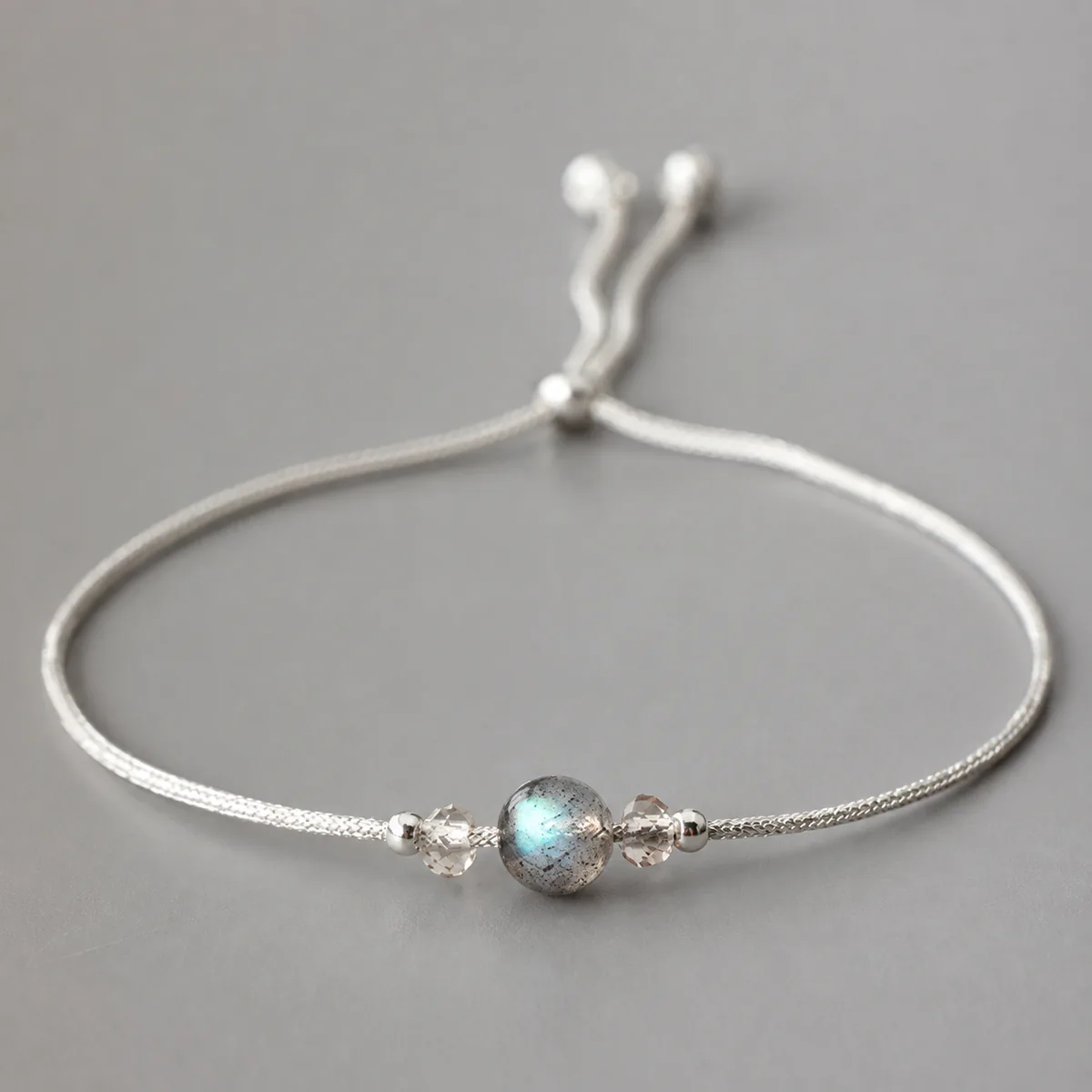
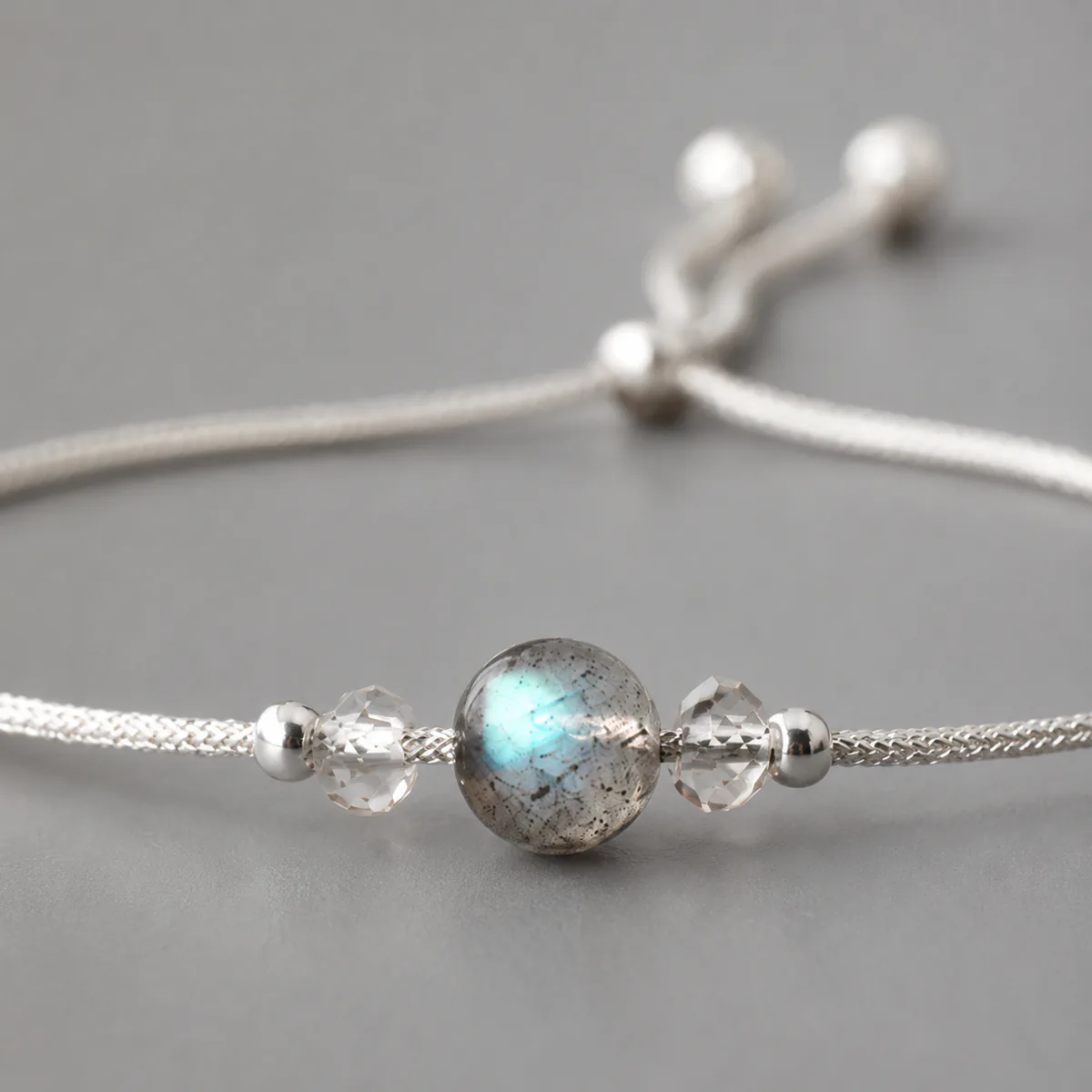
A very fine braided cord, a single gray stone at the center, two small faceted clear beads on either side, and a sliding fastening that adjusts in one movement. It is the most discreet bracelet in the catalog, and the only one where everything rests on a single stone.
One stone, and nothing to hide it
On a row of thirty beads, two or three mediocre stones go unnoticed: the eye averages them out and remembers the whole. Here there is no average. If the central stone is dull, the bracelet is dull, and nothing comes to the rescue. It is a format that does not forgive, and that is also why it is the most honest: you see one stone properly, instead of glimpsing thirty approximately.
This one is a gray stone crossed by a frank blue flash that lights up at a certain angle and goes out at the next. Look at it closely: you will see fine black points in the material. These are not dirt, they are inclusions, and their presence is rather a good sign, because imitation glass never has any. A perfectly clean, uniformly blue stone should, on this kind of material, raise more suspicion than a speckled one.
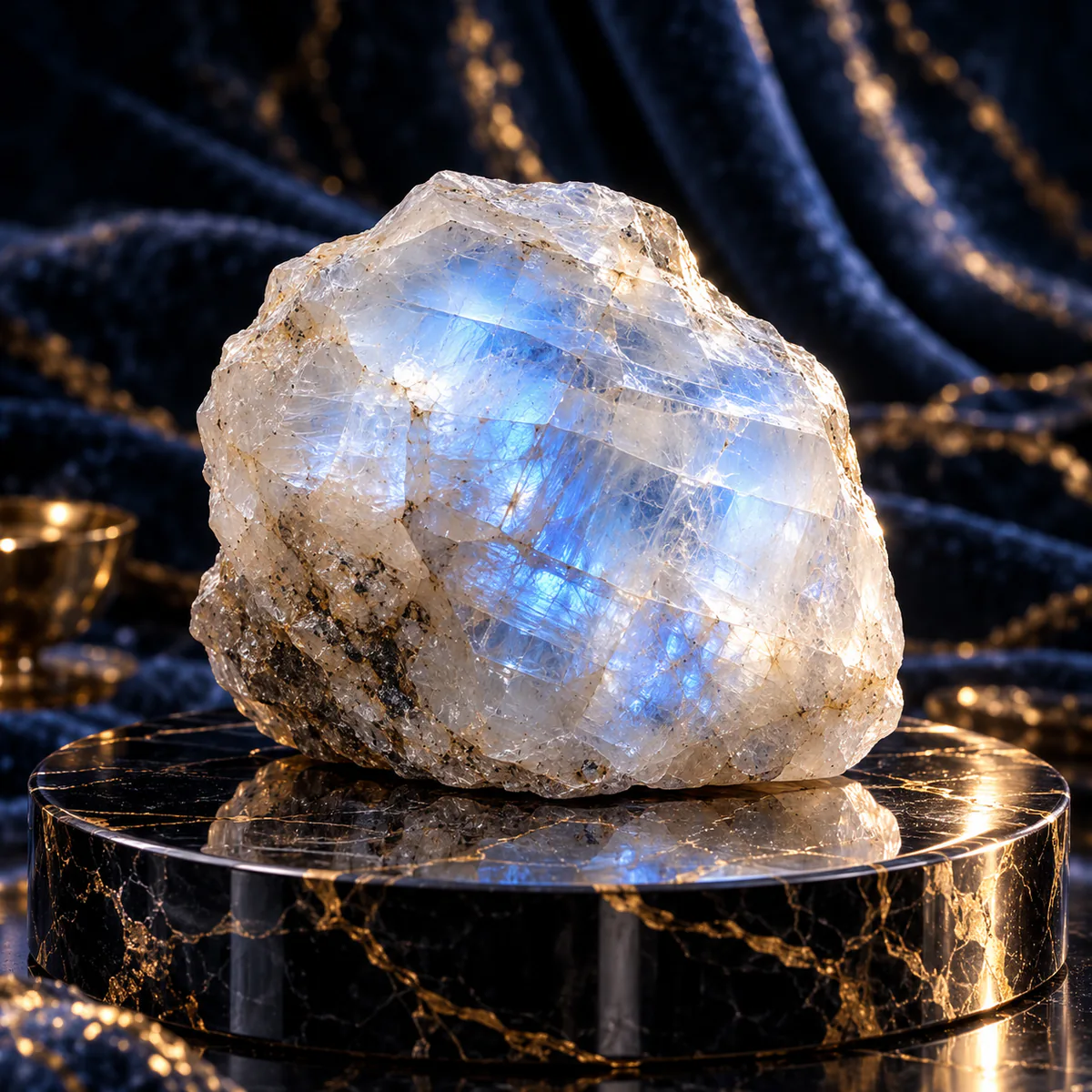
I may as well say it, as on the other pieces concerned: the gray stone with a blue flash is a labradorite, a direct cousin of moonstone and sold everywhere under the same family name. The difference is explained in detail here.
A fastening that adjusts in both directions
It is the quiet advantage of this model, and it deserves a comparison. An extension chain lengthens a bracelet, never the reverse: if you choose too large, that is that. A sliding fastening, on the other hand, tightens and loosens endlessly, with one hand, by pulling on the two strands. It is the format that best adapts to a wrist that swells in summer, and it is also the one you can give without knowing the person’s size. The sizing guide is here, but on this model it serves only to tell whether the cord is long enough.
Its trade-off is mechanical and nobody writes it down: a slider holds by friction, and friction wears. After a few months, the bracelet starts loosening on its own through the day, and you tighten it without thinking. That is not a breakage, it is fatigue, and it can be put right: a jeweler tightens the internal grip of the sliding bead in a few minutes. Do not do it with pliers at home, you would crush the cord running through it.
One last point of use: the two strands sticking out past the fastening hang free and catch on sleeves. Turn the fastening under the wrist as you dress, and the strands then fall along the hand instead of dragging on fabric.
A braided cord cannot be repaired
Here is what is particular about the format, and it is what really sets it apart from the shop’s two other bracelets. A row of beads gets restrung. A bangle gets straightened. A braided cord, once sharply folded or crushed, keeps its mark forever, because the braid opens at the fold and nothing closes it again. It does not break for all that, but the bracelet now has an elbow, and it shows.
Two practical consequences. You do not store it rolled tight at the bottom of a box with other pieces crushing it, but laid in a circle or hung up. And you do not take it off by pulling on it like an elastic: you loosen the slider first, then remove it.
The braid has a second drawback, more everyday: it holds on to everything you give it, soap, cream, the salt of perspiration, and that dirt settles between the strands, where no cloth reaches. That is why this bracelet must come off before the shower and before creamed hands, far more strictly than a solid bangle. When it turns gray, it is almost never the metal that has tarnished, it is the braid that is loaded. The shop’s other bracelets are here.
The stone stays sensitive to impact, like all those in the catalog: it chips rather than scratches. On a flexible cord it also tends to pivot under the wrist, because it is the heaviest point of the bracelet: it therefore often ends up against the table, palm side. A glance now and then to bring it back on top, and it will be better protected. Crystal healing tradition lends this stone correspondences tied to intuition and protection. I have put them apart below. I will go no further: none of it is demonstrated and no piece of jewelry heals anything. Separately, I have gathered what tradition lends this stone, what each color changes and what is said about which wrist to choose.
- A single gray stone with a blue flash, on a very fine braided cord.
- Sliding fastening: it tightens and loosens, unlike an extension chain.
- A sharp fold in the braid cannot be undone. Store it in a circle, never crushed.
- Delivered in two weeks, with a cotton pouch, a handwritten note and a care card.
The specifications
- Stone
- One gray stone with a blue flash, a labradorite
- Accent beads
- Two small faceted clear beads
- Construction
- Fine braided cord, sliding fastening
- Adjustment
- In both directions, with no size limit
- Gender
- Women and men
- Brand
- Melissa Moon
Why one stone costs me more than a whole row
It sounds absurd and yet it is the case. To make up a row, I buy a parcel and accept that a few beads will be average, because they will disappear among the others. For this bracelet, I have to find in that same parcel the rare beads whose flash is frank, wide and well centered, and the rest is no use to me. The price of a solitaire is not the stone, it is everything set aside to obtain it.
It is also the model I recommend to anyone who has never owned this stone. You learn it far better on a single example you look at often than on thirty you stop looking at. And if the flash leaves you cold, you will have found out on a discreet piece rather than on an imposing one. The rest of the shop is here.
On a row, a dull bead hides behind its neighbors. Here, it would be the piece.
No salt, no ultrasonic tank, no hot water: all three damage the stone for good, and the ultrasonic tank would work the braid besides. Care on this model bears above all on the cord: lukewarm water, a drop of mild soap, a very soft toothbrush run in the direction of the braid, a rinse, then flat and thorough drying before you put it away, because the moisture left between the strands is what dulls them. On the stone, a soft dry cloth is enough. The detail is in cleaning a moonstone piece, and the safe methods in caring for it without harming it.