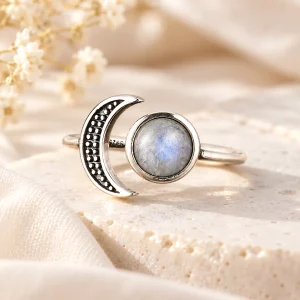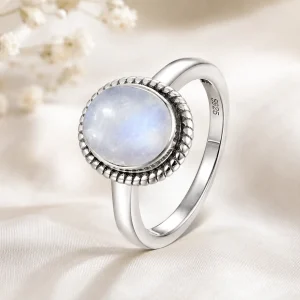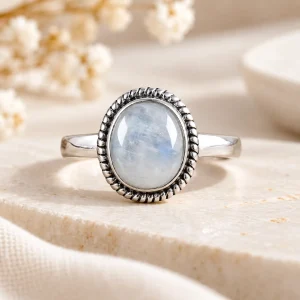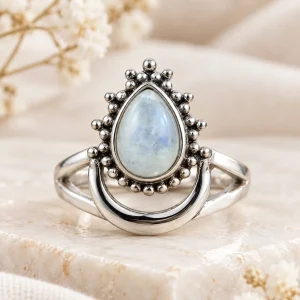



Description
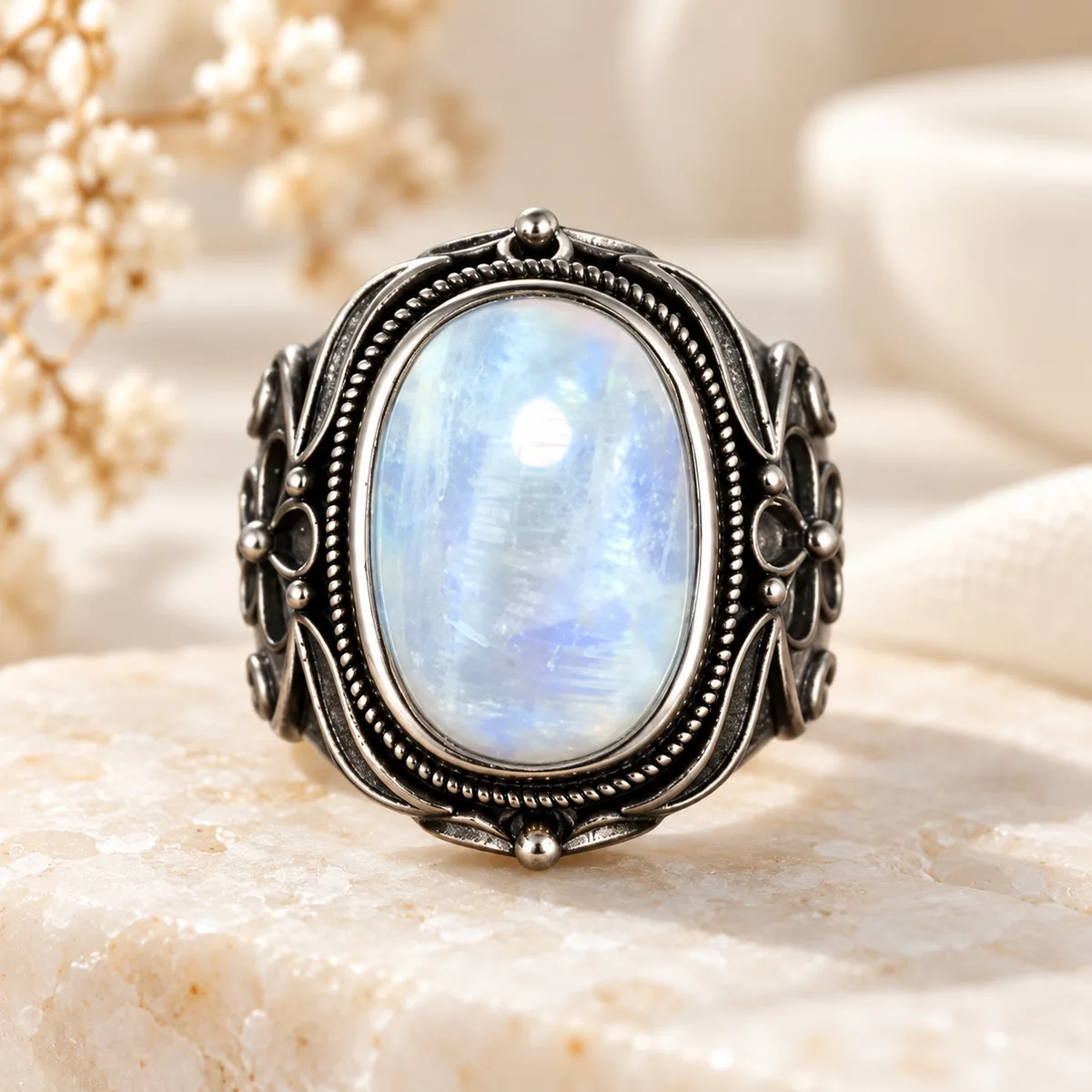
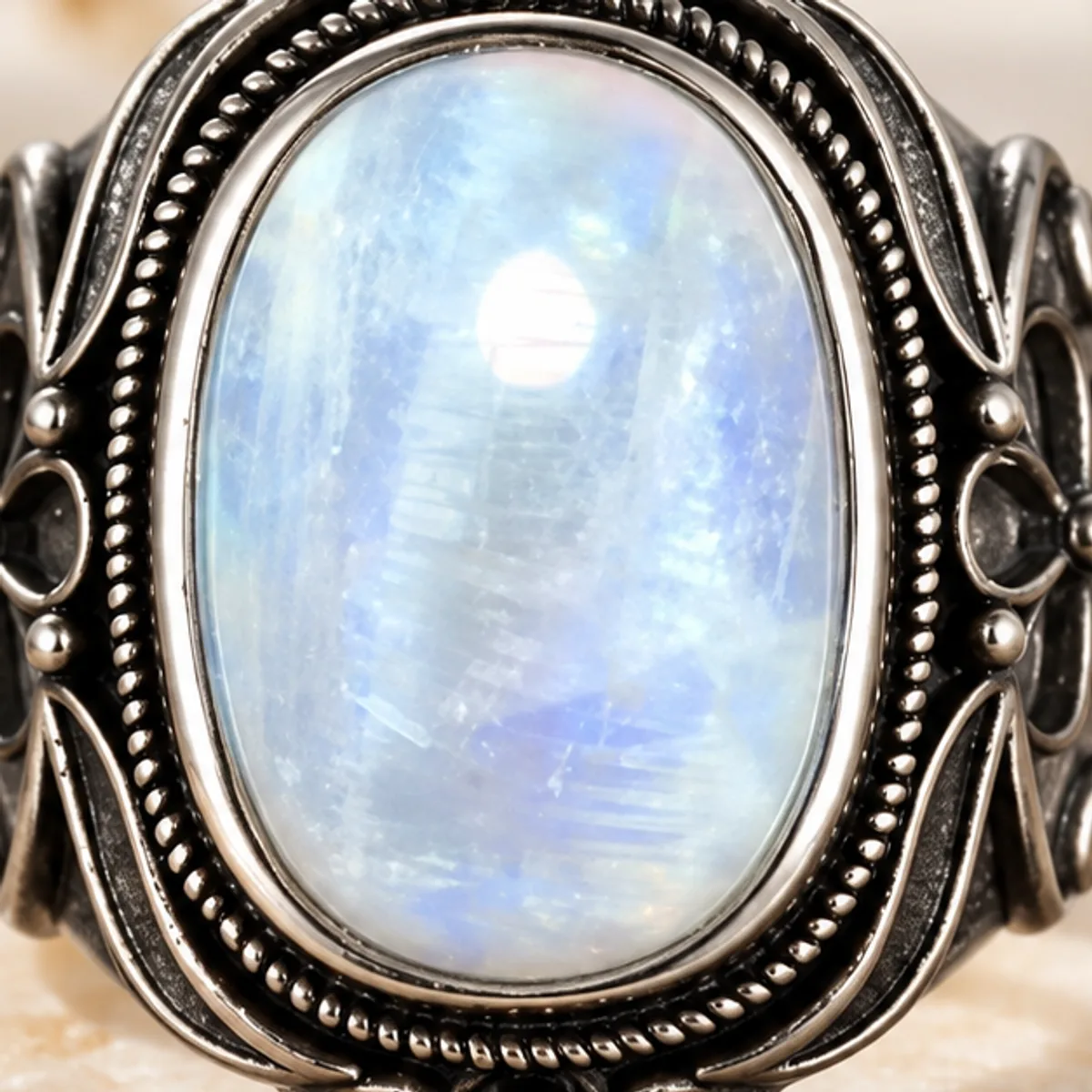
A large oval moonstone, and on either side shoulders in filigree: fine silver wires coiled into tight spirals, blackened in the hollows, rubbed back on top. It is a wide ring, and yet it weighs almost nothing.
Filigree, a decoration that removes material
Filigree means forming a pattern with fine silver wires and soldering them to each other rather than onto a solid ground. The result is openwork: light passes through, you see skin behind the spirals, and the ring stays light despite its width. It is the exact opposite of a heavy signet, where mass makes the volume. Here the volume comes from the void, and a band ten millimetres wide weighs no more than a plain three millimetre one.
The work has a visual consequence you only notice when wearing it: the openwork shoulders let the skin show through, which makes them look finer than they are and concentrates attention on the stone. The silver is oxidised in a bath, then the crests of the spirals are rubbed back one by one with a cloth. The ground stays dark, the edges turn bright again, and the drawing reads at normal distance. Without that contrast, filigree collapses into a grey mass.
The cabochon is large, oval, domed. At that size, adularescence has room to travel: the blue veil slides from one edge to the other as your hand turns, instead of igniting in flashes. The body is milky, the reflection centred, and a few internal inclusions can be made out very close up. On a stone this size, perfect clarity would cost far more than the whole ring; moonstone quality explains why that is not the most useful criterion.
The mount is a bezel setting, no claws and no glue, for the same reason as everywhere else in this catalogue: moonstone chips on impact, and metal that wraps the dome completely is its best protection. The ring is worn on the ring finger or the middle finger, alone. The size guide counts double on a wide model, which fills the finger more than a slim band. The other rings are here.
- Large oval moonstone cabochon, a travelling blue veil, centred reflection.
- 925 sterling silver hallmarked S925, openwork filigree shoulders, spirals soldered wire to wire.
- Wide but light: the decoration is made of void, not of mass.
- UK sizes I 1/2 to T 1/2, that is 48 to 62 mm. Delivered in two weeks with a cotton pouch and a care card.
The specifications
- Stone
- Real moonstone (adularia), large oval cabochon
- Origin
- India
- Metal
- 925 sterling silver, S925 hallmark
- Setting
- Bezel set, no glue
- Decoration
- Openwork filigree shoulders, soldered wire spirals
- Finish
- Oxidized silver, crests rubbed back with a cloth
- Sizes
- UK I 1/2 to T 1/2 (48 to 62 mm)
- Gender
- Women
- Brand
- Melissa Moon
What filigree forgives, and what it does not
It forgives knocks better than you would think. A coiled silver wire deforms instead of breaking, and a slightly bent spiral goes back into place with flat-nosed pliers, at any jeweller, in two minutes. What it does not forgive is cleaning paste. Silver polish settles into the gaps, dries white, and never comes out again: the ring ends up duller after cleaning than before. On this model, lukewarm water, mild soap, a soft brush, and nothing else.
There is also something I prefer to say before the order. Filigree catches long hair when you push back a strand, not every day but often enough to be noticed. It is not serious, it breaks nothing, but it is a surprise in the first week.
Filigree is the only technique where you spend two hours placing what looks, from a distance, like lace. It is frustrating and that is exactly why I keep doing it.
No salt, no ultrasonic tank, no hot water: moonstone is a feldspar, and all three damage it for good. Lukewarm water, a soft cloth, and the ring comes off before the shower and the housework. No paste and no silver polishing cloth on the filigree, which would keep the product in its hollows. The detail is in cleaning a moonstone piece, and the safe methods in caring for it without harming it.