


Description
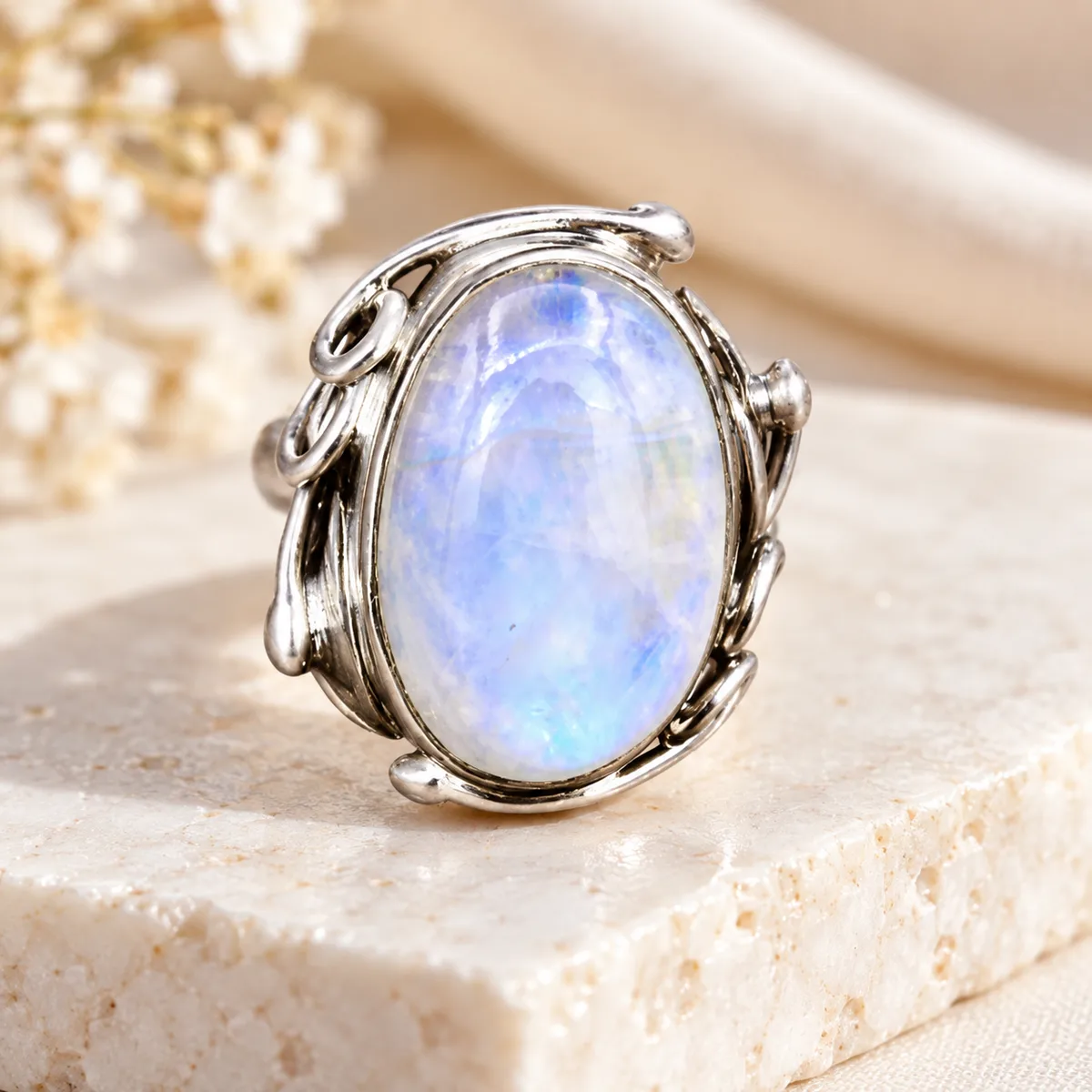
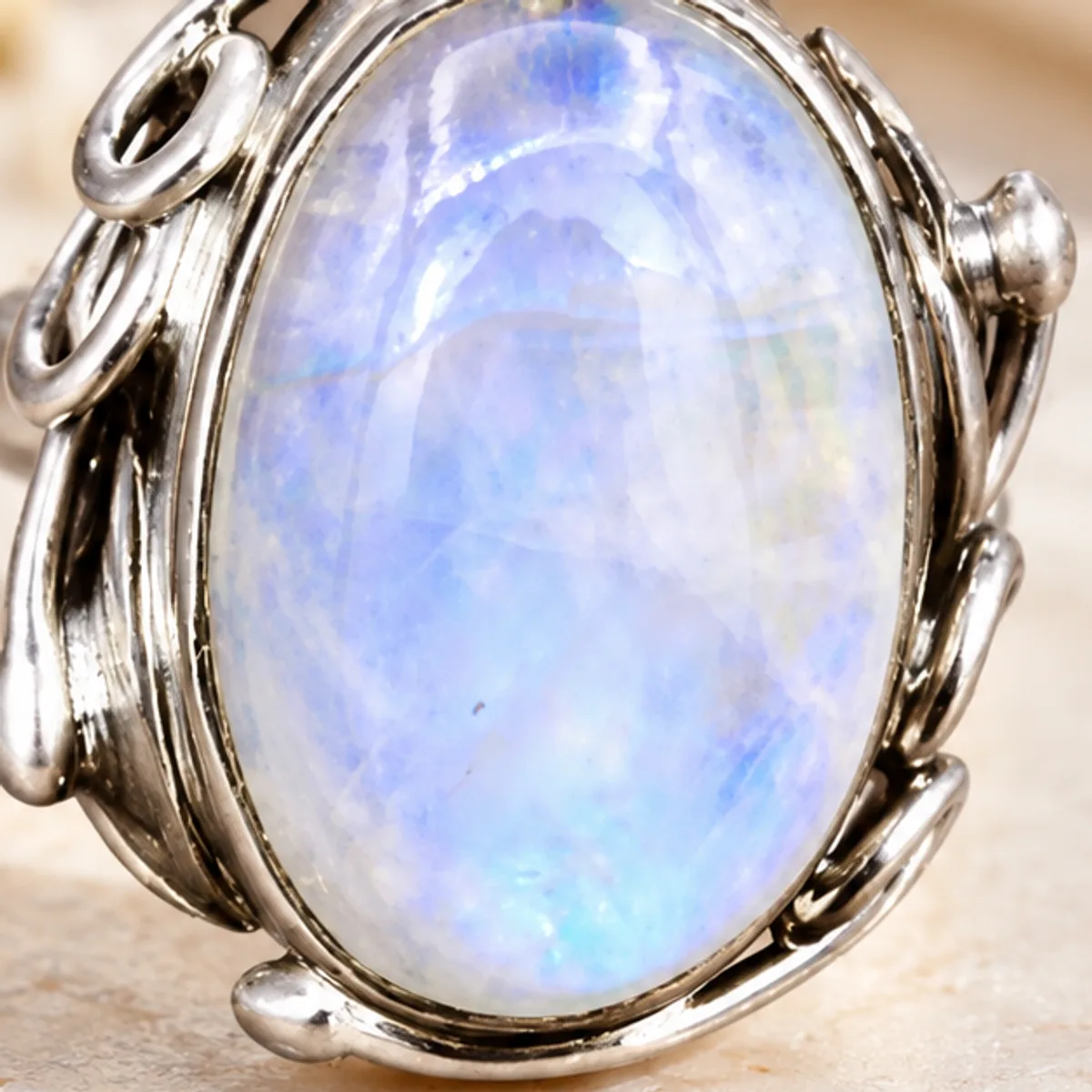
A large oval cabochon held by four claws that do not look like claws: they are silver stems coiled into scrolls, rising from the band and closing over the stone like tendrils on a stake.
Vine claws, and what that changes
An ordinary claw is a straight stem crushed onto the edge of the stone. It holds well and it says nothing. Here each claw starts from the band, describes a loop, and folds back onto the cabochon with its flattened tip. The drawing is that of a vine tendril, and the function is exactly that of a classic claw: four bearing points spread at ninety degrees. The difference is that the mount takes part in the decoration instead of making itself forgotten.
The real benefit lies elsewhere. A claw set stone is open at its sides and underneath, which a bezel setting does not allow. Light therefore enters beneath the dome and exits above, which gives adularescence a depth I cannot get any other way. On a large milky cabochon like this one the difference is clear: the veil looks as though it comes from inside the stone rather than floating on its surface.
The trade-off must be stated, and it is real. Claws expose the edges of the cabochon, and moonstone has perfect cleavage: it chips on impact, especially on an edge. This ring therefore asks for a little more care than a bezel. I advise against it for manual work, and I recommend it to anyone who wants the best possible light on a large stone. The scrolls, by closing their loops towards the stone, actually protect better than straight claws: that is what decided me to keep this model.
The silver is oxidised in the hollows of the scrolls and rubbed back on the crests, so the tendrils read instead of forming a grey mass. The ring is worn on the ring finger or the middle finger, alone. The other rings are here, and the size guide is still useful if you hesitate.
- Large oval moonstone cabochon, a deep veil lit from below.
- 925 sterling silver hallmarked S925, four vine scroll claws, no glue.
- An open mount: more light than a bezel, a little more care to take.
- UK sizes I 1/2 to T 1/2, that is 48 to 62 mm. Delivered in two weeks.
The specifications
- Stone
- Real moonstone (adularia), large oval cabochon
- Origin
- India
- Metal
- 925 sterling silver, S925 hallmark
- Setting
- Four scroll claws, no glue
- Decoration
- Vine tendrils rising from the band
- Finish
- Oxidized silver, crests rubbed back with a cloth
- Sizes
- UK I 1/2 to T 1/2 (48 to 62 mm)
- Gender
- Women
- Brand
- Melissa Moon
Claws or bezel: how I advise choosing
The question is not settled in general, it is settled according to the life you lead. If you do the dishes with your rings on, if you garden, if you carry boxes, take a bezel and stop thinking about it. If your ring spends its days at a keyboard or on a desk, claws will give you a brighter stone for the same price. It is a trade-off between light and safety, not between good and bad.
One concrete thing to finish. Claws can be checked. Once a year, put a fingernail on each one and push very gently outward. If one moves, a jeweller tightens it in five minutes. It is the only mechanical maintenance a silver piece asks for, and it is the difference between a lost stone and a stone that stays thirty years.
For a long time I refused claws on moonstone. I changed my mind the day I set the same stone side by side in a bezel and in claws, in front of a window. It was not the same stone.
No salt, no ultrasonic tank, no hot water: moonstone is a feldspar, and all three damage it for good. The ultrasonic tank is all the more forbidden here because it loosens claws. Lukewarm water, a soft cloth, and the ring comes off before the shower and the housework. The detail is in cleaning a moonstone piece, and the safe methods in caring for it without harming it.