


Description
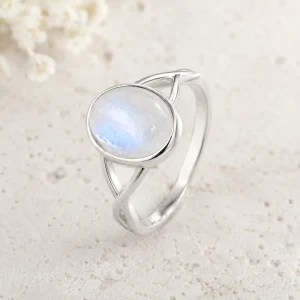
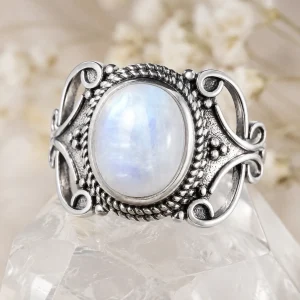
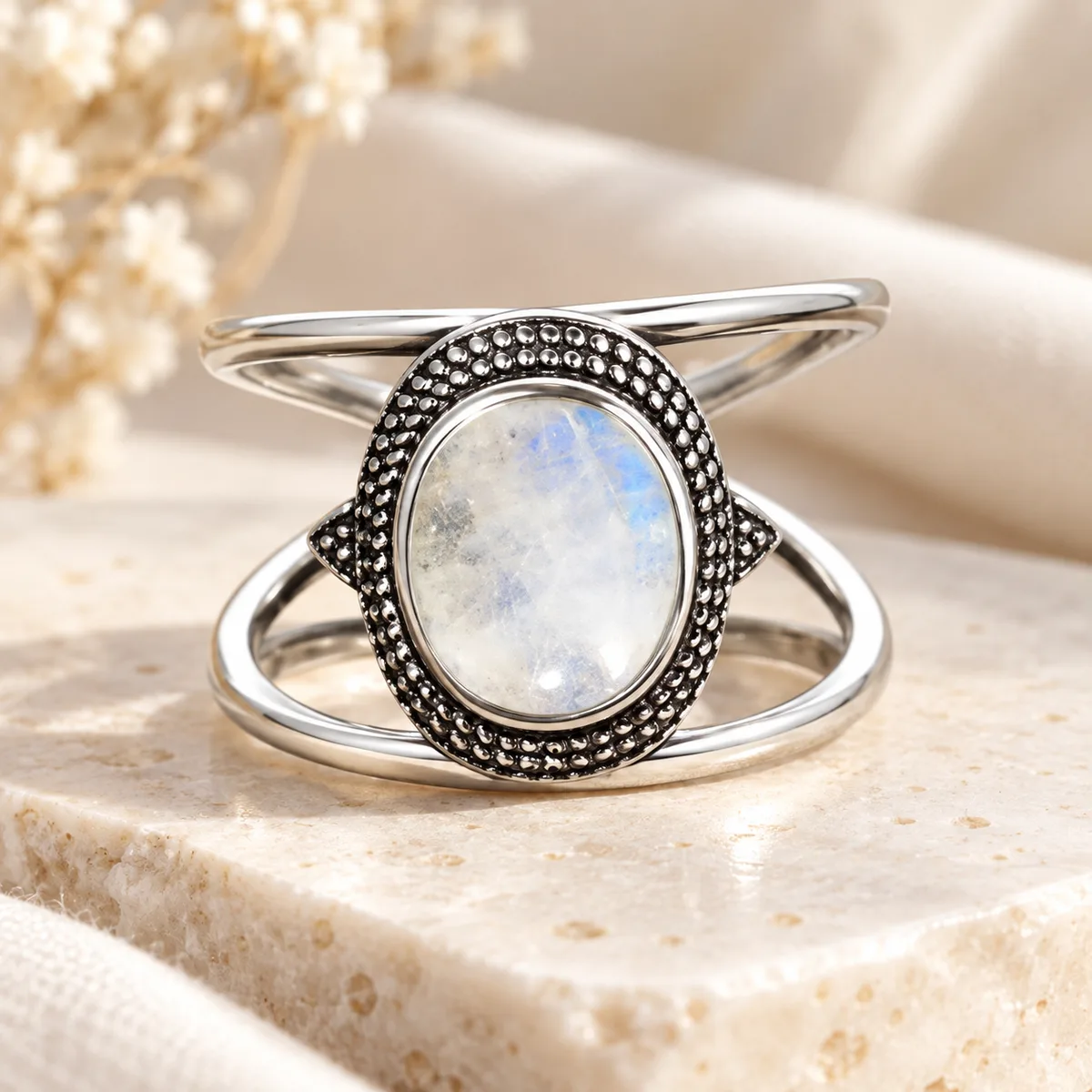
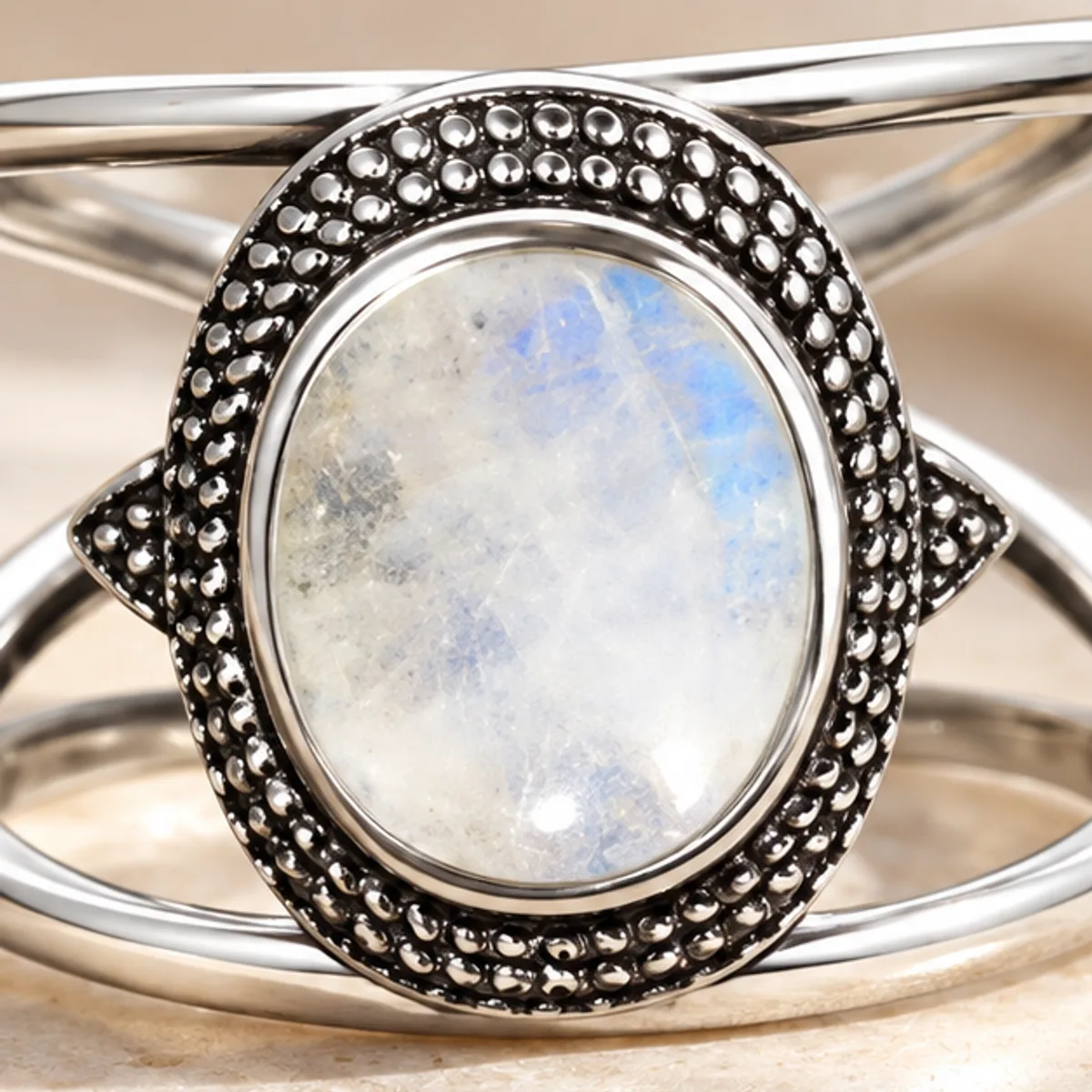
An oval cabochon in a beaded surround, carried by two arms that do not meet head on: they cross over one another at the shoulders and continue as a single band underneath.
A shank that crosses
Most double shanks run parallel and join at the shoulders. This one crosses: the arm coming from the left passes over the arm coming from the right, and each continues past the crossing before curving back under the finger. The join is therefore a lap rather than a butt, and that is a stronger joint in metal for the same reason it is in carpentry: two surfaces bonded face to face rather than edge to edge.
There is a comfort consequence too, and it is the reason I keep this shape. A crossover has a little spring in it. The two arms can flex minutely against each other, so the ring accommodates a finger that swells during the day instead of gripping it. It is not adjustable, and I will not pretend it is, but it is the most forgiving closed ring in this collection for anyone whose fingers change with the weather.
The crossing also solves a visual problem. An oval stone sitting on a plain double band looks like it landed there. With a crossover, the two arms sweep up and past each other, and the eye reads a movement that carries through the stone and out the other side. The stone stops being an object placed on a ring and becomes the point where the lines meet.
The surround is a row of small beads, and the stone sits in a closed bezel beneath them. The blue veil of the oval is at the crossing point, which is where a hand naturally catches the light. The other rings are here, and the size guide takes two minutes.
- Oval moonstone cabochon, closed bezel under a beaded surround.
- 925 sterling silver hallmarked S925, two arms crossing at the shoulders.
- A little spring in it: the most forgiving closed ring of the collection.
- UK sizes I 1/2 to T 1/2, that is 48 to 62 mm. Delivered in two weeks.
The specifications
- Stone
- Real moonstone (adularia), oval cabochon
- Origin
- India
- Metal
- 925 sterling silver, S925 hallmark
- Setting
- Closed bezel, no glue
- Shape
- Crossover shank, two arms lapped at the shoulders
- Decoration
- Beaded surround around the bezel
- Finish
- Oxidized silver, crests rubbed back with a cloth
- Sizes
- UK I 1/2 to T 1/2 (48 to 62 mm)
- Gender
- Women
- Brand
- Melissa Moon
Why fingers change size, and what to do
Fingers are mostly water, and water moves. Heat, salt, altitude, a long flight, a hot bath, the second half of a cycle: all of them change a finger by up to half a size, and none of them is a health problem. In summer most people go up a quarter to a half size compared to January. Anyone who tells you your ring size is a fixed number has not worn a ring through a July.
The practical rule is to size for the middle of your range, not for the smallest. A ring that is perfect in February will be uncomfortable in August, and an uncomfortable ring comes off and stays off. A crossover shank buys you a little of that range back, which is the whole reason it exists, but it does not replace sizing sensibly in the first place.
I would rather make a ring that is a fraction loose in winter than one that has to be cut off in a heatwave. I have done the second and I do not want to again.
No salt, no ultrasonic tank, no hot water: moonstone is a feldspar, and all three damage it for good. The beaded surround holds cream between the beads, so rinse under lukewarm water rather than wiping, and use a dry soft brush once a month. Avoid silver dips, they lift the oxidation that makes the beads visible. The detail is in cleaning a moonstone piece, and the safe methods in caring for it without harming it. The bezel protects the stone, though a moonstone chips on a real knock.