

Description
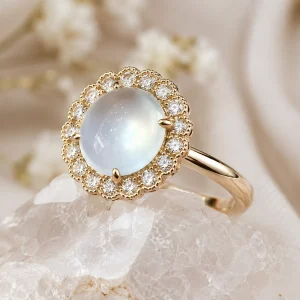
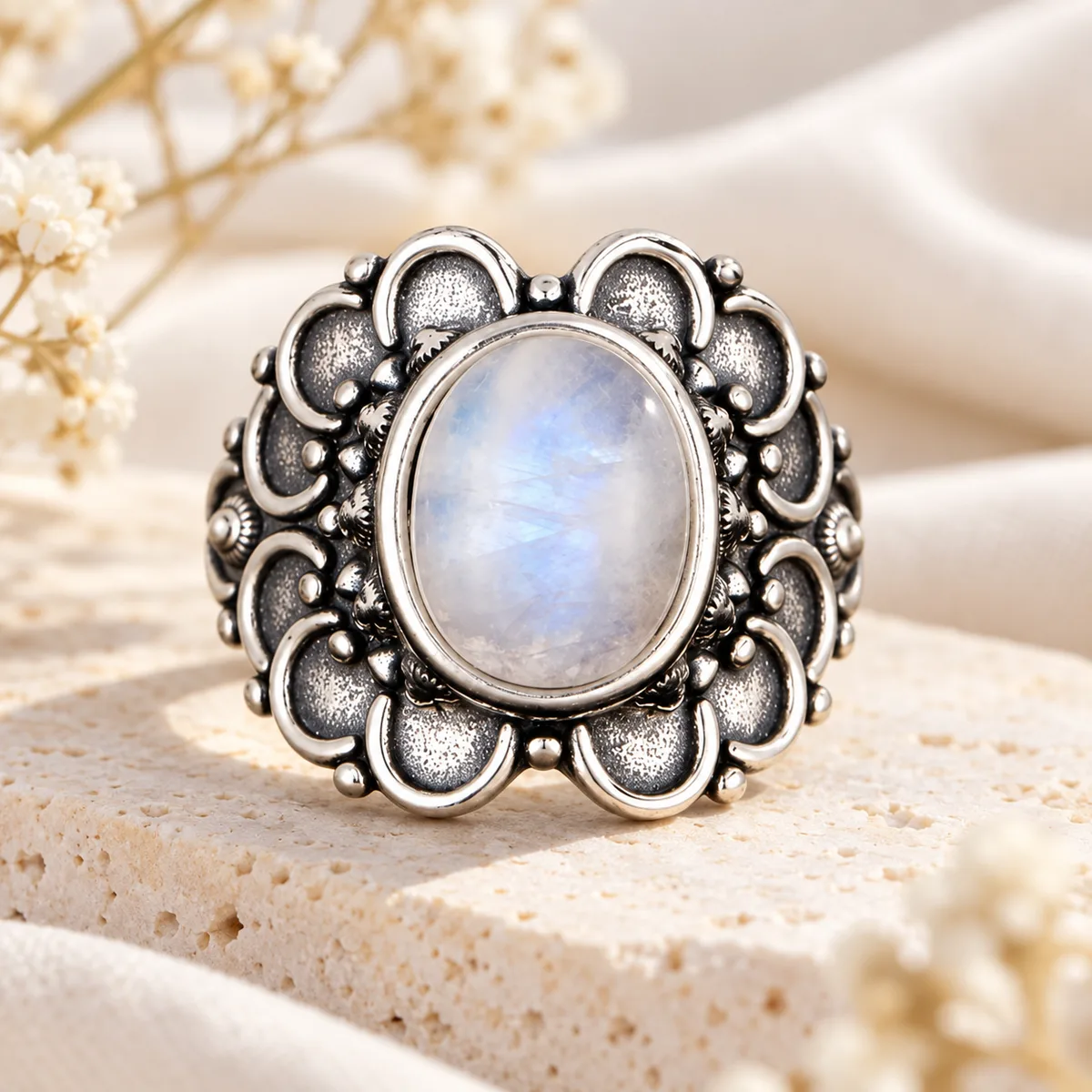
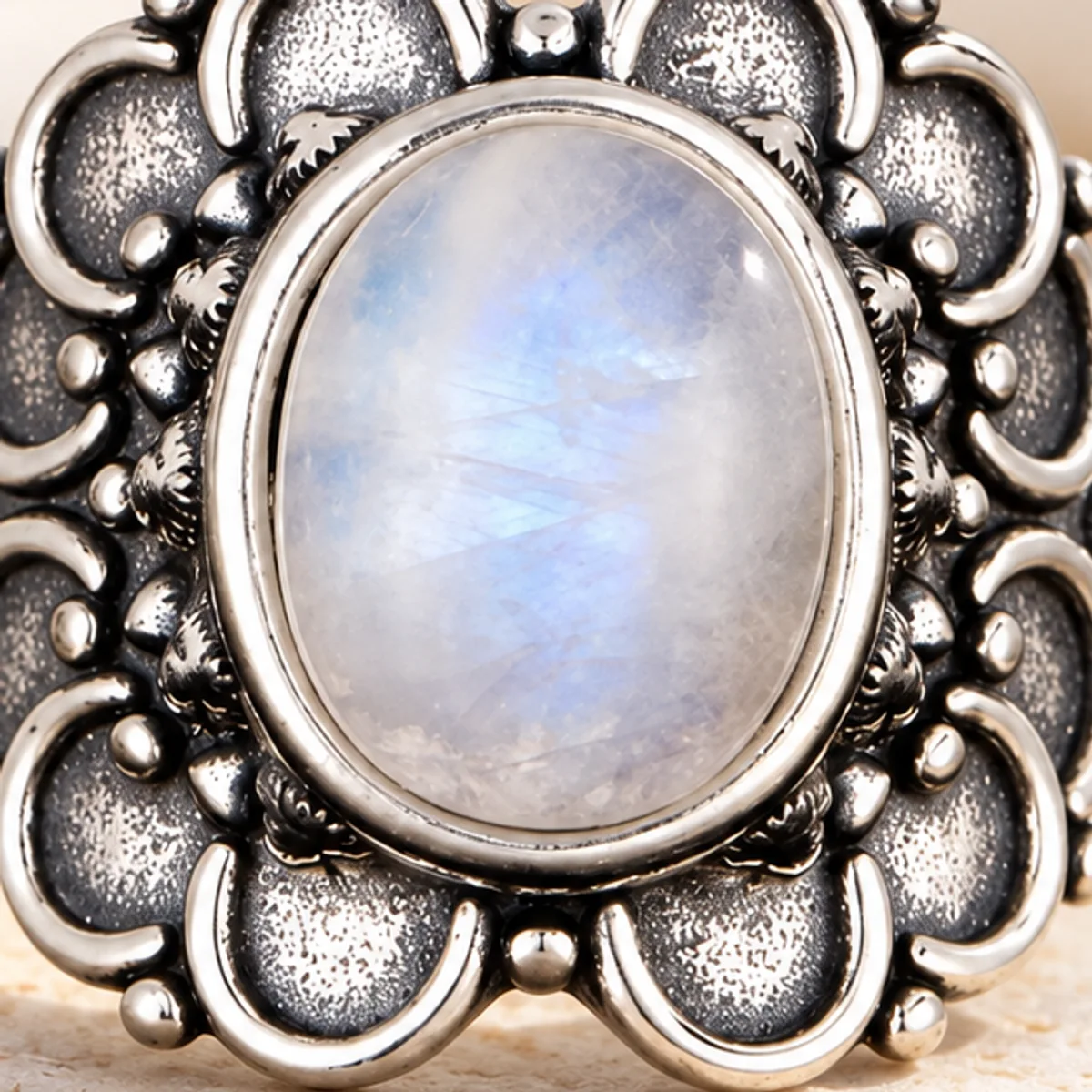
An oval cabochon set inside a corolla, a ring of petals that overlap slightly and lean outward, the way a flower opens rather than the way a frame encloses.
An odd number of petals
Count them: there is an odd number. That is deliberate and it is the single decision that makes this ring look like a flower rather than like a machined rosette. With an even number, every petal has one directly opposite it, the eye finds an axis, and the whole thing reads as geometry. With an odd number no petal has an opposite, there is no axis to find, and the eye gives up measuring and simply sees a flower. Nature mostly uses odd numbers, and this is why.
The petals also lean. They are not flat around the bezel, they rise and tip slightly outward, so each one catches light at a different angle. A flat surround gives one reflection that moves as a block. A leaning corolla gives as many small reflections as there are petals, appearing and disappearing separately. It is the difference between a ring that shines and a ring that flickers.
Under the corolla the bezel is a simple closed setting, and the petals are soldered around it rather than cut from it. That matters for repair: a petal that gets bent can be straightened or, at worst, replaced, without touching the setting that holds the stone. When the petals are cut from the same piece as the bezel, which is how cast versions are made, a damaged petal is a damaged setting.
The blue veil at the centre is the still point of a piece that is otherwise all movement. The ring is wide to look at and light to wear, as openwork always is. The other rings are here, and the size guide takes two minutes.
- Oval moonstone cabochon, closed bezel at the heart of the corolla.
- 925 sterling silver hallmarked S925, an odd number of petals, soldered around the bezel.
- The petals lean outward: as many small reflections as there are petals.
- UK sizes I 1/2 to T 1/2, that is 48 to 62 mm. Delivered in two weeks.
The specifications
- Stone
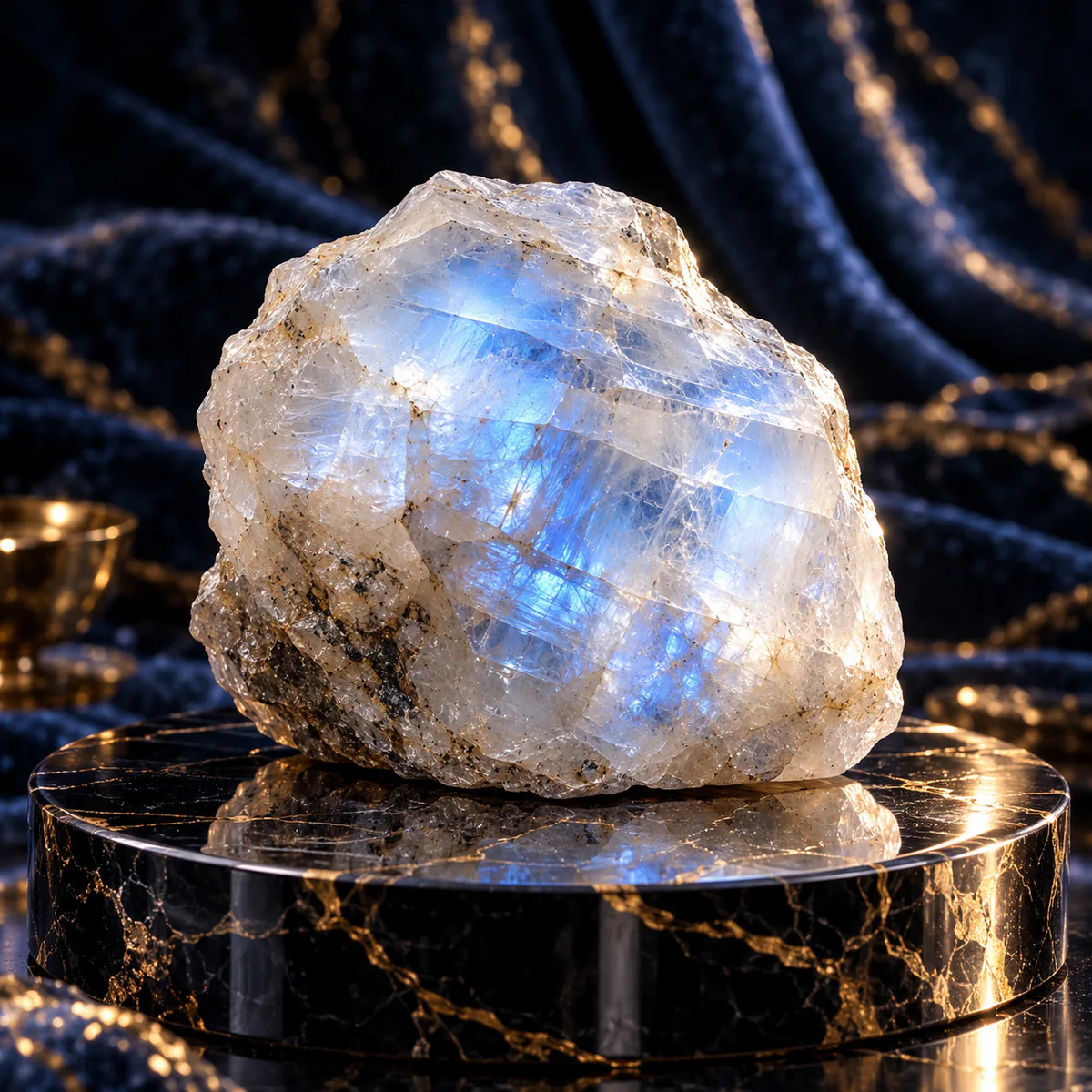
- Real moonstone (adularia), oval cabochon
- Origin
- India
- Metal
- 925 sterling silver, S925 hallmark
- Setting
- Closed bezel, no glue
- Decoration
- Corolla of leaning petals, soldered around the bezel
- Finish
- Oxidized silver, crests rubbed back with a cloth
- Sizes
- UK I 1/2 to T 1/2 (48 to 62 mm)
- Gender
- Women
- Brand
- Melissa Moon
Why repairable matters more than seamless
There is a fashion for pieces made in one block, cast or printed, with no joins anywhere. They look clean and they cannot be repaired. Break one element and the whole piece is scrap, because there is no way to work on the damaged part without heating the part that holds the stone. A ring built from separate pieces has visible joins and can be taken apart by anyone competent, fifty years from now, with tools that already exist.
This is not nostalgia, it is arithmetic. A silver ring at this price is worth less in metal than the hour it takes to repair, so the only repairs that ever happen are the quick ones. Making the quick repair possible is therefore the whole of what durability means at this end of the market. A seamless ring is a ring that gets thrown away.
I would rather you could see how my rings are put together. It means someone else can take them apart when I am not here to do it.
No salt, no ultrasonic tank, no hot water: moonstone is a feldspar, and all three damage it for good. The gaps between petals trap soap, so rinse under lukewarm water rather than wiping, and do not force a brush between them, as a leaning petal bends more easily than a flat one. Avoid silver dips, they lift the oxidation and the corolla flattens. The detail is in cleaning a moonstone piece, and the safe methods in caring for it without harming it. The petals stand above the stone and take knocks first, which suits a stone that chips.