Description
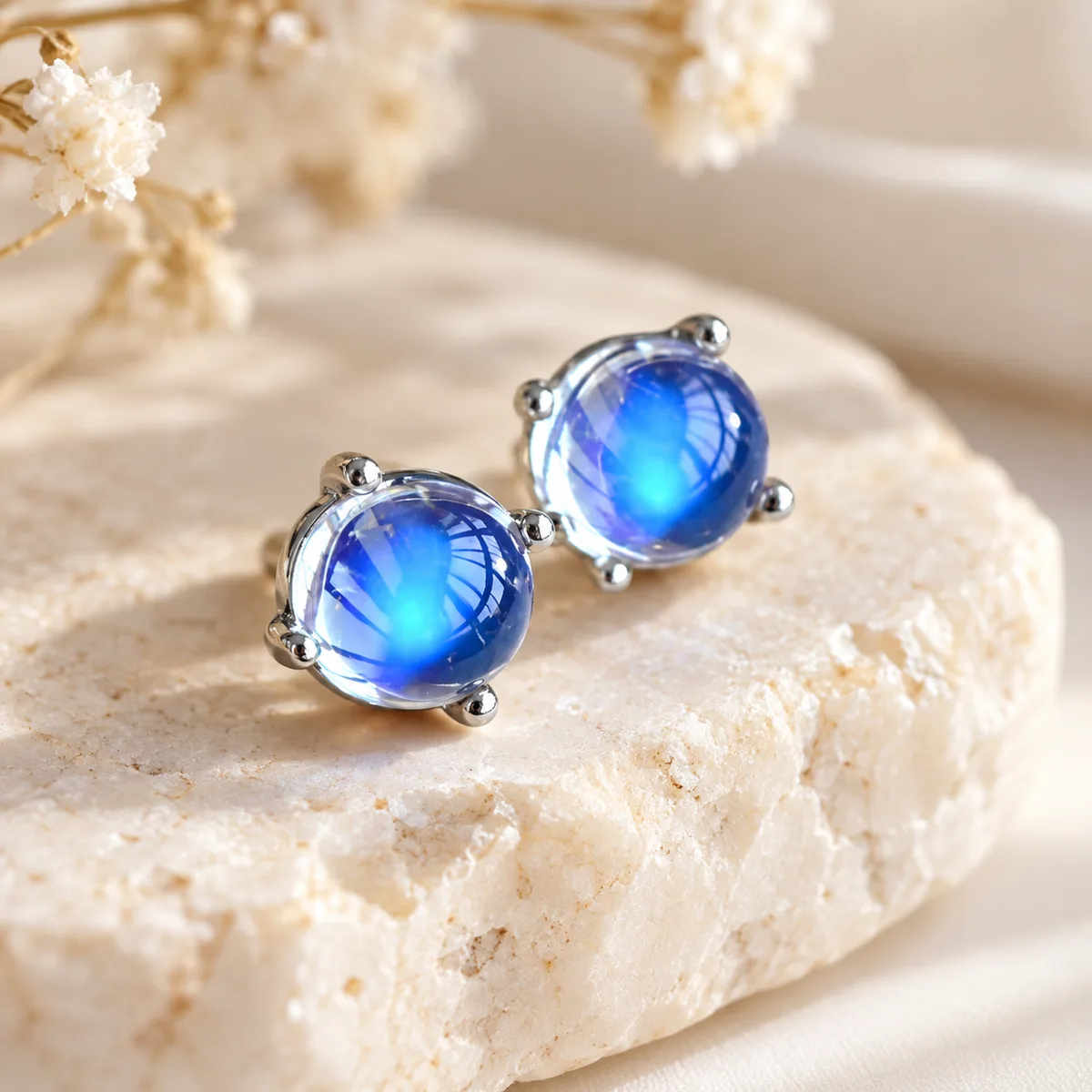
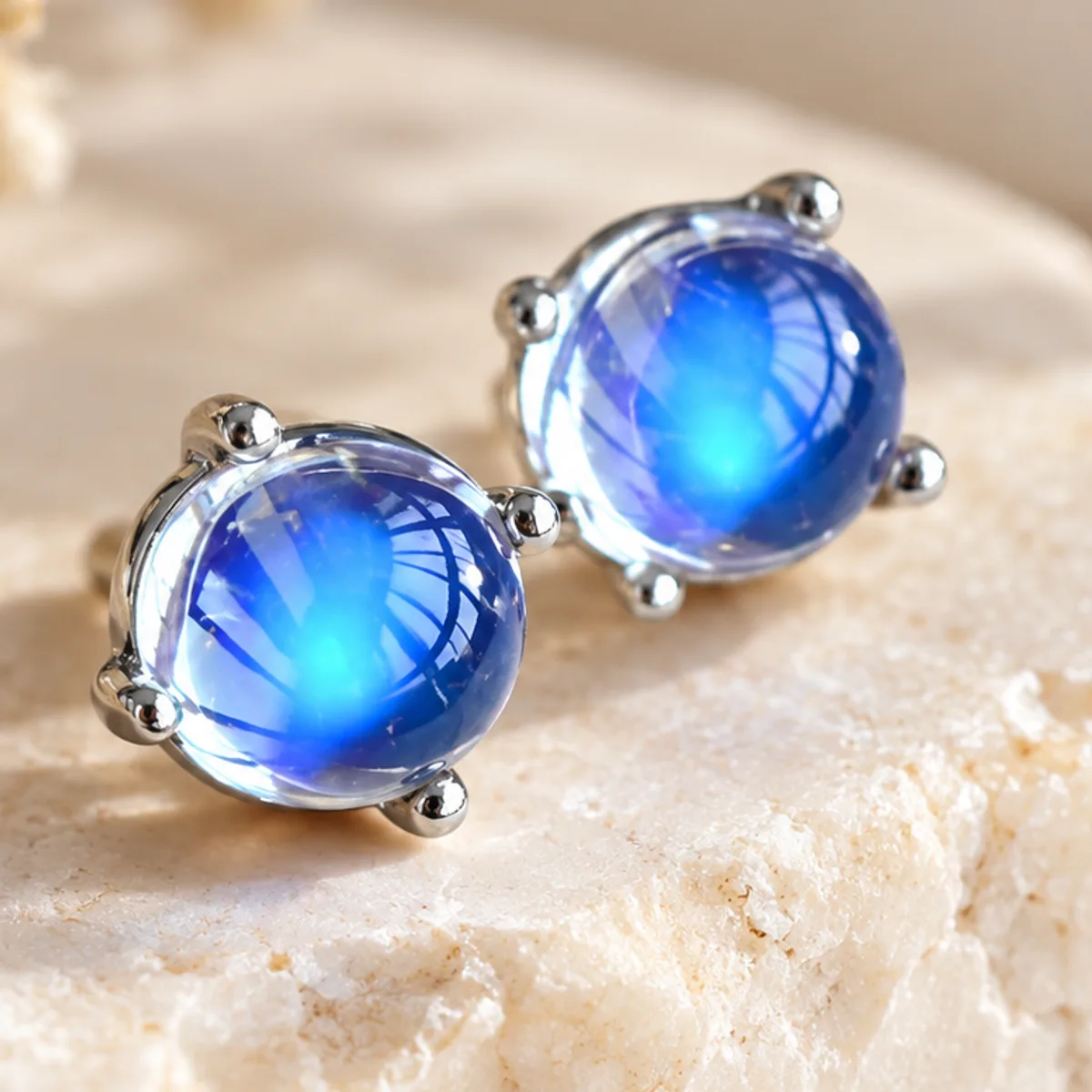
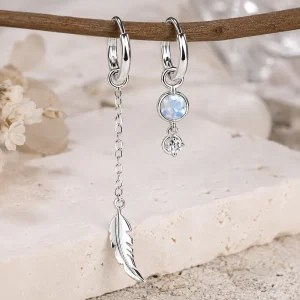
Two round moonstone cabochons with a frankly blue veil, held by four fine claws on posts. It is the colour everybody looks for, and it is not dyed.
The blue you expect from a moonstone
Blue is not a body colour, it is a colour of reflection. The stone itself is milky, almost colourless; it is the adularescence that produces the blue, by scattering light in microscopic lamellae of feldspar. On these two stones the veil is frank and centred, which is the main criterion: a vivid blue pushed to one edge disappears as soon as you turn your head.
The four fine claw mount was chosen for this colour precisely. It lets light in through the flanks of the cabochon, which intensifies the veil. On a stone whose blue is already marked, the difference from a closed bezel is clear. The counterpart is exposure of the edges: moonstone chips on impact, and the claws deserve a check once a year.
These stones are neither dyed, nor coated, nor heated. That is a point to be precise about, because the market for blue stones is the one where treatments are commonest. Treated moonstone explains what is done and how to recognise it. The other earrings are here.
- Two real moonstones with a frank and centred blue veil, round cabochons.
- Neither dyed, nor coated, nor heated. Stated plainly, and explained.
- 925 sterling silver hallmarked S925, four fine claws, posts with butterfly backs.
- Claws let light in through the flanks and intensify the veil. Delivered in two weeks.
The specifications
- Stone
- Real moonstone (adularia), two round cabochons, blue veil
- Origin
- India
- Metal
- 925 sterling silver, S925 hallmark
- Setting
- Four fine claws, no glue
- Shape
- Studs, round domes
- Finish
- Polished silver
- Fastening
- Post and butterfly back
- Gender
- Women
- Brand
- Melissa Moon
How a dyed blue gives itself away
A dyed stone has colour in the body, not in the reflection. Hold it against a window: a real moonstone stays milky and almost colourless by transmission, and the blue only appears by reflection when you tilt it. A dyed one looks blue through and through, and the colour usually pools in the cracks, which shows as darker threads. It takes five seconds, it needs no equipment, and it is the only check worth knowing on blue material.
Hold it up to the light. A real moonstone is colourless through. If it is blue through, the colour was added.
No salt, no ultrasonic tank, no hot water: moonstone is a feldspar, and all three damage it for good. With claws, the ultrasonic tank is doubly out, because the vibration works on the claws too. Cleaning a moonstone piece and caring for it without harming it cover the rest.
What tradition attributes to moonstone
What follows belongs to the traditions and beliefs attached to this stone. I keep it apart from the rest of the page: none of it is proven, and no piece of jewellery heals anything.
The blue variety
Blue veiled material is what reached Europe first and what most old descriptions refer to, which is a fact about trade routes rather than about the stone.
Colour and value
Preferring one sheen to another is a matter of fashion, documented and dated. Nothing about the mineral makes blue superior to gold.
Sacral chakra (Svadhisthana)
Traditional correspondences attach moonstone first to the second chakra, the one of emotion and creativity, and secondarily to the third eye. Worn as a ring it stays on the hand, far from both points, and tradition then makes it a matter of looking rather than of placement.
The traveller's talisman
Long before modern crystal healing, this was the stone taken on the road, in India as in Rome, and given to whoever was leaving. It is probably its only genuinely ancient use, and there is nothing therapeutic about it.
Traditions and beliefs, nothing else. None of these associations amounts to medical advice, and no piece of jewellery replaces a treatment or an examination. If you are on medication, pregnant or in a course of care, talk to your doctor rather than to your jeweller. The full disclaimer is here.
How your jewellery reaches you
Nothing is kept in stock. Each piece is ordered from a partner workshop after you place your order, then dispatched to you directly.
- Delivered in two weeks, tracking number provided as soon as it is dispatched
- Free delivery on orders over 47 €
- 14 days to change your mind, with no explanation required
Customs duties are included wherever you are: there is nothing further to pay on delivery. Lead times, zones, exchanges and refunds are detailed on the Delivery and Returns page.
Caring for a moonstone
No salt, no ultrasonic tank, no hot water. Moonstone is a feldspar with perfect cleavage: it does not scratch easily, but it chips on impact, and those three damage it for good. Lukewarm water and a soft cloth are enough.
Take the piece off before the shower, the pool, sport and housework. Store it on its own in a pouch rather than loose: what scratches a moonstone is almost always another piece of jewellery.
Crystal healing also likes to cleanse and recharge a stone from time to time. On this one, moonlight suits it very well. Salt does not, and yet it is the method most often recommended online.
Chosen one by one
I do not make these pieces myself: I choose each design from partner workshops, and I drop from the catalogue anything that does not live up to its description.
- Metal, stone and dimensions stated on every listing
- No opalite, no coated quartz sold as rainbow moonstone: both were pulled from the catalogue
- No piece sold for anything it might heal
My story, and what I stopped selling.