


Description
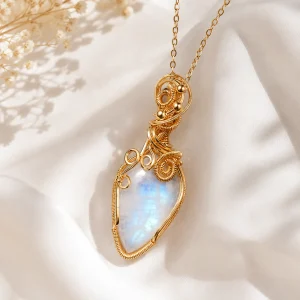
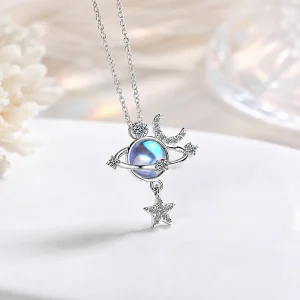
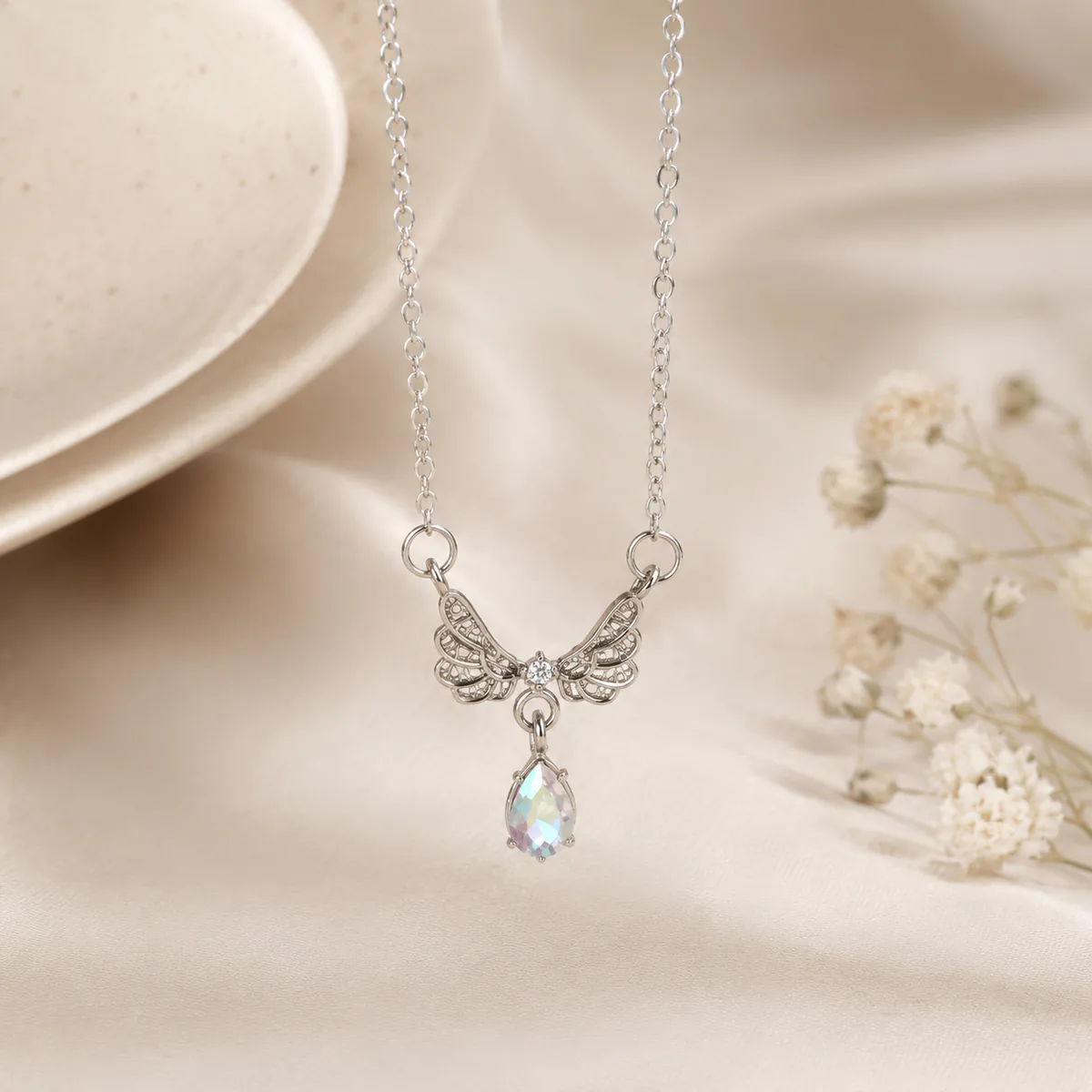
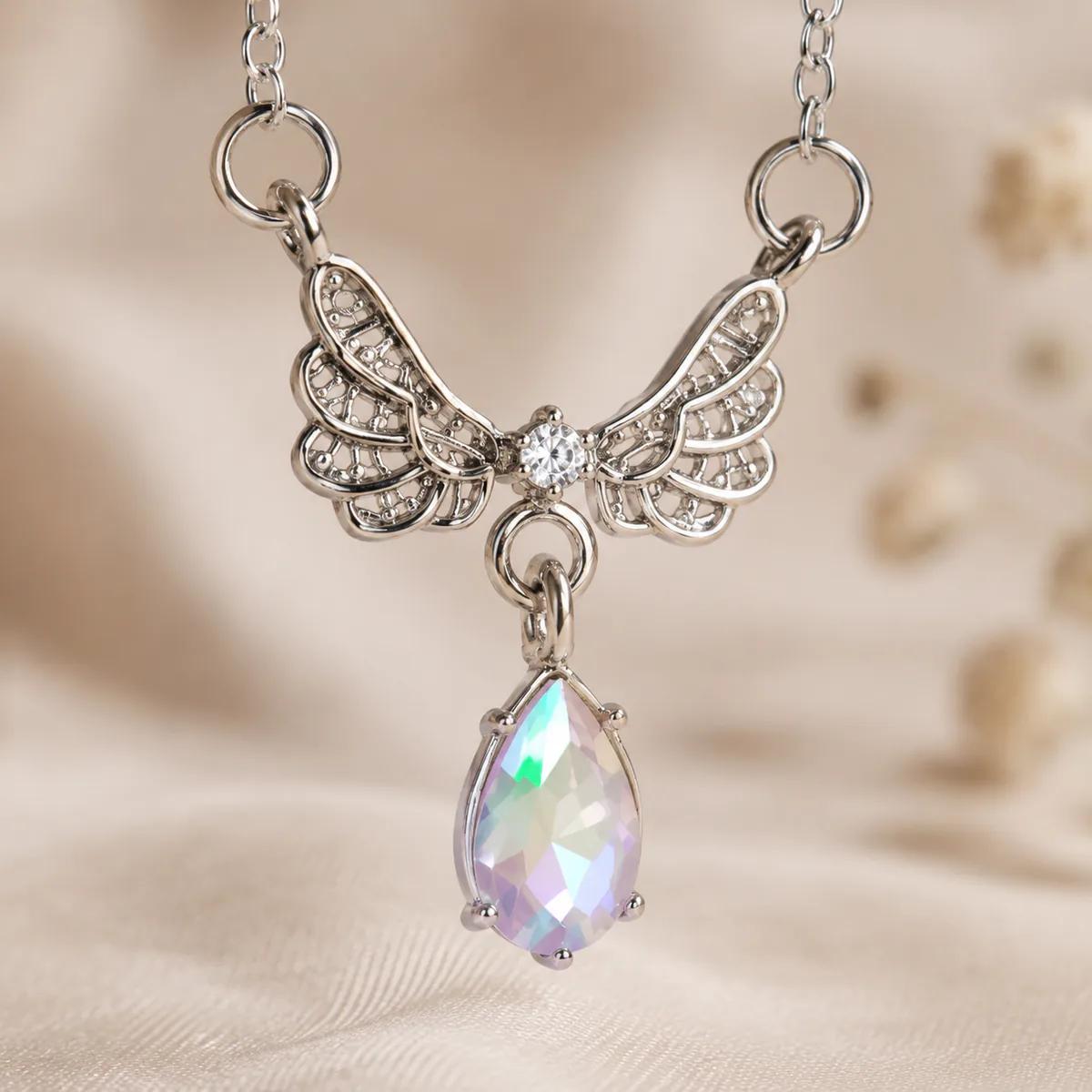
Two finely pierced wings taken directly into the chain, a small pale stone between them, and beneath that assembly a faceted drop playing green, pink and blue depending on the angle. The motif does not hang from a bail: it is part of the necklace.
Two very different things are called rainbow
The word covers two phenomena that have nothing to do with each other, and knowing how to tell them apart applies to everything iridescent you will ever buy, here or elsewhere.
The first comes from inside the stone. That is the one in rainbow moonstone, which is a pale labradorite: light bounces between internal layers and comes back out coloured. It is recognised by its behaviour: the colours occupy zones, they move when you tilt the stone, they light up and go out, and at certain angles there is nothing at all. The question of names is explained here, and the whole rainbow variety is gathered there.
The second lives on the surface. An extremely thin layer deposited on a cut stone produces iridescence by interference, exactly like a film of oil on a puddle. It is just as easy to recognise: it covers the whole stone at once, it is present from every angle, and it does not move when you do. It is also more regular, more complete, often more spectacular than a natural sheen.
The test therefore comes down to one gesture: tilt slowly, and see whether the colours move or stay put. It is not a question of quality but of nature, and it has a practical consequence: an internal effect never wears out, a surface effect fades where the stone rubs, over the years. The quality criteria are detailed here.
A motif taken into the chain
Here is what sets this necklace apart from every other in the catalogue. The wings are not suspended from a bail: the chain attaches at their two ends, so that the motif forms part of the necklace’s line rather than hanging from it.
The result is a piece that does not turn and never shifts, since it is held at two opposite points. But above all, it changes how the necklace sits. An ordinary necklace draws one continuous curve; this one draws two curves separated by a rigid segment, and the wings lie flat against the skin instead of hanging. That is what gives this model its horizontal look, very different from a classic pendant.
It also implies a more precise length than elsewhere. A suspended pendant tolerates a few centimetres more or less; here the motif must sit right in the hollow of the collarbones, otherwise the wings end up too high on the neck or too low on the chest. The sizing guide is here.
Three open jump rings, and that is where it gives way
Here is this model’s particularity, and it is the sort of thing you only discover by repairing jewellery. Count the rings: one at each wing tip, one for the suspended drop. Three jump rings, and they are the ones doing the work.
On an ordinary pendant, movement is spread over the whole chain. Here the central motif is rigid: every time you turn your head, all the flexing concentrates on the two wing rings, and the drop works the third one constantly. Now a jump ring is a simple loop of wire closed up, not soldered on most commercial jewellery: with time it opens, and one day the chain comes out through the gap.
The remedy is simple, inexpensive, and nobody offers it: have the three rings soldered by a jeweller. It is a matter of minutes, it changes nothing about the look, and it removes the only serious failure mode of this piece. Failing that, get into the habit of looking at those three points once a month, in good light: a visible gap between the two ends of a ring is the signal to act before, not after.
The wings, very finely pierced, ask the same care as any openwork: they bend and do not straighten. And the drop, held by claws, remains sensitive to impact like every stone in the catalogue: it chips rather than scratches, its lower point being its most exposed part. The shop’s other necklaces are here.
- Openwork wings integrated into the chain, iridescent faceted drop suspended below.
- Tilt the stone: an internal sheen moves, a surface iridescence stays put.
- Three jump rings carry all the movement. Have them soldered.
- Delivered in two weeks with a cotton pouch, a handwritten note and a care card.
The specifications
- Stone
- Rainbow moonstone, faceted drop
- Look
- Translucent, green, pink and blue iridescence
- Metal
- 925 sterling silver
- Motif
- Pair of openwork wings integrated into the chain
- Construction
- Claw set, three jump rings
- Gender
- Women
- Brand
- Melissa Moon
Why I do not talk about angels
A pair of wings sells much better if you add a sentence about beings who watch over us, about those we have lost, about the signs we receive. It is a formula that works, it is everywhere in this trade, and I will not write it. Not out of coldness, but because people who buy this kind of piece after a bereavement are in a moment where they deserve to be sold an object, not a promise.
What I can honestly say: it is a drawing of wings, it is old, it is beautiful, and it carries what you put into it. If you buy it thinking of someone, that bond belongs entirely to you and it is not for me to put a price on it. The rest of the shop is here.
Wings are a drawing. What you put into them belongs to you, and it does not come with the piece.
No salt, no ultrasonic tank, no hot water: all three damage the stone for good, and ultrasound would also loosen the claws and the rings. One extra precaution here: if the iridescence of this stone is a surface effect, any abrasive attacks it directly, so no paste, no hard brush, no polishing cloth on the drop. Lukewarm water, a drop of mild soap, a very soft brush for the pierced wings, a rinse and a complete drying, dabbing between the cutouts where water leaves rings. Take the necklace off before the shower, the pool and sport, and hang it up rather than leaving it in a heap. The detail is in cleaning a moonstone piece, and the safe methods in caring for it without harming it.