


Description
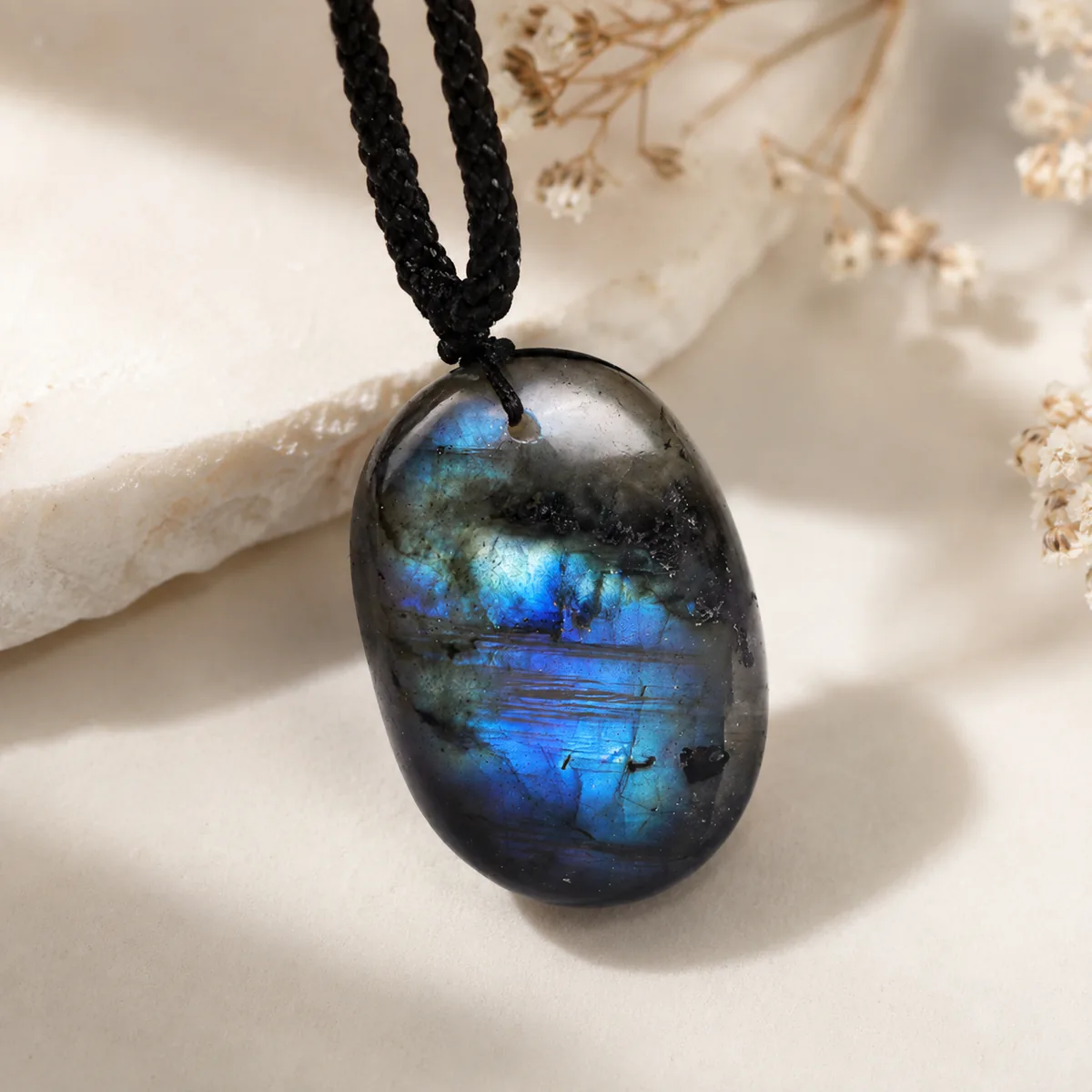
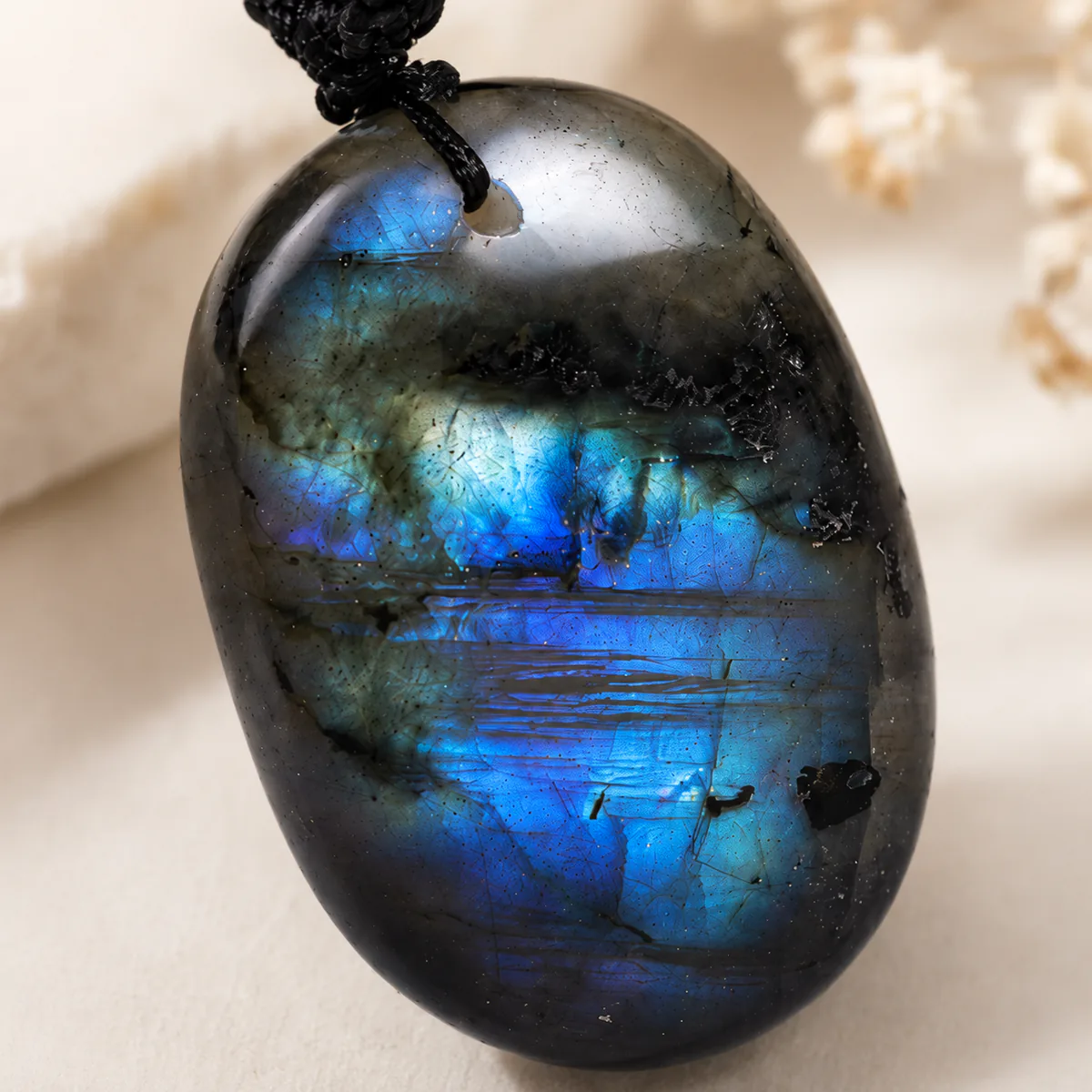
A dark stone, tumbled into a pebble, drilled with a hole through which a black braided cord passes. Its brown-grey ground opens onto a wide blue sheet that floods the whole surface at the right angle. No setting, no clasp, not one gram of metal.
A piece of jewelry with no metal
This is a first in this shop, and it deserves saying: this pendant contains no metal part at all. No bezel, no bail, no jump ring, no clasp. It is made of two things only, a stone and a cord.
Which is to say most of this catalog’s warnings do not apply here. Nothing tarnishes, nothing loses its plating, no coating wears through, no ring opens, no hinge tires, no bead loosens. The usual failure modes of a piece of jewelry all disappear at once, and only one remains, on which all the attention can therefore be concentrated.
It is also the only pendant in the shop you can wear in just about any circumstance: no metal against the skin, nothing that fears perspiration, nothing that snags a sweater. With one exception, and it holds for every stone in the catalog: this one chips on impact rather than scratching, and it is entirely bare. It will take every knock itself.
The cord is the only part that will give way
Here is this model’s particularity. The cord crosses the stone through a hole drilled right through, and it rubs against the edge of that hole with every movement. Now the stone is infinitely harder than the thread: it is not the hole that wears, it is the cord, and always in the same place, exactly where it disappears into the stone.
The right reflex is therefore to slide the cord a few millimeters from time to time, so the contact point moves, exactly as you would rotate a rope. And above all, to look at that precise spot once a month: a braided thread always announces its failure, it fuzzes and frays well before it gives.
The good news is that this is the simplest repair there is: a cord is replaced in five minutes, at home, for a few cents, with any braided thread of decent quality. No other piece in this shop can be repaired with no tool and no jeweler. Note only two things: this assembly has no clasp, so the length must allow it to pass over the head, and a textile cord absorbs perspiration, soap and perfume, which stiffens and darkens it over time. It is a wear part, not a fault.
A tumbled stone, and what that means
This stone was not cut by a lapidary: it was tumbled, that is to say churned for weeks in a barrel with finer and finer abrasives, until its edges disappeared and its surface took the polish. It is a mechanical, patient process, with no craftsman’s hand on the shape.
Three consequences, all visible on the object. The shape follows the original block, it obeys no template, and no other stone will have exactly this one. The surface keeps its accidents: small cavities, lines, matte zones that the tumbling did not erase because they went too deep. Those are traces of the material itself, not scratches from use. And the hole is simply drilled, with no dressing, which is consistent with the rest.
The very dark ground of this stone is what makes its blue so visible. To say it plainly, as on the other pieces concerned: black moonstone with a blue flash is a labradorite, direct cousin of adularia and sold everywhere under the same family name. The difference is explained here, and everything the shop offers in black is there. The other pendants are here.
Crystal healing tradition lends these stones correspondences tied to intuition and protection, and I have kept the last card for what is most ancient about this object. I will go no further: none of it is demonstrated and no piece of jewelry heals anything. Separately, I have gathered what tradition lends this stone and what each color changes.
- Tumbled stone, drilled, on a braided cord. No metal, no clasp.
- It is the cord that wears, not the hole: slide it now and then, replace it yourself.
- Unique shape, small natural cavities on the surface: that is the material, not wear.
- Delivered in two weeks with a cotton pouch, a handwritten note and a care card.
The specifications
- Stone
- Black moonstone, a labradorite, tumbled and drilled
- Look
- Dark ground, wide blue sheet depending on the angle
- Shape
- Free pebble, unique
- Assembly
- Braided cord through the drill hole, no clasp
- Metal
- None
- Gender
- Women and men
- Brand
- Melissa Moon
The third way of paying for a piece of jewelry
I have explained elsewhere that a pendant with a cut stone is paid for in lapidary hours, and that a pendant with a wide frame is paid for in grams of silver. This one illustrates the third case, and it is the rarest: you pay for the stone, and for almost nothing else. Tumbling happens in batches in a machine, drilling takes a few seconds, the cord costs cents. All the rest of the price is material.
That is what makes it possible to wear, for a reasonable sum, a piece of labradorite far larger than any setting would allow. It is also what makes it the least jewelry-like piece in the catalog: there is no goldsmith’s work to admire, there is only a chosen stone. It is up to you to decide what you are looking for. The rest of the shop is here.
A piece of jewelry is paid for in material, in metal or in hours. This one is material, almost alone.
No salt, no ultrasonic tank, no hot water: this stone is a feldspar, and all three damage it for good. Care splits in two here, which is peculiar to this model. For the stone: lukewarm water, a soft cloth, a complete drying, and nothing else; a greasy film is enough to put the blue out, and a dry cloth relights it. For the cord: avoid wetting it needlessly, dry it flat if it has taken water, and replace it without hesitation when it starts to fuzz. Take the pendant off before the shower, the pool and sport, and store it flat rather than in a heap, the stone being entirely bare. The detail is in cleaning a moonstone piece, and the safe methods in caring for it without harming it.