

Description
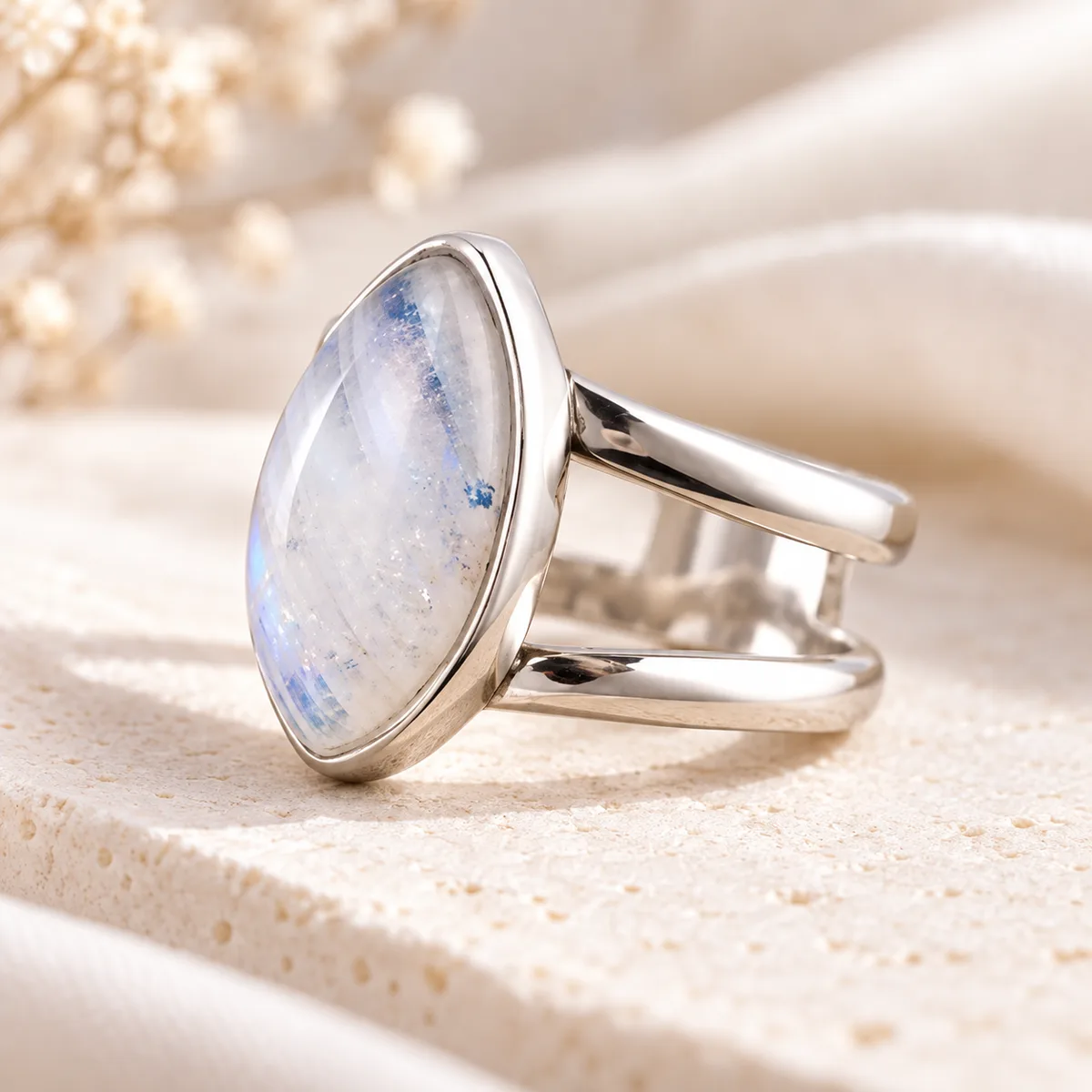
A marquise cabochon, that is a pointed oval, set lengthwise along the finger, and carried by two fine bands rather than one. The whole thing is light, and it draws a line instead of a dot.
The marquise shape, and who it suits
A marquise is an oval brought to a point at each end. Set lengthwise, it does something no round stone does: it lengthens the finger. That is not a marketing claim, it is simple optics, and it is why the shape has been used for three centuries on rings meant to be seen. If you have short fingers, or if you simply like elongated lines, this is the shape to try first.
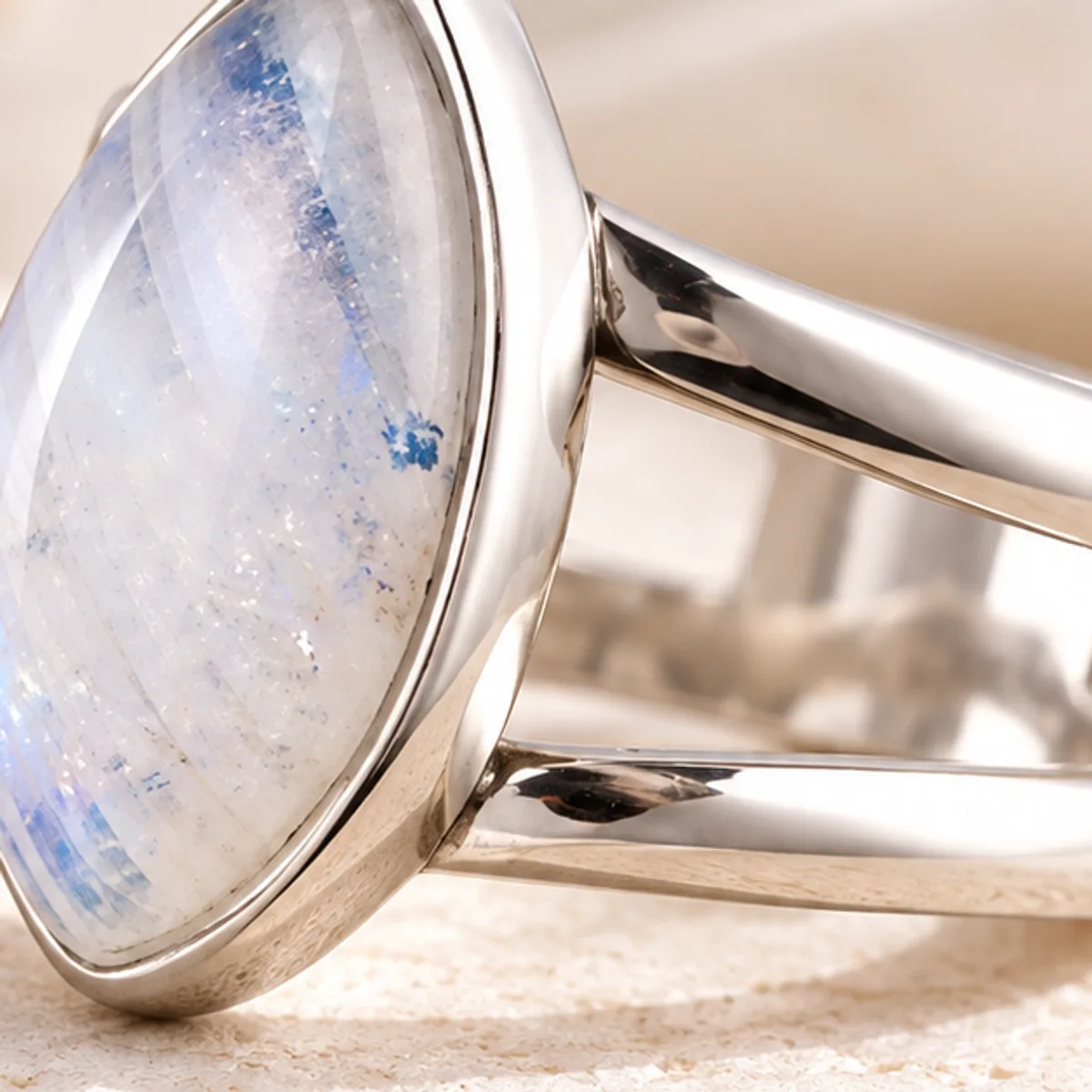
The two points are the delicate part of the piece, and I will not hide it. A marquise is fragile at its tips, on any stone, and on a moonstone that chips along its cleavage the tips are the first thing to suffer. I therefore have them set in a closed bezel that wraps completely around each point instead of leaving them exposed. That is the only way I accept this cut, and it is why the metal edge is visible at each end.
The double band changes the balance. A single band under a long stone looks thin and lets the setting tip sideways on the finger. Two fine bands, spaced a couple of millimeters apart, hold the stone level and spread the weight, and they cost no more in silver than one thick band. The gap between them also lets the skin show, which keeps the ring light to look at despite the length of the stone.
The silver is lightly oxidized in the join between the two bands and left bright elsewhere, so the ring reads as a double line rather than a flat mass. The blue veil travels along the length of the cabochon when the hand moves, which on a marquise is the best thing this stone does. The other rings are here, and the size guide is worth two minutes.
- Marquise moonstone cabochon, set lengthwise, the veil travels along the stone.
- 925 sterling silver hallmarked S925, fine double band, closed bezel around the points.
- An elongated shape that visually lengthens the finger.
- US sizes 4 1/2 to 10, that is 48 to 62 mm. Shipped in two weeks.
The specifications
- Stone
- Real moonstone (adularia), marquise cabochon
- Origin
- India
- Metal
- 925 sterling silver, S925 hallmark
- Setting
- Closed bezel wrapping both points, no glue
- Shape
- Fine double band, stone set lengthwise
- Finish
- Bright silver, lightly oxidized in the join
- Sizes
- US 4 1/2 to 10 (48 to 62 mm)
- Gender
- Women
- Brand
- Melissa Moon
Why the points decide everything
On a marquise, everything is played out at the two ends. A point is thin metal around thin stone, and it is where a badly made ring will fail: the bezel opens a fraction, the stone moves, and a month later there is a chip. I check both points on every piece before it leaves, and it is the only check I do with a loupe rather than a fingernail.
For the person wearing it, the rule is simple: a marquise does not go into a pocket full of keys, and it does not go under a glove you pull on quickly. Not because it is weak, but because its two tips stick out further than the rest of the ring and they meet the world first. Treat those two millimeters with respect and the ring will outlive you.
The marquise is the cut I refuse most often on moonstone. When I accept it, the bezel wraps the points completely, or I do not make the ring.
No salt, no ultrasonic tank, no hot water: moonstone is a feldspar, and all three damage it for good. The ultrasonic tank is doubly forbidden on a marquise: the vibration works on exactly the two weakest points. Lukewarm water, a soft cloth, and the ring comes off before the shower and the housework. The detail is in cleaning a moonstone piece, and the safe methods in caring for it without harming it.