


Description
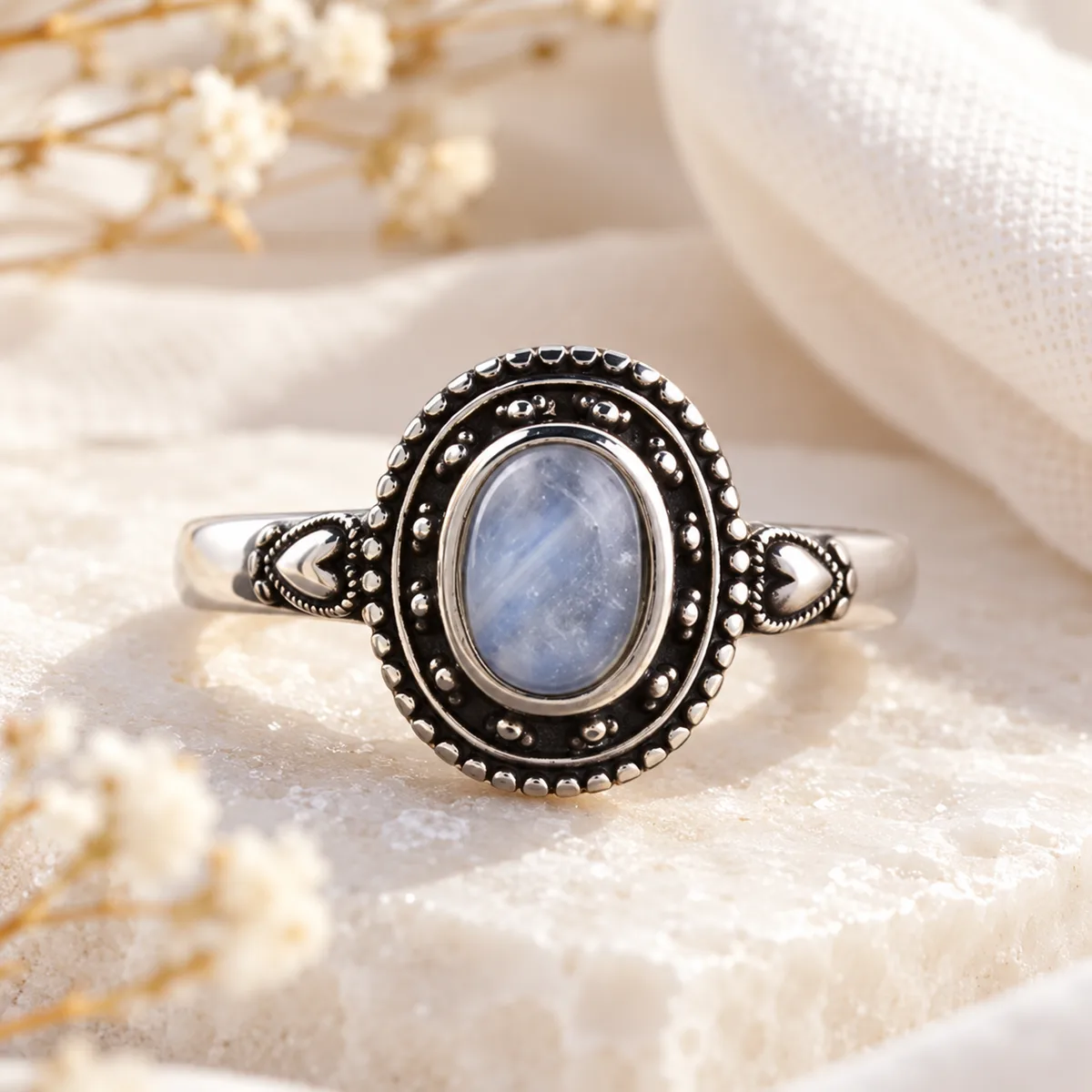
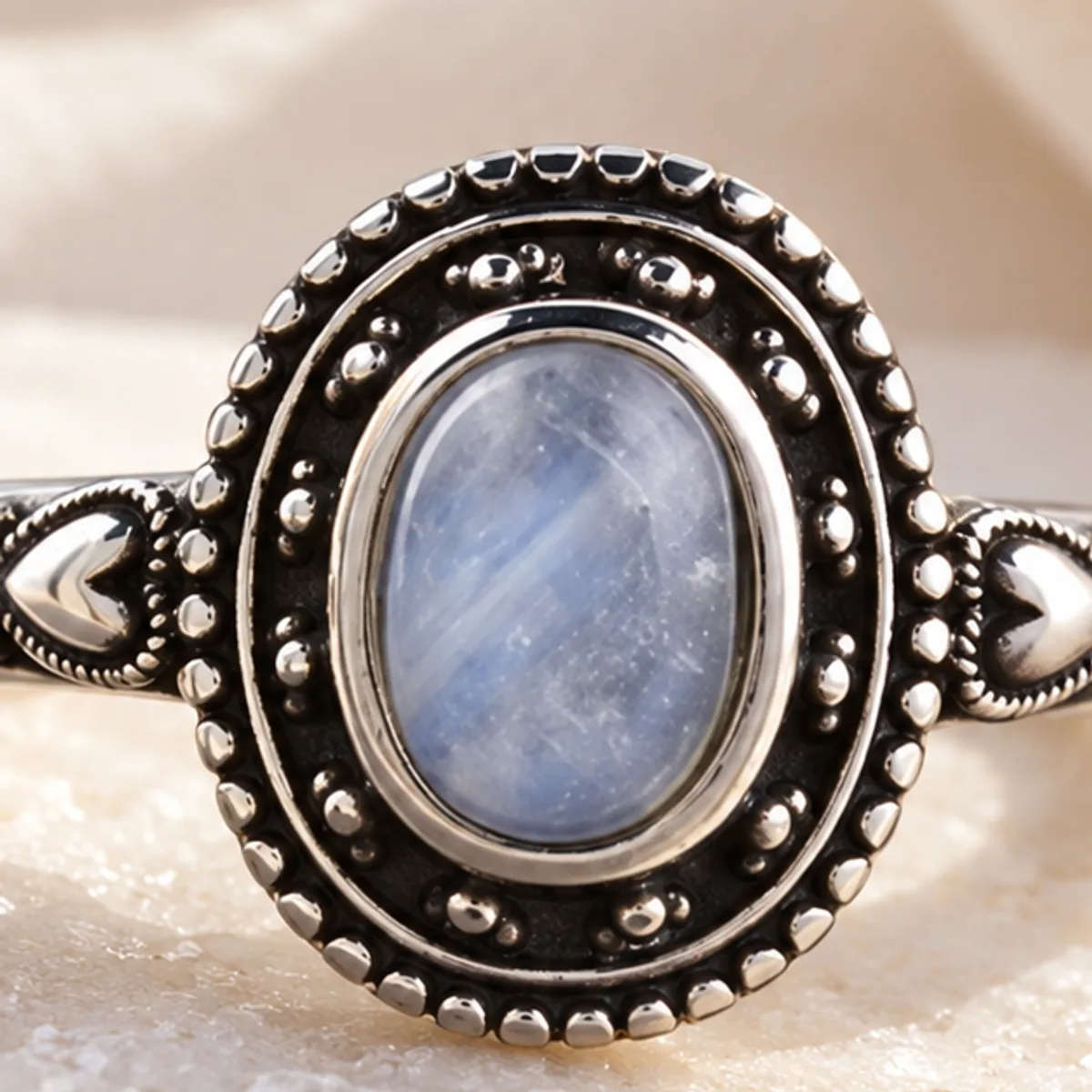
An oval cabochon in a beaded frame that is deliberately black, while the hearts on the shoulders and the band itself stay bright silver.
Blackening one part and not the others
Oxidising a whole ring is easy. Oxidising one element and leaving the rest bright is the difficult version, and it is what gives this piece its graphic quality: a black ring of beads around the stone, two bright hearts either side, nothing in between. The eye reads it as a drawing in two tones rather than as a decorated surface.
The way it is done is by masking. The parts that must stay bright are coated with a varnish that resists the sulfur bath, the piece goes in, comes out black all over, and the varnish is dissolved off to reveal clean silver underneath. It sounds simple and the difficulty is the boundary: varnish that creeps a fraction gives a grey halo around the bright areas, varnish that falls short gives a black line where none was wanted. The edge of a masked area is the only place worth inspecting.
There is an alternative, which is to blacken everything and then polish the bright parts back. It is faster and it is what most workshops do, and you can recognise it because the transition is soft: the polished areas fade into the black rather than stopping at a line. Masked blackening has a hard edge. Neither is dishonest, and the hard edge is why I mask.
The stone sits in a closed bezel under the black beading, and the blue veil gains from the dark frame exactly as it does on the fully blackened models. The other rings are here, and the size guide takes two minutes.
- Oval moonstone cabochon, closed bezel under a blackened beaded frame.
- 925 sterling silver hallmarked S925, hearts on the shoulders left bright.
- Blackened by masking, so the boundary between black and bright is a hard line.
- US sizes 4 1/2 to 10, that is 48 to 62 mm. Shipped in two weeks.
The specifications
- Stone
- Real moonstone (adularia), oval cabochon
- Origin
- India
- Metal
- 925 sterling silver, S925 hallmark
- Setting
- Closed bezel, no glue
- Decoration
- Blackened beaded frame, bright hearts on the shoulders
- Finish
- Selective blackening by masking
- Sizes
- US 4 1/2 to 10 (48 to 62 mm)
- Gender
- Women
- Brand
- Melissa Moon
How to tell masked blackening from polished back
Look at the boundary under a good light. If the black stops at a clean line, the bright area was masked before the bath. If it fades through grey over a millimeter or so, the whole piece was blackened and the bright parts were polished afterwards. The second method also leaves the bright areas very slightly lower than the black ones, because polishing removes metal, and on a piece with fine detail that loss is visible.
This matters for repair as much as for looks. A masked piece can be re blackened without touching the bright parts. A polished back piece has to be blackened all over again and re polished, which takes a little more metal off each time. After three or four cleanings of that kind, fine detail starts to disappear. It is a slow problem and it is the reason I put up with the varnish.
You can see the difference from across a table once you know to look at the edge rather than at the black.
No salt, no ultrasonic tank, no hot water: moonstone is a feldspar, and all three damage it for good. On this piece the rule about silver dips is absolute: a dip removes the black from the frame in seconds and will not touch the bright hearts, so you end up with the design inverted. Polish the bright parts with a cloth if you like, and stay off the frame. The detail is in cleaning a moonstone piece, and the safe methods in caring for it without harming it. In a bezel the stone is well protected.