


Description
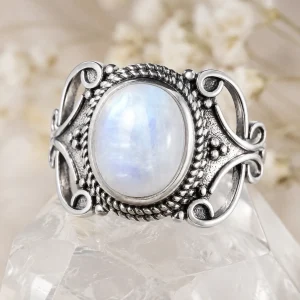
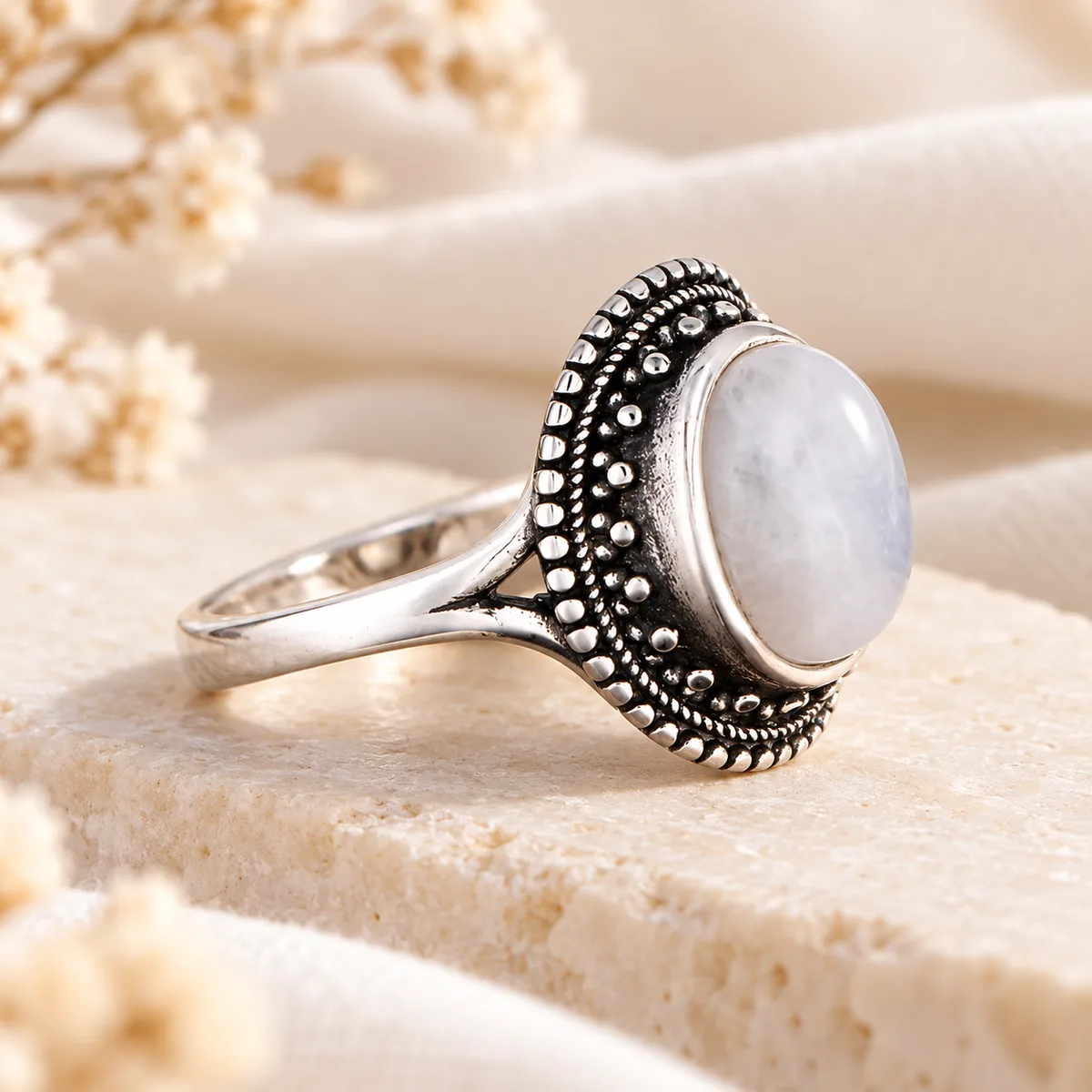
An oval cabochon ringed by granules large enough to count, each one a small sphere sitting against the next, carried on a deliberately thin band.
Big granules, and why the band is thin
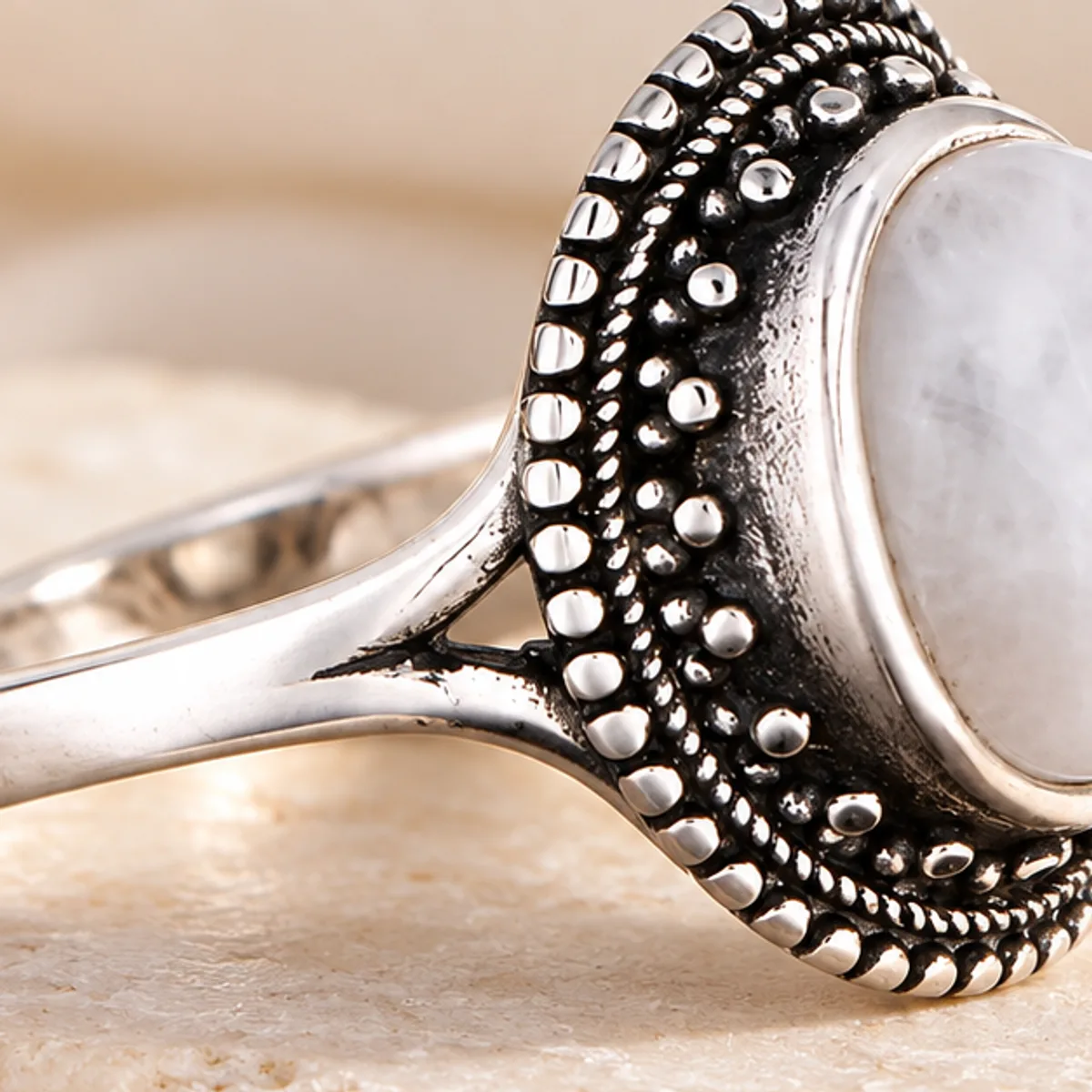
Most beaded surrounds in this collection use grains small enough to read as a texture. These are the opposite: perhaps a millimeter and a half across, distinctly spherical, and you can count them without effort. At that size they stop being a border and become the decoration itself, which is why everything else on the ring is kept out of the way. The band is thin, plain, and does nothing, so that the ring is a circle of spheres around a stone and nothing more.
Large granules do something small ones cannot: they each hold a single bright highlight. A row of tiny beads gives a soft glitter, an average of many reflections. A row of large spheres gives you a dozen distinct points of light that move separately as the hand turns. It is a livelier effect and a more graphic one, and it photographs far better, which is not why I made it but is worth knowing.
Now the honest part. True granulation, the Etruscan technique, fuses each granule to the surface with no visible solder at all, using a copper compound and very precise heat. It is one of the hardest things in the trade and it is not what this ring is. These granules are soldered, conventionally, and if you look closely with a loupe you will see a tiny fillet at the base of each one. Anyone selling silver at this price as Etruscan granulation is misdescribing it.
The stone sits in a closed bezel inside the ring of granules, and the blue veil is framed by twelve small highlights. The other rings are here, and the size guide takes two minutes.
- Oval moonstone cabochon, closed bezel inside a ring of large granules.
- 925 sterling silver hallmarked S925, soldered granulation, thin plain band.
- Each granule holds its own highlight: distinct points of light rather than a soft glitter.
- US sizes 4 1/2 to 10, that is 48 to 62 mm. Shipped in two weeks.
The specifications
- Stone
- Real moonstone (adularia), oval cabochon
- Origin
- India
- Metal
- 925 sterling silver, S925 hallmark
- Setting
- Closed bezel, no glue
- Decoration
- Ring of large soldered granules
- Shape
- Thin plain band
- Finish
- Oxidized silver, crests rubbed back with a cloth
- Sizes
- US 4 1/2 to 10 (48 to 62 mm)
- Gender
- Women
- Brand
- Melissa Moon
How a granule is made round
You cannot file a sphere. A granule is made by melting: a tiny piece of silver wire is heated until surface tension pulls it into a ball, and then it cools as a perfect sphere because that is the shape with the least surface for its volume. Physics does the shaping, not the hand. The skill is in cutting pieces of wire that are all the same length, because a piece twice as long gives a granule that is noticeably bigger.
The second skill is not melting them again when you solder them on. Silver granules and silver solder are close in melting point, and a second too long with the flame turns a row of spheres into a puddle. That is why granulation is a technique people either do well or avoid entirely: there is no halfway result, there is a row of granules or there is a mess to file off and start again.
A granule is the only part of a ring I do not shape. I make the conditions and the metal makes the sphere, which is a good arrangement when it works.
No salt, no ultrasonic tank, no hot water: moonstone is a feldspar, and all three damage it for good. The hollows between large granules trap cream more than a flat surface does, so rinse under lukewarm water rather than wiping, and use a dry soft brush once a month. Avoid silver dips, they lift the oxidation from between the spheres and the ring of granules goes flat. The detail is in cleaning a moonstone piece, and the safe methods in caring for it without harming it. The granules stand higher than the stone and take knocks before it does, which suits a stone that chips.