

Description
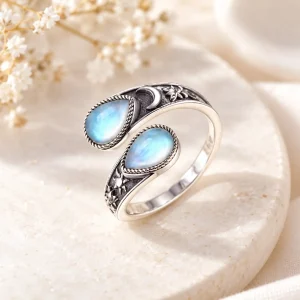
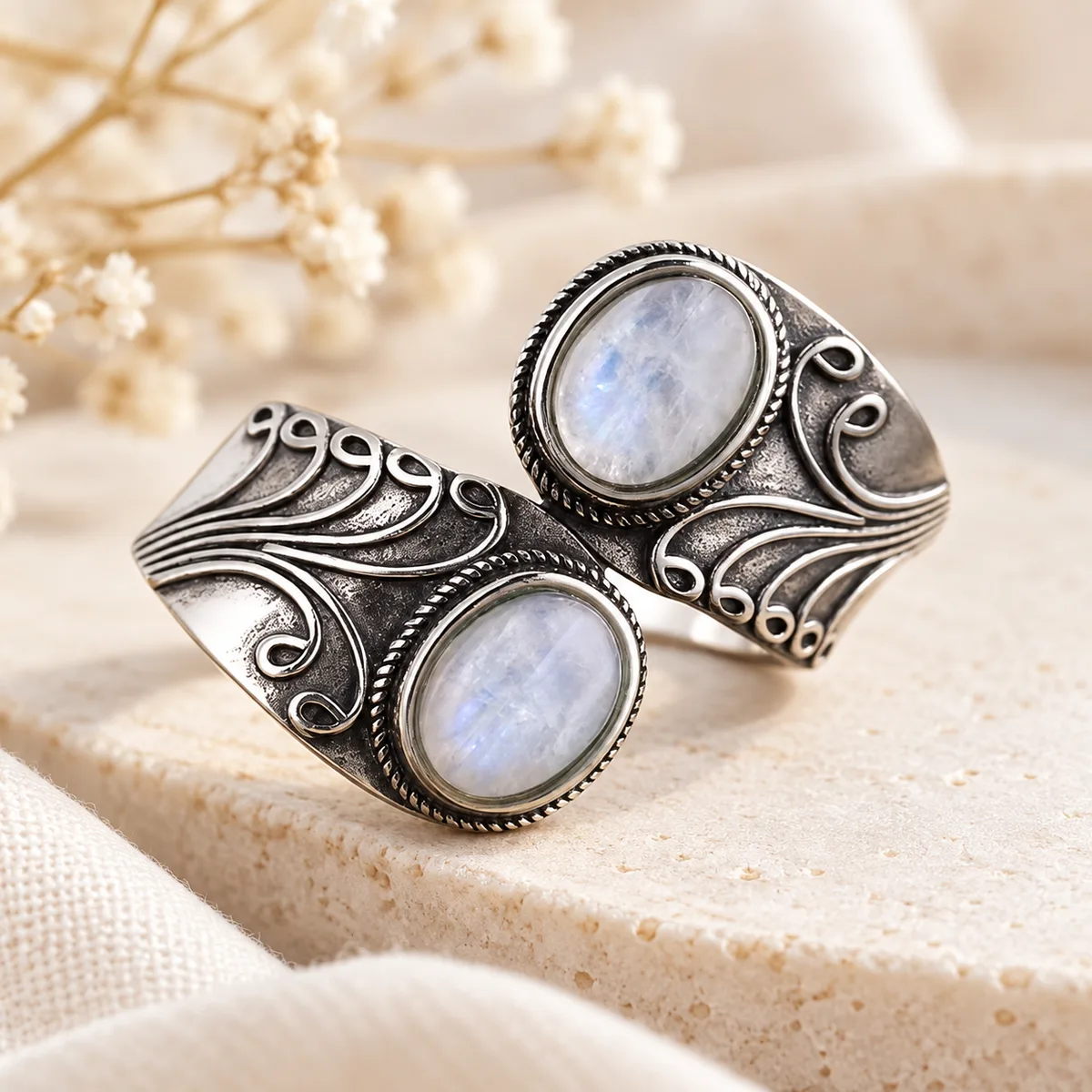
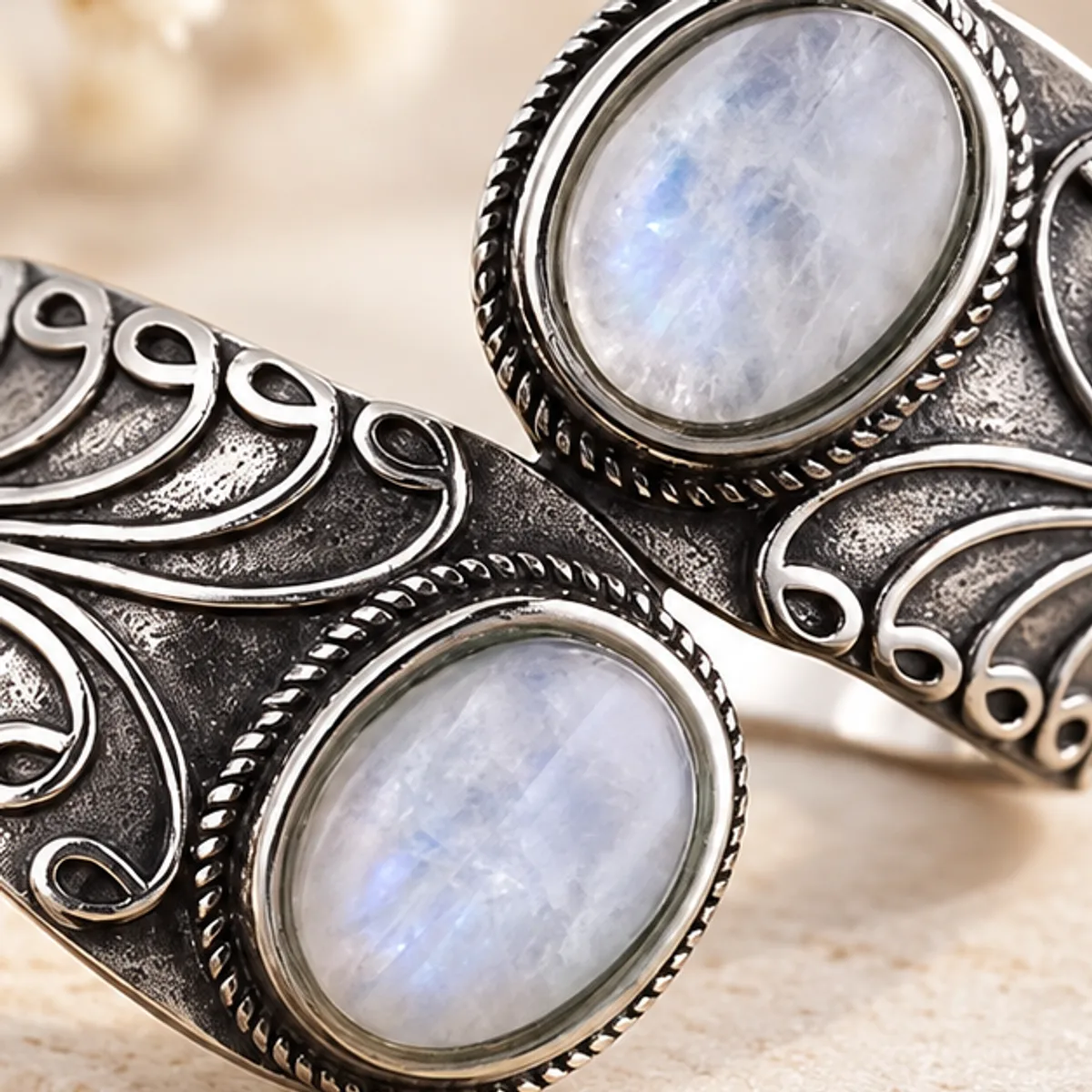
An open ring: the two ends do not meet, and each carries a round moonstone. Between them the silver widens into chased scrolls, cut in the manner of an old spoon handle.
An open ring, and what that solves
The two ends stop a few millimeters apart, which means the ring adjusts. You widen it slightly to pass the knuckle and press it gently back once it is on. For anyone whose knuckle is larger than the base of the finger, and that is a great many people, this is the design that finally fits. It is also the answer for fingers that swell in summer and shrink in winter.
Adjusting has a rule, and it is the only thing you need to know: open and close it with two hands, by moving both ends outward in the plane of the ring, never by twisting it sideways. Silver tolerates being opened and closed dozens of times in the first direction. Twisted sideways, it work hardens at the shoulders and eventually cracks. Two hands, in the plane, and this ring will outlast the rest of the collection.
Two stones, one at each end, and they are round rather than shaped because a round cabochon can be set very close to the edge of the metal. That matters here: on an open ring the ends are what people see first, and a stone set back from the end would waste the design. Each sits in a closed bezel, protected, and the two are paired by veil before setting as I do on every two stone piece.
Between the bezels the silver widens and carries scrolls chased with a burin, deliberately in the manner of a spoon handle: a flat surface that swells, a symmetrical curl, and a line that follows the edge. The blue veil of the two small cabochons shows as a flash rather than a permanent glow. The other rings are here, and the size guide matters less on this model than on any other.
- Two round moonstone cabochons, one at each end, closed bezels.
- 925 sterling silver hallmarked S925, open ring, adjustable by hand.
- Scrolls chased with a burin, in the manner of an old spoon handle.
- Adjusts across roughly two sizes, US 4 1/2 to 10 as a guide. Shipped in two weeks.
The specifications
- Stone
- Real moonstone (adularia), two round cabochons
- Origin
- India
- Metal
- 925 sterling silver, S925 hallmark
- Setting
- Two closed bezels, no glue
- Shape
- Open ring, adjustable, chased scrolls
- Finish
- Oxidized silver, crests rubbed back with a cloth
- Sizes
- Adjustable, roughly US 4 1/2 to 10 (48 to 62 mm)
- Gender
- Women
- Brand
- Melissa Moon
The spoon ring, and why the shape survives
Rings cut from silver spoon handles are a real and documented craft, common in Britain from the seventeenth century and revived in the nineteen sixties. The reason is practical before it is romantic: a spoon handle is already a long, flat, decorated strip of silver of exactly the right thickness, and bending one into a circle leaves the decoration on the outside. Nothing here is cut from an actual spoon, but the shape and the chasing come straight from that lineage.
The open form came from the same source. A handle bent into a ring naturally leaves a gap, and rather than solder it closed, people discovered the gap was useful. That is how a great many good designs happen: a constraint of the material becomes the feature, and three hundred years later we draw it on purpose.
An open ring is the only kind I can make in one size and have fit almost every hand. That is not a small thing when you are shipping to nine countries.
No salt, no ultrasonic tank, no hot water: moonstone is a feldspar, and all three damage it for good. Avoid silver dips, they strip the oxidation from the chasing. Lukewarm water, a soft cloth. The detail is in cleaning a moonstone piece, and the safe methods in caring for it without harming it. Adjust it as little as you actually need, and never with pliers: the stones sit near the ends, and pliers concentrate force exactly there.