


Description
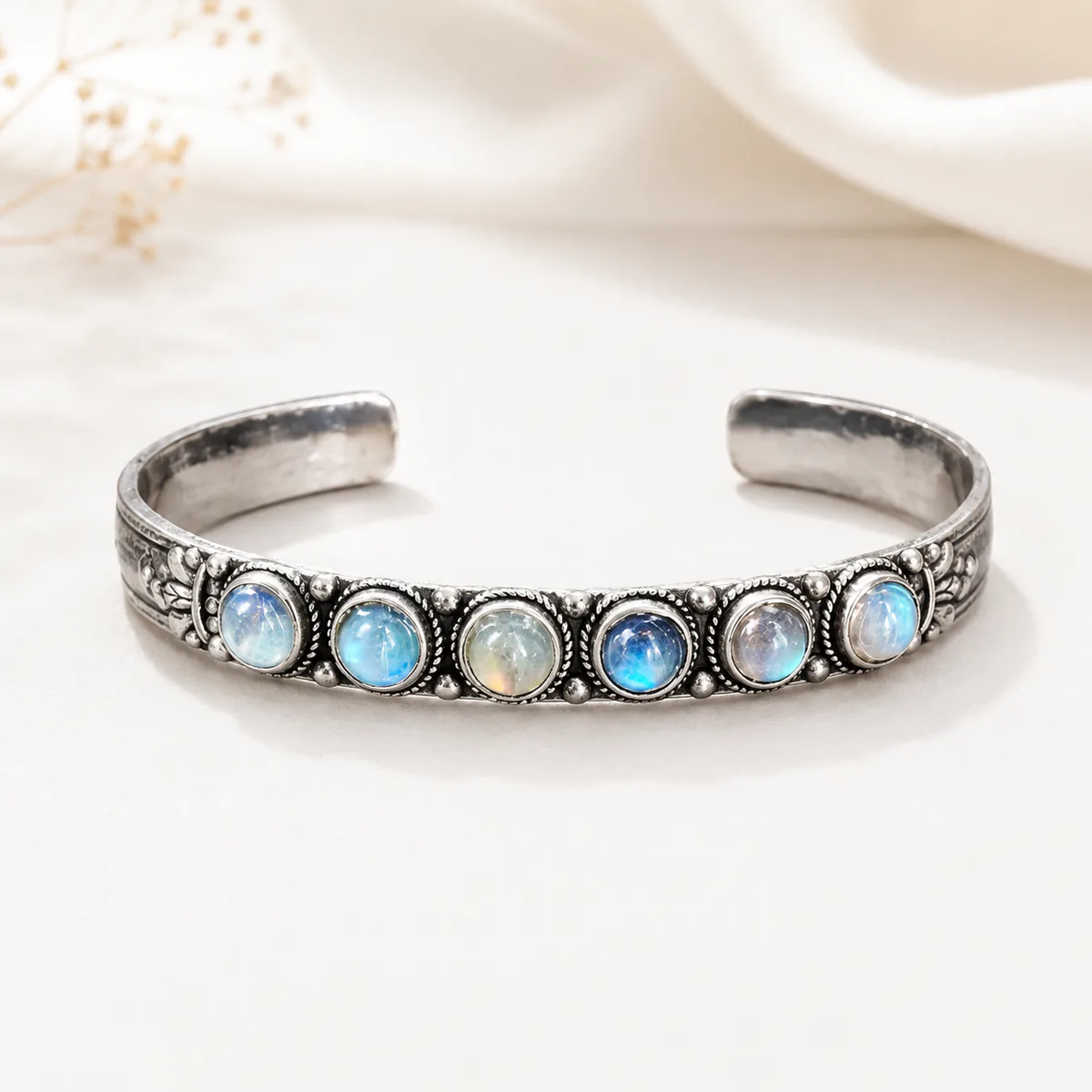
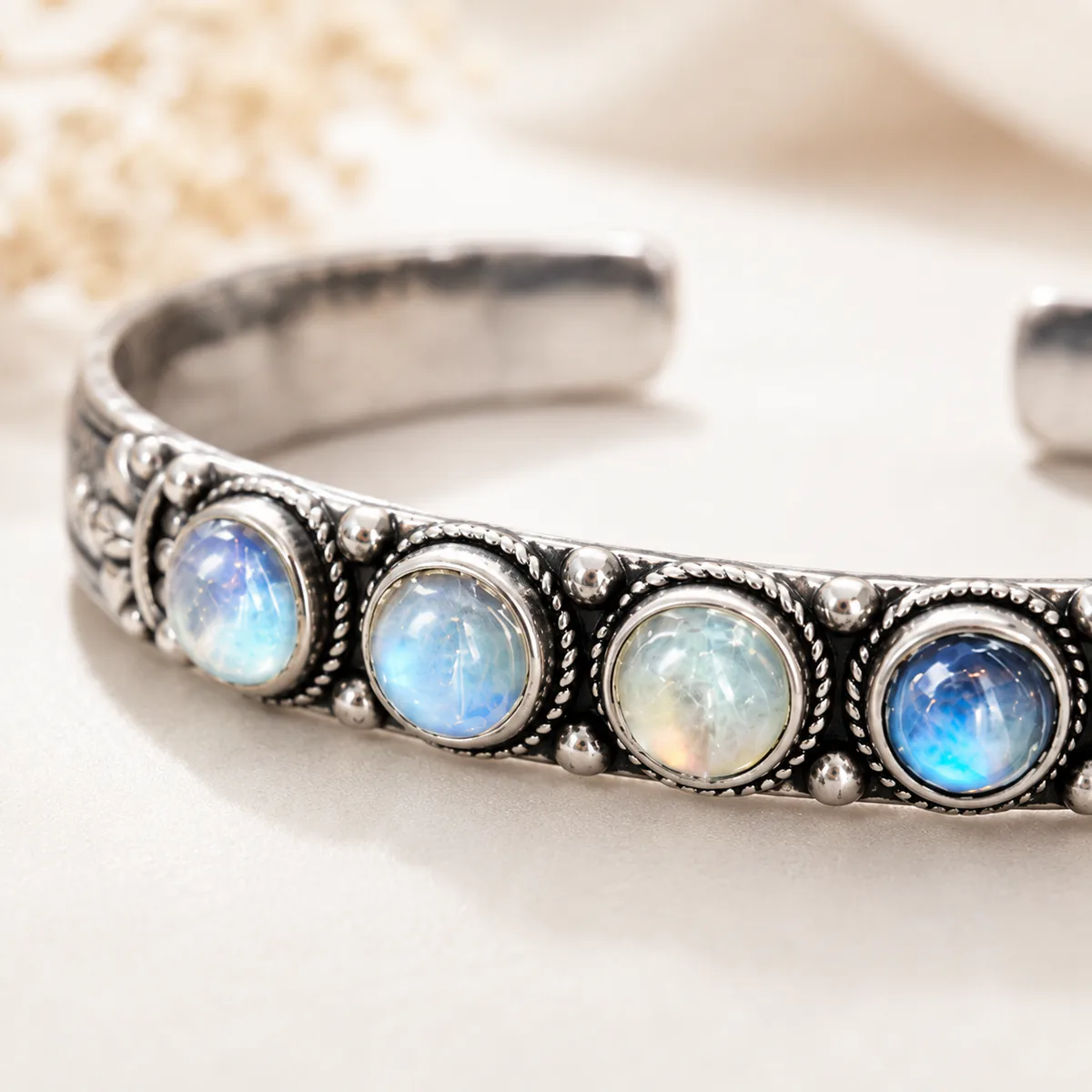
It is the only rigid bracelet in the shop, and the only one with no wear part at all. Six cabochons aligned on a blackened silver bangle, each ringed with granulation, between two leaf motifs. No elastic, no clasp, no cord: nothing that can ever give out. This is the one you wear for twenty years.
Six stones on a single line
The cabochons follow each other along the face of the bangle, all the same diameter, each in a bezel surrounded by a row of soldered beads. Their sheen shifts from clear blue to gold depending on the angle you look from, and because there are six side by side, they never all light up at once: it is a wave that crosses the bracelet as the wrist turns. A single stone cannot do that.
The rest of the surface is worked, and deliberately dark. Leaf motifs sit at the shoulders, a beaded line runs along both edges, and the background is blackened. On a bracelet that presents its face to view all day, uniformly polished silver would throw light back everywhere and the relief would vanish. The black in the recesses is what makes the design legible.
The bangle is not closed: it has an opening at the back, which lets it fit a wrist without having to pick a size. It is the most durable of the three formats the shop offers. A beaded bracelet rests on stretch cord that tires in one to three years. A cord bracelet gets dirty and cuts. Here it is all solid metal, and a well-cared-for silver bangle gets passed down. The other bracelets are here.
The trade-off is that it does not wear like a soft bracelet, and that is what most people discover after buying it.
How to put it on, and why it matters
An open bangle goes on from the side of the wrist, never over the hand. Present it edge-on, slide the opening against the narrowest part of the wrist, then rotate it into place. The natural move, which is to pull the two ends apart to pass it over the knuckles, is exactly the one to avoid: silver work-hardens with every flex, and a bangle opened and closed every day eventually cracks at its thinnest point.
The fit itself is set once, on arrival. Squeeze or open it gently with both hands, pushing gradually rather than forcing it, until it holds without marking the skin. After that, leave it alone. The size guide explains how to measure a wrist for a bangle, which is not the same measurement as for a soft bracelet.
One last thing nobody mentions: a bangle rotates. It does not hug the wrist, it rests on it, and it turns over the course of a day. Place its opening under the wrist rather than on top: the six stones stay visible longer that way, and the opening does not catch on sleeves. Moonstone also has perfect cleavage, it chips on impact without scratching easily. On a rigid bracelet, it is the top-facing stones that take the hits against doorframes and table edges. Closed bezels protect them, but they are no miracle.
- Six moonstone cabochons in a line, each ringed with soldered granulation.
- Sterling silver, rigid open bangle. Leaf motifs and a blackened background.
- No wear part: no elastic, no clasp, no cord. Nothing that can ever give out.
- One size, set once on arrival. Shipped in two weeks with a cotton pouch and a care card.
The specifications
- Stones
- Six round moonstone cabochons
- Metal
- 925 sterling silver
- Shape
- Rigid open bangle, sized once
- Setting
- Closed bezel, no glue
- Decoration
- Granulation around the stones, leaf motifs, blackened background
- Size
- One size, adjustable by hand within a narrow range
- Gender
- Women and men
- Brand
- Melissa Moon
Matching six stones
This is what makes this piece difficult. On a ring, one stone is enough. On a pair of earrings, you need to match two. Here you need six, aligned and seen at a single glance, and a moonstone’s sheen depends on the orientation of its internal planes, which nobody chooses when cutting it. Finding six cabochons whose sheens are close enough to hold together on one line takes time, and that is what explains the price of a bangle like this one. The six criteria I apply are here.
I do not claim to set this one myself. The granulation and the repoussé motifs come from workshops that do only that, and my part stops at choosing the stones, which on this model takes longer than elsewhere since six need to be matched. The rest of the shop is here, including what I have taken out of the catalog.
The one piece in the shop I never sell twice. On a beaded bracelet, restringing will come up in two or three years, and that is normal. On a necklace, the clasp eventually tires. Here there is nothing to replace: the metal is solid, the stones are set in closed bezels, and the only weak point is the one you create yourself by opening and closing the bangle every morning.
No salt, no ultrasonic tank, no hot water: moonstone is a feldspar, and all three damage it for good. Lukewarm soapy water, a thorough rinse, and dry it completely by patting, without rubbing the recesses. No brush, no paste, no silver polish: they strip the black from the bottom of the granulation and would leave you a uniformly grey bangle with no relief. If the edges dull, buff them alone with a dry fingertip. Store it flat rather than loose in a pouch: a bangle deforms when tossed in a bag. The detail is in cleaning a moonstone piece, and the safe methods in caring for it without harming it.