


Description
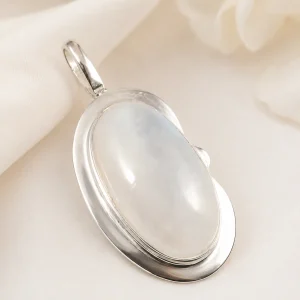
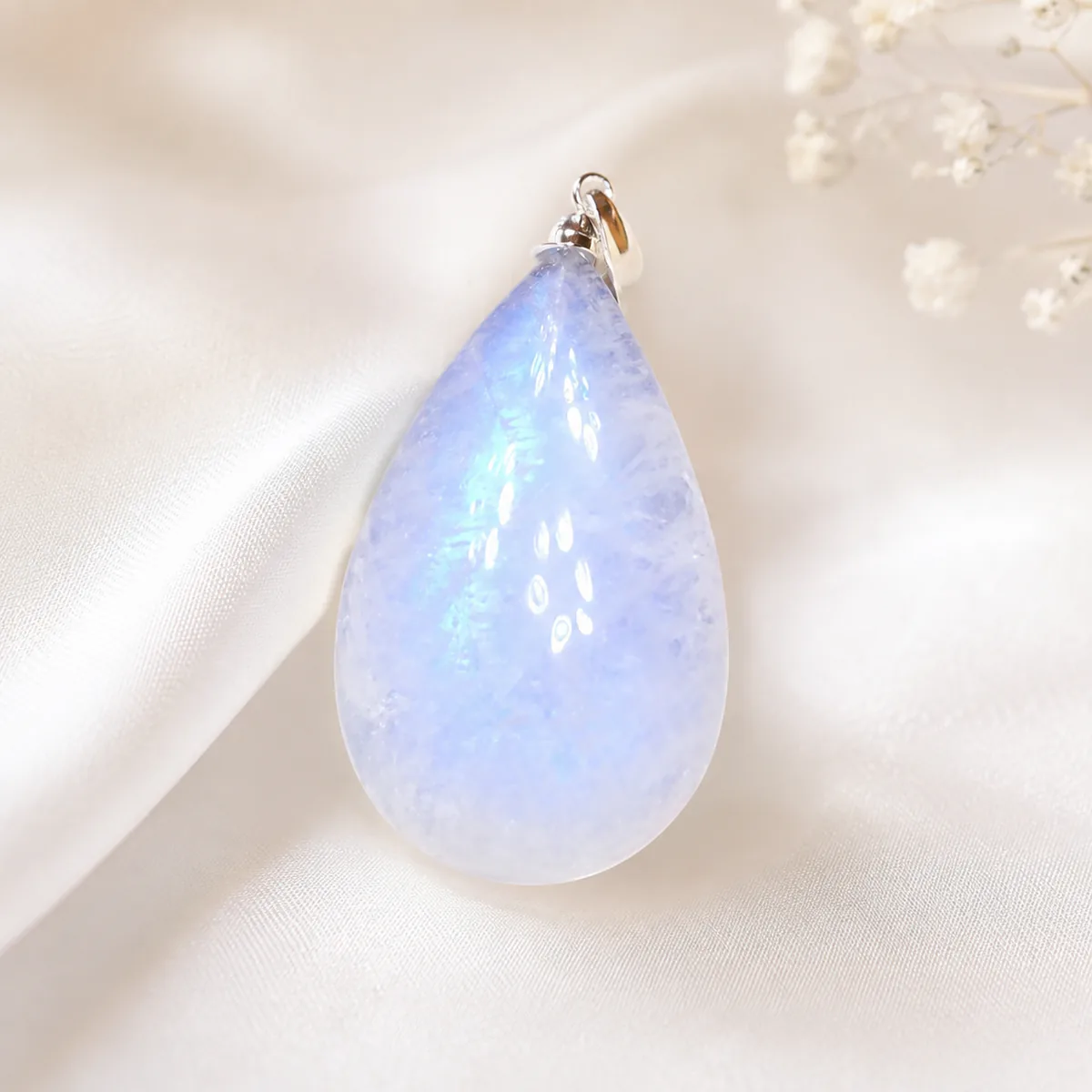
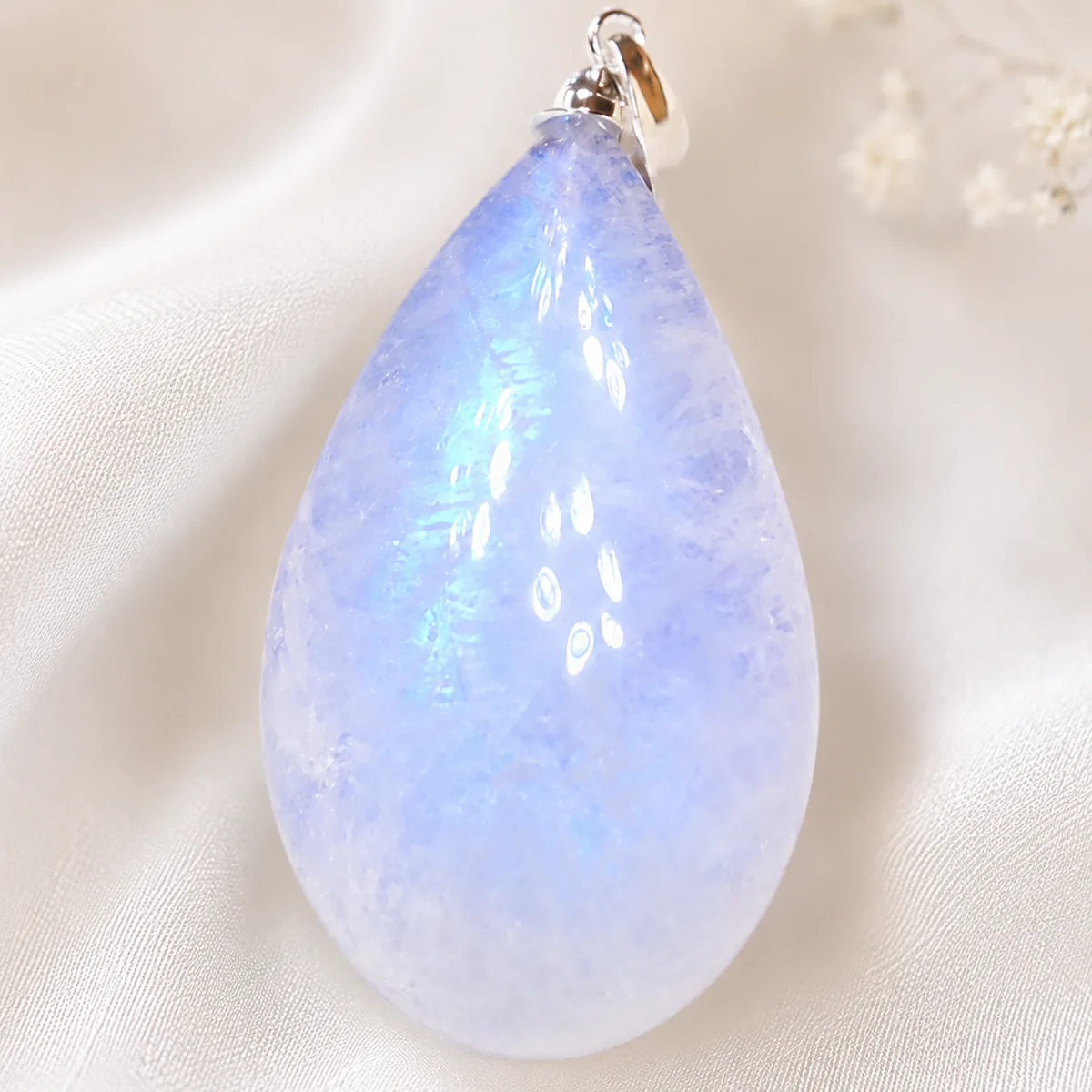
A large polished teardrop, milky and translucent, crossed by a blue veil that turns green in places, held by nothing more than a small bail closed over its tip. No setting, no decoration: this is the largest and barest stone in the catalog.
Everything rests on one square centimeter
Look at this pendant as a whole: there is a single point of contact between the stone and the metal, that small bail set on the tip. No bezel around it, no cage, no prongs spread along the rim. The entire weight passes through that one joint, and that weight is not still: a teardrop this size swings with every step, lifts when you lean forward, drops back when you straighten up.
That is what sets a large pendant apart from a small one, far more than its size does. A load that swings back and forth stresses a setting far more than a load that simply rests. Nothing to worry about on a properly made piece, but it justifies a habit: once a month, hold the stone in one hand, the bail in the other, and pull gently along the axis. Nothing should move, slip, or make a sharp sound.
Second habit, even more important on a heavy piece: never suspend the pendant by holding the stone to thread it onto a chain. Always hold it by the bail. The shop’s other pendants are here.
A pinching bail, not a drop of glue
Here is this model’s particularity, and it also decides how long it lasts. The bail is not a cup filled with adhesive, it is a spring piece whose two small arms pinch the stone on either side of its tip, seating into two tiny notches made for them. The hold is mechanical: it is the tension of the metal doing the work, nothing else.
The difference is not theoretical. A glued stone comes loose one day, almost always under the same circumstances: a run under hot water, a car left in the sun, a lukewarm cleaning bath, a summer evening. Adhesives soften long before the metal so much as flinches, and the stone comes off without warning, usually somewhere you never find it again. A mechanical pinch, by contrast, could not care less about heat.
You can check this yourself, on any pendant for that matter: look at the join from the side, in full light. A glued setting almost always leaves a shiny, slightly overflowing rim, sometimes yellowed with time, between the metal and the stone. A pinched setting shows only metal resting on stone, with nothing in between. This inspection takes five seconds and applies to every cheap pendant on the market.
A large stone shows its interior
Look closely at the cabochon and you will see veils, fine pale feathers, zones a little cloudier than others. These are inclusions, and on a stone this size they are the rule, not the exception. The larger a stone, the more material there is for the eye to travel through, and the more visible whatever it contains becomes: a small stone is not purer, it is simply smaller.
What matters most is that inclusions are not the enemy of the sheen, they are its condition. This stone’s blue veil is born of stacked internal layers: a perfectly homogeneous material with no internal structure would produce no sheen at all. Demanding a large, completely clear cabochon would therefore amount to asking for a moonstone that is not a moonstone. The mechanism is explained here, and the real quality criteria are detailed there.
This stone, though, is entirely bare: no metal covers its rim, and it is the widest part, the bottom, that meets corners first. Moonstone chips on impact without scratching easily, and on a piece this size a chip would be visible and permanent. This is a pendant you take off to carry boxes, to hold a child against you, or for anything that presses against the chest.
- Large polished teardrop, mounted on a pinching bail, no bezel or decoration.
- Mechanical hold, no glue at all: a glued join fails under heat, this one does not.
- Internal veils are normal on a large stone, and they are what makes the sheen.
- Shipped in two weeks with a cotton pouch, a handwritten note and a care card.
The specifications
- Stone
- Moonstone, large teardrop cabochon
- Look
- Milky translucent, blue veil with green flashes
- Metal
- 925 sterling silver
- Construction
- Pinching bail, mechanical hold, no glue
- Chain
- Sold separately
- Gender
- Women
- Brand
- Melissa Moon
Why this one ships without a chain
It is not a way to save money, it is a matter of weight. A teardrop this size has real heft, and a chain has to be chosen with what it carries in mind: too fine, it twists under the load, wears through at the point of contact with the bail, and eventually fails; properly sized, it will outlast the pendant. Chains bundled by default with large pendants are almost always the first kind, because they have to fit the price.
So I would rather let you choose, and simply tell you what to look for: a link a little heavier than you would pick for a small pendant, a spring clasp of decent size, and a length that lets the teardrop hang freely rather than pressing it flat. On a piece like this, the chain is not an accessory. The rest of the shop is here.
On a large pendant, the chain is not an accessory. It is half the piece of jewelry.
No salt, no ultrasonic tank, no hot water: moonstone is a feldspar, and all three damage it for good. The ultrasonic tank is doubly to avoid on a stone this large, since it vibrates the material along its internal planes, which here are fully visible. Lukewarm water, a drop of mild soap, a soft cloth, a complete drying with attention under the bail, where water settles. On a polished surface this size, fingerprints kill the sheen more surely than any amount of wear: a wipe with a dry cloth restores its depth, and it is often all that is missing from a pendant you think has dulled. The detail is in cleaning a moonstone piece, and the safe methods in caring for it without harming it.