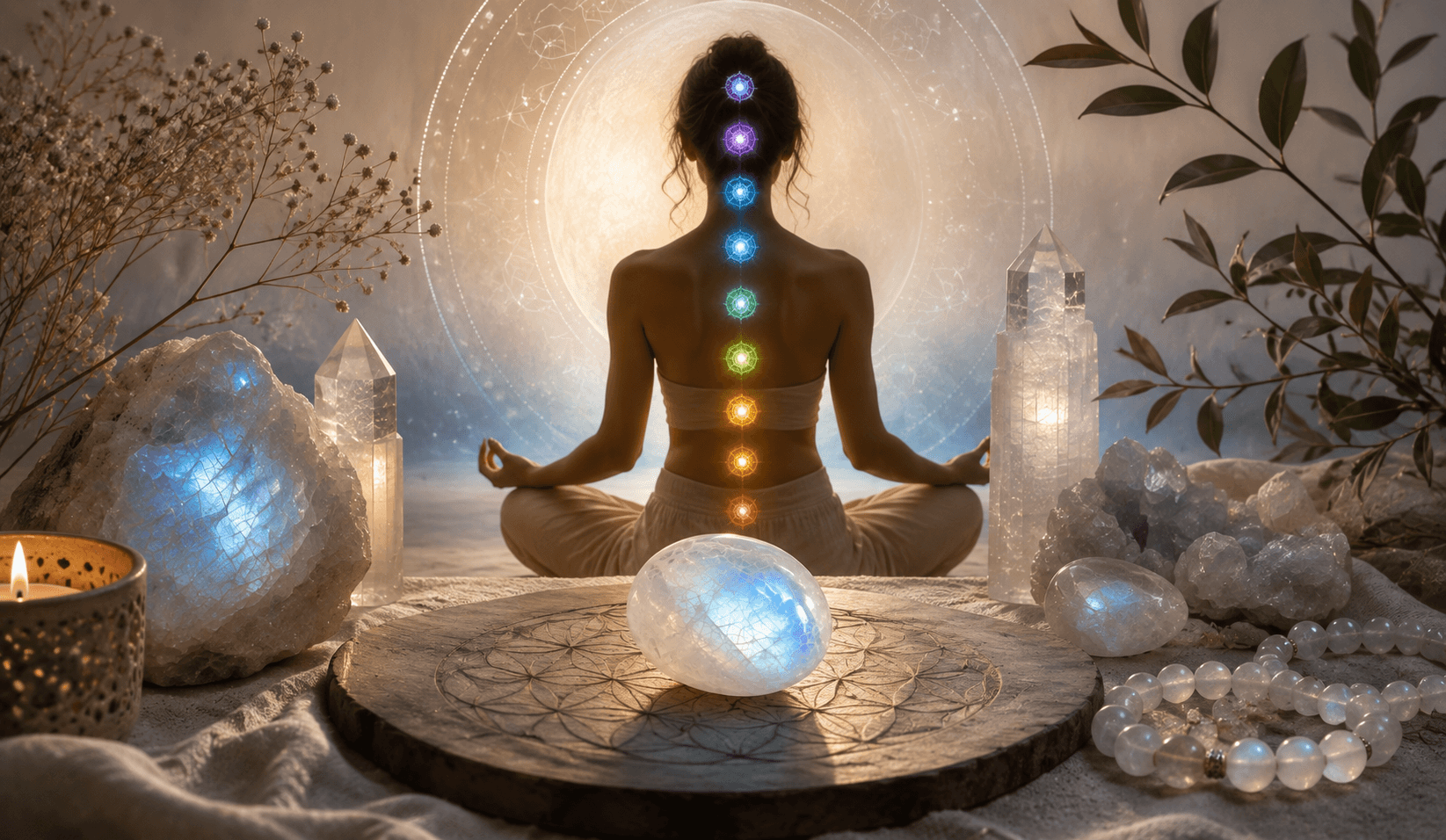
Moonstone and the Chakras
It gets placed at the sacral chakra, the heart and the third eye, depending on the author. Here's why those three, how it's used during a session, and one thing I haven't read anywhere else: on this particular stone, the system contradicts its own colour rule.
I don't practice this, and I'm not going to pretend I do. What I can do is honestly report what authors say, date where it comes from, and add the one thing I genuinely know: what a session does to a cabochon, and how to avoid damaging it.
The essentials, if you're in a hurry
- Three locations come up again and again: the sacral chakra, the heart and the third eye. Authors don't agree, and the third eye dominates.
- None of the three follows the system's own colour rule. A white stone with a blue sheen should go to the throat or the crown.
- The seven-chakra rainbow system isn't Indian, at least not in this form. The colours come from a 1927 book.
- Four stacked layers: a 1577 Sanskrit text, a 1919 translation, a 1927 coloring, an attribution of stones in the 1980s.
- The stone is placed, not applied. On a mat, on clothing, in the hand: never stuck against greasy or damp skin.
- A session damages a cabochon more than people think: sweat, creams, falls onto a hard floor. Those are the real risks.
- None of this has a proven effect. A session isn't a treatment and never replaces a healthcare professional.
What a chakra is, put simply
Might as well start with an honest definition, because most pages on this topic assume you already know.
Chakra is a Sanskrit word meaning "wheel" or "disc." In Indian tantric and yogic traditions, it refers to centres described along the body's axis, used as supports for meditation. They're not organs: no ancient text claims you could dissect them. They're points of concentration, linked to symbols, syllables and precise visualizations.
Contemporary crystal healing uses the idea differently. It treats each chakra as a slot matched to a colour and a family of stones, and suggests placing the stone on the slot. That's a considerable simplification of the original system, and it's worth knowing before reading on.
Let me be clear right away, so the rest reads properly: none of what follows is measurable. I report what authors say, name who and when, and write it all in the conditional. What concerns the stone itself, its hardness, its care, its risk of breaking, I write in the indicative, in separate paragraphs.
The three chakras it gets linked to
Three locations come up again and again among authors, and a fourth appears from time to time.
The third eye, ajna, between the eyebrows. This is by far the most cited location. The justification is always the same: moonstone is said to be tied to intuition, to perception, to what you grasp without reasoning, and ajna is the centre linked to those faculties. This is a correspondence of meaning, not of colour.
The sacral chakra, svadhisthana, below the navel. Second in frequency, and the justification changes nature entirely: it rests on the modern association between the stone, the feminine and cycles. So it's a thematic correspondence, grafted onto an attribution dating from the 1990s, which I date in the properties of moonstone.
The heart, anahata, at the centre of the chest. Cited more rarely, mostly by authors who link the stone to softness and emotional soothing rather than intuition. It's the least stable of the three.
The crown, sahasrara, shows up with some authors, generally for very white or very transparent moonstone. It's the only one of the four that follows the colour logic, and it happens to be the least cited.
A word of honesty before going further. These four locations aren't compatible with each other. A solid correspondence system wouldn't assign the same stone to four different centres with four different reasonings. That this happens here says a lot about how these attributions were built, and I show why in the next section.
The contradiction nobody points out
Here's the point that decided me to write this page instead of copying the usual list.
Modern crystal healing works first by colour. It's the simplest, most used rule: a stone is assigned to a chakra because the stone's colour matches the chakra's colour. A red stone at the root, a green stone at the heart, a blue stone at the throat. That's what makes the system teachable in ten minutes, and that's why it won.
Let's apply that rule to moonstone. It's white with a bluish sheen. The colour rule would place it at the throat, which is blue, or the crown, which is white or violet depending on the author.
Yet it gets placed at the third eye and the sacral chakra. That is, at indigo and orange. Two colours this stone has never had.
| Chakra | Why it's placed there | Rule followed |
|---|---|---|
| Third eye, indigo | Linked to intuition | No |
| Sacral, orange | Linked to the feminine and cycles | No |
| Heart, green | Linked to softness | No |
| Crown, white or violet | Colour of the stone | Yes, rarely cited |
| Throat, blue | Colour of the sheen | Yes, never cited |
Read the last column. The two locations the rule predicts are the ones nobody uses, and the three that are used contradict the rule. This isn't an error on a few sites: it's the case everywhere.
What I take from this isn't that the system is bad. It's that it's more flexible than it presents itself as being: when colour doesn't fit, reasoning switches to theme, and when theme doesn't fit, reasoning switches back to colour. A system that can justify any placement predicts nothing. That doesn't stop anyone from using it, but it's worth knowing while reading it.
Where this system actually comes from
The timeline is documented, and it surprises almost everyone. Four layers stacked up, and each one added something the previous one didn't have.
| Step | What it added | Date |
|---|---|---|
| Ṣaṭ-cakra-nirūpaṇa, by Pūrṇānanda | The six-centre model, plus the crown | 1577 |
| The Serpent Power, Arthur Avalon | Its translation and spread in the West | 1919 |
| The Chakras, Charles Leadbeater | The rainbow colours | 1927 |
| Crystal healing guides | Assigning stones to the centres | 1980s |
Three notes on this table, and they matter.
The 1577 text is real and it is old. The Ṣaṭ-cakra-nirūpaṇa, whose title roughly means "description of the six centres," is the text that fixed the model the West knows. It sits within a tantric tradition much older than itself. Nobody disputes that.
The colours, on the other hand, date from 1927. Charles Leadbeater, a member of the Theosophical Society, publishes The Chakras and describes there what he claims to perceive through clairvoyance. He's the one who lines up the seven centres on the rainbow spectrum, from red at the root to violet at the crown. It's not a transmission, it's a personal proposal, and it turned out so convenient that it became the world standard.
Ancient texts do give colours, and they don't form a rainbow. I'm not tabulating them here, for a reason I'd rather state plainly: the translations I've consulted don't agree with each other on several centres. I'm not going to manufacture a clean table out of sources that contradict each other. What's established, and is enough for the argument, is that the sequence red, orange, yellow, green, blue, indigo, violet appears in no ancient text.
The stone attributions are the most recent layer of all. They come from English-language crystal guides of the 1980s through 2000s, the same ones that fixed the properties. Their precise dating is in the properties of moonstone.
None of this disqualifies the practice. A recent tradition is still a tradition, and I've written the same thing about the properties and the meaning. What bothers me, here as elsewhere, is the phrase "according to thousand-year-old Indian tradition" stuck in front of a 1927 colour chart.
The other stones at the same spot
A frequent and legitimate question: if moonstone goes to the third eye, what else goes there, and can they be combined?
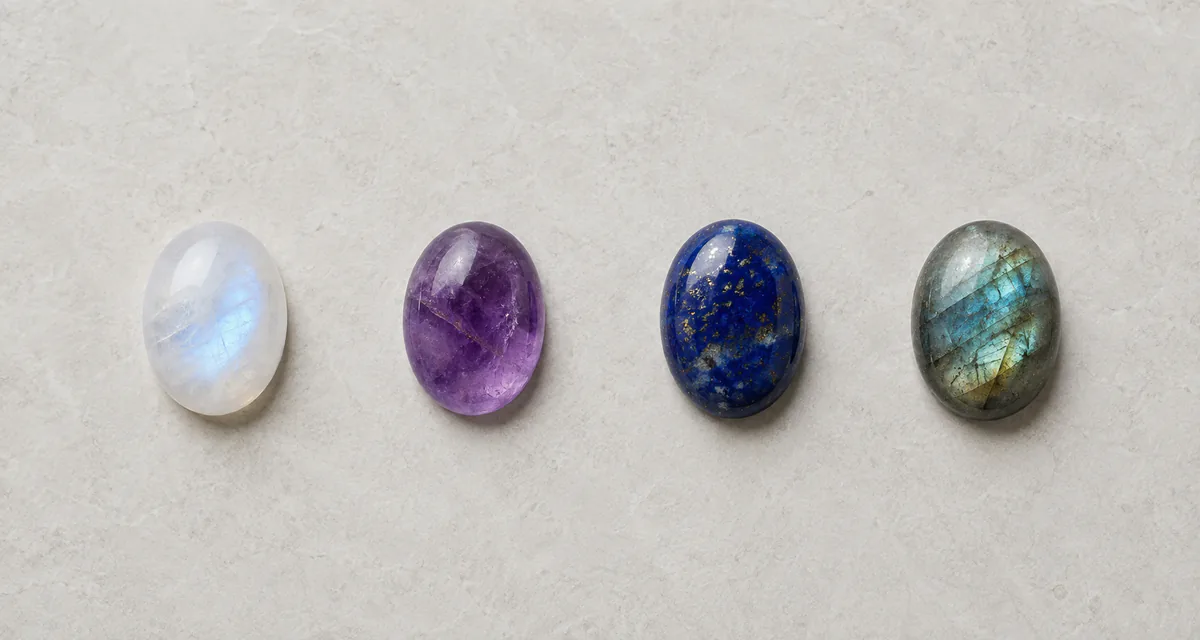
The stones most often cited at the third eye are amethyst, lapis lazuli, sodalite, fluorite and labradorite. At the sacral chakra, carnelian dominates by far, along with sunstone and amber. At the heart, rose quartz, green aventurine and malachite.
What I can add, and it's worth more than yet another list: these stones don't all combine without harm. Amethyst and lapis lazuli are harder than moonstone and scratch it; malachite is markedly softer and scratches against everything. The hardness table and the stringing precautions are in what crystals to pair with moonstone, and the pairings I don't recommend are in what stones not to pair with moonstone.
One fun note to close: labradorite shows up on third-eye lists, and if you own a rainbow or black moonstone, you already have labradorite in your hands. Almost no shop says so, and it's explained in moonstone or labradorite.
Four varieties, four sheens, one species with two branches
How it's used during a session
Here's what practitioners describe, reported as plainly as possible. I'm not recommending anything: I'm describing a use.
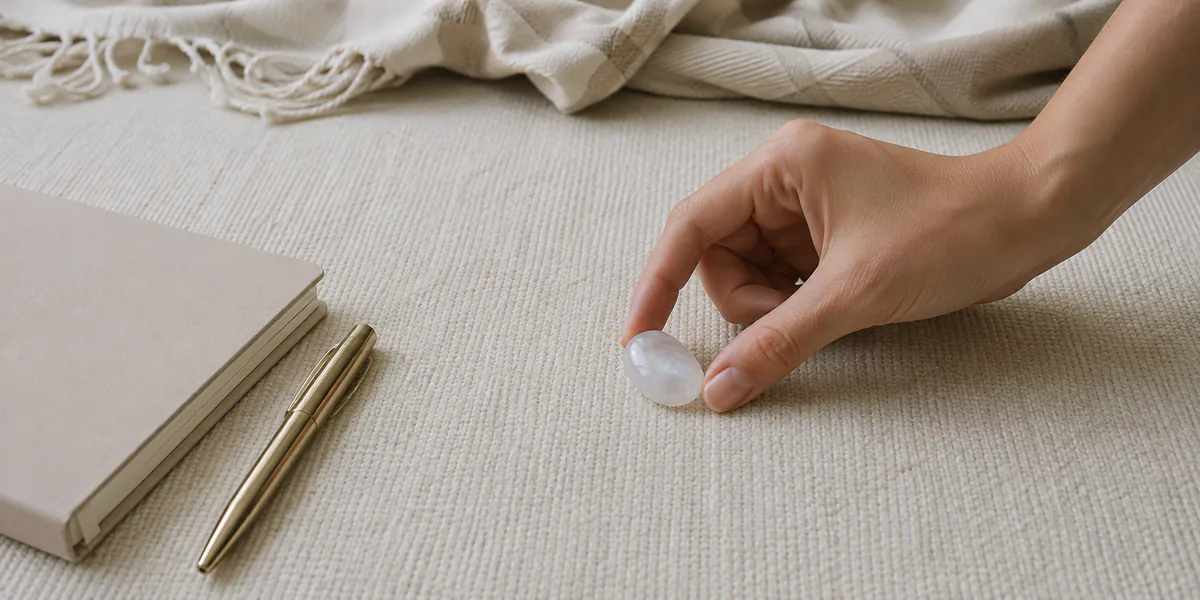
The stone is placed, it isn't applied. The person lies down, the stone is set on clothing or on skin, at the chosen location, and left there. There's no pressure, no massage, no movement. A session generally lasts ten to thirty minutes depending on the practitioner.
One stone at a time, most often. Seven-stone layouts exist, one per centre, but most authors recommend starting with a single stone and observing. It's also the most sensible advice from a material standpoint: seven cabochons resting on a moving body means seven chances to fall.
Seated or in hand rather than lying down. Many people who write to me don't do formal sessions: they keep a tumbled stone in their hand for a few minutes, or set it in front of them on a desk. It's the most common and least risky use, for them and for the stone.
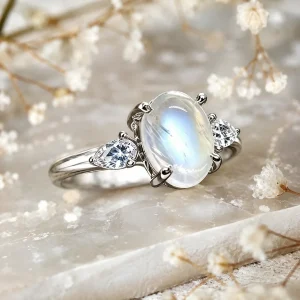
A tumbled stone is better than jewellery. A setting would be a hard point of contact against skin, and a bezel-set cabochon sits awkwardly flat. If you want a stone for this use, get a tumbled stone or a small loose cabochon, and save the jewellery for wearing. The topic of shapes is covered in raw or cut moonstone.
If this is your first stone and all this sounds unclear, there's an article made for that: getting started in crystal healing with moonstone.
What a session does to the stone
Shift in register, and this is the part where I know what I'm talking about. What follows is written in the indicative, because it can be checked.
Moonstone is a feldspar with a hardness of 6 to 6.5, with perfect cleavage: internal planes along which the crystal splits cleanly. It doesn't scratch easily, it chips on impact. A session exposes it to three things.
Falling. This is the real risk, and it's mundane. A stone resting on a chest falls when the person sits up, and a tiled floor is unforgiving. Set it on a mat, never near the edge, and pick it up before you stand. The stone's actual fragility is detailed in is moonstone fragile.
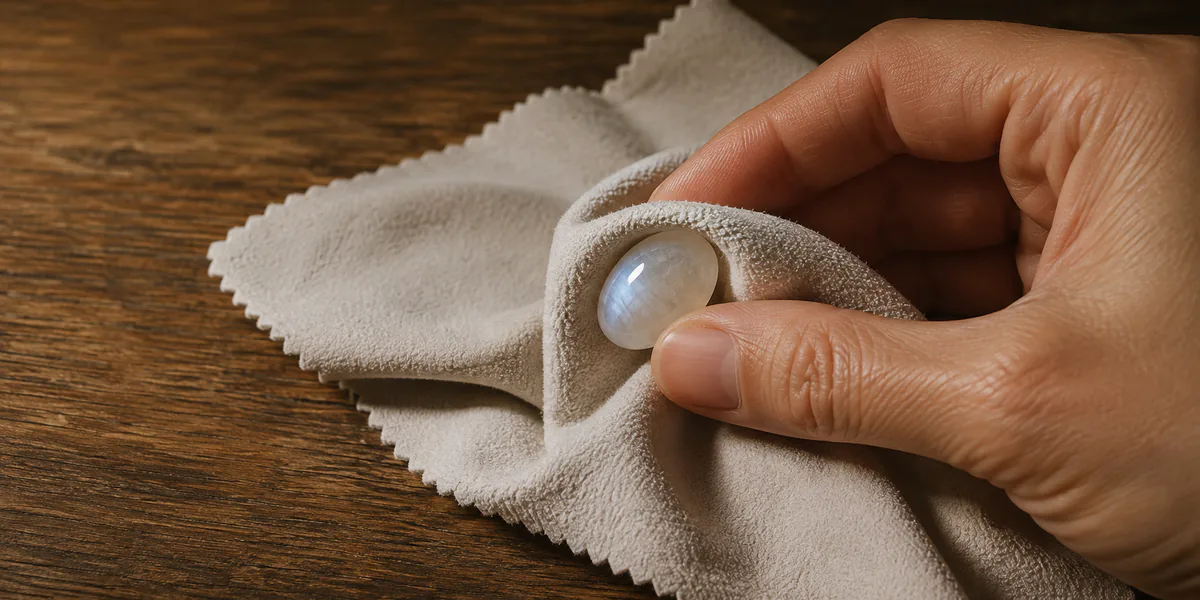
Oily residue. Massage oil, moisturizer, serum, sunscreen. A feldspar with perfect cleavage has microfractures, and anything greasy settles into them and doesn't come back out. A stone regularly placed on oiled skin turns dull, and the sheen loses its crispness. Wipe it with a soft cloth after each use.
Sweat. Same mechanism, slower. It's slightly acidic and it attacks the polished surface over time.
And three restrictions that keep coming up in cleansing protocols, two of which are real material constraints rather than beliefs: never salt, which is abrasive and hygroscopic; never prolonged soaking, explained in can moonstone go in water; and never ultrasonic cleaners, which shatter perfect cleavage. Compatible methods are compared in cleansing and recharging your moonstone and the seven methods.
The limits I set for myself
Three things I won't write, and one I keep repeating.
I won't write that a chakra can be "blocked" and that a stone "unblocks" it. It's the most common vocabulary in the field, and it deliberately borrows from medical language without having its substance. A meditation centre doesn't clog like a pipe.
I won't write that a session acts on a symptom. Not on sleep, not on mood, not on a cycle, not on anything that falls under a healthcare provider's remit. Sensitive topics have their own pages, handled with the same precautions: periods and the cycle, fertility, contraindications.
I won't write "according to thousand-year-old Indian tradition." Not for a 1927 colour chart and an assignment of stones from the 1980s. The tradition exists, it's respectable, and it deserves to have its real dates cited.
What I do keep repeating, though: the act of sitting for ten minutes with an object in your hand is real, and it's yours. It isn't the stone that's doing the work, it's the attention you're giving yourself. I explain why that's not a criticism in the properties of moonstone.
These correspondences belong to crystal healing, an approach rooted in tradition and belief. They do not constitute a medical claim and never replace the advice of a healthcare professional. Never interrupt a treatment and never delay a consultation because of a stone. Read the full disclaimer.
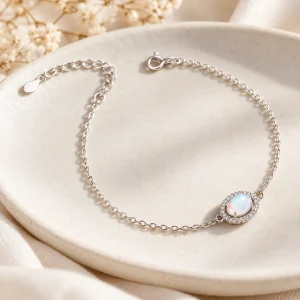
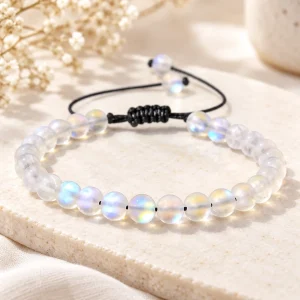
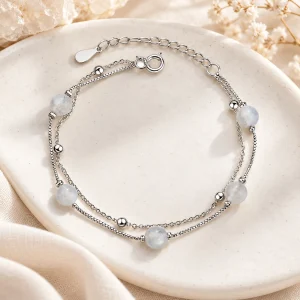
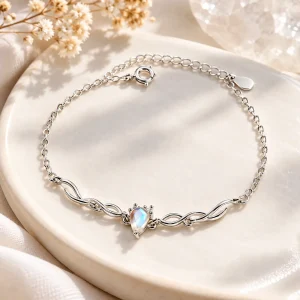
Bracelets, for wearing rather than placing
Frequently asked questions
Which chakra does moonstone correspond to?
Most often the third eye, sometimes the sacral chakra, more rarely the heart. Authors don't agree, and none of these three locations follows the system's own colour rule, which would place it at the throat or the crown.
Why is it placed at the sacral chakra when it's white?
Because in this specific case, the placement is made by theme rather than by colour: it rests on the modern association between the stone, the feminine and cycles. That association dates from the 1990s, making it the most recent of the justifications.
Are the chakra colours ancient?
No. The rainbow sequence, from red at the root to violet at the crown, comes from the book The Chakras by Charles Leadbeater, published in 1927. Ancient texts give other colours, and they don't form a spectrum.
How many chakras are there?
It depends on the text. The seven-centre model comes from the 1577 Ṣaṭ-cakra-nirūpaṇa, which describes six plus the crown, and it became established in the West after its 1919 translation. Other traditions describe a different number.
Should the stone be placed directly on skin?
Practitioners do both. From the stone's point of view, clothing is better: skin carries creams and sweat, and a feldspar with perfect cleavage has microfractures where everything settles in. If you place it directly on skin, wipe it with a soft cloth afterward.
Can jewellery be used for a session?
It's possible but not very practical: a setting creates a hard point against the skin and a bezel-set cabochon sits awkwardly flat. A tumbled stone or a small loose cabochon works better, and the jewellery stays what it is, jewellery.
How long does a session last?
Practitioners generally state ten to thirty minutes. Many people, in fact, don't do a formal session at all and simply hold the stone for a few minutes, which is the most common use.
Can several stones be placed at once?
Seven-stone layouts exist. Most authors recommend starting with just one, and it's also the wiser choice materially: every stone resting on a moving body is a possible fall onto a hard floor.
Can a chakra be blocked?
That's the common vocabulary of the field, and I don't use it. It borrows from medical language without having its substance, and a stone unblocks nothing. If something feels wrong, the answer is a healthcare professional.
Which moonstone should I choose for this use?
A tumbled stone or a bare cabochon, ideally with no visible crack or chip on the edge. The variety doesn't matter for the practice; for choosing yours, see the colours and varieties, and how to recognise a genuine stone.
Where to go next
- The general picture: the properties and benefits, the meaning, astrology and Cancer.
- The practice: getting started in crystal healing, pairings, ones to avoid, sleeping with moonstone.
- Caring for the stone: cleansing and recharging, the seven methods, water, fragility, cleaning a piece of jewellery.
- The stone itself: the colours and varieties, raw or cut, moonstone or labradorite.
- The full picture: the complete moonstone guide.
The jewellery is in the shop. I don't sell tumbled stones for now, and if you're looking for one for this use, I'll tell you honestly where to find one rather than sell you a piece of jewellery instead: write to me.
My sources
For the system's timeline: the Ṣaṭ-cakra-nirūpaṇa by Pūrṇānanda, 1577, which fixes the six-centre model plus the crown; The Serpent Power by Arthur Avalon, pen name of Sir John Woodroffe, 1919, which translates and spreads it in the West; and The Chakras by Charles W. Leadbeater, Theosophical Society, 1927, which introduces the rainbow colour attribution. This last point is acknowledged even by Theosophical publications themselves.
For the assignment of stones to the centres, the English-language crystal healing guides of the 1980s through 2000s, whose detailed dating is in the properties of moonstone.
For the stone: hardness 6 to 6.5 on the Mohs scale and perfect cleavage, according to the GIA and Mindat. The effects of oily residue and sweat on a feldspar polish are workshop observations, and I flag them as such rather than inventing a reference for them.
Two limitations I'd rather state. First, I don't give the lotus colours as described in the ancient texts: the translations I've consulted diverge on several centres, and manufacturing a clean table out of contradicting sources would have been more marketable than honest. What's established, and is enough for the argument, is that the rainbow sequence appears in none of them. Second, I don't practice this myself: the description of sessions comes from what practitioners and guides report, not from personal experience.
Last updated: August 19, 2026. If you find an error in this article, let me know: I'll correct it and note it.
✦ À porter, à offrir
Découvrez mes créations