


Description
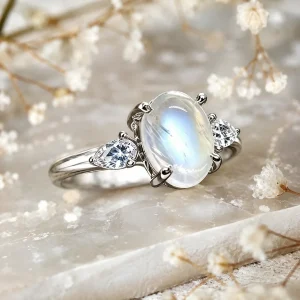
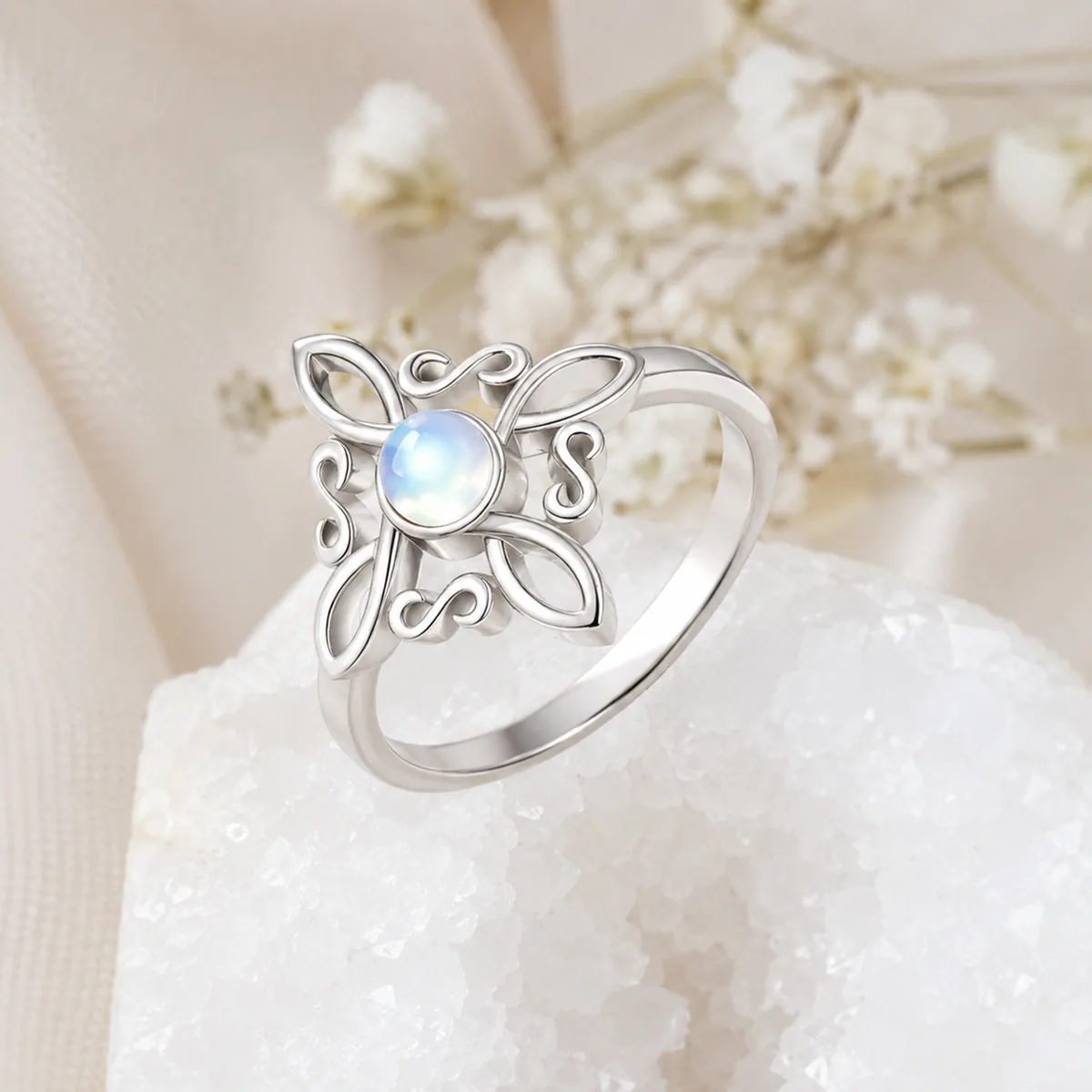
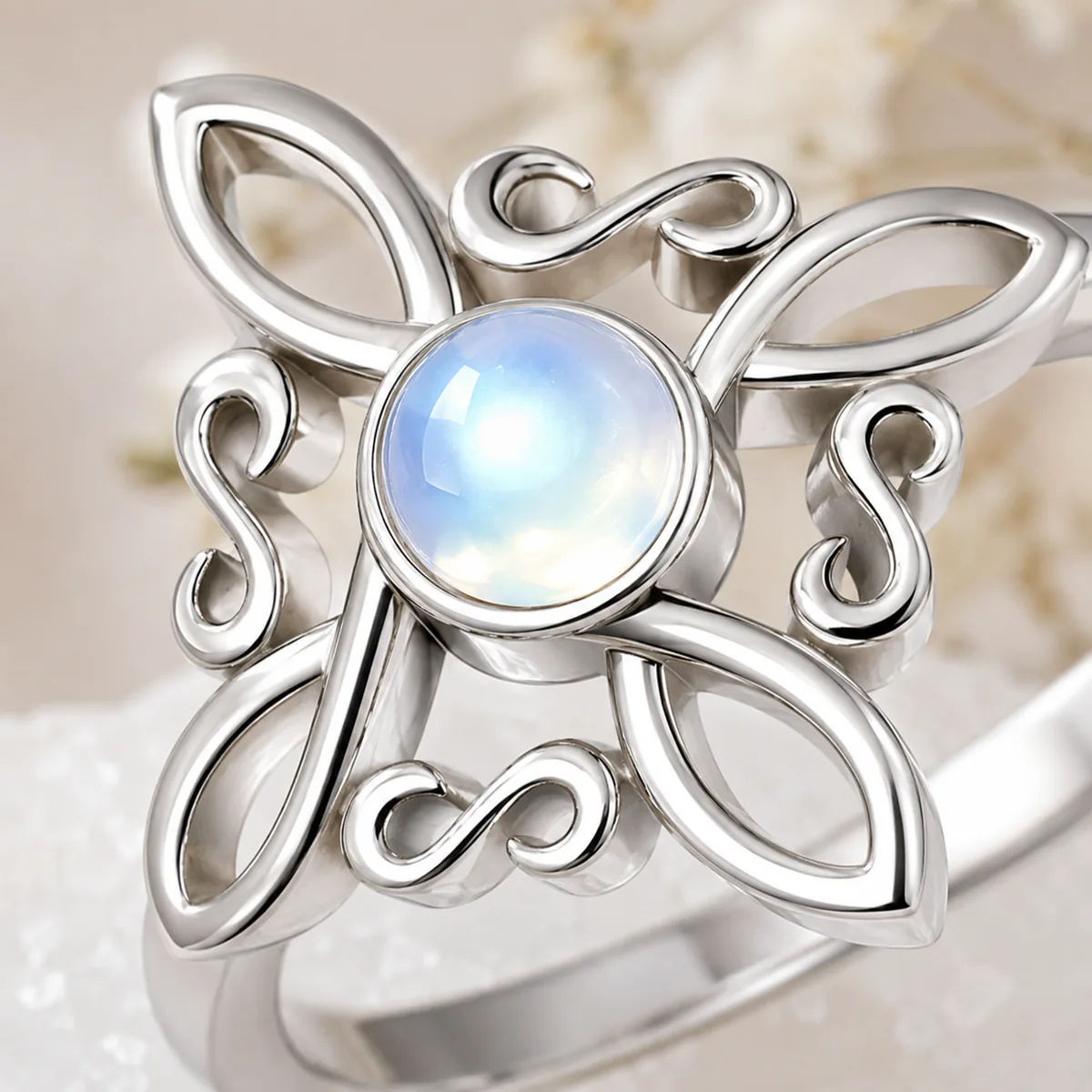
This is the coldest ring in the catalog, and that is the whole point. A white metal, almost blue under a northern light, an openwork motif of four petals joined by scrolls, and at the center a small round cabochon whose flashes run from blue to gold. It is the one you choose when you do not want an ounce of warmth in a piece of jewelry.
An openwork motif, a deliberately small stone
The setting is not a setting, it is a drawing. Four almond-shaped petals, pierced through, meet around the stone, and between them four S-shaped scrolls close the composition. Everything is hollowed out: light passes through the motif and lands on the finger below, which gives the ring its lightness despite its apparent width. It is the kind of piece that looks bigger in a photograph than on the hand.
The stone is small, and that is deliberate. On a mounting this drawn, a large cabochon would crush the motif and the openwork would no longer be visible. Here it serves as an anchor point at the center of the figure, in a plain bezel that adds no line of its own. It is exactly the reverse of the logic of the shop’s other rings, where the metal effaces itself behind the stone. They are all here, and if you hesitate about your size, the sizing guide will save you a return.
What you need to know about this metal
Here is what almost no shop writes down. White gold is not white. It is a yellow gold alloy whitened by another metal, and it comes out grey, slightly yellowish. What gives it its mirror brightness is a layer of rhodium deposited on top. That layer wears, as all layers do, and on a ring, which is to say on the most rubbed piece of all, it generally holds one to three years before the grey starts showing through on the edges. You then have it redone at a jeweler, a routine and inexpensive operation, but you need to know it exists. A white gold that yellows slightly after two years is not a failed white gold, it is white gold.
Two other reservations, while we are at it. The motif is pierced, so it catches: this is not the ring you wear to pull on gloves or rummage in a bag. And moonstone has perfect cleavage, it chips on impact without scratching for all that, even if on this one the small format and the closed bezel keep it rather well sheltered.
Sizes and what tradition lends this ring
Sizes run from 4½ to 10, and a ring bought a size too large is a ring that turns and offers its stone to every door frame. The sizing guide is here.
Crystal healing tradition makes moonstone a stone of cycles, of intuition and of the return to calm; it is said to accompany periods of change rather than to bring them about. I will go no further: none of it is demonstrated and no piece of jewelry heals anything. Separately, I have gathered what tradition lends it and what a moonstone ring is said to mean when it is given, in the conditional from start to finish.
- Rhodium-plated white gold, the coldest metal in the catalog. The rhodium is redone every one to three years.
- Openwork motif of four petals and four scrolls, entirely hollowed out.
- Small round moonstone cabochon in a plain bezel, at the center of the figure.
- Sizes 4½ to 10. Delivered in two weeks with a cotton pouch, a handwritten note and a care card.
The specifications
- Stone
- Moonstone, round cabochon cut
- Metal
- White gold, rhodium finish
- Setting
- Plain bezel setting, no glue
- Motif
- Four openwork petals and four scrolls
- Metal upkeep
- Rhodium plating to redo every one to three years
- Sizes
- 4½ to 10
- Gender
- Women
- Brand
- Melissa Moon
Why I would rather announce the rhodium plating than keep quiet about it
Because it is the first disappointment of white gold buyers, and it always arrives at the same moment: between one and three years, when an edge starts pulling toward grey. People then believe they were sold something fake. Nothing false was sold to them, someone simply forgot to tell them how the metal they bought works. Three lines on a product page would have been enough, and those three lines cost nothing.
It is the same rule as for gold plating, which is not gold, and for rainbow, which is not adularia. None of these clarifications makes me sell more. They only prevent you from learning it elsewhere. The rest of the shop is here, including what I took out of the catalog.
A metal that ages is not a fault. A metal nobody said would age, that is.
No salt, no ultrasonic tank, no hot water: moonstone is a feldspar, and all three damage it for good. For the metal, the rule is stricter still: no paste, no polishing cloth, no silver product. These products are abrasive and the rhodium is only a few microns thick: they remove it instead of reviving it. Lukewarm water, a soft dry cloth, and take the ring off before the pool, since chlorine attacks rhodium plating faster than anything else. The detail is in cleaning a moonstone piece, and the safe methods for the stone in caring for it without harming it.