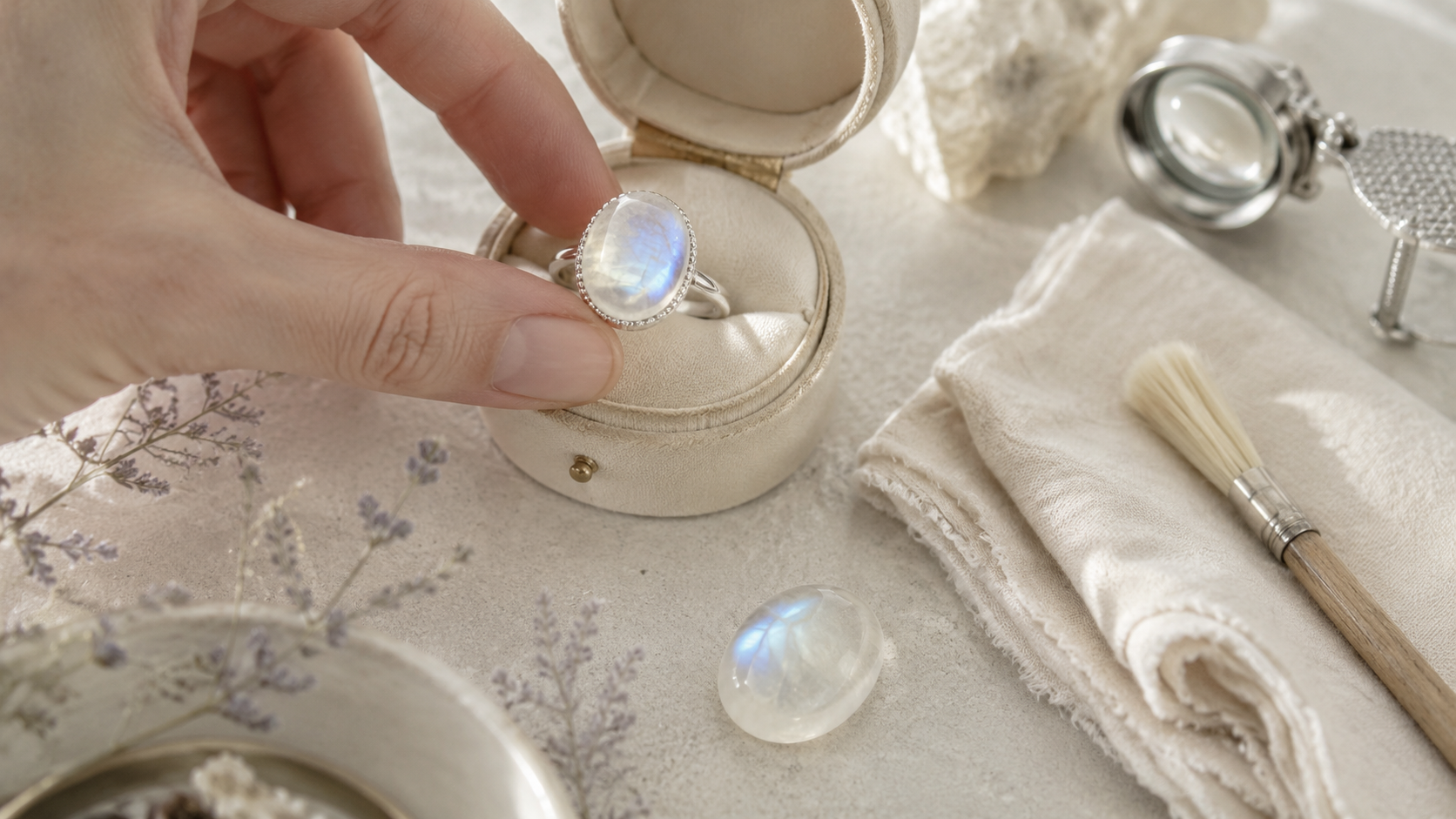
How Durable Is Moonstone?
Yes, it's fragile, but not for the reason people think. Its hardness is fine, 6 to 6.5 on the Mohs scale, about the same as an opal. What makes it fragile is its cleavage: it doesn't scratch, it splits clean. Here is the difference between the two, where accidents actually happen, and how to live with it without locking it away.
This is the property behind everything else on this site: the ban on ultrasonic cleaners, the choice of a closed bezel, the advice to take a ring off for sports. It all starts here, and almost no one explains it correctly. The full mineral profile is in moonstone properties; here, just one question.
The essentials, if you're in a hurry
- Yes, it's fragile, but hardness has almost nothing to do with it. 6 to 6.5 on the Mohs scale is perfectly fine.
- The right word is cleavage. The GIA gives it two cleavage directions and low toughness.
- Hardness and toughness are two different things. One measures scratch resistance, the other resistance to breaking.
- It doesn't wear down, it breaks all at once. A single impact is enough, and there's no warning sign.
- The break is clean, sharp, with a crisp edge. It can't be glued back and it can't be re-polished away.
- Almost all accidents happen at home: the sink, the door handle, the jewellery box, the tiled floor.
- A closed bezel changes a lot, and it's the only real protection you can buy.
The answer, and the misconception it corrects
Yes, moonstone is fragile. But if you're looking for why and you land on "because it's only 6.5 on the Mohs scale," you've been given the wrong reason.
6 to 6.5 isn't soft. It's harder than opal, turquoise, malachite, fluorite, apatite, selenite, amber, pearl and coral. It's roughly the level of the softest garnet, and not far from quartz. Moonstone doesn't scratch easily.
And yet it breaks. Regularly, cleanly, often on the very first real impact. That's where the confusion comes from: two properties that have nothing to do with each other get mixed up, and one of the two isn't on the Mohs scale at all.
The rest of this page explains the difference, then draws out every practical consequence. This is probably the single most useful article on the site for anyone who just bought a ring.
Three properties mistaken for one
In gemmology, "solid" isn't a property. There are three, they're measured separately, and a stone can excel at one and be poor at another.
| Property | What it measures | Moonstone |
|---|---|---|
| Hardness | Resistance to scratching | Fine |
| Toughness | Resistance to breaking and impact | Low |
| Stability | Resistance to heat and chemicals | Moderate |
Hardness answers one question: does it scratch? That's the Mohs scale, from 1 for talc to 10 for diamond, and it's the only one of the three that everyone knows.
Toughness answers an entirely different question: does it break? The GIA rates it low for moonstone. It isn't measured on a mainstream numbered scale, which partly explains why no one talks about it.
Stability covers resistance to heat, light and chemicals. For this stone, heat is the issue, and that's the subject of can moonstone go in water.
Diamond is the best example to understand the gap: 10 on Mohs, the hardest natural substance there is, and yet it has cleavage, and a cutter can split it with one well-placed tap. Hard doesn't mean unbreakable, for any stone.
What the Mohs scale doesn't measure
A word on this scale, because it's everywhere and people make it say far too much.
It was built for one thing only: to know which mineral scratches which other one. It's a comparative ranking, not a measurement. It isn't even linear: the gap between 9, corundum, and 10, diamond, is far larger than all the previous gaps combined.
What it doesn't tell you, and which matters at least as much for a piece of jewellery: impact resistance, the presence of cleavage planes, sensitivity to heat, porosity, solubility. Five properties absent from a single number that everyone quotes as if it summed up a stone's solidity.
Hardness stays useful, and for one specific reason: household dust contains quartz, at 7 on Mohs. Anything below 7 scratches slowly, through simple friction, from being wiped with a dusty cloth or stored in a pile. That's a genuine hardness argument, and it holds for moonstone.
The two planes of weakness
Here is the property that explains everything else, and the GIA states it very clearly.
Moonstone has two cleavage directions, which it shares with the entire feldspar family. Cleavage is an atomic direction of weakness: the crystal is less strongly bonded there, and it separates cleanly along it under stress.
Two directions means two families of planes, roughly perpendicular to each other, running clean through the stone. These aren't flaws, they aren't cracks: they're the mineral's very structure. A perfectly pure, inclusion-free moonstone has exactly the same planes as a mediocre one.
What that changes day to day. A stone without cleavage absorbs an impact by chipping slightly, at worst. A stone with cleavage absorbs the same impact by separating along an entire plane, all at once. There's no intermediate damage, no warning, no crack that gives notice.
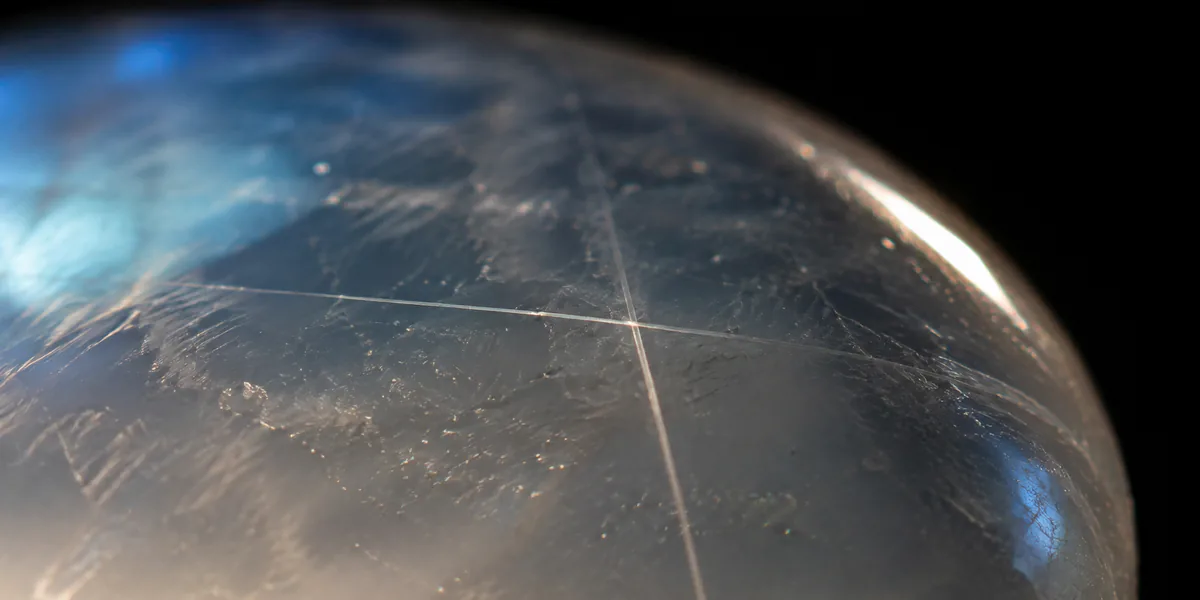
That's also why ultrasonic cleaners are off-limits: the vibrations travel along these planes and open up what was still closed. The detail is in cleansing and charging your moonstone.
Where it actually stands
A table beats a paragraph. I put together the stones most commonly seen in jewellery, with both properties side by side.
| Stone | Mohs hardness | Toughness |
|---|---|---|
| Diamond | 10 | Good, but cleavage |
| Sapphire, ruby | 9 | Excellent |
| Quartz, amethyst | 7 | Good |
| Garnet | 6.5 to 7.5 | Fine |
| Moonstone | 6 to 6.5 | Low |
| Labradorite | 6 to 6.5 | Low |
| Opal | 5.5 to 6.5 | Very low |
| Turquoise | 5 to 6 | Variable |
| Malachite | 3.5 to 4 | Low |
Read both columns together and the point becomes obvious. Moonstone is harder than opal and turquoise, and just barely softer than garnet. But on the right-hand column, it joins the weak students.
The most telling comparison is still with garnet: half a point of difference on Mohs, and a considerable difference in behavior in a ring worn every day. The number predicts nothing.
How it breaks, concretely
Three forms of damage, in order of severity, and it's worth knowing how to tell them apart because they don't have the same fix.
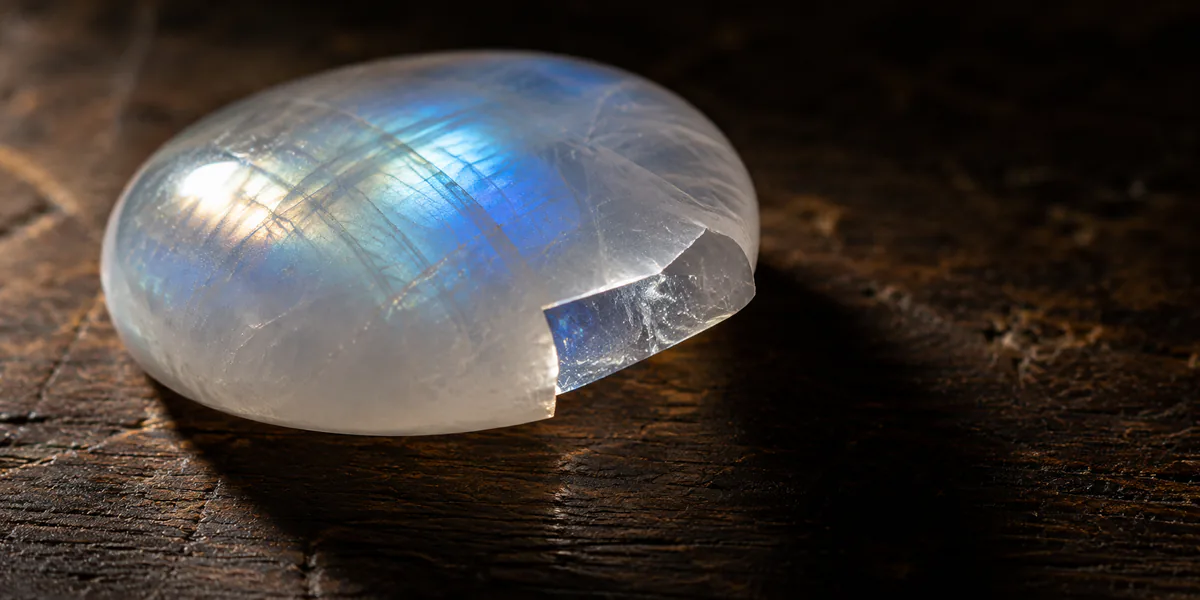
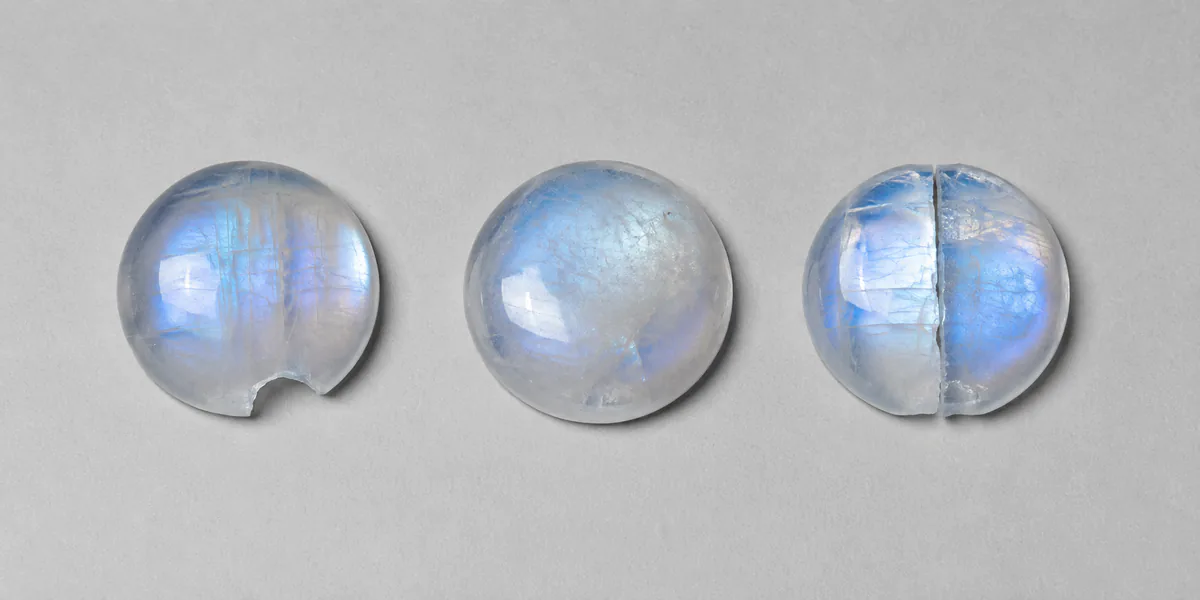
An edge chip. The most common one. A small piece comes off around the edge of the cabochon, often right at the join with the setting. The break is clean and leaves a sharp edge. On a closed bezel, the metal sometimes hides the damage; on prongs, it shows immediately. A lapidary can sometimes re-polish a chipped cabochon by shrinking it, which means unmounting it and resetting it.
An internal haze. A cleavage plane has opened up inside without anything breaking off. The stone looks milky in places, a matte whiteness that doesn't move when you tilt it, unlike adularescence. It's irreversible and can't be fixed. It's the typical result of an ultrasonic cleaner or a thermal shock.
A clean split. The stone splits in two along a plane. It's rare, it's dramatic, and there's nothing to be done. Usually an impact on an edge, or a fall onto tile.
One point of honesty: none of these three types of damage come from wear. Moonstone doesn't fatigue, it doesn't wear down, it doesn't become more fragile with time. It's exactly as solid after twenty years as it was on day one, and it breaks over a single event.
Where accidents actually happen
This is the part I can document best, because it comes from the messages I get. It doesn't look at all like what people imagine.
People picture the stone breaking on a hike or during a move. In reality, almost all accidents happen at home, during ordinary movements.
- The sink. A ring taken off a soapy hand, over a hard ceramic basin. By far the number one on the list.
- The door handle and furniture edges. A hand moves quickly, the ring knocks against a metal corner. A sideways impact on a stone is the worst kind of all.
- The jewellery box. Not a break, but scratches, happening overnight against harder pieces. The fix is one pouch per piece.
- Tiled floors. A foot is enough. A fall onto hardwood or carpet generally does nothing.
- Sports and gardening. The only ones on the list that everyone already thinks about, and they come last precisely because people think about them.
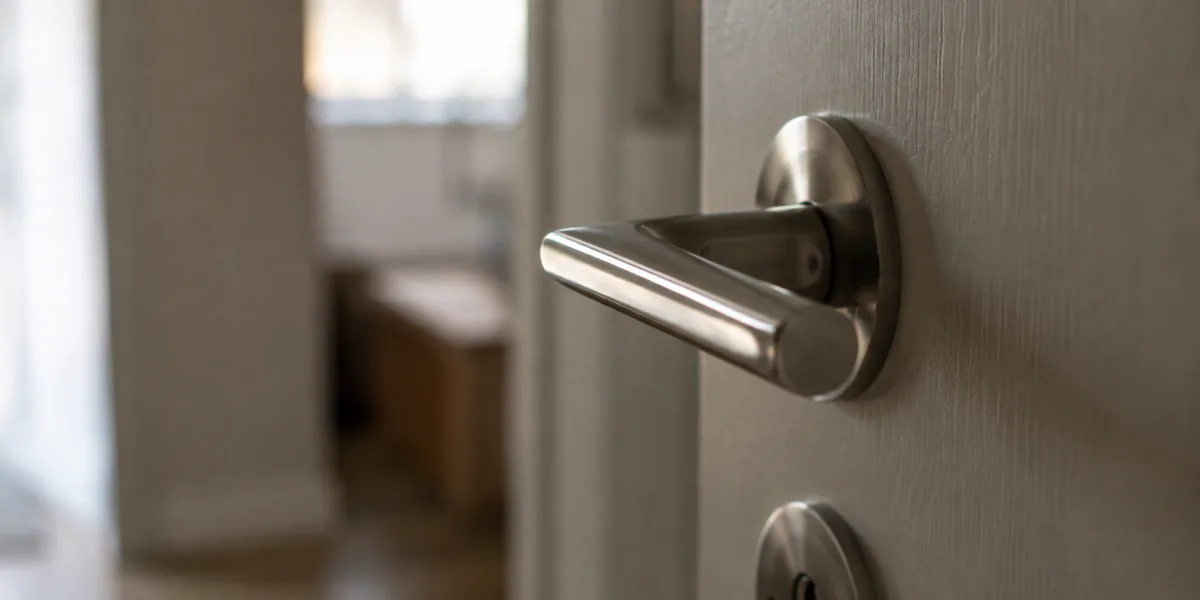
This ranking has one nice consequence: the moves that protect the most are domestic and free. A little dish on the bathroom shelf, a towel at the bottom of the sink, one pouch per piece of jewellery. Nothing to buy.
What the setting changes
It's the only real protection you can buy, and it's decided the moment you choose the piece.
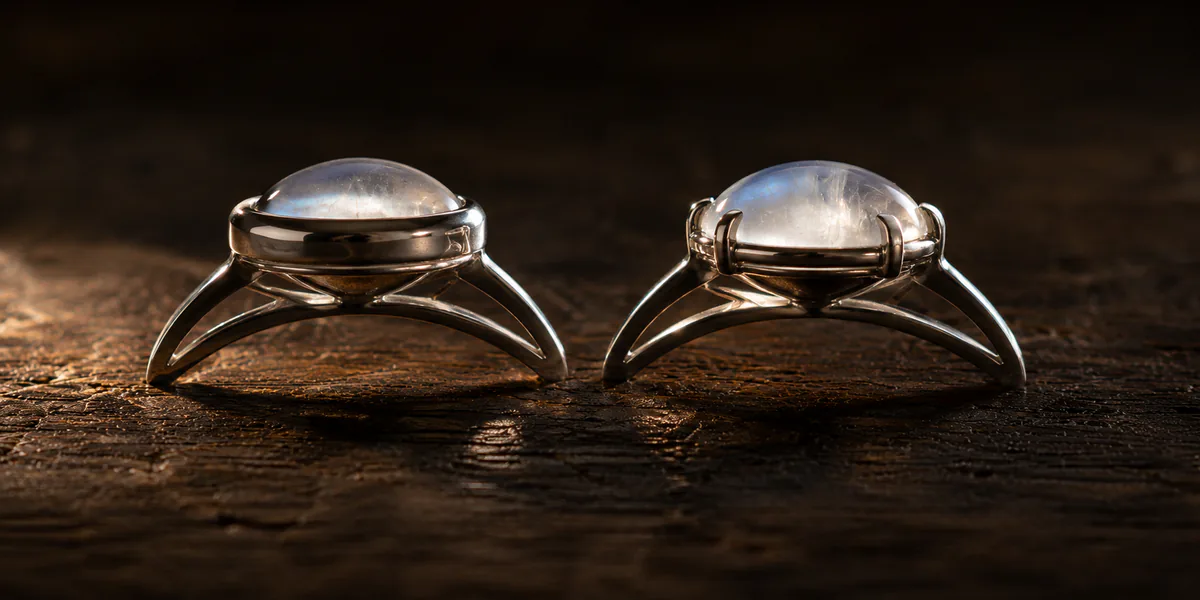
A closed bezel surrounds the stone with a continuous rim of metal. On a stone with cleavage, this isn't a matter of style: the metal absorbs sideways impacts instead of the stone, and it protects the edge, which is the most exposed zone. That's why I mount most of my rings this way, and the topic is developed in closed bezel or prongs.
Prongs show off the stone better, let in more light and expose it more. They also have a flaw of their own: they catch on clothing and hair, and a snag applies exactly the kind of force that works a cleavage plane.
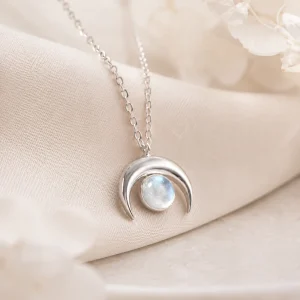
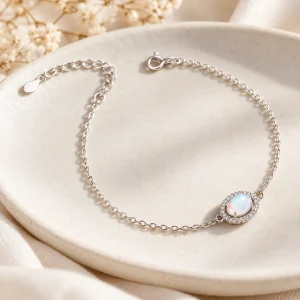
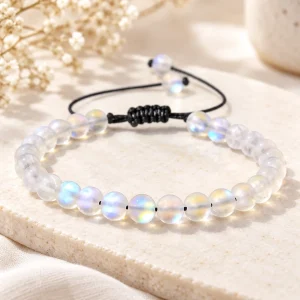
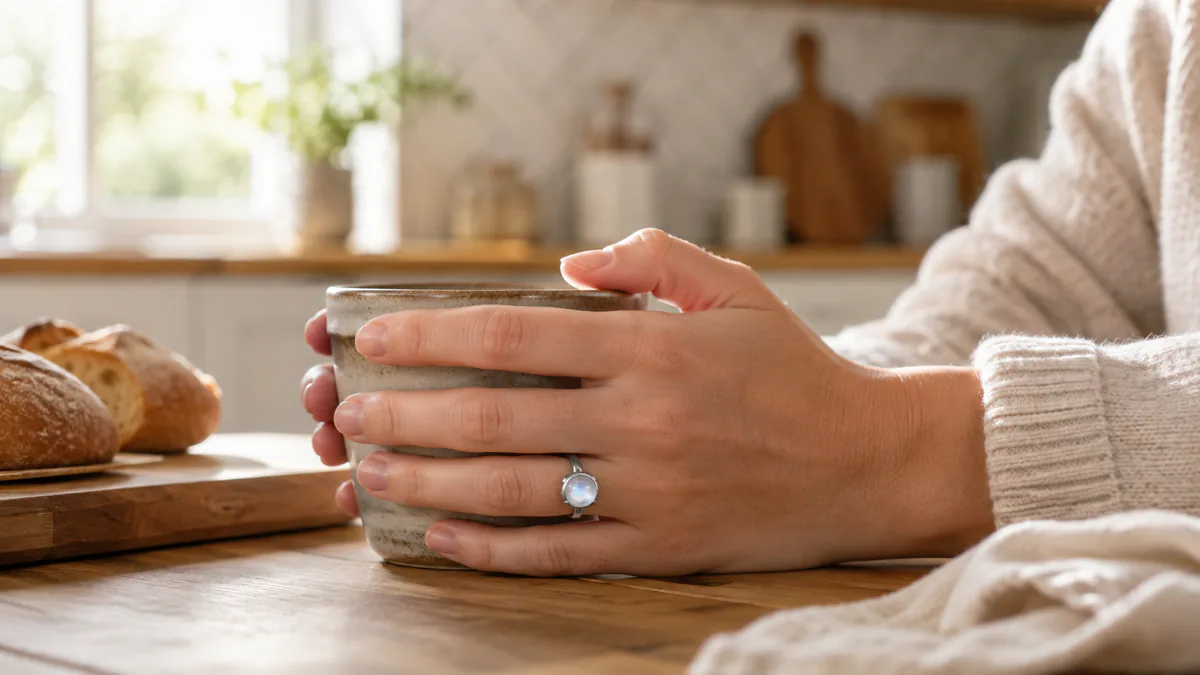
The type of jewellery matters as much as the setting. The hand is the part of the body that bumps into things: a ring is the most exposed piece, a bracelet noticeably less so, a pendant almost not at all. If you're torn on a gift and the person has an active lifestyle, a pendant is the safe choice. The detail is in how to wear moonstone.
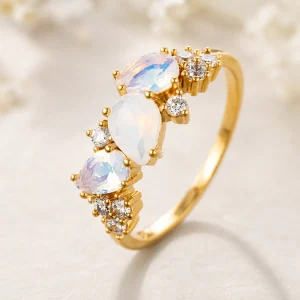
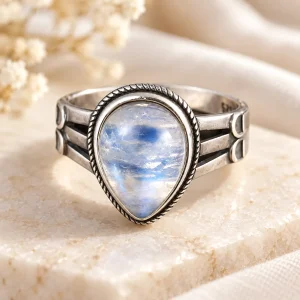
The workshop's rings, mostly set in closed bezels




Living with it, without locking it away
This entire page could make you want to never wear the stone, and that would be bad advice. Here's the reasonable version.
A moonstone can be worn every day, provided you accept two habits. First: take it off for sports, cleaning, gardening and dishwashing. Second: don't store it in a pile.
These two habits cover most of the risk, and they take about a week to become automatic. The rest is a matter of statistics, and I don't know anyone who has broken a stone while working at a computer or reading.
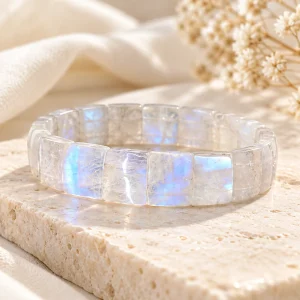
The bracelets, the setting least exposed to impact
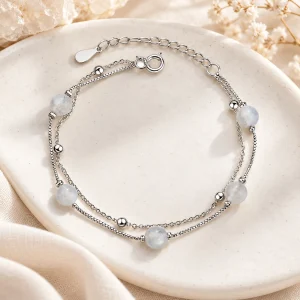
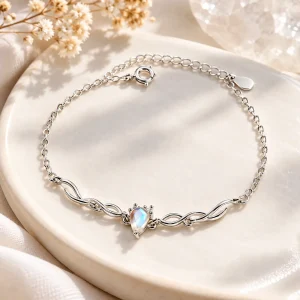
What I tell anyone hesitating over a purchase: this stone asks for the same care as an opal or a pearl. No one gives up a pearl necklace because it has to come off before a shower. It's the same level of upkeep, and it's not a dealbreaker.
And if it breaks? Send me a photo. On an edge chip, there's sometimes something to be done, by unmounting it and re-polishing it smaller. On an internal haze or a clean split, I'll tell you honestly: there's nothing to be done, and resetting a new stone into the existing setting is often the best option.
Frequently asked questions
Is moonstone fragile?
Yes, but because of its cleavage, not its hardness. It's 6 to 6.5 on the Mohs scale, which is fine, and the GIA gives it low toughness and two cleavage directions. It doesn't scratch easily, it splits cleanly under impact.
What's the difference between hardness and toughness?
Hardness measures resistance to scratching, toughness measures resistance to breaking. These are two independent properties: diamond is the hardest of all and yet has cleavage that a cutter exploits to split it.
Can you wear a moonstone ring every day?
Yes, by taking it off for sports, cleaning, gardening and dishwashing, and storing it alone in a pouch. It's the same level of upkeep as a pearl necklace or an opal.
Does moonstone wear down over time?
No. It's exactly as solid after twenty years as it was on day one. It doesn't fatigue and doesn't become more fragile: it breaks over a single event, with no warning sign.
My stone turned milky on the inside, what happened?
A cleavage plane opened up. The haze is a matte white and doesn't move when you tilt the stone, unlike adularescence. The two usual causes are an ultrasonic cleaner and thermal shock. It's irreversible.
Can an edge chip be repaired?
Sometimes. A lapidary can re-polish the cabochon by shrinking it slightly, which means unmounting and remounting it, and so a cost that often exceeds the value of the stone. A new stone on the existing setting is frequently the more reasonable option.
Does a closed bezel actually protect the stone?
Yes, and it's the only protection you can buy. The continuous rim of metal absorbs sideways impacts instead of the stone and protects the edge, which is the most exposed zone. Prongs expose it more and catch on things.
Where do stones break most often?
At home, during ordinary movements. The sink comes in well ahead, then door handles and furniture corners, then tiled floors. Sports and gardening come last, because everyone already thinks of those.
Is it more fragile than labradorite?
No, exactly the same. They're both feldspars, same hardness of 6 to 6.5 and same cleavage. Which means rainbow moonstone and black moonstone, which are labradorites, carry the same constraints as the white variety.
Is it suitable for an engagement ring?
It's a beautiful symbolic idea and a risky stone for a piece worn every day for forty years. I've written out what to weigh in moonstone engagement rings, without trying to sell you the one in the catalog.
Where to go from here
- The stone in detail: the complete mineral profile, adularescence, moonstone or labradorite.
- The care that follows: cleansing and charging without damaging it, cleaning jewellery, the question of water.
- Choosing accordingly: closed bezel or prongs, how to wear it, the engagement ring question, the six quality criteria.
- The full picture: the complete moonstone guide.
The jewellery is in the shop. And if you've broken a stone, send me a photo: I'll tell you whether there's anything to be done, including when the answer is no.
My sources
For the properties: the Moonstone Care and Cleaning sheet from the GIA, which places the stone between 6 and 6.5 on the Mohs scale, gives it low toughness and recognises two cleavage directions, common to the feldspar family, specifying that cleavage is an atomic direction of weakness that makes a crystal more prone to breaking.
For the compared hardnesses in the table, Mindat and standard gemmological references. For diamond's cleavage, it's a classic property that cutters have exploited for centuries.
For the note on household dust, the presence of quartz at 7 on the Mohs scale in dust is the reason commonly given in conservation for why materials below 7 scratch through simple dusting.
Two limitations I'll flag. The ranking of accident locations comes solely from the messages I receive: it's a field observation on a modest sample, not a statistic, and I present it for what it's worth. And the toughness column in the comparison table uses qualifiers rather than numbers, because this property doesn't have a mainstream numbered scale equivalent to Mohs: that's precisely why it's so rarely mentioned.
Last updated: August 19, 2026. If you spot an error in this article, let me know: I'll fix it and note it.
✦ À porter, à offrir
Découvrez mes créations