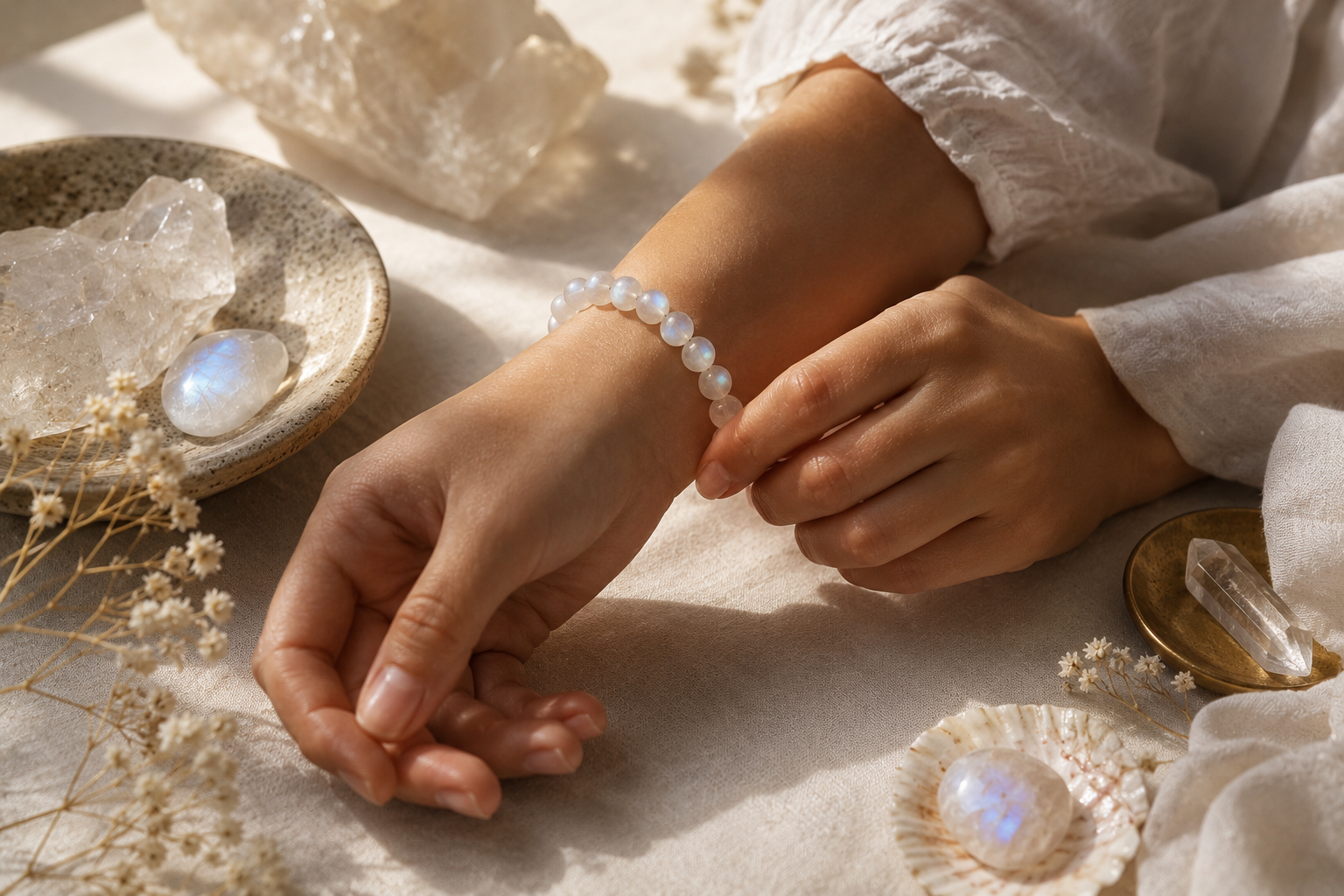
Which Wrist to Wear a Moonstone Bracelet On
Tradition says the left wrist, the side it calls receptive. Mechanics say the least active wrist. For most people, both answers land in the same place, and for left-handed people they contradict each other. Here's where each answer comes from, which one I favor, and the detail nobody mentions: the watch.
This is the question I get asked most, even before the price. It deserves better than a "left" copied from site to site, because the answer depends on what you expect from the bracelet and which hand you use most.
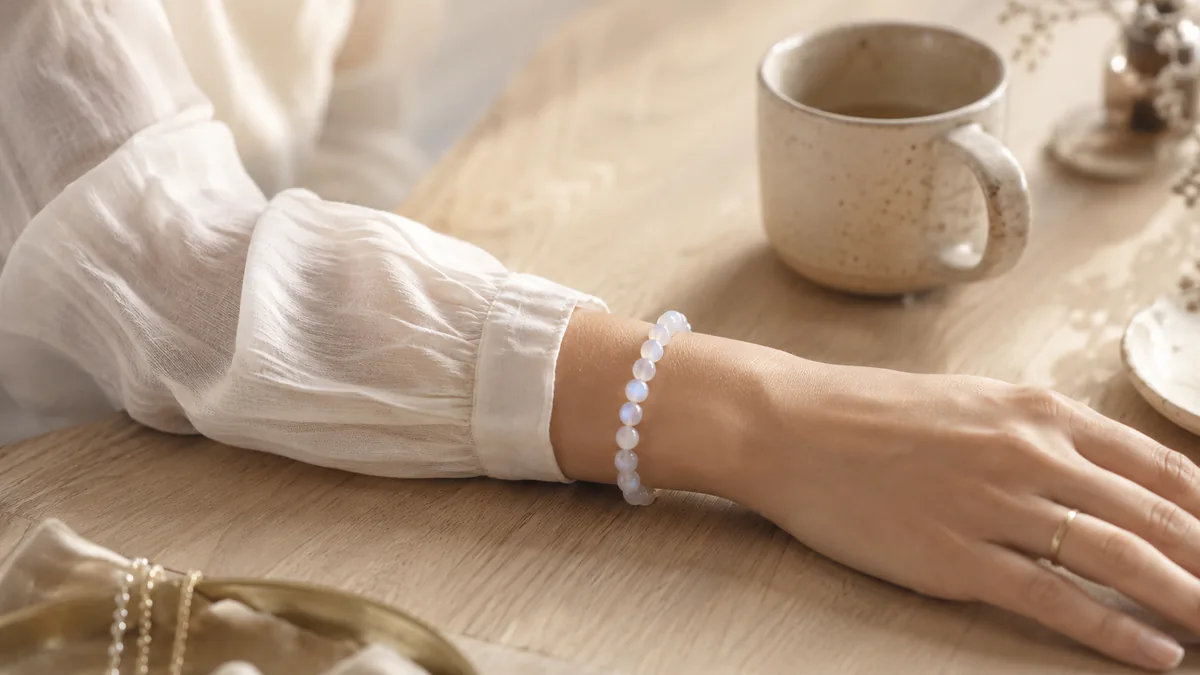
The essentials, if you're in a hurry
- Tradition says left, the side it calls receptive, the one that welcomes rather than the one that acts.
- Mechanics say the least active wrist, which is the left one for a right-handed person. The two answers agree nine times out of ten.
- For a left-handed person, they diverge: tradition still says left, mechanics say right. It's up to you to decide which matters more.
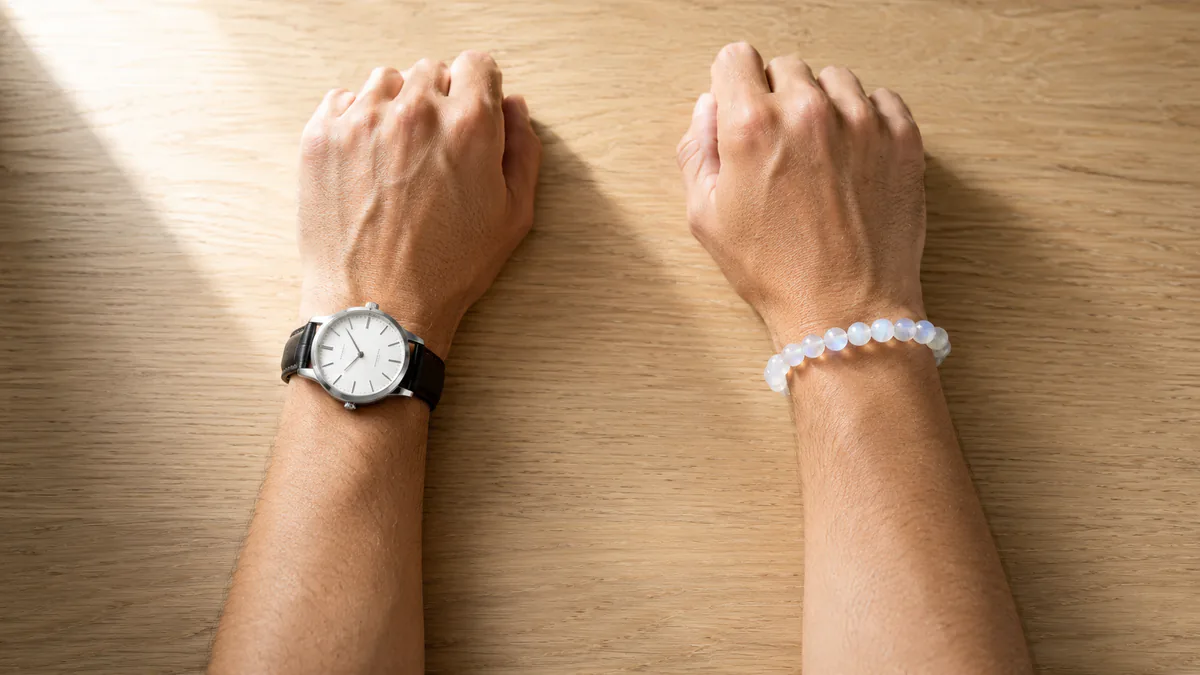
- The real issue is the watch. A watch crystal is harder than moonstone. Never wear both on the same wrist.
- Don't stack it with quartz, amethyst, or garnet without a spacer: those stones are harder and will scratch it.
- The meaning fits in three words: softness, intuition, new beginnings. These are recent traditions, not ancient knowledge.
- The bracelet is the second most exposed family after the ring, but a distant second.
Two answers, and they don't say the same thing
When you look up which wrist to wear a moonstone bracelet on, you run into a single, confident answer: the left. It isn't wrong, it's incomplete, because it blends two lines of reasoning that have nothing to do with each other.
The first is symbolic. It rests on a divide between a side that receives and a side that acts, and it doesn't care whether you carry your bags on your right shoulder.
The second is mechanical. It only cares about where the stone will take the fewest impacts, and it doesn't care what tradition thinks.
These two answers line up for most people, which is why nobody bothers telling them apart. They split as soon as you're left-handed, or as soon as you wear a watch.
The left wrist, the side called receptive
Here's the symbolic version, as crystal healing frames it.
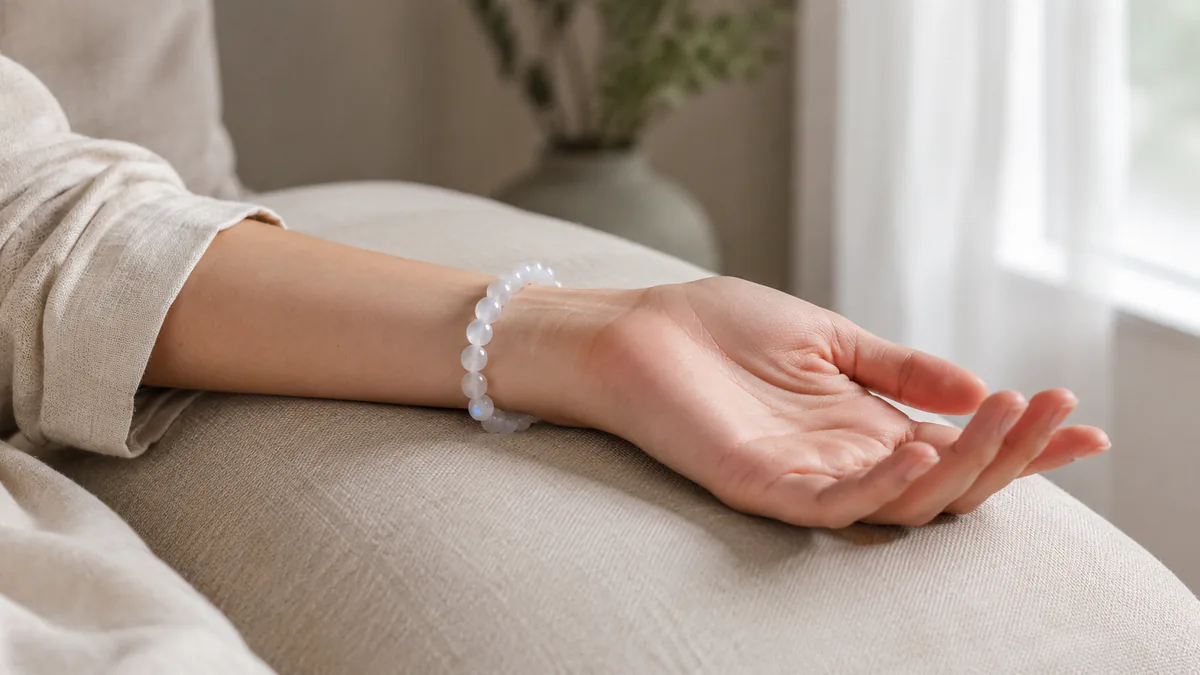
The left side is presented as the receptive side: the one that welcomes, that receives, that lets in. The right side would be the active side: the one that gives, that acts, that carries out. A stone you expect to soothe or accompany you would therefore be worn on the left, the side that receives.
Moonstone falls squarely into that category. It's credited with a role of softness and intuition, not impulse or action, which places it on the left across almost every source.
One clarification: this divide has nothing to do with being right- or left-handed. In the symbolic logic, the left side stays the receptive side for everyone, no matter which hand they use.
When tradition says right
It does say that, but not for this stone, and it's worth knowing so you don't apply the wrong rule.
By the same logic, so-called action stones, the ones expected to bring momentum, protection, or assertiveness, would be worn on the right, the side that gives. Red and dark stones are usually filed under that heading in the charts that circulate.
Moonstone isn't one of them. No common source places it on the active side, and the whole body of sources puts it on the left. On this specific point, tradition is unusually consistent with itself, which isn't all that common.
There's a purely practical exception: if your left wrist is already taken up by a watch or a hard-stone bracelet, the least bad solution is to switch to the right. A symbolic principle doesn't undo a scratched cabochon.
Since when has this been said
Since this site has made it a rule to date what it reports, might as well do it here.
The divide between a receptive side and an active side isn't an ancient mineralogical tradition. It spread with modern crystal healing, starting in the 1970s and 1980s, borrowing from older systems the idea of a polarity between the two sides of the body. It then froze into place with the internet, where it gets copied identically from one page to the next.
That doesn't make it nonsense. A recent convention is still a convention, and it can usefully structure a gesture. It just means no ancient text is waiting to tell you which wrist to put your bracelet on, and you're free to go with the mechanical answer without betraying anything.
The same dating work is done in moonstone myths and legends.
The mechanical answer, the one I favor
Here's my take, and it comes from what I see coming back to the workshop.
Wear the bracelet on the least active wrist. For a right-handed person, that's the left. It's the one that rests on tables less, carries bags less, and bumps into doorframes and desk edges less often.
The reason is in the stone. Moonstone sits at 6 to 6.5 on the Mohs scale, which is decent, but above all it has perfect cleavage: it splits cleanly on impact, along internal planes. On a bracelet, the impacts don't come from an accident, they come from repetition, a hundred times a day, from a wrist resting on a work surface.
That's also why the bracelet remains a good jewellery family for this stone. It ranks right after the ring in the risk order, but a distant second: a ring takes head-on impacts, a bracelet mostly takes friction. The full ranking is in how to wear moonstone.
Left-handed people, and the case where you have to decide
This is the only case where the two answers flatly contradict each other, and where you have to choose.
For a left-handed person, tradition still says left, since it doesn't account for dominant hand. Mechanics say right, since that's the least-used wrist.
My position is known: I recommend the right, because a broken bracelet serves no function at all, symbolic included. But I fully understand the other choice, and there's nothing to prove against someone who values the receptive side.
A middle-ground solution exists and works well: wear the bracelet on the left outside of risky activities, and take it off for cooking, DIY, gardening, or sports. That's what most people who keep their pieces for a long time end up doing.
The real issue: the watch
Here's the point I put at the centre of this page, because it damages more bracelets than the choice of side ever does.
A watch crystal is harder than moonstone. Mineral crystals sit around 6 to 7 on the Mohs scale, and sapphire crystals go up to 9. Add a steel case and a link bracelet, and you have, on the same wrist, an object that scratches and an object that gets scratched.
The mechanism is mundane and relentless: the watch and the bracelet slide against each other with every movement of the arm, hundreds of times a day. After a few months, the sheen on the beads facing the watch fades. Not because the stone is bad, but because adularescence reads through the polished surface: a micro-scratched surface no longer lets it through.
The rule is simple: never the watch and moonstone on the same wrist. If your watch is on the left and you're right-handed, then the bracelet goes on the right, and so much for the receptive side. It's the one case where I unhesitatingly recommend setting tradition aside.
Moonstone bracelet: what it means
The question of the wrist always leads to another one: what is a moonstone bracelet supposed to mean. Here's what tradition reports, framed conditionally, and what you can take from it without believing any of it.
Three words come up everywhere. Softness, understood as calming sharp reactions. Intuition, the ability to sense before reasoning. And new beginnings, by analogy with the phases of the moon, which wane and always come back.
The bracelet has one feature that sets it apart from other jewellery: it's the one you see yourself. A ring gets looked at, a pendant disappears under a collar, earrings are never seen by the person wearing them. A bracelet stays in your field of view all day, which makes it, in practice, more of a reminder object than a decorative one.
That, in fact, is the only meaning I stand behind without reservation, because it doesn't require any belief: an object you see a hundred times a day reminds you of what you decided when you bought it. What the stone adds to that is up to each person.

The general meaning of the stone is covered in the meaning of moonstone, and the ring is covered in moonstone ring.
These correspondences fall under crystal healing, an approach based on traditions and beliefs. They are not a medical claim and never replace the advice of a healthcare professional. Read the full disclaimer.
Stacking it with other bracelets
Stacking is trendy and it's the second leading cause of dulled beads, right after the watch. The principle is the same: whatever is harder scratches whatever is softer.
| Neighboring material | Hardness (Mohs) | Effect |
|---|---|---|
| Sapphire watch crystal | 9 | Scratches outright |
| Garnet | 7 to 7.5 | Scratches |
| Quartz, amethyst, rose quartz | 7 | Scratches |
| Labradorite | 6 to 6.5 | Neutral, same hardness |
| Lapis lazuli, turquoise, hematite | 5 to 6 | Safe |
| Silver, gold | 2.5 to 3 | Safe |
| Cultured pearl | 2.5 to 4 | Safe, but it's at risk from everything else |
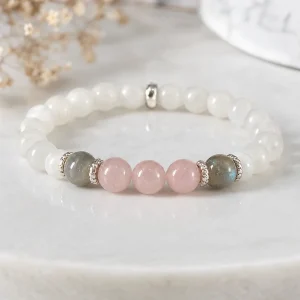
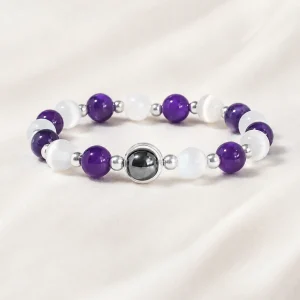
That doesn't mean you should never mix them. It means you put something in between. On my multi-stone bracelets, small silver spacers sit exactly where the different hardnesses meet: rose quartz never touches moonstone directly, a soft metal comes between them.
If you're stacking your own bracelets, apply the same principle: a smooth metal bangle between two rows of stones, or keep them on separate wrists. Pairings are detailed in which stone to pair with moonstone and the ones that clash.
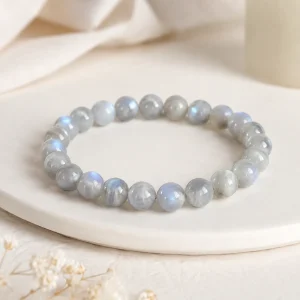
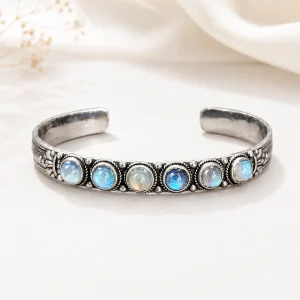
The multi-stone bracelets, and where the spacers sit
Elastic, bangle, or clasp
The build changes how a bracelet behaves on the wrist more than you'd think.
Elastic cord is the simplest: it slips on with one hand, it covers wrist sizes from 5.5 to 8 inches, and it has no wear parts. Its one flaw is well known: elastic fatigues over time. Take it off by rolling it rather than pulling on it, and restring it every two or three years.
A rigid bangle is the safest option for the stones. It has no elastic and no clasp, so nothing that can fail, and it's sized once and for all. In return, it doesn't flex: it needs to have the right opening from the start.
A clasp offers the best hold but adds a moving part, so a point of failure, and a metal lobster clasp that sometimes knocks against the beads. If you choose one, check that it sits on the underside of the wrist rather than on top.
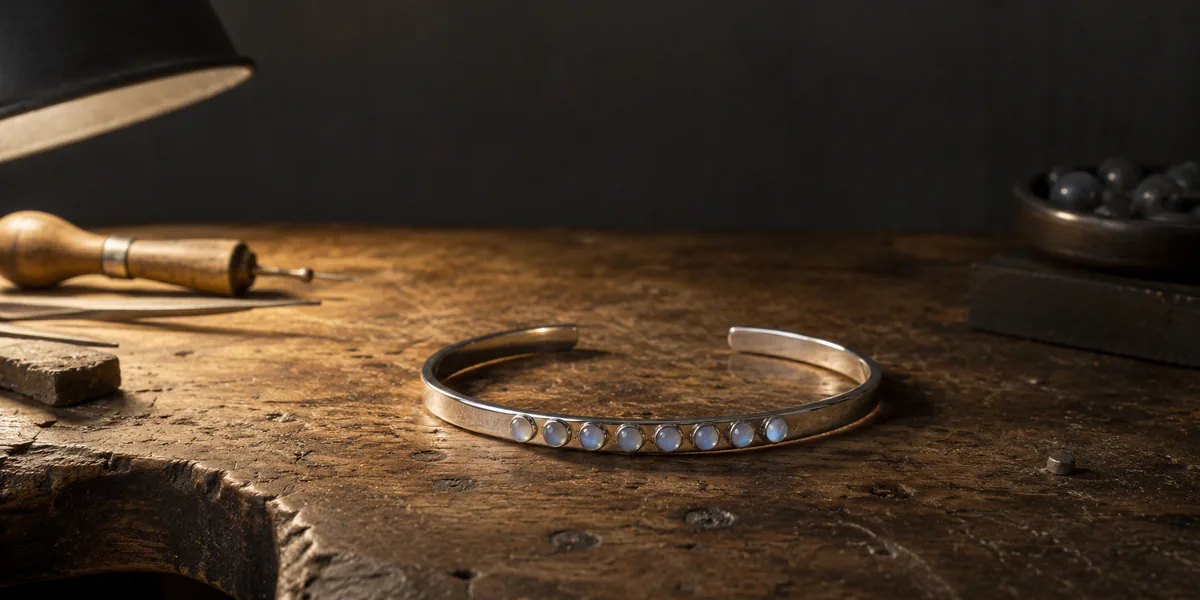
What damages a bracelet on the wrist
Four habits, and they handle the essentials.
Take it off before water. Shower, pool, sea. Hot water creates thermal shock, chlorine and salt settle into microfractures, and soap dulls the polish between the beads.
Take it off before exercise. Weightlifting, ball sports, carrying loads. A bracelet caught between a bar and a wrist takes exactly the kind of pressure that opens a cleavage plane.
Put it on last. After lotion, perfume, and hairspray. Alcohols and oils settle between the beads and dull the surface, which kills the sheen since it reads through it.
Store it alone. An individual pouch, not the bottom of a drawer with other bracelets. That's where half the scratches happen, entirely outside any day of actual wear. Cleaning is covered in how to clean moonstone jewellery.
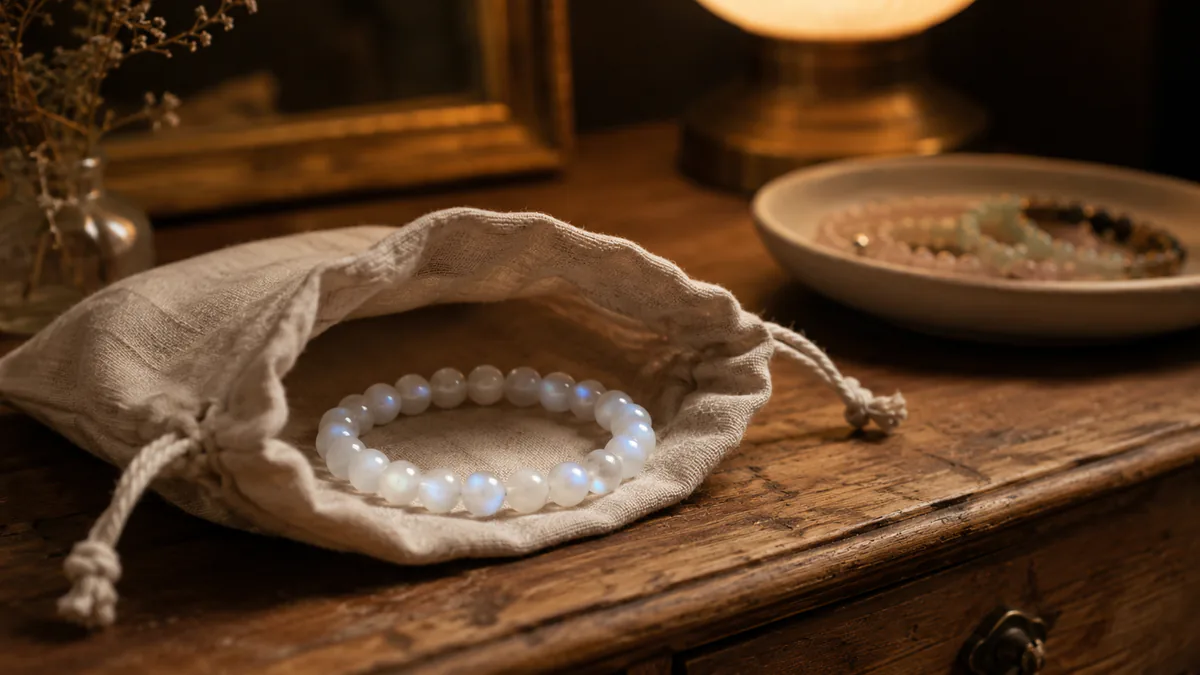
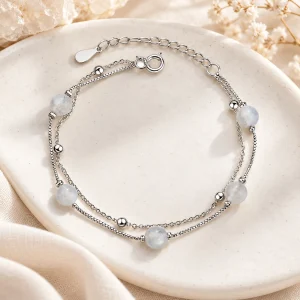
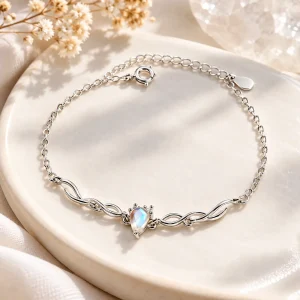
The workshop's bracelets, wrist sizes 5.5 to 8 inches
Frequently asked questions
Which wrist should you wear a moonstone bracelet on?
The left wrist according to tradition, which calls it receptive. The least active wrist according to mechanics, which comes down to the left for a right-handed person. The two answers coincide for the vast majority of people, and diverge for left-handed ones.
What if I'm left-handed?
Tradition still says left, mechanics say right. I recommend the right, because a broken bracelet no longer serves any function. If you value the receptive side, keep it on the left and take it off for cooking, DIY, and sports.
Can you wear it with a watch?
Not on the same wrist. A mineral watch crystal sits around 6 to 7 on the Mohs scale and a sapphire crystal goes up to 9, while moonstone tops out at 6.5. Continuous friction kills the sheen within months. Watch on one side, stone on the other.
What does a moonstone bracelet mean?
Tradition associates it with softness, intuition, and new beginnings, by analogy with the phases of the moon. These are recent attributions, spread by modern crystal healing. Its concrete distinguishing feature is elsewhere: it's the only piece of jewellery you see yourself all day long.
Can you stack it with other bracelets?
Yes, as long as you insert something softer in between. Quartz, amethyst, and garnet sit at 7 and up, and they scratch moonstone through simple friction. A smooth metal bangle between the two rows, or small silver spacers where the hardnesses meet, are enough.
Can you sleep with it on?
Nothing forbids it, but it's the surest way to lose beads: an elastic bracelet catches on a sheet and eventually gives way. And the main risk isn't breakage, it's not finding the bead again in the morning.
Should you take it off in the shower?
Yes, without exception. Hot water creates thermal shock, soap settles between the beads and dulls the polish, and the sheen reads through the surface: a grimy surface kills it. Dry it with a cloth if it gets wet.
How do you choose a bracelet size?
Measure your wrist at the end of the day, when it's at its widest, with a tailor's tape. Add 0.6 inches to that measurement for an elastic build. Elastic models generally cover 5.5 to 8 inches, which covers nearly every adult.
Where to go from here
This page covers the wrist and the bracelet. For the rest:
- Wearing and protecting: wearing it every day, is it fragile, cleaning it, sleeping with it.
- Pairing: which stone to pair it with, the ones that clash.
- The meaning: the meaning, the ring, the necklace and pendant, myths and legends.
- Choosing: colours and varieties, judging quality, where to buy it.
- The full picture: the complete guide.
The bracelets I make are in the bracelet collection, all covering wrist sizes from 5.5 to 8 inches. Not sure about your size? Write to me with your measurement, and I'll tell you which build to choose.
My sources
The compared hardnesses, for moonstone, quartz, garnet, watch crystals, and precious metals, follow the Mohs scale as published by the GIA, Mindat, and the International Gem Society. Feldspar's perfect cleavage and its consequences for impacts come from the same sheets.
The divide between a receptive side and an active side is a modern crystal-healing convention, spread starting in the 1970s and 1980s. I report it as such, without lending it an age it doesn't have, and without claiming it produces any effect.
The advice to wear the stone on the least active wrist, the watch rule, and the observations on stacking come from my workshop and from pieces brought to me for repair.
Last updated: August 19, 2026. If you spot an error in this article, let me know: I'll fix it and note it.
✦ À porter, à offrir
Découvrez mes créations