


Description
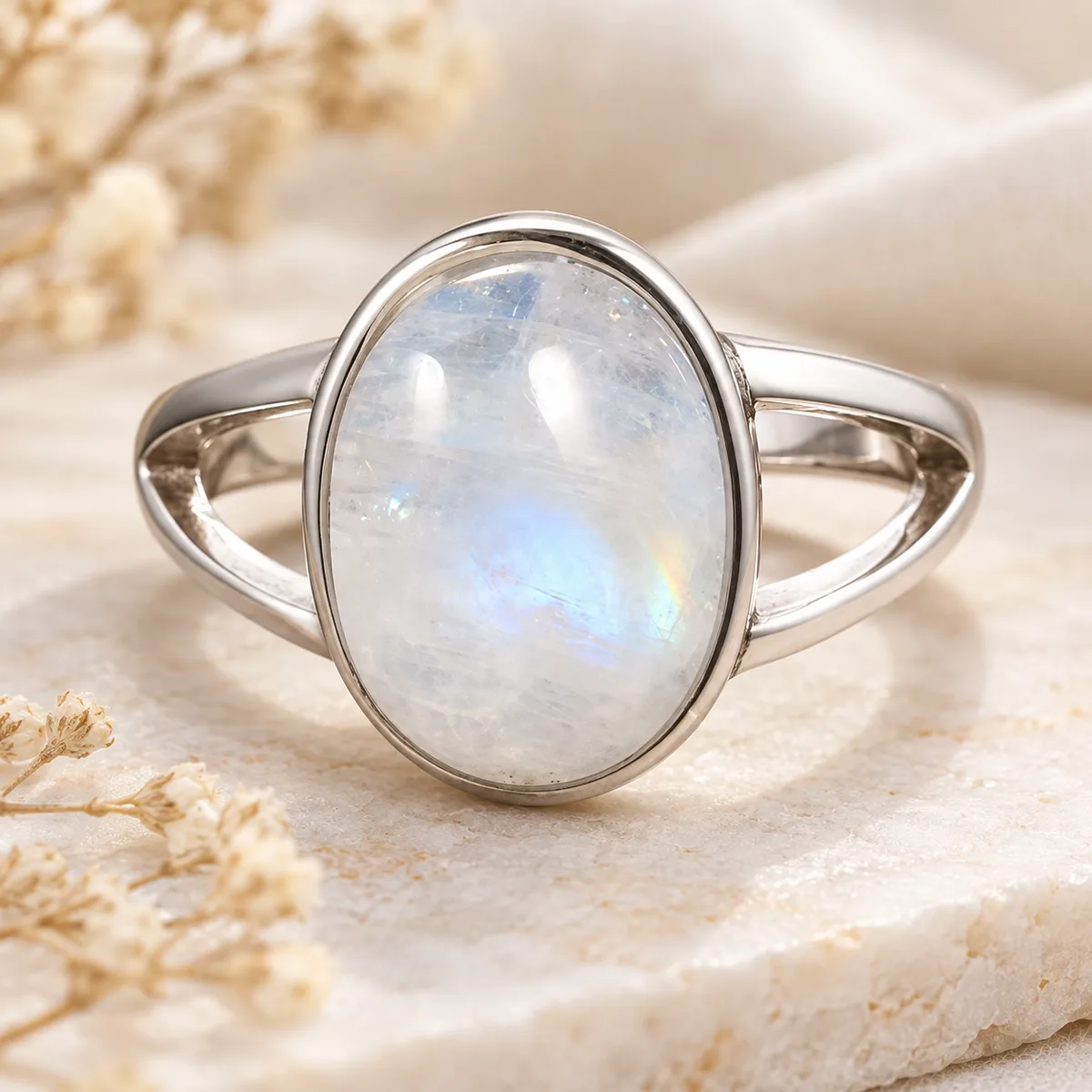
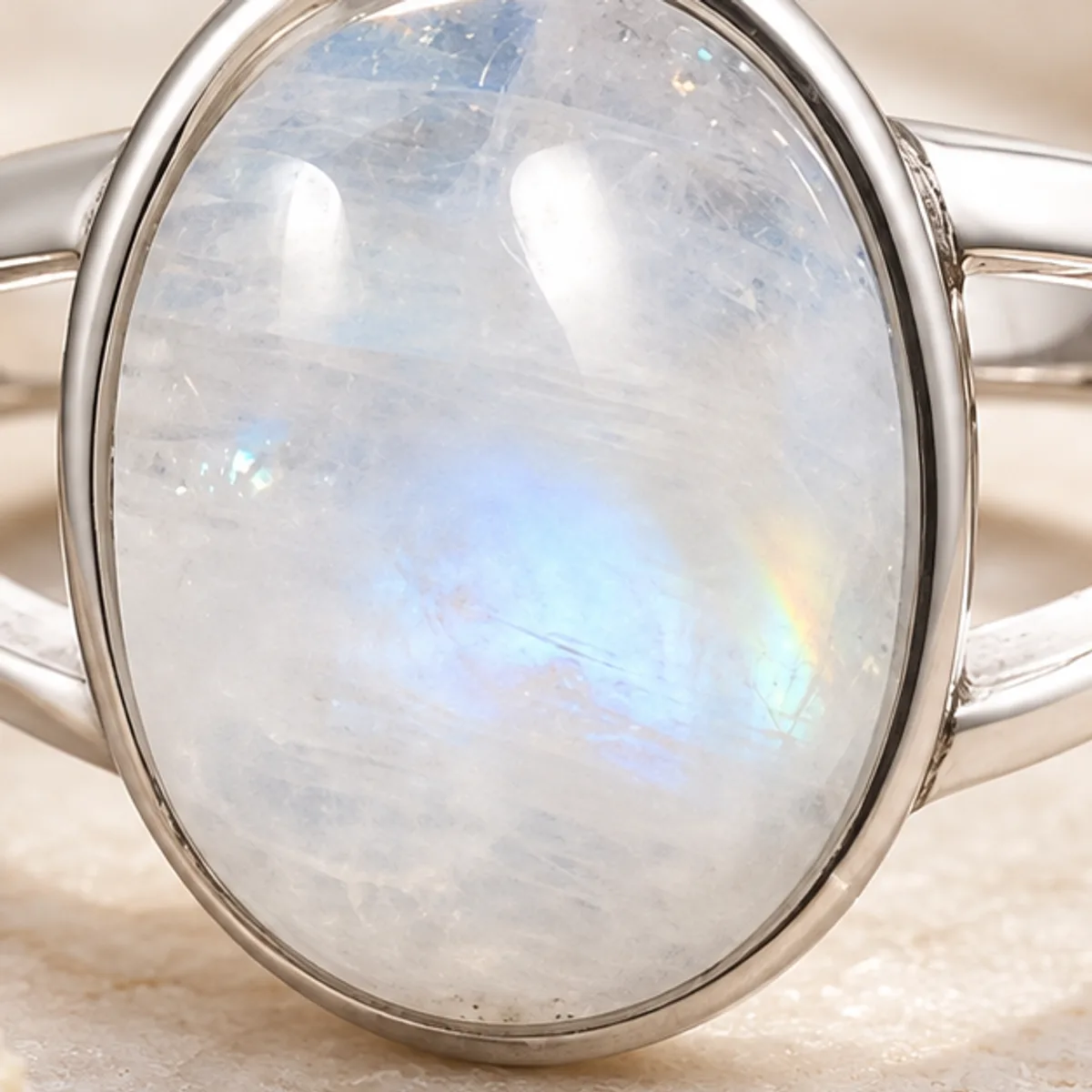
A large oval moonstone, a plain bezel with no decoration at all, and a band that splits into two polished arms before reaching the stone. The whole design is in that split.
A bare bezel, and why it is harder than it looks
On busy rings, a surround of beads or rope hides a great deal: the join of the bezel, the evenness of the rim, the micro-irregularities of the edge folded over the stone. Here there is nothing to hide. The band of silver around the cabochon is smooth, polished, and readable along its whole circumference. The slightest variation in thickness would read as a fault in the drawing. That is why a bare bezel is always set last, when the hand is warm, and why it is redone without argument if it is not even.
A bezel setting is not only a matter of style. Moonstone has perfect cleavage: it resists scratches reasonably well but it chips on impact, especially on an edge. Metal that wraps the dome completely removes every exposed edge, and it is the mount I recommend to anyone wearing their ring daily. Claws are brighter and less safe; on this stone I come down on the side of safety.
The band splits halfway round. The two arms stay parallel, mirror polished, and rise to the flanks of the bezel without meeting. That construction does three things at once: it lightens the piece visually, it lets a little skin show under the stone, and it frames the cabochon with two bright lines that bring the eye back to the centre. The mirror polish here is not a shortcut in finishing: it is the only contrast the ring has.
The cabochon is large, oval, with an even dome. Adularescence slides from one edge to the other instead of igniting in flashes, and the veil stays visible across a wide range of angles. Milky body, centred blue reflection, a few internal inclusions visible very close up: this is the classic Indian stone, and every deposit has its signature. The other rings are here, and the size guide will save you a return.
- Large oval moonstone cabochon, a travelling blue veil, centred.
- 925 sterling silver hallmarked S925, plain undecorated bezel, mirror-polished split band.
- No edge of the stone exposed: the safest mount for daily wear.
- UK sizes I 1/2 to T 1/2, that is 48 to 62 mm. Delivered in two weeks with a cotton pouch and a care card.
The specifications
- Stone
- Real moonstone (adularia), large oval cabochon
- Origin
- India
- Metal
- 925 sterling silver, S925 hallmark
- Setting
- Plain bezel, no glue
- Band
- Split into two parallel arms
- Finish
- Mirror-polished silver
- Sizes
- UK I 1/2 to T 1/2 (48 to 62 mm)
- Gender
- Women
- Brand
- Melissa Moon
Mirror polish, its quality and its flaw
Its quality is obvious: it throws light back cleanly, it gives the piece a crisp look, and it sets off a matte stone by contrast. Its flaw is just as obvious: it shows everything. After a month of daily wear, a polished band carries micro-scratches that brushing would never have let you see. That is not wear, it is patina, and it eventually forms an even veil that is rather lovely. If you prefer the first day, any jeweller repolishes a band in a few minutes.
The second thing to know concerns the split band. The two arms are integral with the bezel, they do not move, but they make resizing a little more delicate than a simple band. It remains possible, over a size or two, provided it is done by someone who works in silver. Better to take the right size from the start.
A well made bezel goes unnoticed. It is the only part of my work I know is right when nobody mentions it.
No salt, no ultrasonic tank, no hot water: moonstone is a feldspar, and all three damage it for good. Lukewarm water, a soft cloth, and the ring comes off before the shower and the housework. On this model, with no oxidation, a silver polishing cloth is allowed on the metal only, never on the stone. The detail is in cleaning a moonstone piece, and the safe methods in caring for it without harming it.