


Description
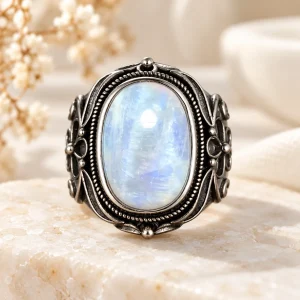
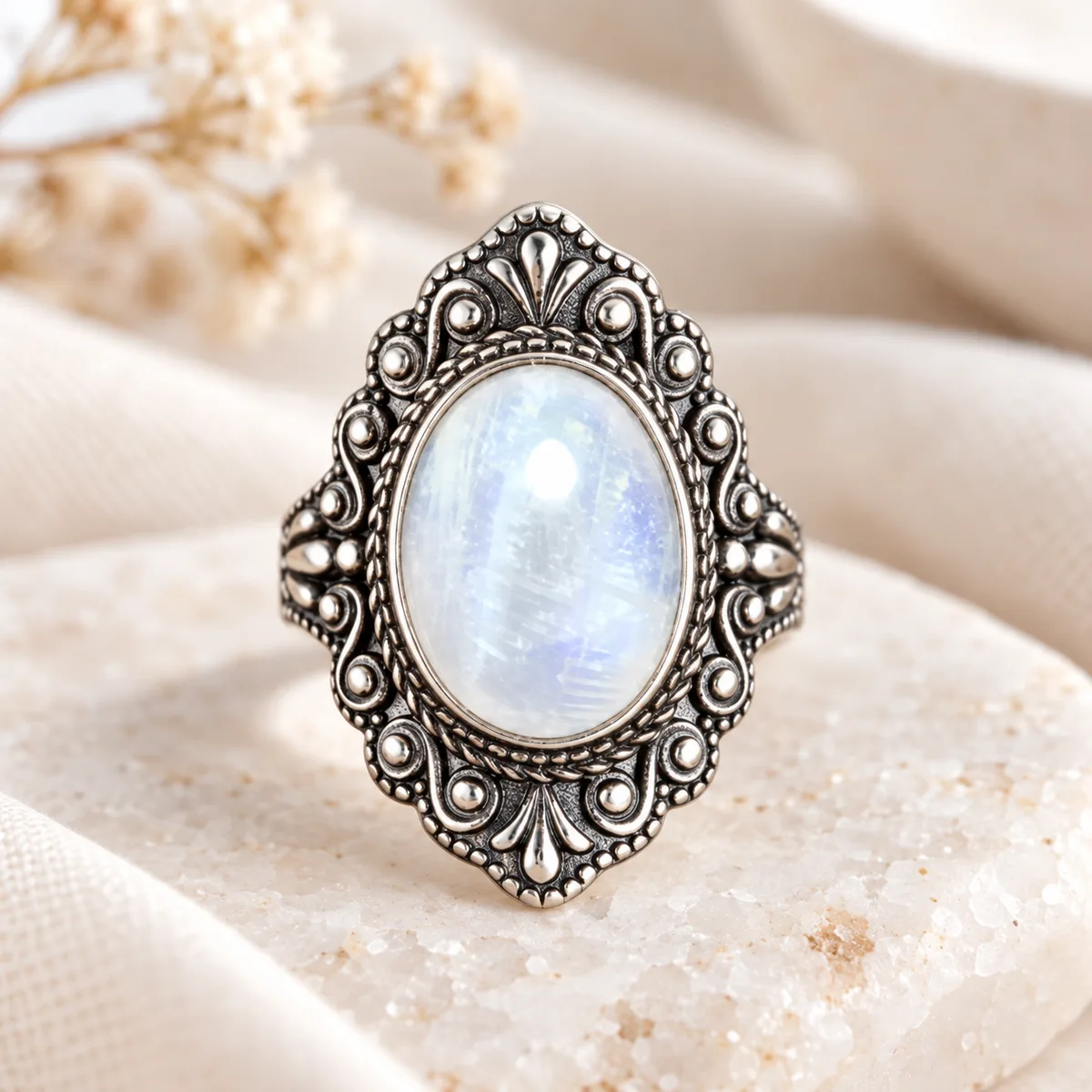
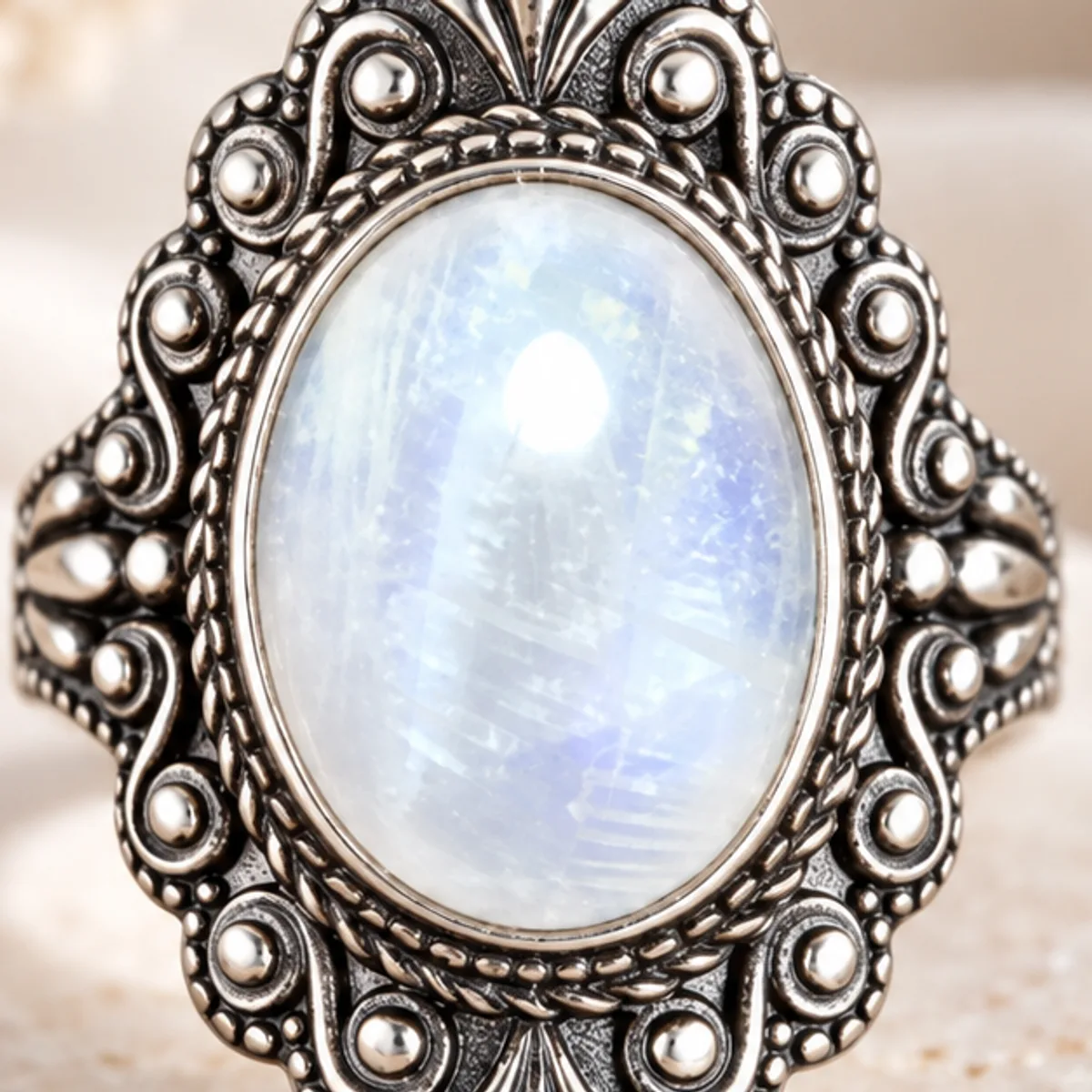
An oval cabochon set in a frame that does not try to be discreet: chased scrolls, a line of beads, a raised edge. It is the baroque vocabulary, applied to a stone that usually gets sober mounts.
A frame, and why it suits this stone
Most of my rings put the stone alone on the band. Here the cabochon sits at the centre of a worked frame, and that changes how it is read. A moonstone is pale, cool, slightly veiled. Set it in a plain mount and it floats; set it in a chased frame and it becomes the bright point of a composition that is otherwise grey. The contrast between the worked metal and the smooth dome is the whole subject of this model.
The frame is a cast piece, then chased by hand: the scrolls are deepened with a burin, and the beads are set one by one on the outer edge. That is why no two rings are exactly alike, and why the relief is crisper than on a purely molded ring. The stone is held by a closed bezel inside the frame, which is the safest setting there is and is what I want on a piece meant to be worn on days when you dress up.
The silver is oxidised black, then rubbed back with a cloth on the high points. The scrolls therefore stay dark in the hollows and light on the crests, which is what makes the chasing readable at arm’s length. Left bright, all this relief would turn into a confused glare; left black, it would turn into a grey mass. The rubbed back finish is the middle way, and it is the one I keep on every worked piece.
It is a wide ring and a tall one. Worn on the ring finger or the index, alone, never next to another ring: it would clash and it would scratch. The blue veil moves as the hand does, and the frame holds it in place like a setting holds a portrait. The other rings are here, and the size guide avoids ordering twice.
- Oval moonstone cabochon, blue veil, set in a chased frame.
- 925 sterling silver hallmarked S925, closed bezel, scrolls and beads.
- Oxidized then rubbed back by hand: the relief reads from a distance.
- UK sizes I 1/2 to T 1/2, that is 48 to 62 mm. Delivered in two weeks.
The specifications
- Stone
- Real moonstone (adularia), oval cabochon
- Origin
- India
- Metal
- 925 sterling silver, S925 hallmark
- Setting
- Closed bezel inside the frame, no glue
- Decoration
- Chased baroque scrolls, beaded outer edge
- Finish
- Oxidized silver, crests rubbed back with a cloth
- Sizes
- UK I 1/2 to T 1/2 (48 to 62 mm)
- Gender
- Women
- Brand
- Melissa Moon
What chasing adds, and what it costs
A chased frame is not decoration added at the end, it is metal removed. The burin cuts a furrow, and the two shoulders of that furrow catch the light. That is why a chased piece keeps its relief for decades while a printed pattern fades: there is nothing to wear off, the shape is in the thickness. It is also why it costs more in time than in material.
The cost is elsewhere. A worked surface collects everything: soap, cream, dust. On a smooth ring you wipe and it is done. Here you need a soft brush, dry, once a month, to take the grey out of the hollows. Thirty seconds. Anyone who tells you that an oxidised chased piece needs no maintenance has never worn one for a year.
I hesitated a long time before offering baroque pieces. What convinced me is a detail: on a worked frame, a stone that is a little veiled looks intentional rather than dull.
No salt, no ultrasonic tank, no hot water: moonstone is a feldspar, and all three damage it for good. On an oxidised piece, add this: no silver dip either, it strips the black from the hollows in seconds. Lukewarm water, a soft cloth, a dry brush for the reliefs. The detail is in cleaning a moonstone piece, and the safe methods in caring for it without harming it.