


Description
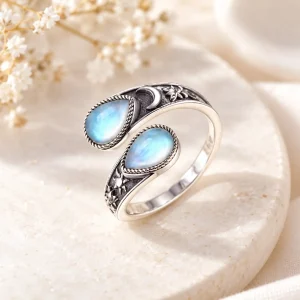
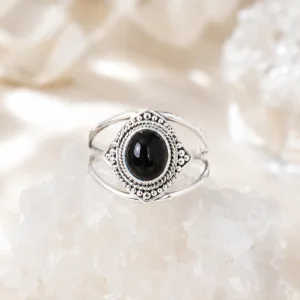
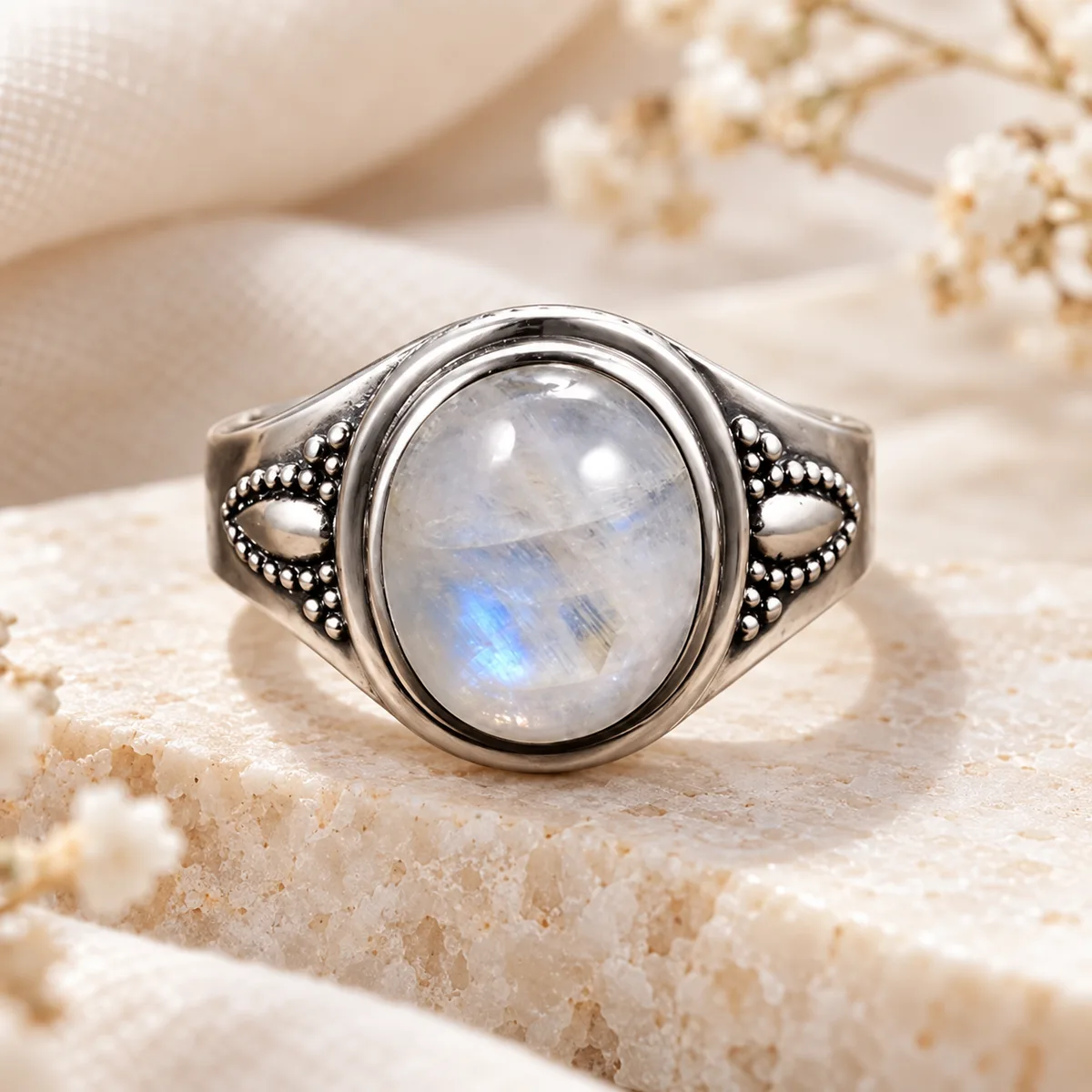
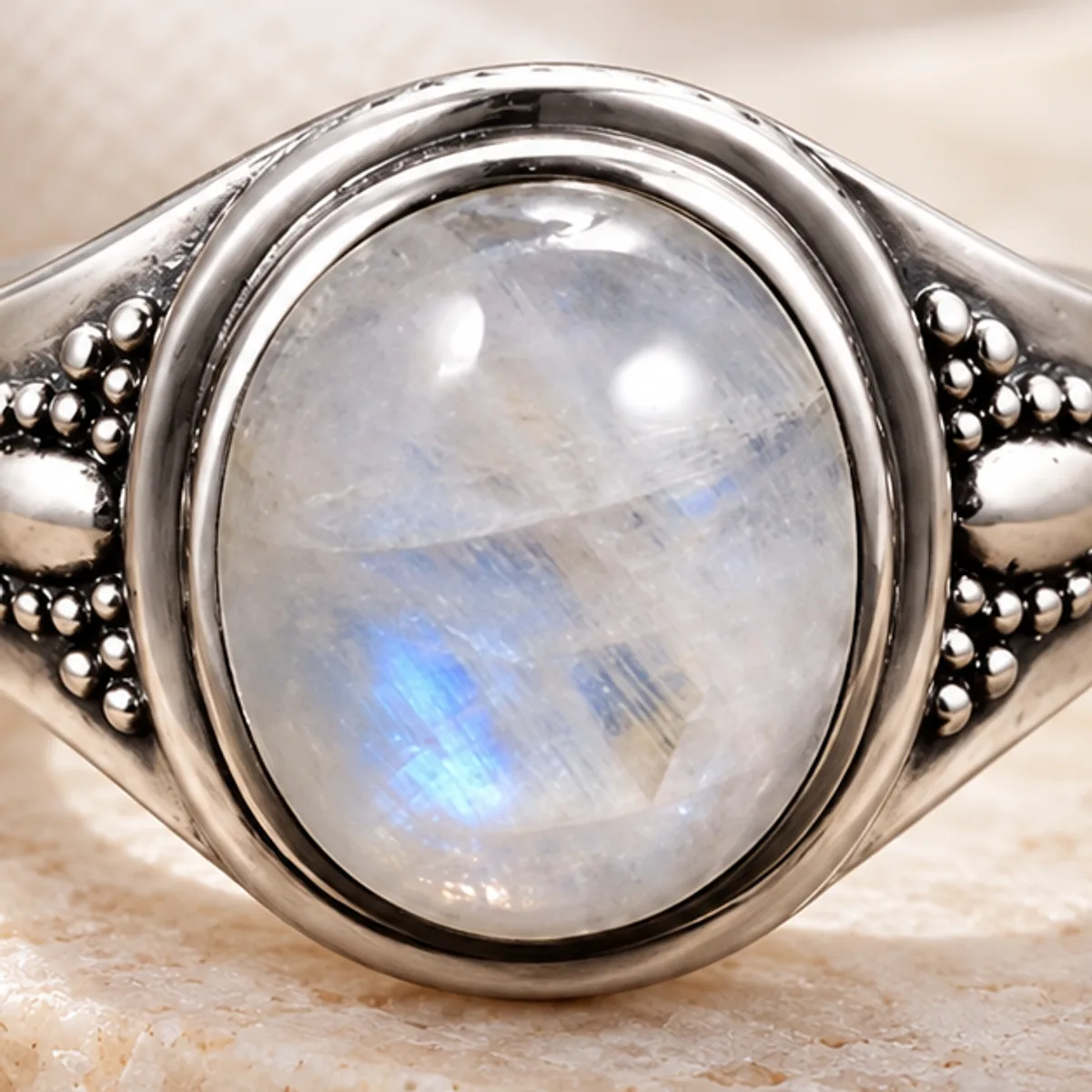
An oval cabochon on a wide band, and on each shoulder a teardrop shape flanked by small beads, the two sides mirroring each other across the stone.
Mirrored, not repeated
Look closely at the two shoulders and you will see they are not the same motif twice: they are the same motif reversed. The teardrops point away from the stone on both sides, so the left one is the mirror image of the right. That sounds like a small thing and it is the difference between a ring that looks designed and one that looks printed.
The reason is how a ring is actually seen. A hand rarely presents a ring face on. You see it at an angle, and at an angle you see one shoulder clearly and the other foreshortened. If the two shoulders were identical rather than mirrored, the drawing would run in one direction, and from most angles the ring would look as if it were sliding off the finger. Mirrored, it reads as balanced from every side, which is the point of symmetry in ornament: it is not about the object, it is about the viewer.
Each teardrop is raised, with a bead set at its narrow end and another at its base. The beads are there to close the shape, because a bare teardrop on a flat shoulder looks unfinished at the tip. That is the kind of correction that gets made at the bench rather than on paper: the drawing was fine, the metal was not, and a bead solved it.
The stone sits in a closed bezel and the band is wide, so take a quarter size up compared to a thin ring. The blue veil of the oval is the still centre between two moving shoulders. The other rings are here.
- Oval moonstone cabochon, closed bezel, the calm centre of the design.
- 925 sterling silver hallmarked S925, wide band, mirrored teardrops on the shoulders.
- Beads set at each end of the teardrops to close the shape.
- UK sizes I 1/2 to T 1/2, that is 48 to 62 mm. Delivered in two weeks.
The specifications
- Stone
- Real moonstone (adularia), oval cabochon
- Origin
- India
- Metal
- 925 sterling silver, S925 hallmark
- Setting
- Closed bezel, no glue
- Shape
- Wide band, mirrored shoulders
- Decoration
- Raised teardrops and set beads
- Finish
- Oxidized silver, crests rubbed back with a cloth
- Sizes
- UK I 1/2 to T 1/2 (48 to 62 mm)
- Gender
- Women
- Brand
- Melissa Moon
Why symmetry is harder than it sounds
Drawing two mirrored shoulders takes a minute. Making them takes far longer, because the two sides are worked in opposite directions and a right handed hand is not equally good at both. The left shoulder, for me, is the one I do first and slowest. Everyone who works metal by hand has a weak side, and the pieces where it shows are the ones that do not leave the bench.
There is a way to check symmetry that anyone can use, and it costs nothing. Photograph the ring face on, then flip the photograph horizontally and compare the two images. Your eye forgives asymmetry when it looks at an object directly, and stops forgiving it the moment the image is reversed. It is the same trick painters use with a mirror, and it catches things that hours of looking will not.
Symmetry is not about the object being balanced. It is about the person looking at it feeling that it is, from wherever they happen to be standing.
No salt, no ultrasonic tank, no hot water: moonstone is a feldspar, and all three damage it for good. No silver dip, it strips the oxidation around the teardrops and the shoulders go flat. Lukewarm water, a soft cloth, a dry brush around the beads once a month. The detail is in cleaning a moonstone piece, and the safe methods in caring for it without harming it. The bezel protects the stone, but a moonstone chips on a real knock.