


Description
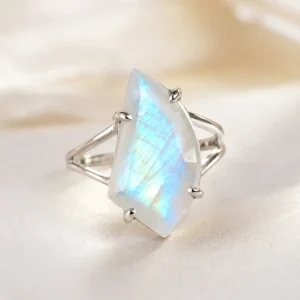
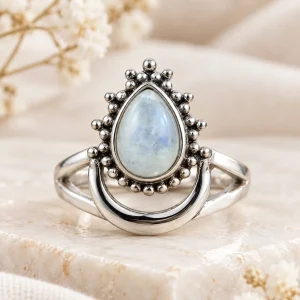
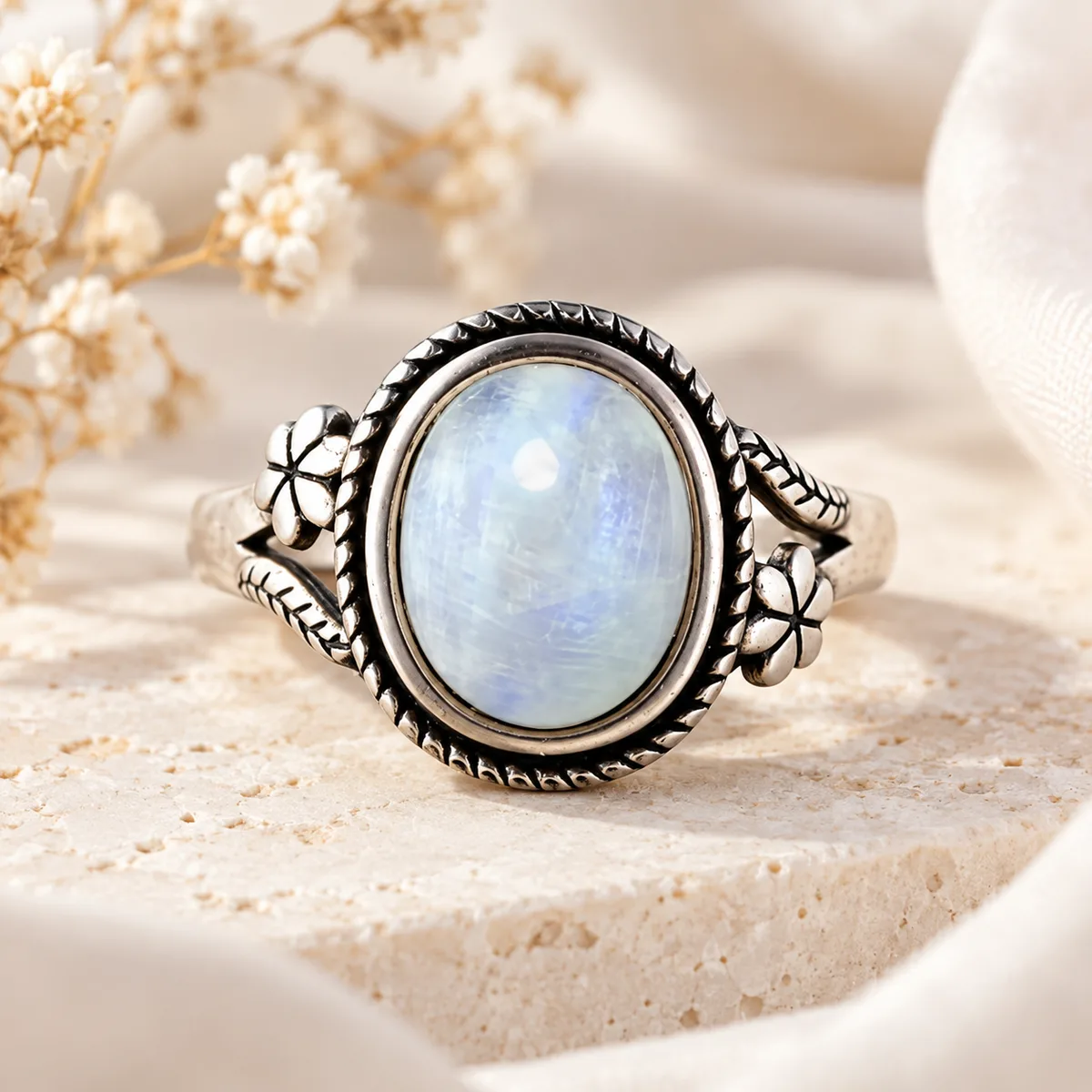
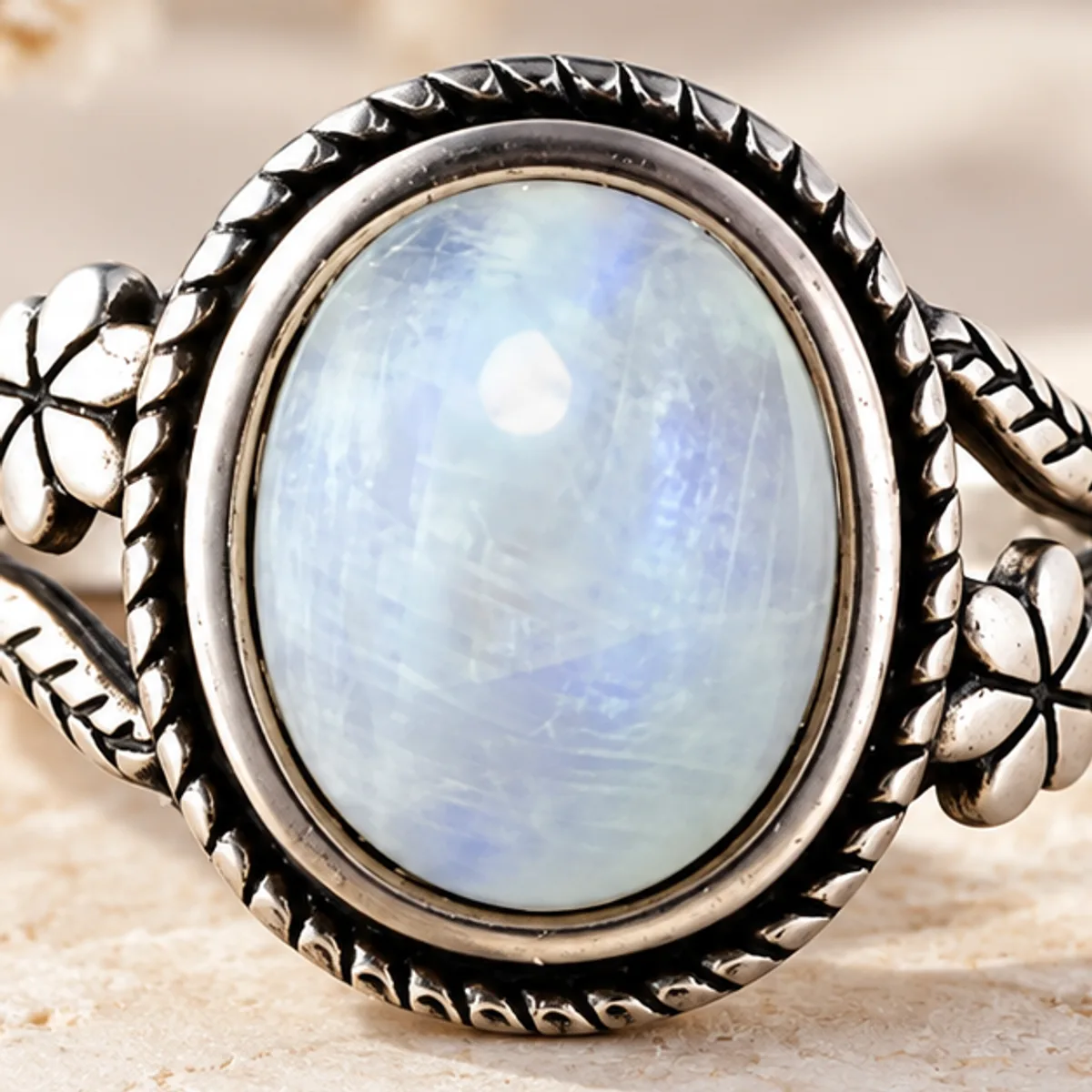
An oval cabochon, and on each shoulder a small flower with a leaf folded against it, both raised from the surface rather than cut into it.
A flower needs a leaf
A flower on its own is a decoration; a flower with a leaf is a plant. That sounds like a distinction without a difference and it is not. A lone rosette sits on the metal as a stamp, symmetrical and static. Add a leaf on one side and the motif acquires a direction: it grew from somewhere, it leans, and the eye reads it as a living thing rather than as a mark. Every plant motif in European silverwork does this, and the pieces that skip the leaf always look like a pattern rather than a garden.
Here the two shoulders are mirrored, so the leaf on the left leans the other way from the leaf on the right, and the whole reads as balanced. Each shoulder taken alone is asymmetric, which is what keeps it lively; the pair is symmetric, which is what keeps it calm. That combination is the reason this kind of shoulder has survived unchanged for two hundred years.
What makes this ring slow to build is the number of separate pieces. The bezel, the two flowers, the two leaves and the band are six elements that all have to be joined, and each joining reheats everything already done. Get the order wrong and the first joint opens while you are making the fourth.
The stone sits in a closed bezel between the two motifs, and the blue veil is the one thing on the ring that is neither flower nor metal. The other rings are here, and the size guide takes two minutes.
- Oval moonstone cabochon, closed bezel between the two shoulders.
- 925 sterling silver hallmarked S925, a raised flower and leaf on each shoulder.
- Six separate elements, soldered in a fixed order with three grades of solder.
- UK sizes I 1/2 to T 1/2, that is 48 to 62 mm. Delivered in two weeks.
The specifications
- Stone
- Real moonstone (adularia), oval cabochon
- Origin
- India
- Metal
- 925 sterling silver, S925 hallmark
- Setting
- Closed bezel, no glue
- Decoration
- Raised flower and leaf on each shoulder, mirrored
- Finish
- Oxidized silver, crests rubbed back with a cloth
- Sizes
- UK I 1/2 to T 1/2 (48 to 62 mm)
- Gender
- Women
- Brand
- Melissa Moon
Three grades of solder, in order
Silver solder comes in grades that melt at different temperatures: hard, medium and easy, roughly thirty degrees apart. On a piece with several joints you use hard solder first, then medium, then easy, so that each new joint melts at a lower temperature than the ones already made. Done in that order, the earlier joints survive. Done in the wrong order, the first joint opens while you are making the last, and you start again.
This is why a multi element piece costs what it does, and it is invisible in the finished ring. Nobody looking at a flower and a leaf on a shoulder can tell whether they were soldered in one careless go or in a planned sequence. The difference shows up years later, when a piece assembled carelessly starts shedding its elements and a piece assembled in order does not.
The order of operations is most of the craft. The hand work is the part people watch, and it is not the part that decides whether the ring survives.
No salt, no ultrasonic tank, no hot water: moonstone is a feldspar, and all three damage it for good. The fold between each flower and its leaf holds cream, so rinse under lukewarm water rather than wiping, and use a dry soft brush once a month. Avoid silver dips, they lift the oxidation and the motifs flatten into the shoulder. The detail is in cleaning a moonstone piece, and the safe methods in caring for it without harming it. The motifs stand above the stone and take knocks first, which helps a stone that chips.