Description
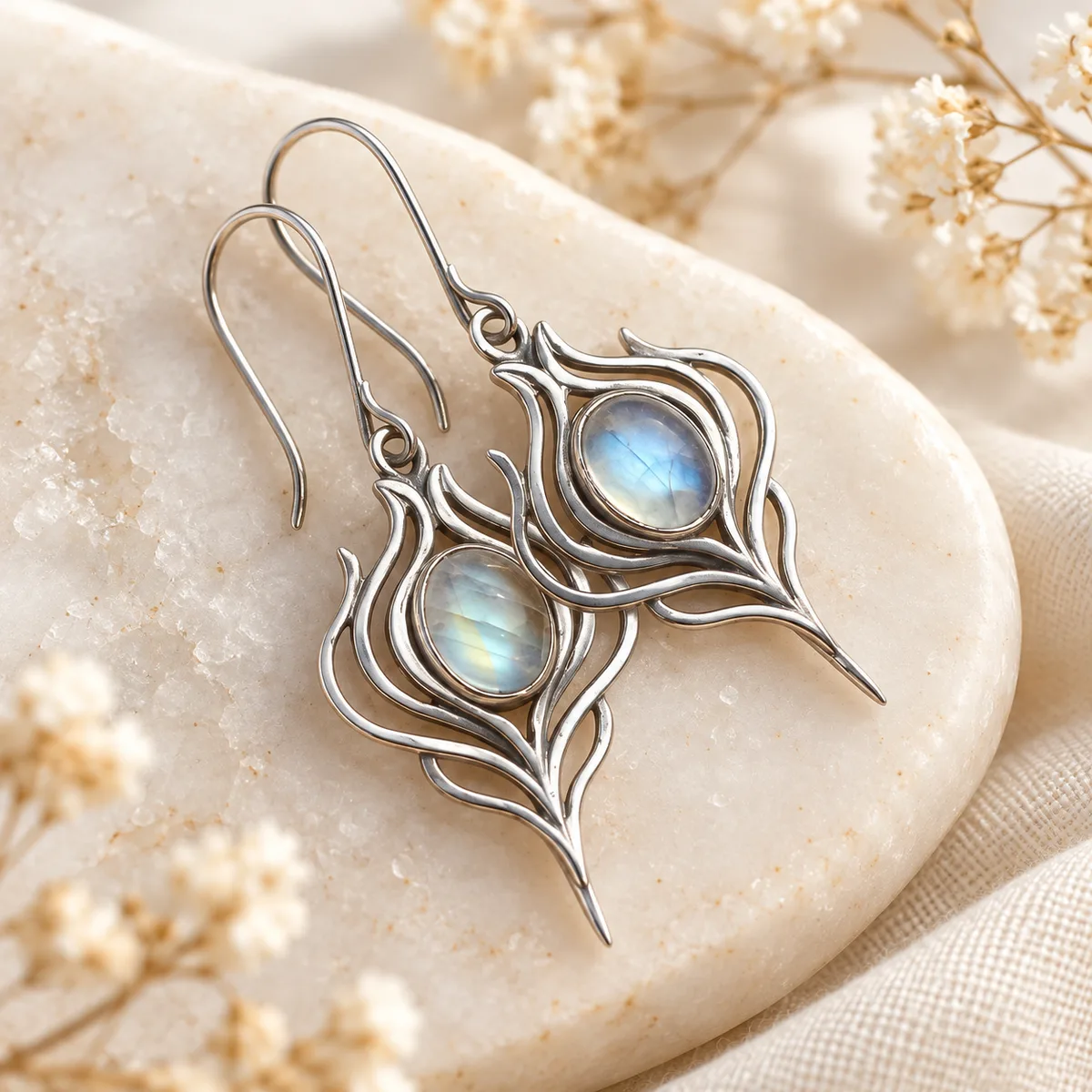
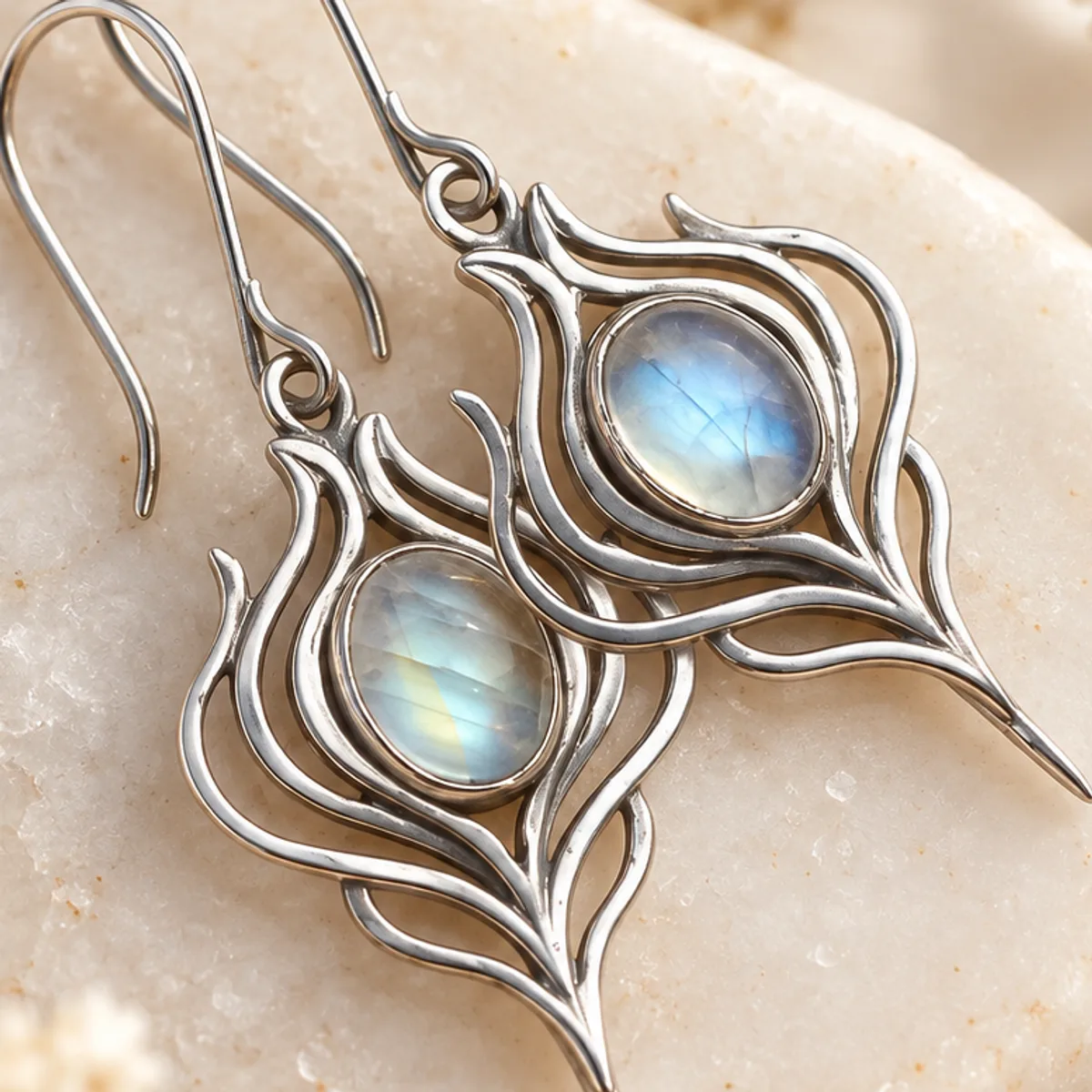
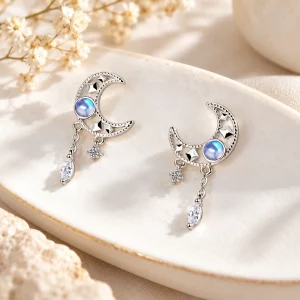
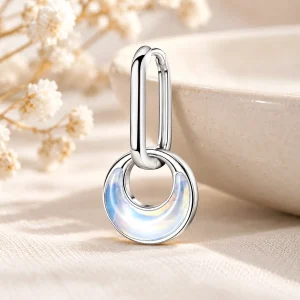
Two pierced silver feathers, their barbs cut one by one, and at the base of each an oval moonstone cabochon. They hang four centimetres.
A cut feather, not an engraved one
The difference is visible immediately. An engraved feather is a plate of metal with lines scored into it: it stays opaque and heavy. Here the barbs are genuinely cut out, separated from one another by open slits, and light passes between them. The feather is therefore translucent in places, it moves with a slight tremble, and it weighs a third of what a plate of the same size would.
That is also what makes it wearable. A four centimetre drop in solid metal pulls on the lobe all day; pierced, it is forgotten. Each earring weighs about two and a half grams, cabochon included, which is little for this format.
The oval cabochon is set at the base of the feather, where the barbs draw together, in a closed bezel with no claws and no glue. On this dome the adularescence slides from one edge to the other at the least movement of the head: on an earring that swings constantly, the veil is almost always lit. Moonstone chips on impact, and the closed bezel protects it. The other earrings are here.
- Two real moonstones, oval cabochons in closed bezels, matched for tone and veil.
- 925 sterling silver hallmarked S925, barbs cut one by one with open slits.
- About 2.5 g each: a four centimetre drop that is forgotten rather than felt.
- Pierced, so light passes through and the feather trembles. Delivered in two weeks.
The specifications
- Stone
- Real moonstone (adularia), two oval cabochons
- Origin
- India
- Metal
- 925 sterling silver, S925 hallmark
- Setting
- Closed bezel at the base of the feather, no claws, no glue
- Shape
- Pierced feather of about 4 cm
- Finish
- Polished silver, hollows lightly oxidised
- Fastening
- Leverback
- Gender
- Women
- Brand
- Melissa Moon
Cutting is what costs, and it is the only thing that shows
Engraving a feather takes ten minutes with a graver and looks convincing in a photograph. Cutting one takes an hour and a half, because every slit is a hole drilled, a blade threaded, a curve sawn and the blade unthreaded again. The reason I do it is not craft pride: an engraved feather is a grey shape at two metres, and a cut one reads as a feather, because the light coming through the slits is what the eye recognises.
An engraved feather is a grey shape at two metres. A cut one is a feather, because you see through it.
No salt, no ultrasonic tank, no hot water: moonstone is a feldspar, and all three damage it for good. Open slits catch on knitwear, so lift the earrings clear before pulling a jumper over your head. Cleaning a moonstone piece and caring for it without harming it cover the rest.
What tradition attributes to moonstone
What follows belongs to the traditions and beliefs attached to this stone. I keep it apart from the rest of the page: none of it is proven, and no piece of jewellery heals anything.
The feather
Feathers carry readings of lightness and of flight in many decorative traditions, and of rank in a few. About the form, not about the stone.
Openwork
Cutting a motif right through is documented from antiquity onward, chosen as much for lightness as for the light behind it. A technique, not a meaning.
Sacral chakra (Svadhisthana)
Traditional correspondences attach moonstone first to the second chakra, the one of emotion and creativity, and secondarily to the third eye. Worn as a ring it stays on the hand, far from both points, and tradition then makes it a matter of looking rather than of placement.
The traveller's talisman
Long before modern crystal healing, this was the stone taken on the road, in India as in Rome, and given to whoever was leaving. It is probably its only genuinely ancient use, and there is nothing therapeutic about it.
Traditions and beliefs, nothing else. None of these associations amounts to medical advice, and no piece of jewellery replaces a treatment or an examination. If you are on medication, pregnant or in a course of care, talk to your doctor rather than to your jeweller. The full disclaimer is here.
How your jewellery reaches you
Nothing is kept in stock. Each piece is ordered from a partner workshop after you place your order, then dispatched to you directly.
- Delivered in two weeks, tracking number provided as soon as it is dispatched
- Free delivery on orders over 47 €
- 14 days to change your mind, with no explanation required
Customs duties are included wherever you are: there is nothing further to pay on delivery. Lead times, zones, exchanges and refunds are detailed on the Delivery and Returns page.
Caring for a moonstone
No salt, no ultrasonic tank, no hot water. Moonstone is a feldspar with perfect cleavage: it does not scratch easily, but it chips on impact, and those three damage it for good. Lukewarm water and a soft cloth are enough.
Take the piece off before the shower, the pool, sport and housework. Store it on its own in a pouch rather than loose: what scratches a moonstone is almost always another piece of jewellery.
Crystal healing also likes to cleanse and recharge a stone from time to time. On this one, moonlight suits it very well. Salt does not, and yet it is the method most often recommended online.
Chosen one by one
I do not make these pieces myself: I choose each design from partner workshops, and I drop from the catalogue anything that does not live up to its description.
- Metal, stone and dimensions stated on every listing
- No opalite, no coated quartz sold as rainbow moonstone: both were pulled from the catalogue
- No piece sold for anything it might heal
My story, and what I stopped selling.