

Description
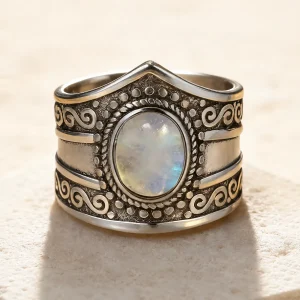
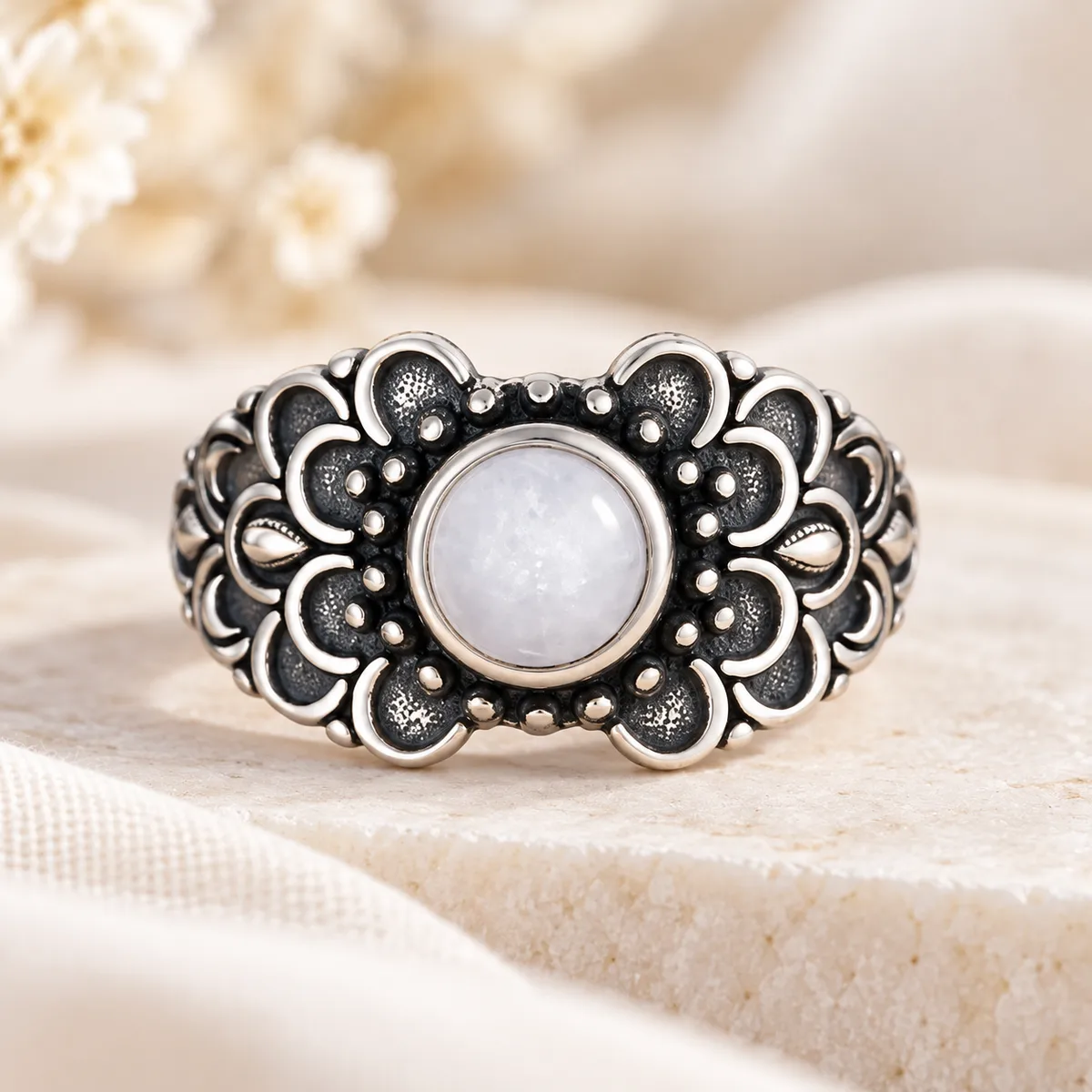
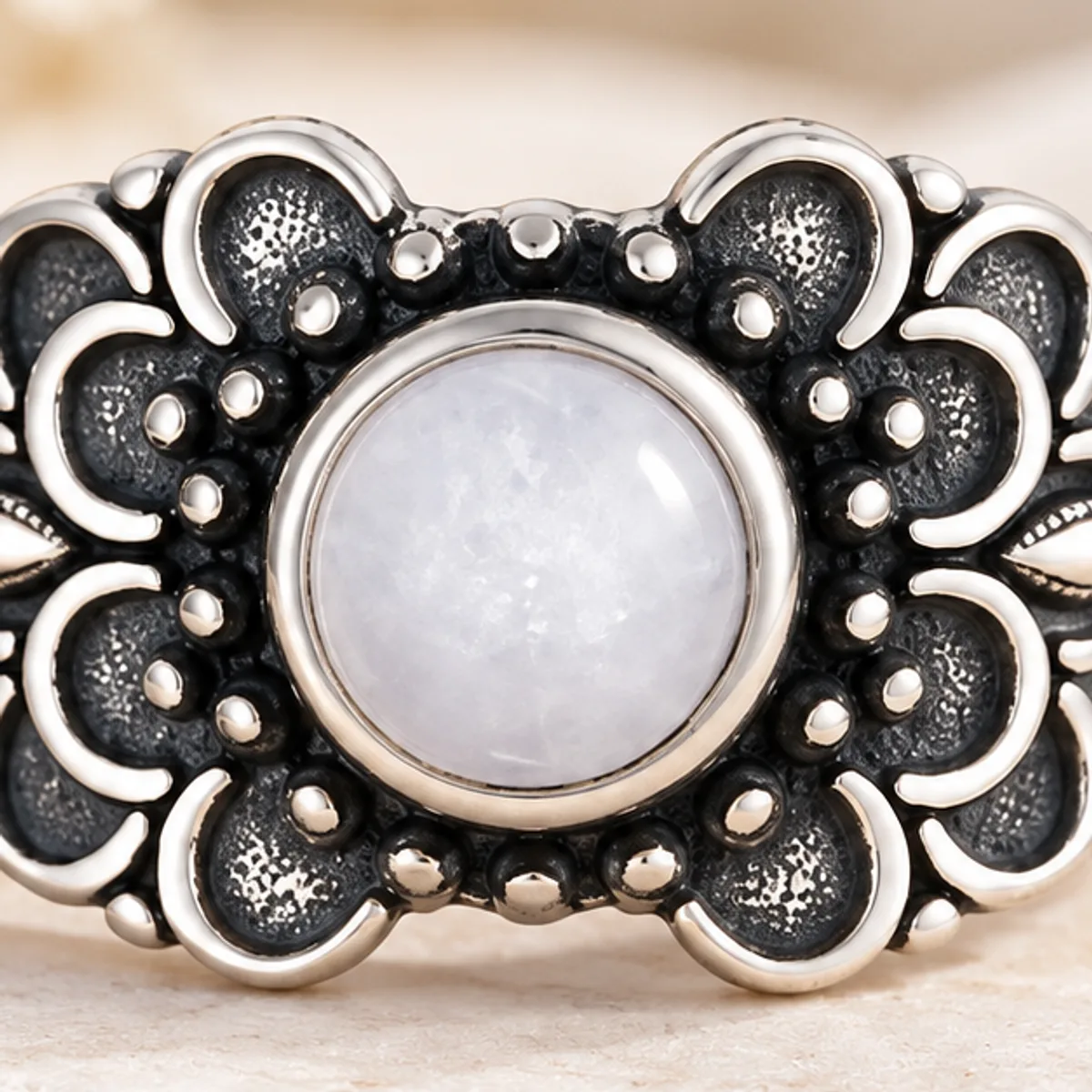
A round cabochon on a wide band, and covering that band a lace of beads, small enough and dense enough that from arm’s length you stop counting them.
The point where counting stops
There is a threshold in how we look at repeated elements, and it falls somewhere around six or seven per centimetre. Below it the eye counts: you see individual beads, and the piece reads as a pattern. Above it the eye gives up and averages: you see a surface, and the piece reads as a texture. The beads on this band are just above that threshold, deliberately, which is why at arm’s length it looks like woven silver and only up close resolves into separate grains.
That transition is the whole pleasure of the ring. Most decorated silver looks the same from every distance. This one is two different objects: a soft grey textile from across a table, a field of tiny spheres when you bring your hand to your face. Nobody designs for that on purpose very often, and it costs nothing extra once you know where the threshold is.
The practical consequence is that small irregularities disappear. Below the threshold, one bead out of line is obvious and ruins the row. Above it, the eye is averaging anyway, and a bead a fraction off its neighbour vanishes into the field. That is why dense beading is more forgiving to make than sparse beading, and it is the opposite of what most people assume.
The stone is round and sits in a closed bezel, low against the textured field. Because the band is wide, take a quarter size up compared to a thin ring. The blue veil is the one smooth thing on a ring that is entirely surface. The other rings are here.
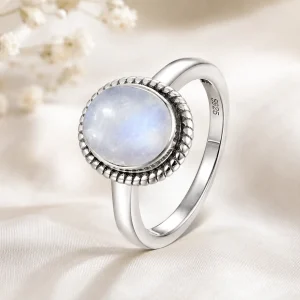
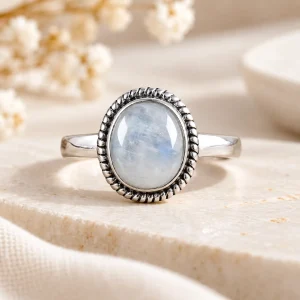
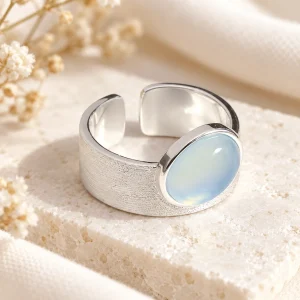
- Round moonstone cabochon, closed bezel, set low against the beading.
- 925 sterling silver hallmarked S925, wide band covered in a dense lace of beads.
- Texture rather than pattern: at arm’s length you stop counting the beads.
- UK sizes I 1/2 to T 1/2, that is 48 to 62 mm. Delivered in two weeks.
The specifications
- Stone
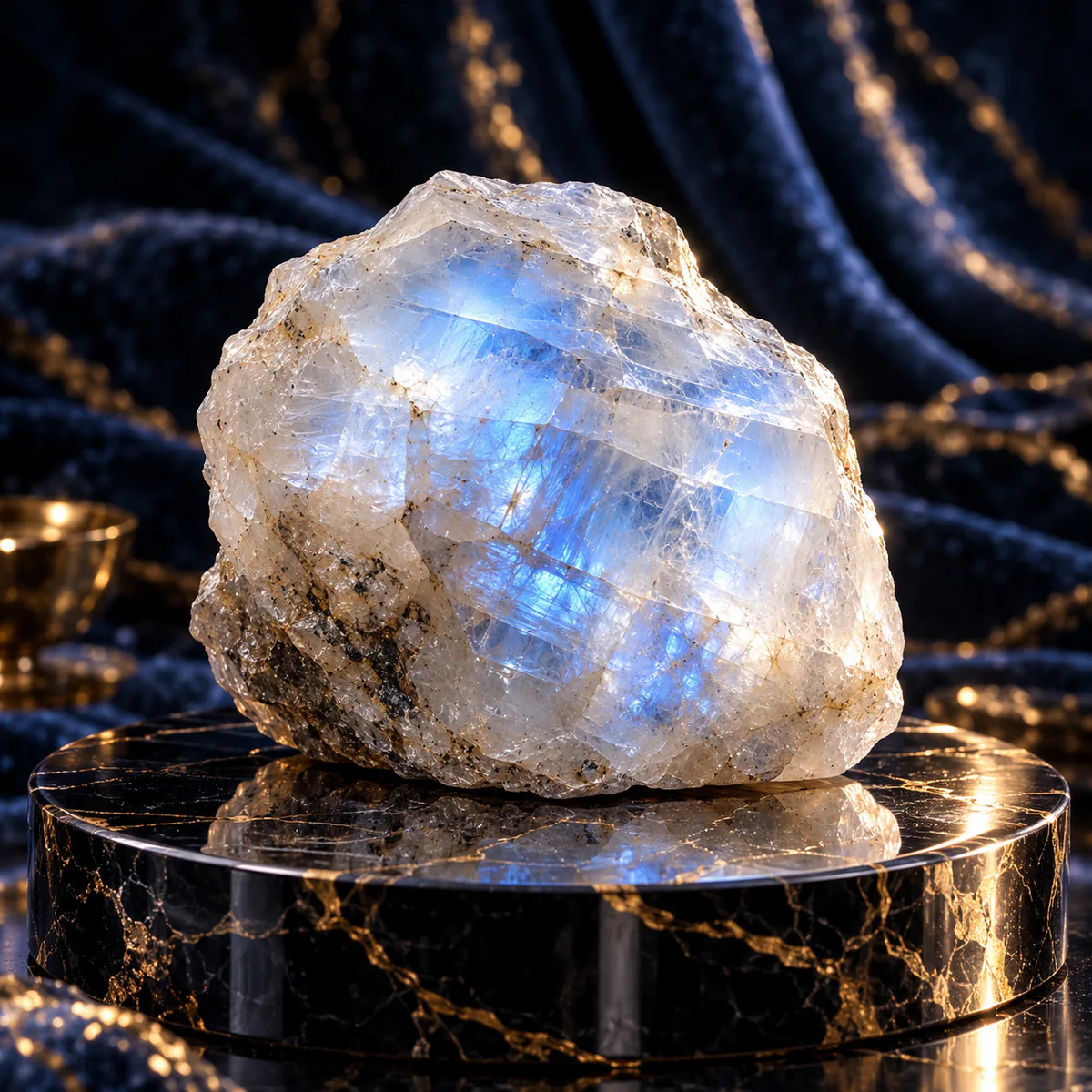
- Real moonstone (adularia), round cabochon
- Origin
- India
- Metal
- 925 sterling silver, S925 hallmark
- Setting
- Closed bezel, no glue
- Shape
- Wide band, densely beaded across its whole width
- Finish
- Oxidized silver, crests rubbed back with a cloth
- Sizes
- UK I 1/2 to T 1/2 (48 to 62 mm)
- Gender
- Women
- Brand
- Melissa Moon
Dense is easier than sparse
This surprises people, including apprentices. A row of six large beads has to be perfect, because the eye compares them one against another and finds the one that is out of place in half a second. A field of two hundred small beads does not, because nobody compares two hundred of anything. The work is more repetitive and less demanding, and that is a good trade when what you want is a surface.
Where dense beading does get hard is the edge. In the middle of the field an irregularity hides; at the border, where the beads stop and the plain metal begins, the eye has a straight line to compare against and it sees everything. So on a piece like this the last row along each edge takes as long as the whole middle, and it is the only part I do with the piece held in a clamp rather than in my fingers.
The middle of a textured surface forgives almost anything. The edge forgives nothing, and that is where to look if you want to judge the work.
No salt, no ultrasonic tank, no hot water: moonstone is a feldspar, and all three damage it for good. A dense beaded field holds a great deal of soap and cream, so rinse under lukewarm water rather than wiping, and use a dry soft brush once a month across the whole band. Avoid silver dips, they lift the oxidation from between the beads and the texture flattens into grey. The detail is in cleaning a moonstone piece, and the safe methods in caring for it without harming it. The bezel protects the stone, though a moonstone chips on a real knock.