


Description
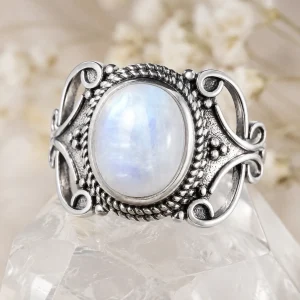
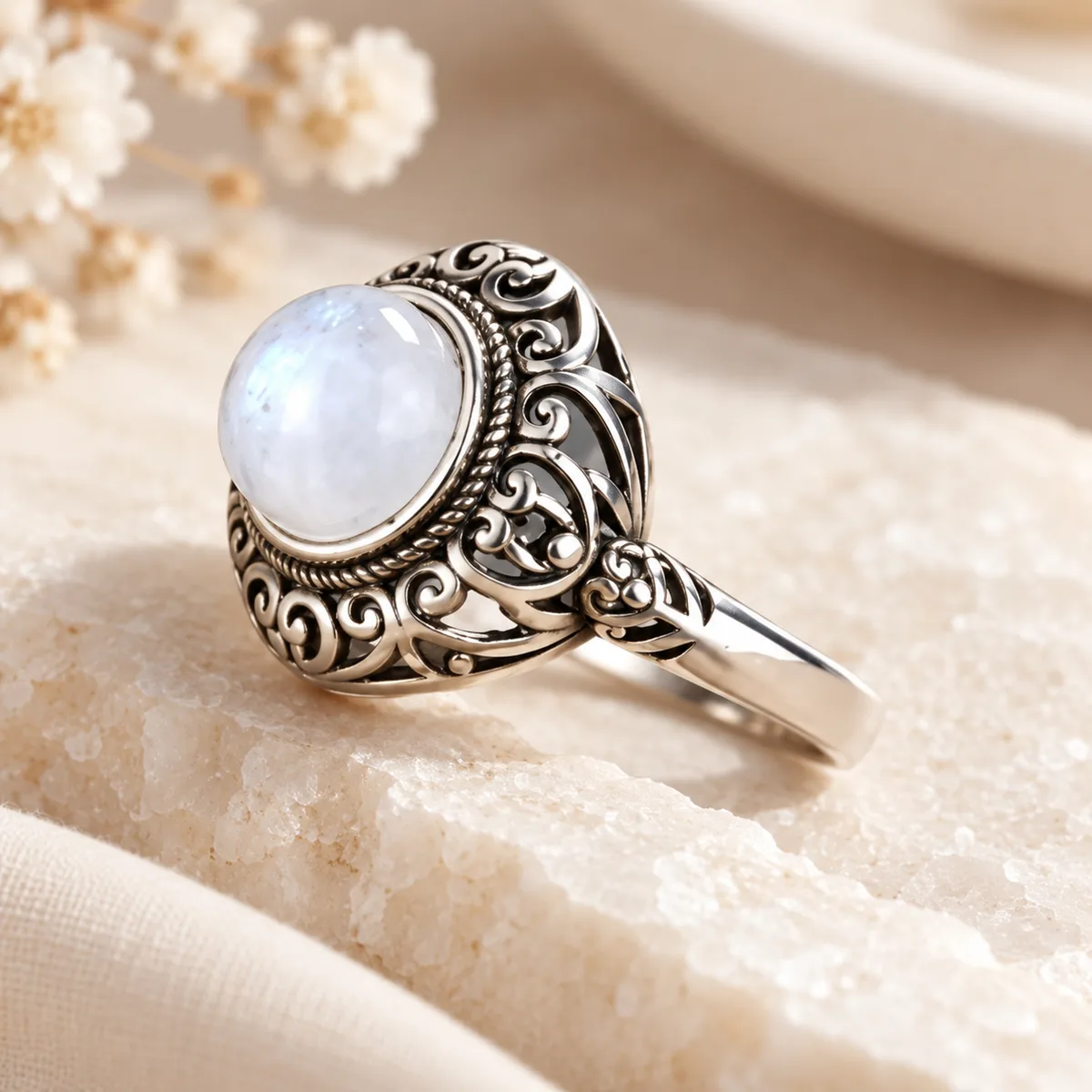
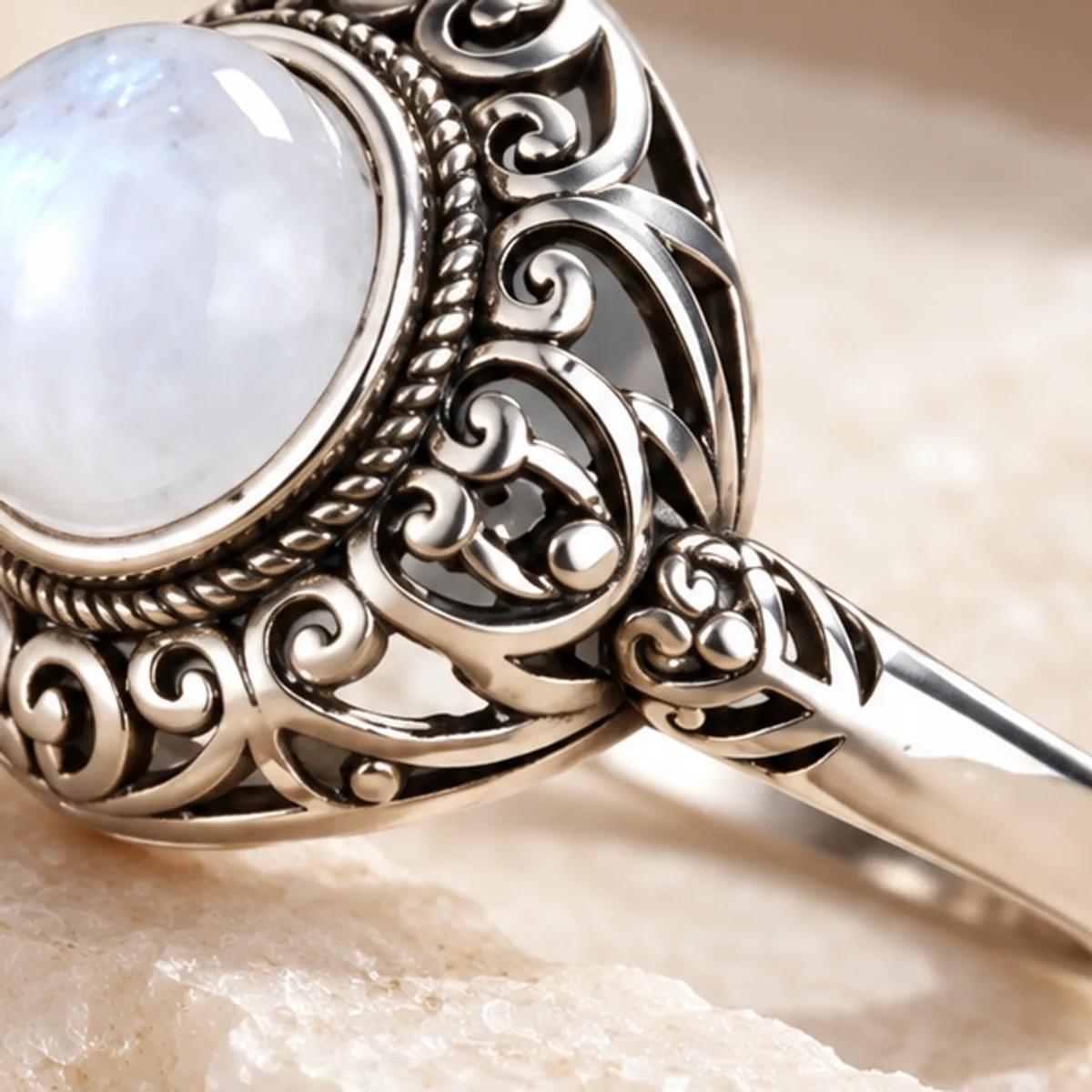
A round cabochon on a band whose profile is domed rather than flat, and whose two shoulders open into pierced scrolls on either side of the stone. It is the shoulders that do the work here, not the setting.
Shoulders, and why they matter more than people think
The shoulders are the two sections of the band on each side of the stone. On a cheap ring they are simply the band continuing, and the setting looks stuck on top. On a well drawn ring they widen, rise, and meet the setting, so the eye travels from the finger to the stone without a break. That transition is the difference between a ring that looks made and a ring that looks assembled.
Here the shoulders open into pierced scrolls: the metal widens, then is cut away so that what remains is a curl on each side. Two effects follow. The ring gains visual width without gaining weight, and the openings let skin show at the two points where a solid shoulder would look heaviest. On a hand in movement it reads as lightness, which is exactly what a round stone needs around it.
The band is domed, meaning rounded on the outside rather than flat. That is a comfort decision before it is an aesthetic one. A flat band has two edges that press on the neighbouring fingers; a domed band has none. On a ring meant to be worn all day, it is the single detail that decides whether it stays on the hand or ends up in a drawer.
The stone sits in a closed bezel, protected on all sides, which pairs well with a round cabochon: nothing sticks out, nothing catches. The blue veil slides across the dome when the hand turns. Worn on any finger, and it stacks well with a plain band, which is rare enough in this collection to be worth saying. The other rings are here, and the size guide is two minutes well spent.
- Round moonstone cabochon, closed bezel, the veil slides as the hand turns.
- 925 sterling silver hallmarked S925, pierced scrolled shoulders.
- Domed band: no edges, comfortable next to the other fingers.
- UK sizes I 1/2 to T 1/2, that is 48 to 62 mm. Delivered in two weeks.
The specifications
- Stone
- Real moonstone (adularia), round cabochon
- Origin
- India
- Metal
- 925 sterling silver, S925 hallmark
- Setting
- Closed bezel, no glue
- Shape
- Domed band, shoulders opening into pierced scrolls
- Finish
- Oxidized silver, crests rubbed back with a cloth
- Sizes
- UK I 1/2 to T 1/2 (48 to 62 mm)
- Gender
- Women
- Brand
- Melissa Moon
Domed or flat: the comfort question
I get asked about stones and settings. I am almost never asked about the profile of the band, and it is the thing that decides whether a ring is worn. Flat inside, flat outside, and after four hours the two edges have marked the neighbouring fingers. Domed outside and slightly rounded inside, and you forget it is there. The difference in material is a fraction of a gram; the difference in wear is everything.
The other half of comfort is the inside. A ring can be domed outside and still have a sharp inner edge where it was cut. I round that edge on every piece, which is called comfort fit, and it is the reason a well made silver ring slides on over a knuckle that a badly made one of the same size will not pass.
A ring that is not comfortable is not worn, and a ring that is not worn is a failure whatever it looks like in a photograph.
No salt, no ultrasonic tank, no hot water: moonstone is a feldspar, and all three damage it for good. Avoid silver dips as well, they lift the oxidation from the scroll hollows. Lukewarm water, a soft cloth, a dry brush now and then in the openwork. The detail is in cleaning a moonstone piece, and the safe methods in caring for it without harming it. The bezel protects well, but the stone still chips on a hard knock.