


Description
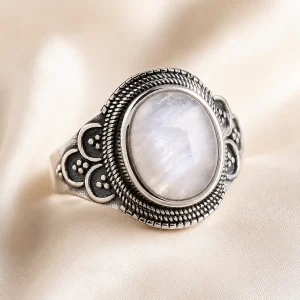
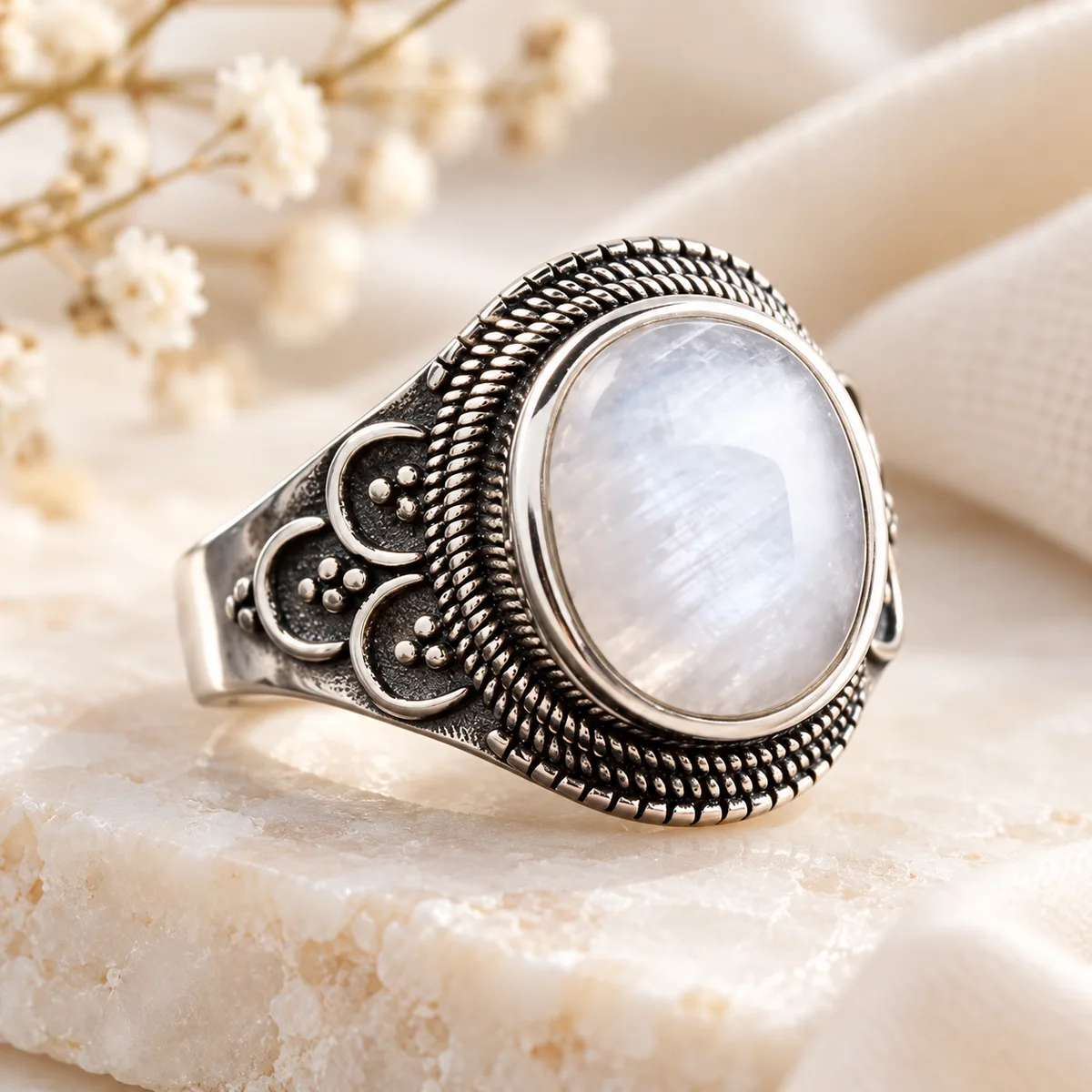
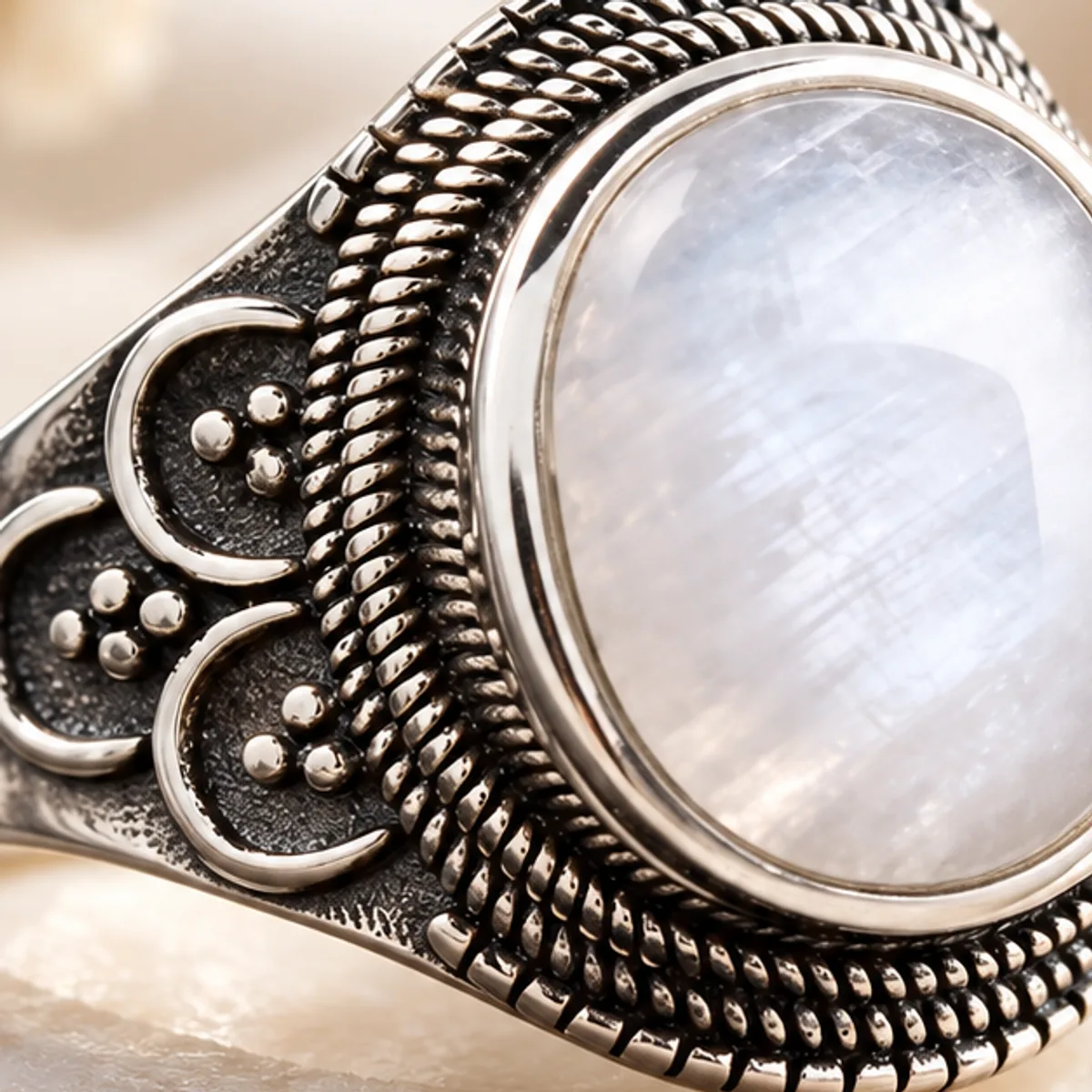
An oval signet ring, the stone framed by a twisted wire, and around that frame four small flowers stamped into the silver. A wide band, a full surface, and a motif that is read rather than glimpsed.
Flowers on a signet ring
A signet ring is a flat surface, and a flat surface is an invitation. Historically it carried arms or initials; here it carries four small flowers, set at the compass points around the stone, each a raised disc with five petals and a beaded centre. The motif is small enough not to fight the cabochon and large enough to survive the oxidation, which is the balance to find on any decoration under 3 mm.
The flowers are struck with a punch rather than engraved. A punch is a steel tool with the motif cut into its end: it is placed on the metal and hit once. The mark is instant and slightly different every time, because no two hammer blows are identical. That irregularity is how you tell struck work from cast work, where the four flowers would be perfectly identical clones. Look closely at the petals and you will see one is always a fraction deeper.
Between the flowers, a twisted wire runs around the bezel and holds the composition together. Without it the four flowers would float on the surface with nothing to relate them to the stone. With it, they read as a border, and the eye moves round the ring instead of bouncing between four separate points. It is a small thing that took several attempts to get right.
The stone sits in a closed bezel, flush with the shoulders, so the ring passes through a sleeve without catching. It is a wide band, so take a quarter size up compared to a thin ring. The blue veil is the only cool note in a warm, worked piece. The other rings are here.
- Oval moonstone cabochon, closed bezel, set flush with the shoulders.
- 925 sterling silver hallmarked S925, wide band, four flowers struck with a punch.
- Twisted wire around the bezel, oxidised then rubbed back by hand.
- UK sizes I 1/2 to T 1/2, that is 48 to 62 mm. Delivered in two weeks.
The specifications
- Stone
- Real moonstone (adularia), oval cabochon
- Origin
- India
- Metal
- 925 sterling silver, S925 hallmark
- Setting
- Closed bezel, set flush, no glue
- Shape
- Oval signet ring, wide band
- Decoration
- Twisted wire and four struck flowers
- Finish
- Oxidized silver, crests rubbed back with a cloth
- Sizes
- UK I 1/2 to T 1/2 (48 to 62 mm)
- Gender
- Women
- Brand
- Melissa Moon
Struck, engraved, cast: telling them apart
Three ways to get a motif onto silver, and they do not age the same. A struck motif is compressed metal: the silver is denser where the punch hit, and it will still be there in fifty years. An engraved motif is removed metal, equally durable, and it shows tool marks on the walls of the furrow. A cast motif is neither, it is just the shape of a mould, and it is the one that softens over time because there is no work hardening in it.
For the buyer, the test is easy and needs no loupe. Look at four supposedly identical motifs on the same piece. If they are identical to the millimetre, they came out of a mould. If they differ slightly in depth and angle, someone struck or cut them one at a time. Neither is dishonest, but only one of them is handwork, and only one justifies the price.
I keep the punch marks slightly uneven on purpose. Evening them out would take an hour and would make the ring look machine made.
No salt, no ultrasonic tank, no hot water: moonstone is a feldspar, and all three damage it for good. No silver dip either: the black in the flower centres is what makes them visible, and a dip removes it in seconds. Lukewarm water, a soft cloth on the crests, a dry brush in the flowers once a month. The detail is in cleaning a moonstone piece, and the safe methods in caring for it without harming it. Flush set, the stone is well protected, which is what makes this a daily ring.