


Description
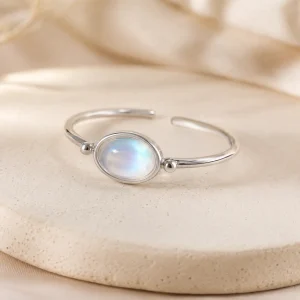
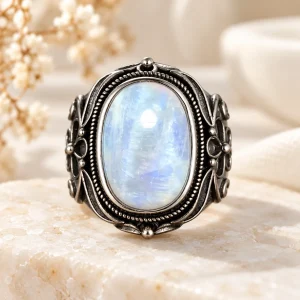
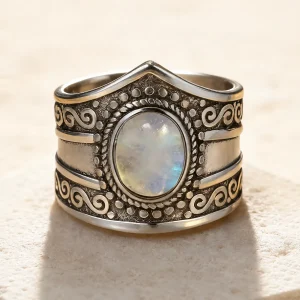
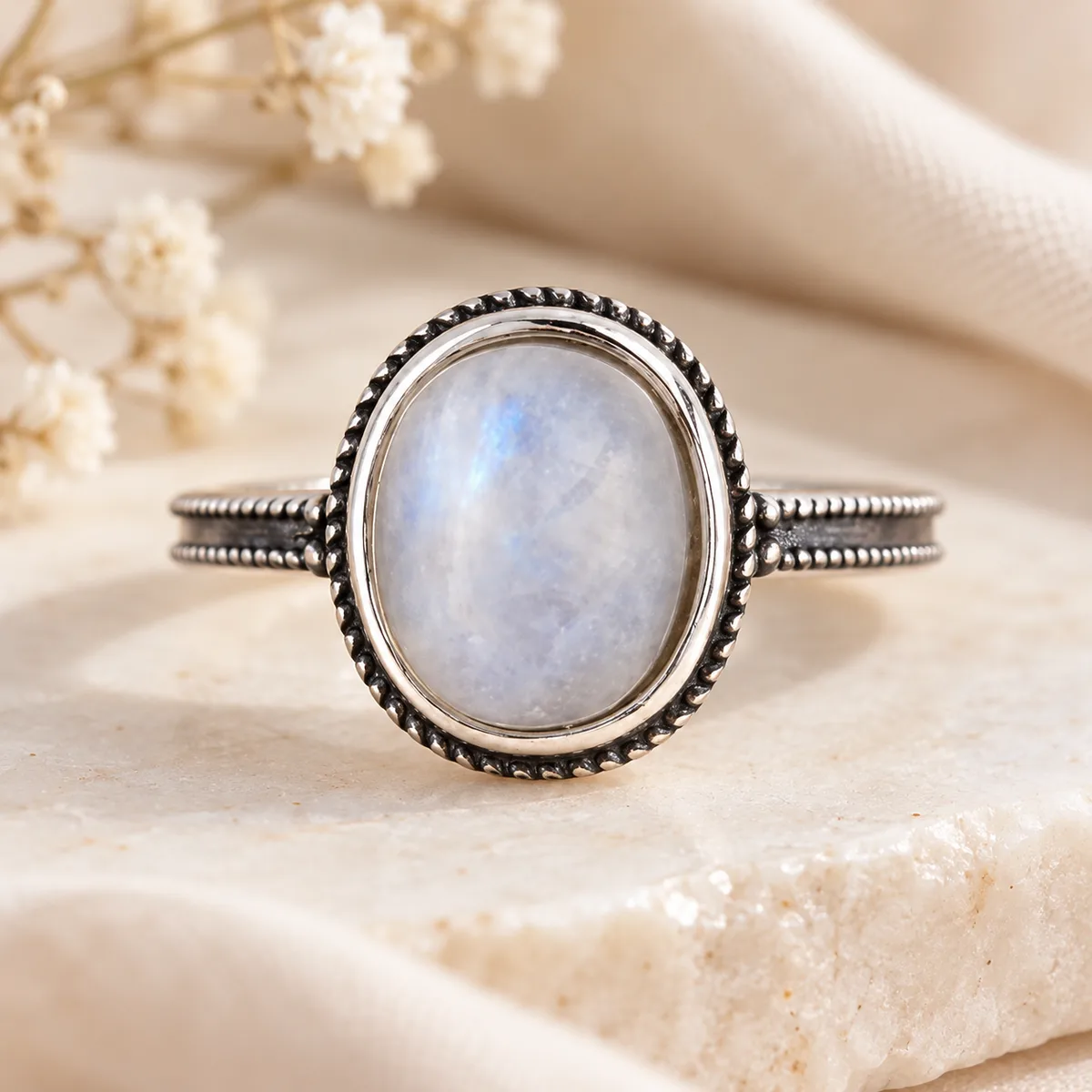
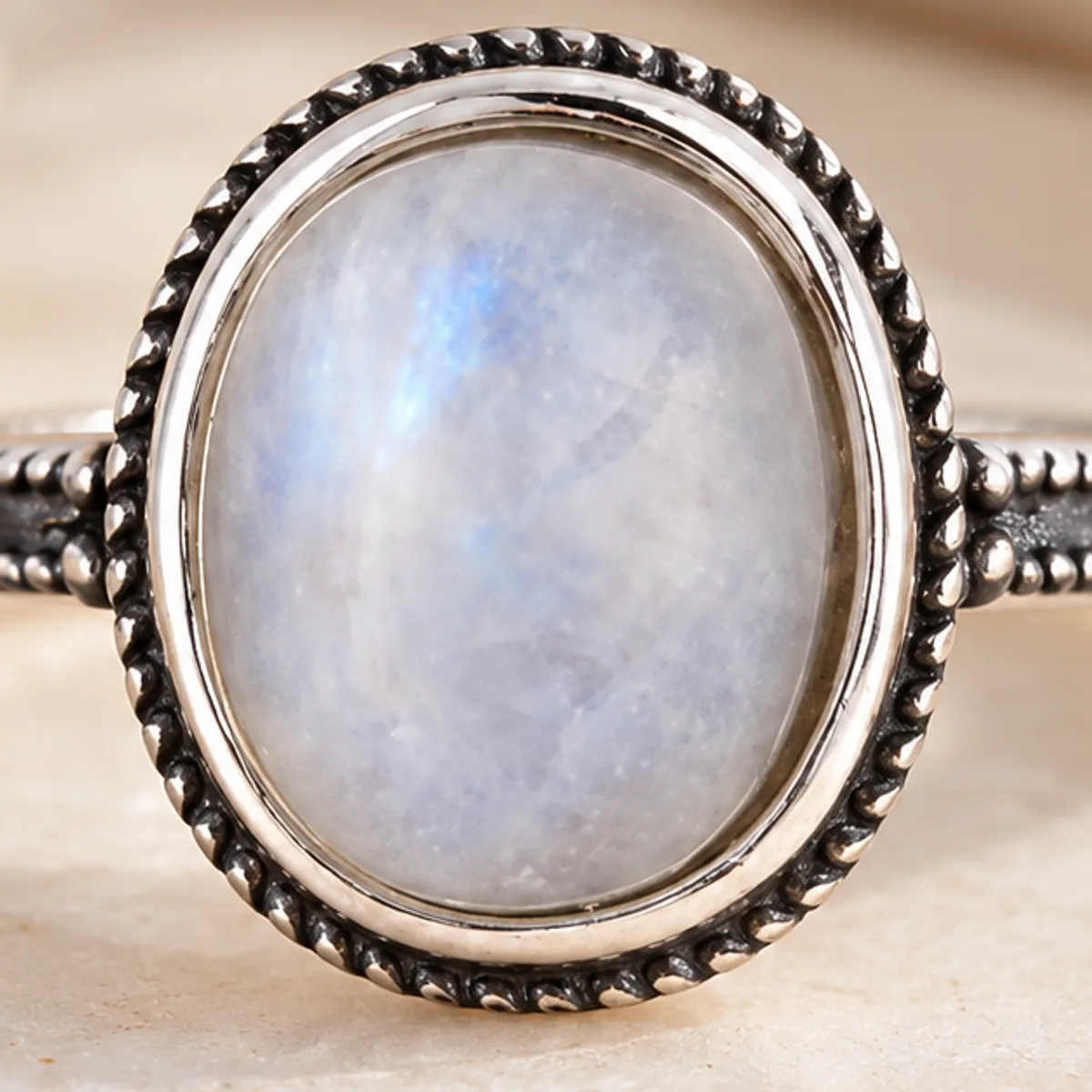
An oval cabochon, a fine beaded edge around it, and a band that runs as two thin lines with a gap of skin between them.
The gap is part of the design
Two thin bands with a space between is not a way of using less silver. It is a way of putting skin inside the outline of the ring. The eye reads the two lines and the gap as one object, and that object is wider than either band, but it weighs nothing extra and it lets light through. On a hand the effect is a broad, light ring, which is a combination a single band cannot give you at this price.
Empty space in a design has to look intended or it looks like something missing. The rule I follow is that the gap must be narrower than each band is wide, otherwise the two bands stop reading as a pair and start reading as two separate rings that happen to be touching. Here the gap is about the width of one band, which is the widest I will go, and it is why the ring holds together visually.
The surround is a fine beaded edge, made of beads small enough that from a normal distance you read a soft glitter rather than individual grains. That kind of very small beading is called millegrain, and it does a specific job on a pale stone: it puts a line of tiny highlights between the metal and the cabochon, so the blue veil has something bright to be compared against, and it gains contrast without a black frame.
The stone sits in a closed bezel under the millegrain, and the whole head is low. The two bands are joined at the shoulders and separate everywhere else. It is a comfortable ring, and it goes well next to a plain band, provided the plain band goes on the other side of the finger rather than between the two. The other rings are here, and the size guide takes two minutes.
- Oval moonstone cabochon, closed bezel, fine millegrain edge.
- 925 sterling silver hallmarked S925, double band with an open gap.
- Wide to look at, light to wear: the gap is part of the design.
- UK sizes I 1/2 to T 1/2, that is 48 to 62 mm. Delivered in two weeks.
The specifications
- Stone
- Real moonstone (adularia), oval cabochon
- Origin
- India
- Metal
- 925 sterling silver, S925 hallmark
- Setting
- Closed bezel, no glue
- Shape
- Double band joined at the shoulders
- Decoration
- Fine millegrain edge around the bezel
- Finish
- Oxidized silver, crests rubbed back with a cloth
- Sizes
- UK I 1/2 to T 1/2 (48 to 62 mm)
- Gender
- Women
- Brand
- Melissa Moon
Millegrain, and why it is disappearing
Millegrain is made with a small steel wheel that has notches cut into its rim. You run it along the edge of the metal under pressure and it raises a row of tiny beads, dozens per centimetre. It takes a steady hand and a wheel in good condition, and a worn wheel gives an uneven row that has to be filed off and redone. It is skilled, quick when it goes well, and completely ruined by one slip.
It is disappearing because casting cannot reproduce it convincingly. A cast millegrain has rounded, soft beads with no crisp tops, and once you have seen a raised one you cannot unsee the difference. Manufacturers therefore drop the detail rather than fake it badly, and the technique survives mostly on repairs and on small workshops. That is a reason to like it that has nothing to do with how it looks.
Millegrain is the detail customers never name and always notice. They say the edge looks finished, and that is exactly what it is doing.
No salt, no ultrasonic tank, no hot water: moonstone is a feldspar, and all three damage it for good. Millegrain holds dirt between its beads and a cloth will not reach in there, so rinse under lukewarm water and use a dry soft brush once a month. Avoid silver dips: the oxidation between the beads is what makes the row visible, and without it millegrain looks like a plain edge. The detail is in cleaning a moonstone piece, and the safe methods in caring for it without harming it. The low head keeps the risk of chipping down.