


Description
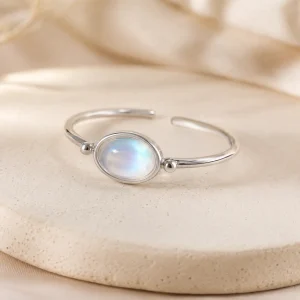
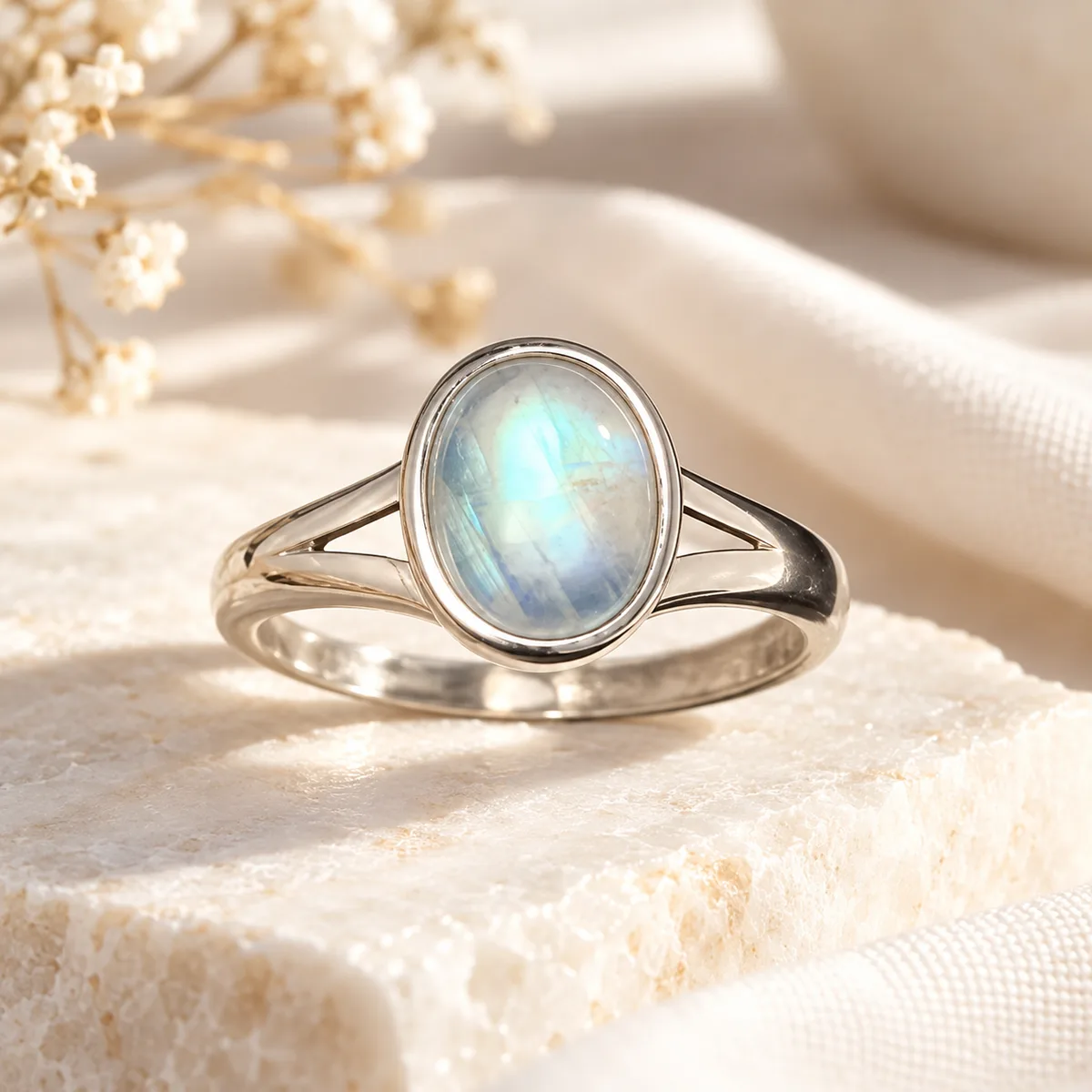
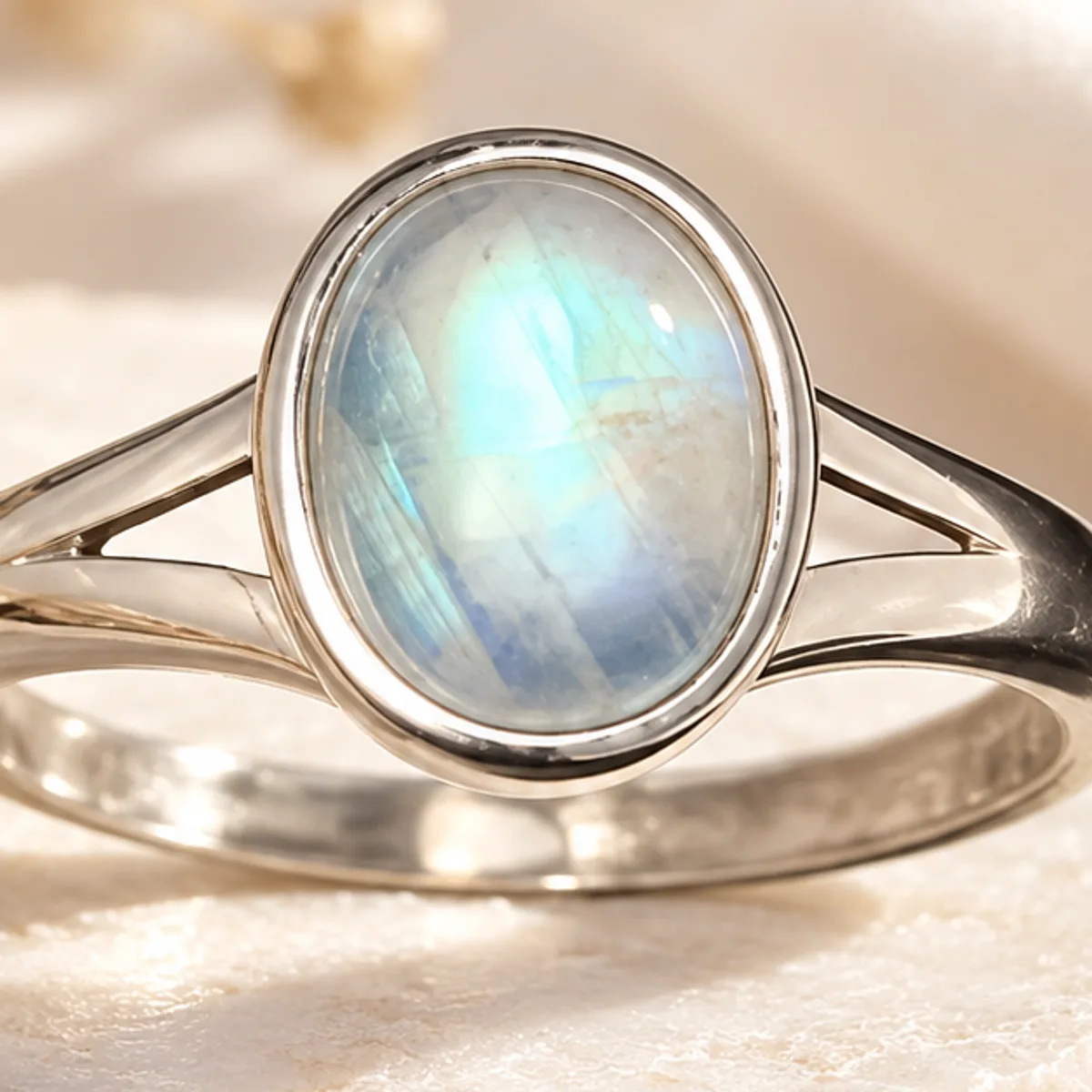
An oval cabochon, a smooth bezel, a split shank. Three elements and nothing else. This is the ring I recommend when somebody tells me they only want one.
The ring nobody regrets
Worked jewellery has a fault that nobody raises at the moment of purchase: it belongs to a period. Filigree, lace and baroque ornament all carry a date, and that date eventually shows. A stone in a smooth rim on a plain shank carries none: the same drawing existed in the first century and will still exist in fifty years. It is less exciting to look at in a window, and it is the only model I can recommend without reservation to somebody who wants to buy once.
The stone is a large oval cabochon, and on a model with no ornament it has to carry everything. The sorting is therefore stricter than on a worked setting: an off centre veil, an uneven dome or a body that is too milky have nowhere to hide. On this one the adularescence slides from one edge to the other as the hand turns, and stays visible across a wide range of angles.
The setting is a smooth closed bezel, with no claws and no glue, its rim folded down evenly all the way round. That is the most visible gesture on a bare ring: the smallest variation in thickness would read as a fault in the drawing. It also protects the stone, which chips on impact despite a respectable hardness.
The shank splits halfway round into two parallel polished branches that rise to the sides of the bezel without meeting. That construction lightens the silhouette and frames the stone with two bright lines. The other rings are here, and the size guide will save you a return.
- Large oval cabochon of real moonstone, mobile and well centred blue veil.
- 925 sterling silver hallmarked S925, smooth closed bezel, polished split shank.
- No ornament at all: a drawing with no date, which will not go out of fashion.
- UK sizes I 1/2 to T 1/2, that is 48 to 62 mm. Delivered in two weeks.
The specifications
- Stone
- Real moonstone (adularia), large oval cabochon
- Origin
- India
- Metal
- 925 sterling silver, S925 hallmark
- Setting
- Smooth closed bezel, no claws, no glue
- Shape
- Split shank, two parallel polished branches
- Finish
- Polished silver, no oxidation
- Sizes
- UK I 1/2 to T 1/2 (48 to 62 mm)
- Gender
- Women
- Brand
- Melissa Moon
Why the plain one is the hardest
This is the model that goes back in the crucible most often, which surprises people who assume the elaborate pieces are the difficult ones. Ornament forgives: a slightly heavy scroll reads as character. A smooth rim does not forgive anything, because the eye follows an unbroken line and finds the one place where it thickens. I true the bezel under a loupe and I still reject pieces that would pass on a decorated ring.
The same goes for the stone. On a ring with beads, twists and leaves, a mediocre cabochon disappears into the composition. Here there is nothing to look at but the stone, so the ones I would use elsewhere go elsewhere. That is the real reason this apparently simple ring sits at the top of the range and not the bottom.
Ornament hides the work. A smooth rim shows every hour you did not spend on it.
No salt, no ultrasonic tank, no hot water: moonstone is a feldspar, and all three damage it for good. A polished bare ring shows scratches on the silver more than an oxidised one, which is cosmetic rather than serious and comes back with a polishing cloth. Cleaning a moonstone piece covers the routine and caring for it without harming it the rest. The closed bezel is what keeps chipping to a small risk.