


Description
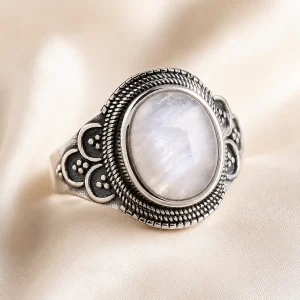
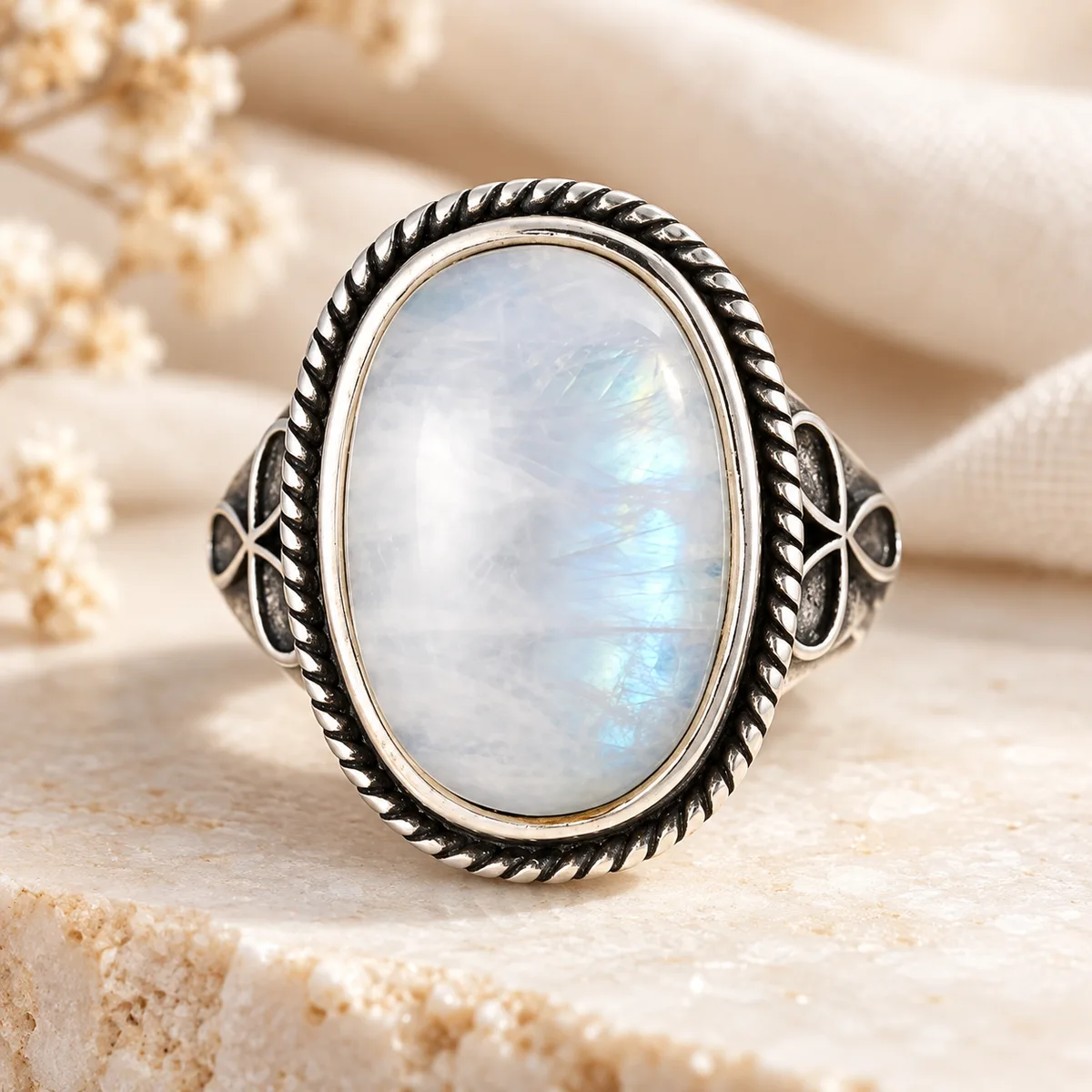
A large oval cabochon, a twisted silver wire all around it, and worked shoulders climbing toward the stone. This is the model people ask for when they want the stone seen from across a room.
Why a large cabochon changes the nature of the piece
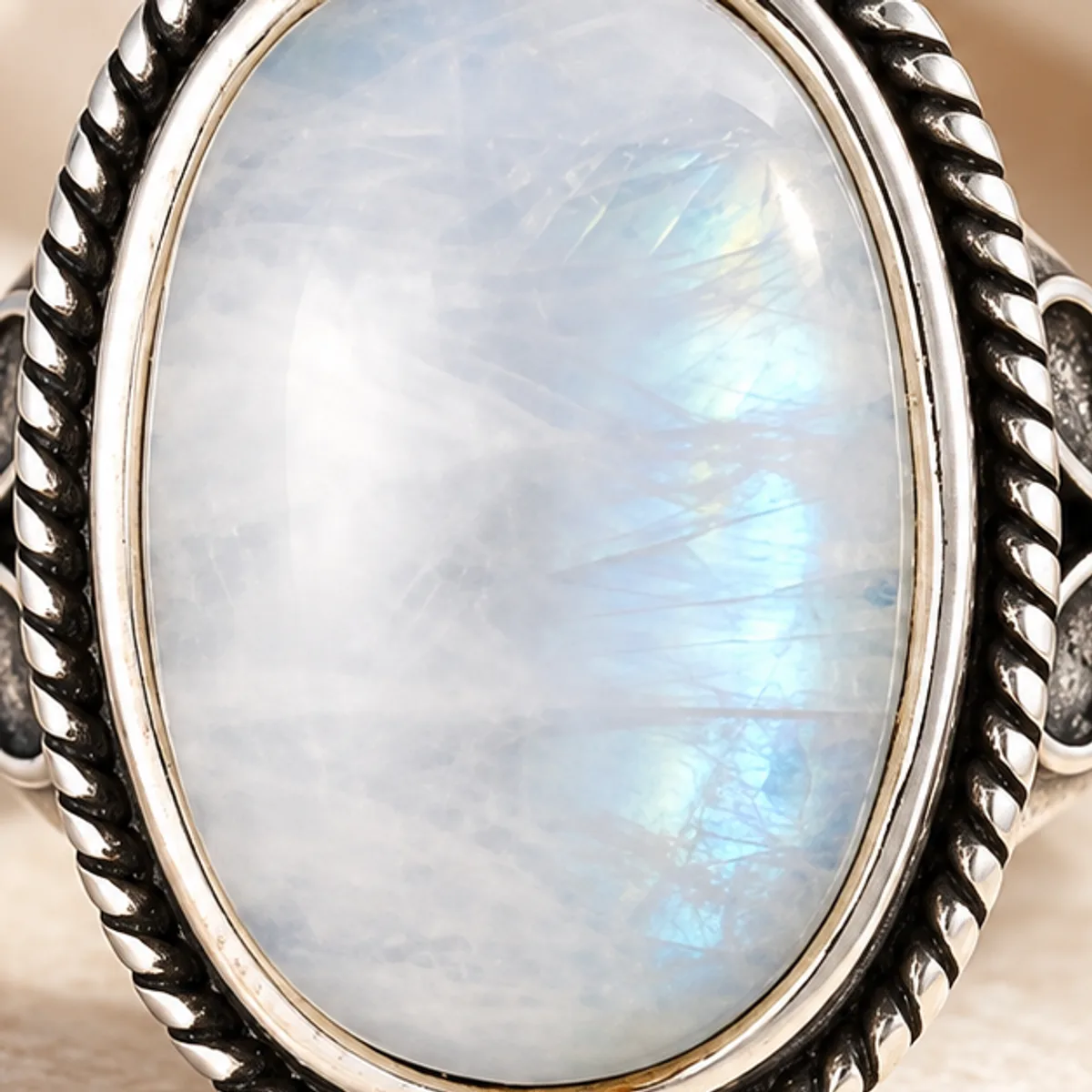
On a moonstone, the size of the cabochon is not only a difference in price, it changes what the eye perceives. On a small dome, adularescence lights up all at once when the angle is right, then vanishes. On a large dome like this one, the veil has room to travel: it slides from one edge to the other as you turn your hand, and it stays visible across a far wider range of angles. It is the same optical phenomenon, stacked feldspar layers scattering light, but it becomes a movement instead of a flash.
The trade-off exists, and I would rather say it. A large stone shows everything: the inclusions, the little milky veils, the variations in transparency from edge to edge. On a cabochon this size, a perfectly clean stone would cost three times the price of this ring. This one has a slightly milky body, a few fine internal fissures visible only very close up, and a clear, centered blue reflection. That is the right compromise for a piece meant to be worn, and moonstone quality explains how those criteria rank.
The twisted wire around the stone is a silver rope, made by twisting two wires together before soldering them into a crown. It is the oldest motif in silverwork, and it has a technical merit: the twist breaks light into small segments, which softens the border between bright metal and matte stone. Without it, a plain bezel would draw a hard line around the cabochon. The shoulders then climb toward the stone in two solid scrolls, oxidized in the hollows, rubbed back on the crests.
The stone is held in a bezel setting, no prongs and no glue. On a large cabochon that is almost compulsory: moonstone has perfect cleavage, it chips on impact, and the larger the exposed surface, the more a free edge becomes a risk. The ring is worn on the ring finger or the middle finger. The other rings are here, and the size guide will save you a return.
- Large oval moonstone cabochon, a blue veil that travels across the whole surface.
- 925 sterling silver hallmarked S925, soldered twisted-wire surround, solid scrolled shoulders.
- Bezel set with no glue, no edge of the stone left exposed.
- US sizes 4 1/2 to 10 (48 to 62 mm). Shipped in two weeks with a cotton pouch and a care card.
The specifications
- Stone
- Real moonstone (adularia), large oval cabochon
- Origin
- India
- Metal
- 925 sterling silver, S925 hallmark
- Setting
- Bezel set, no glue
- Decoration
- Twisted-wire surround, scrolled shoulders
- Finish
- Polished silver, oxidized hollows
- Sizes
- US 4 1/2 to 10 (48 to 62 mm)
- Gender
- Women
- Brand
- Melissa Moon
What I look at before accepting a large stone
Three things, in this order. First, whether the veil is centered: a reflection pushed to one edge disappears the moment the hand moves, and on a large cabochon that flaw is twice as visible as on a small one. Then the evenness of the dome, because uneven polishing cuts the veil into patches instead of letting it slide. Finally the inclusions, and there I am less severe than you might think: a perfectly pure moonstone exists, it costs a lot, and it is not more beautiful.
What I always reject are stones whose veil only shows under artificial light. It happens more often than you would imagine, and it is invisible in a shop lit by spotlights. So I look at all my stones at a north-facing window, never under a lamp.
A poor large stone is seen from across the room. A poor small stone goes unnoticed. That is why I sort large cabochons longer than anything else.
No salt, no ultrasonic tank, no hot water: moonstone is a feldspar, and all three damage it for good. Lukewarm water, a soft cloth, and the ring comes off before the shower, the pool and the housework. Silver polishing cloths should stay away from the oxidized hollows of the shoulders. The detail is in cleaning a moonstone piece, and the safe methods in caring for it without harming it.