


Description
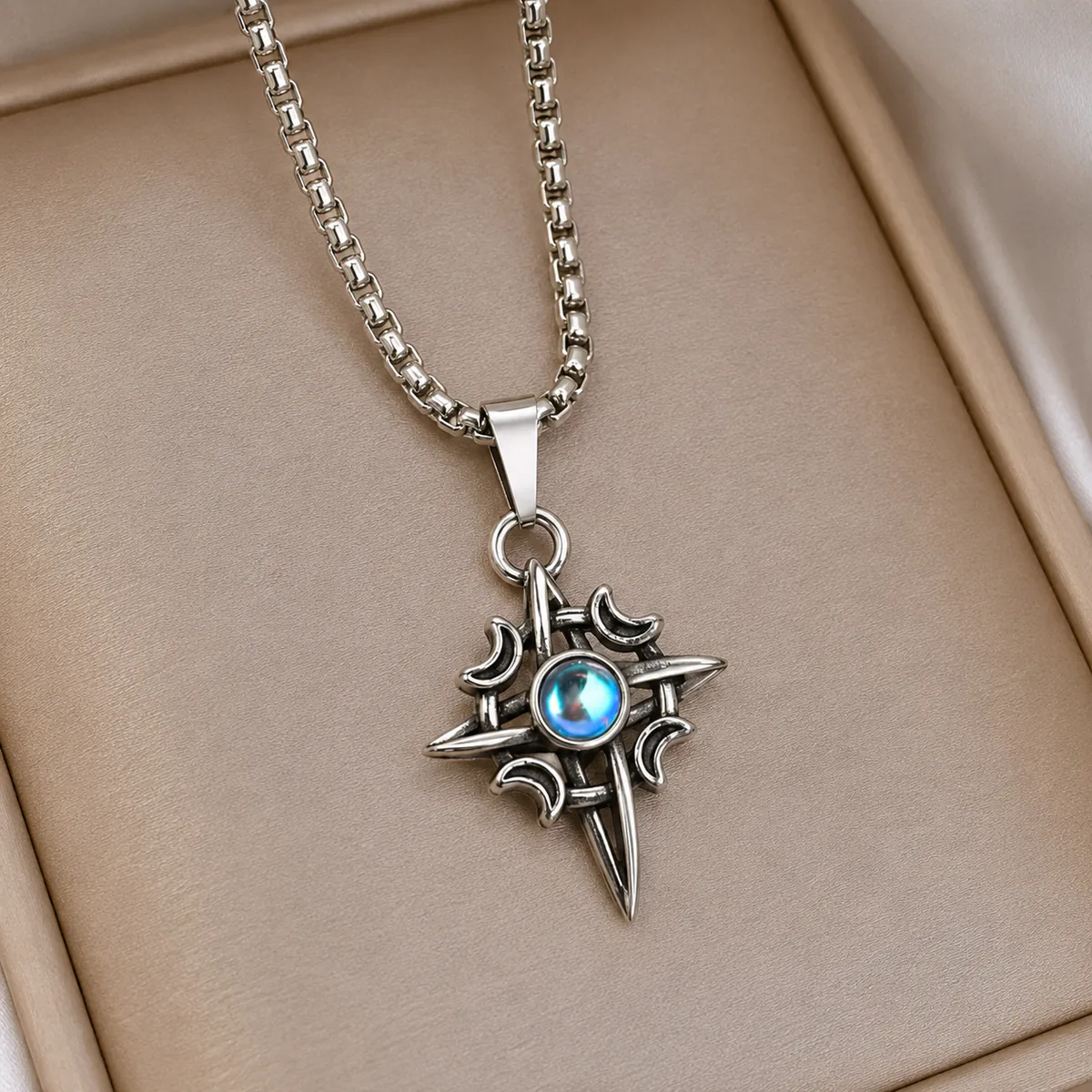
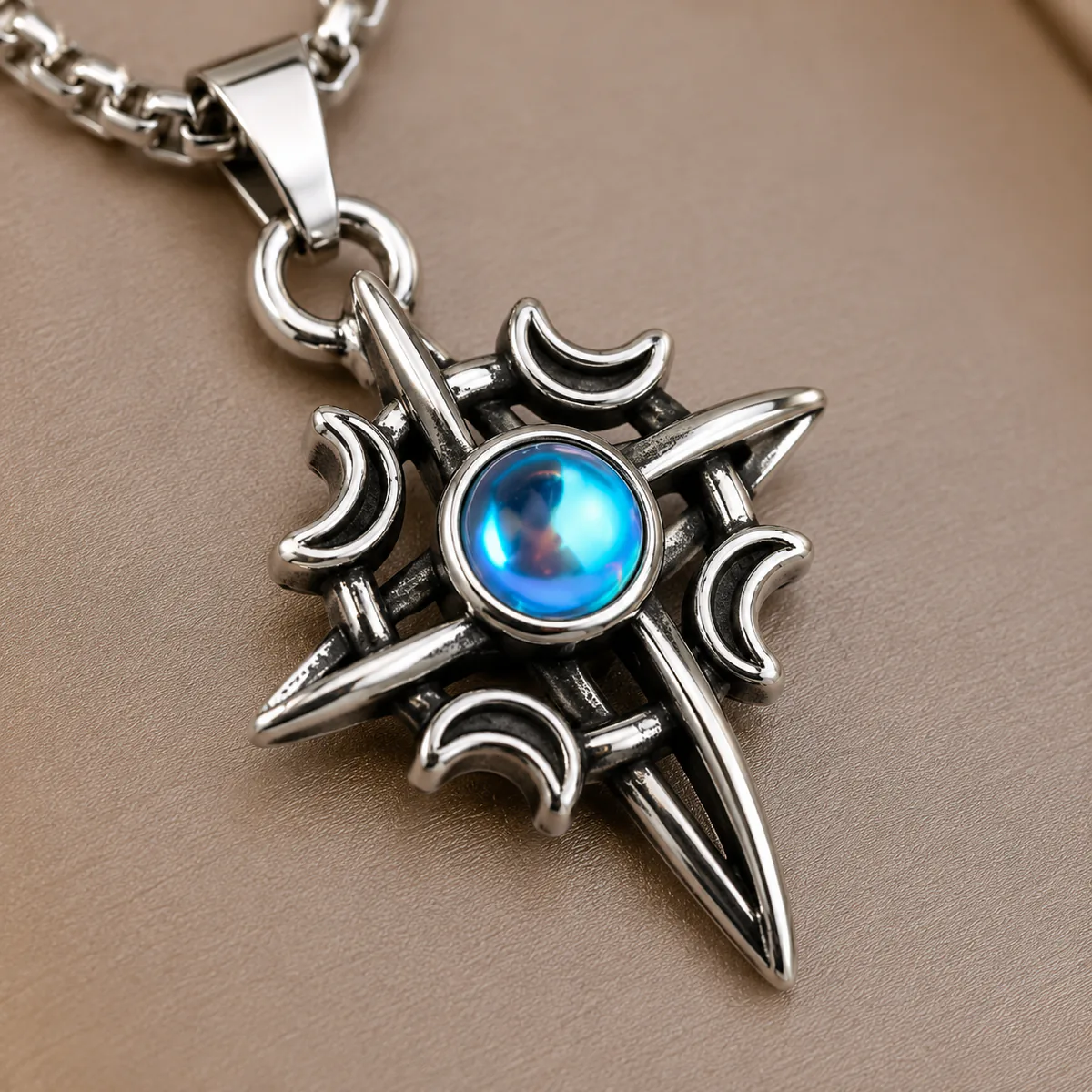
A star with tapered points, doubled by crescents between each tip, entirely blackened in its hollows, and at the center a small round cabochon whose blue lights up the moment you move. All of it on a plain square-link chain. It is the most angular piece in the catalog, and the only one that pricks.
Points, and what they do day to day
Let us start with what you notice first once the piece is worn, and which nobody writes down: this pendant has points, and they behave like points. It is not a fault, it is the design, but it is better known beforehand than after.
Three situations come back. Fine knits first: a wool sweater, a scarf, a knitted collar catch on a tapered arm far more easily than on a round pendant. Wear it over the garment rather than under, which is anyway where a piece this size belongs. The bent-forward position next: when you lean down, a pointed pendant presses into the skin instead of lying flat, and you feel it. Surfaces last: set down on a varnished table or a dashboard, it scratches, because all its weight rests on three or four tiny points.
In use, those same points are the zones that will age fastest: they blunt, they polish through contact, and the black in the hollows wears off there first, which brings the drawing out rather than spoiling it. On this kind of piece, aging tends to go the right way. The rule holds in three words: nothing that polishes.
The stone is the softest part, and the best protected
Here is this model’s particularity, and it settles a legitimate worry. A moonstone cabochon is by far the most fragile element of this assembly: it chips on impact rather than scratching, whereas the metal around it takes just about anything.
Now look at the construction: the stone sits at the geometric center of the star, recessed relative to the arms, and its bezel is lower than the points surrounding it. In other words, anything that reaches this pendant touches metal before it reaches the stone. It is the most protective mounting in the catalog, and it is so by accident as much as by design: an aggressive shape makes an excellent bumper.
The check is the same as on any set stone, and it takes five seconds a month: put the pad of your finger on the cabochon, push it gently sideways, it must neither move nor click. On a piece in relief, add a fingernail run along the arms: nothing should catch, and a point that has opened or bent can be straightened as long as it has not broken. The shop’s other pendants are here.
Silver or steel, what changes for you
Men’s jewelry is made in both materials, they look alike once patinated, and yet they do not behave at all the same way. Worth setting out the differences, they will serve you for any purchase of this kind.
Silver darkens and can be brought back. It tarnishes in air, it scratches fairly easily, but it repolishes indefinitely, it solders, it repairs, and it carries a mark guaranteeing its fineness. It is a living metal, which a jeweler restores in a few minutes. Steel barely moves at all. It does not tarnish, it resists scratches far better, it demands no care, but in exchange it cannot be worked in a jewelry workshop: a broken steel chain is replaced, it is not soldered back at the local jeweler, and there is no guarantee mark for it.
How to tell? Look for a stamp with a loupe on the bail or the clasp tag, a tiny 925; weigh the piece in your hand, silver being distinctly heavier than steel at equal volume; and look at the color, steel pulling slightly toward grey where silver pulls toward a warm white. Neither material is better than the other, they answer two different expectations, and the only real problem would be paying for one while believing you are buying the other. The sizing guide explains how to choose a length, reckoning longer than for a woman’s neck.
Crystal healing tradition lends moonstone correspondences tied to cycles, which raises in passing a question I have dealt with further down. I will go no further: none of it is demonstrated and no piece of jewelry heals anything. Separately, I have gathered what tradition lends this stone and what each color changes.
- Star with tapered arms and crescents, blackened hollows, small cabochon set at the center.
- The points catch knits and scratch surfaces: wear it over, set it down on fabric.
- The stone is recessed at the center: anything that arrives touches metal before it.
- Delivered in two weeks with a cotton pouch, a handwritten note and a care card.
The specifications
- Stone
- Moonstone, small round cabochon
- Look
- Translucent blue, moving sheen
- Metal
- Finish patinated black in the hollows
- Motif
- Star with tapered arms, crescents between
- Setting
- Bezel set, stone recessed
- Gender
- Men
- Brand
- Melissa Moon
Weight is the one quality a photograph does not show
On a screen, a solid pendant and a hollow stamped shell look identical line for line. Same drawing, same finish, same sheen, and one weighs three times the other. That is the difference nobody sees before opening the parcel, and it is precisely the one you notice first once the piece is in hand, especially on a men’s piece, where mass makes half the impression.
The useful reflex is therefore to look for the weight in grams in the specifications, on any shop, and to be wary when it is not there. A piece whose mass is not given is rarely a heavy piece. It is not an absolute quality criterion, a well-made hollow piece is still a piece of jewelry, but it is information the seller has and you do not. The rest of the shop is here.
Weight is the one quality a photograph does not show. Look for it in the specifications.
No salt, no ultrasonic tank, no hot water: all three damage the stone for good. And on this model, one rule outranks all the others: nothing that polishes, no silver cloth, no paste, no eraser, on pain of erasing the black in the hollows that draws the motif. Lukewarm water, a drop of mild soap, a very soft brush run between the arms, a rinse and a complete drying, dabbing under the crescents where water stays trapped. Store it flat and on its own: its points would scratch the other pieces in a box as surely as a varnished table. The detail is in cleaning a moonstone piece, and the safe methods in caring for it without harming it.