

Description
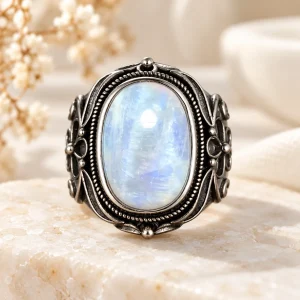
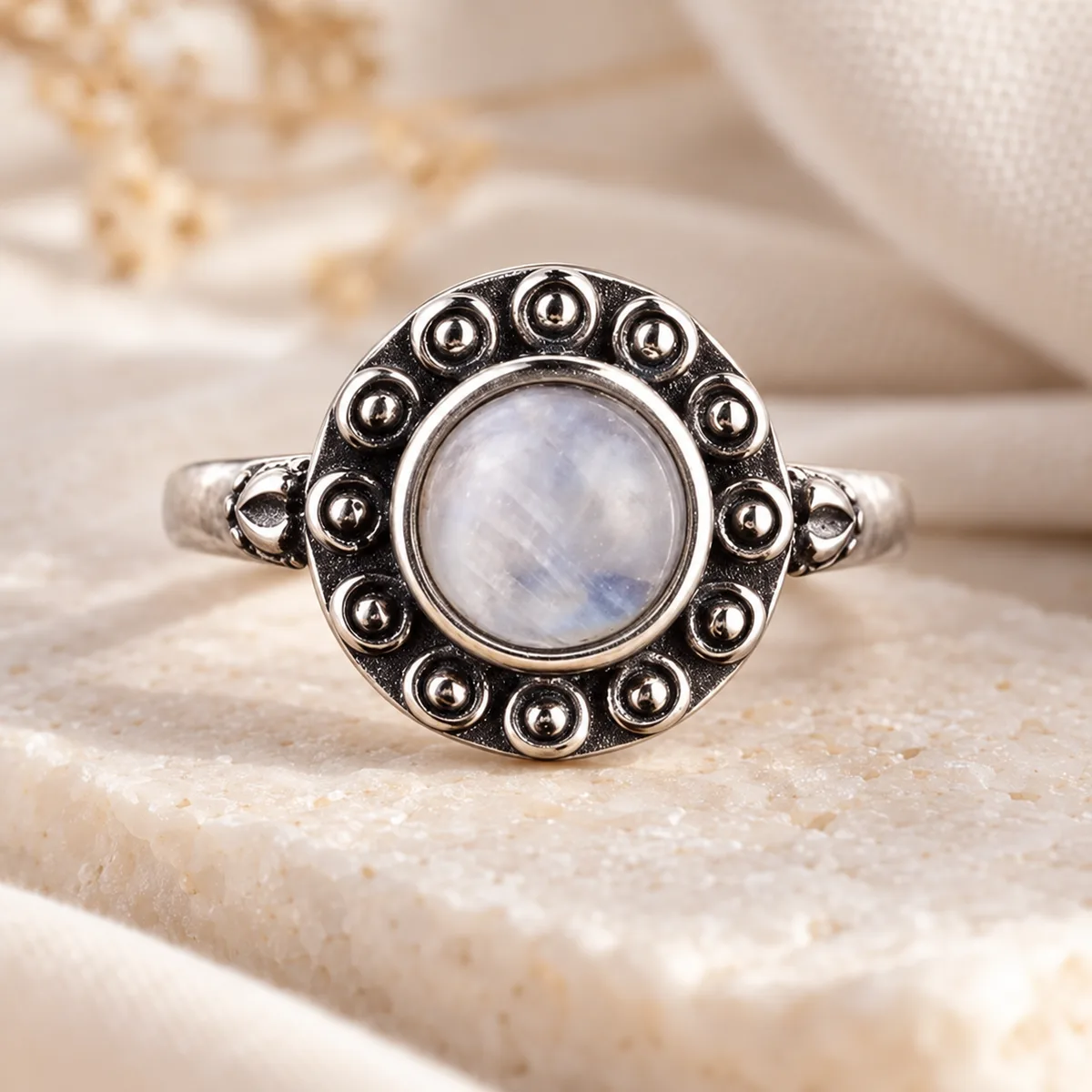
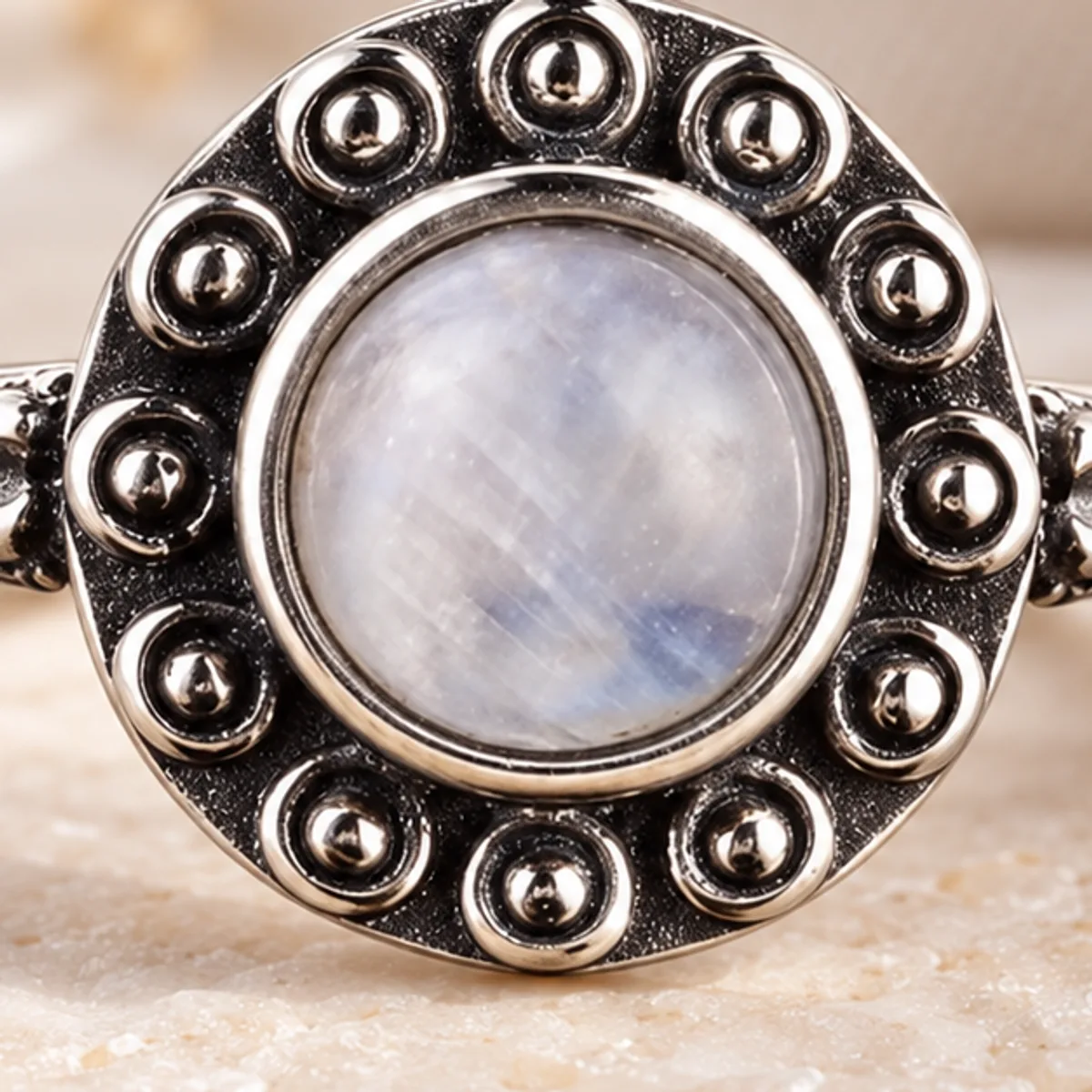
A round cabochon inside a ring of large dots, each one a dome flattened on top rather than a full sphere, carried on a band worked with scrolls.
A dome is not a sphere
These look at first like the granules used elsewhere in this collection and they behave completely differently, because a granule is a full sphere and these are domes with a flat top. A sphere has one point on its surface facing any given direction, so it returns a single small highlight wherever the light comes from. A flattened dome has a plane on top, and a plane returns the whole light source at once when the angle is right, then nothing at all when it is not.
The practical result is that a ring of spheres twinkles continuously and a ring of flattened domes flashes. Turn your hand slowly under a lamp and the dots light up together, all at the same moment, then go out together. It is a stronger and more abrupt effect, and it is the reason I use flattened dots when I want the surround to announce itself and granules when I want it to shimmer.
The flattening is done after setting, with a flat steel punch and one blow each. That is also a quality check: a dot that is not properly soldered comes loose under the punch rather than six months later on a hand. Flattening a surround of twenty dots therefore tests twenty joints in about a minute, which is the only free quality control I know of.
The band is worked with scrolls to keep the piece from being all dots, and the stone sits in a closed bezel at the center. The blue veil is continuous where the dots are intermittent. The other rings are here, and the size guide takes two minutes.
- Round moonstone cabochon, closed bezel at the center of the dots.
- 925 sterling silver hallmarked S925, large dots flattened with a punch, scrolled band.
- Flattened tops flash all together rather than twinkling separately.
- US sizes 4 1/2 to 10, that is 48 to 62 mm. Shipped in two weeks.
The specifications
- Stone
- Real moonstone (adularia), round cabochon
- Origin
- India
- Metal
- 925 sterling silver, S925 hallmark
- Setting
- Closed bezel, no glue
- Decoration
- Ring of large dots, flattened after soldering
- Shape
- Band worked with scrolls
- Finish
- Oxidized silver, crests rubbed back with a cloth
- Sizes
- US 4 1/2 to 10 (48 to 62 mm)
- Gender
- Women
- Brand
- Melissa Moon
The free quality check
Most quality control costs time and finds nothing, which is why it gets skipped. The good checks are the ones that are also a step in the work. Flattening the dots is one: the punch tests every joint at the moment it shapes it, so a bad solder reveals itself at the bench instead of on a customer’s hand. I did not invent this, it is why the technique exists in the form it does.
The same principle applies to setting a stone in a closed bezel: pushing the metal over the stone also tells you whether the seat underneath was cut properly, because a badly cut seat lets the stone rock and you feel it through the tool. A process that inspects itself is worth more than an inspection bolted on at the end, and most old techniques have that property built in.
The best check is the one you cannot skip because it is also how the thing gets made.
No salt, no ultrasonic tank, no hot water: moonstone is a feldspar, and all three damage it for good. The hollows around the dots hold cream, so rinse under lukewarm water and use a dry soft brush once a month. Avoid silver dips, they lift the oxidation from around the dots and the surround flattens visually. The detail is in cleaning a moonstone piece, and the safe methods in caring for it without harming it. The dots stand above the stone and take knocks first, which helps a stone that chips.