

Description
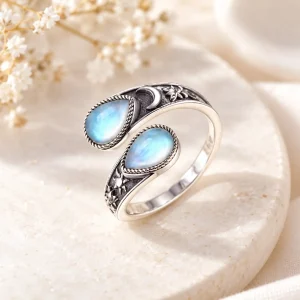
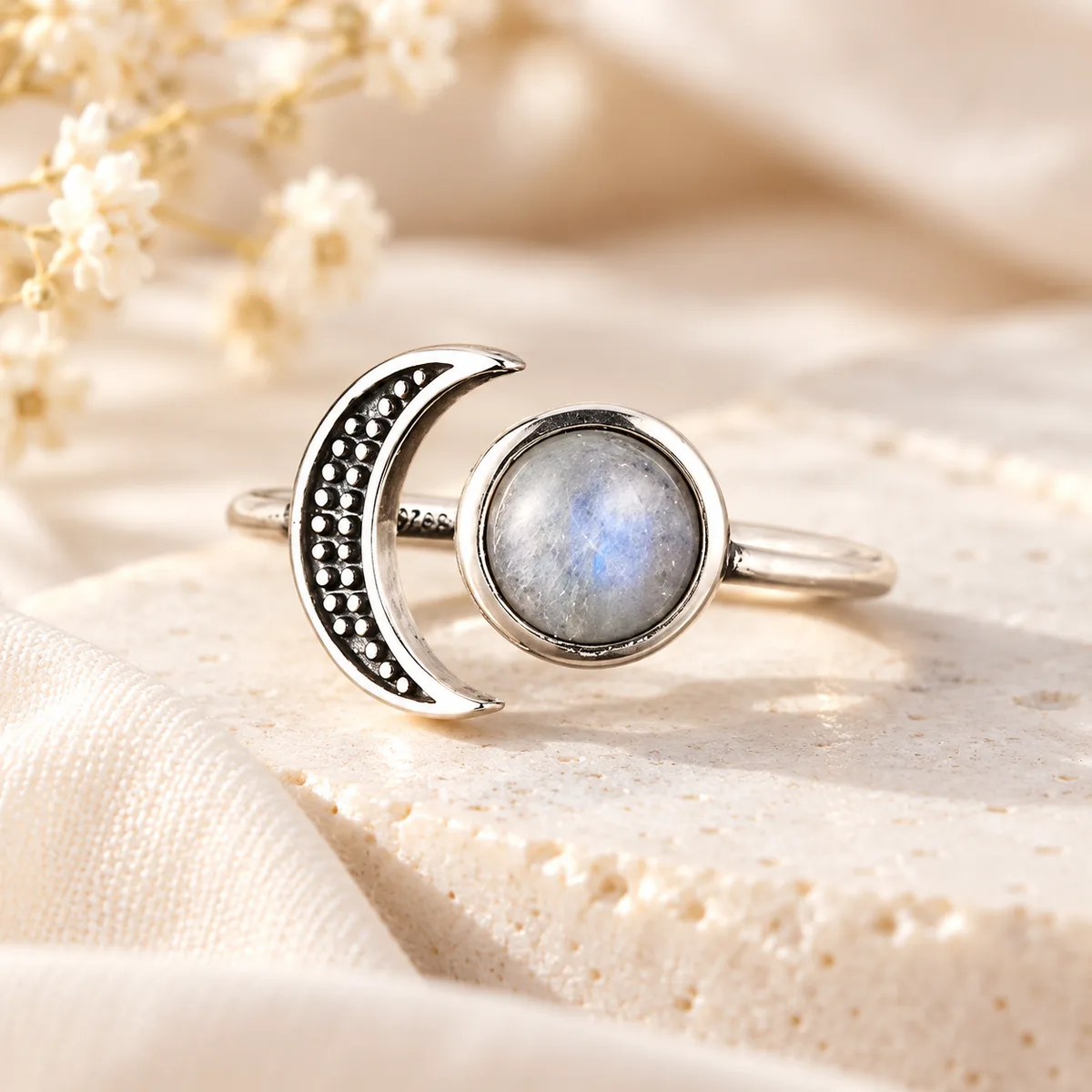
A small round cabochon, a crescent moon set just beside it, and a slim band that does nothing but carry them. Two shapes, one solid and one hollow, telling the same thing.
The circle and the crescent, one idea in two gestures
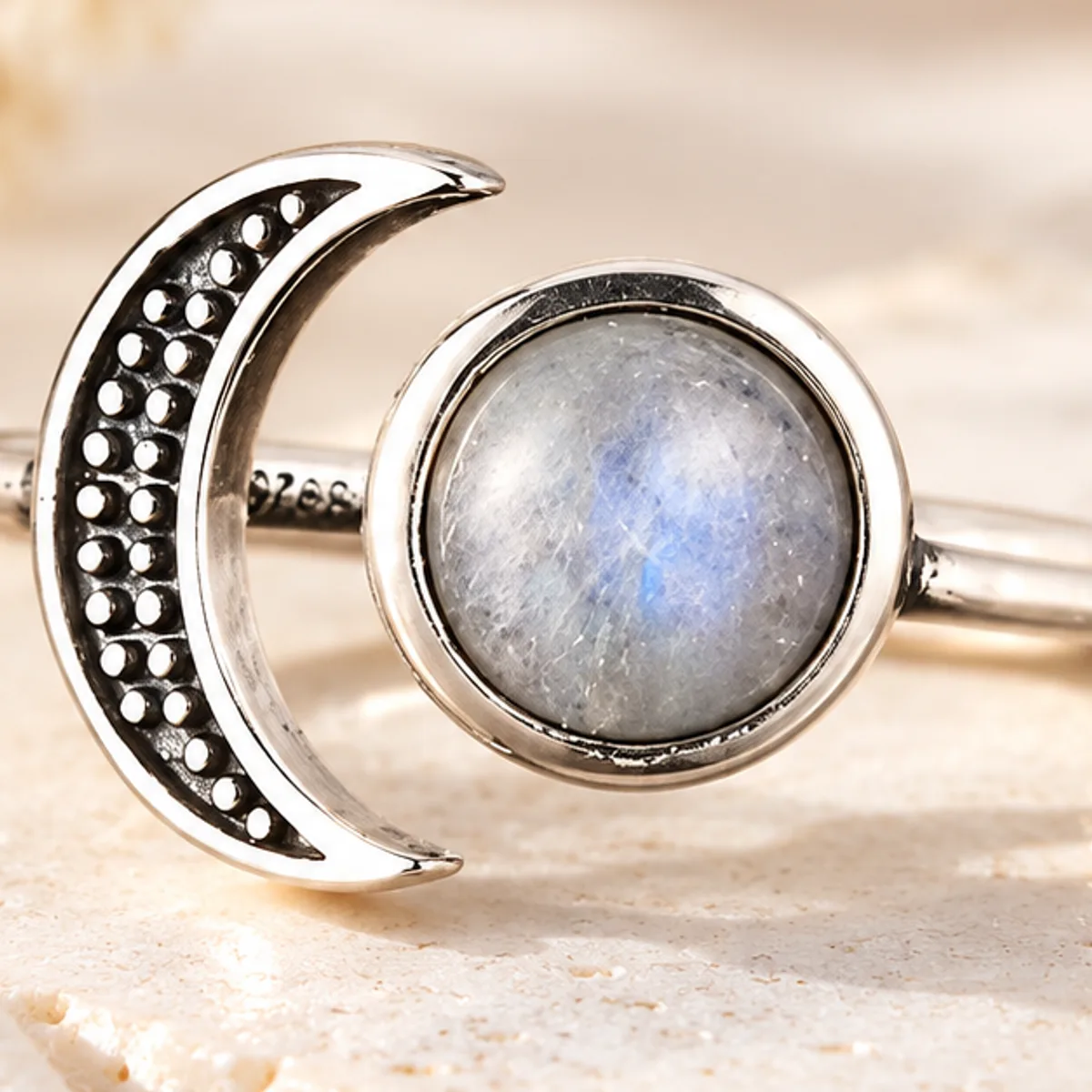
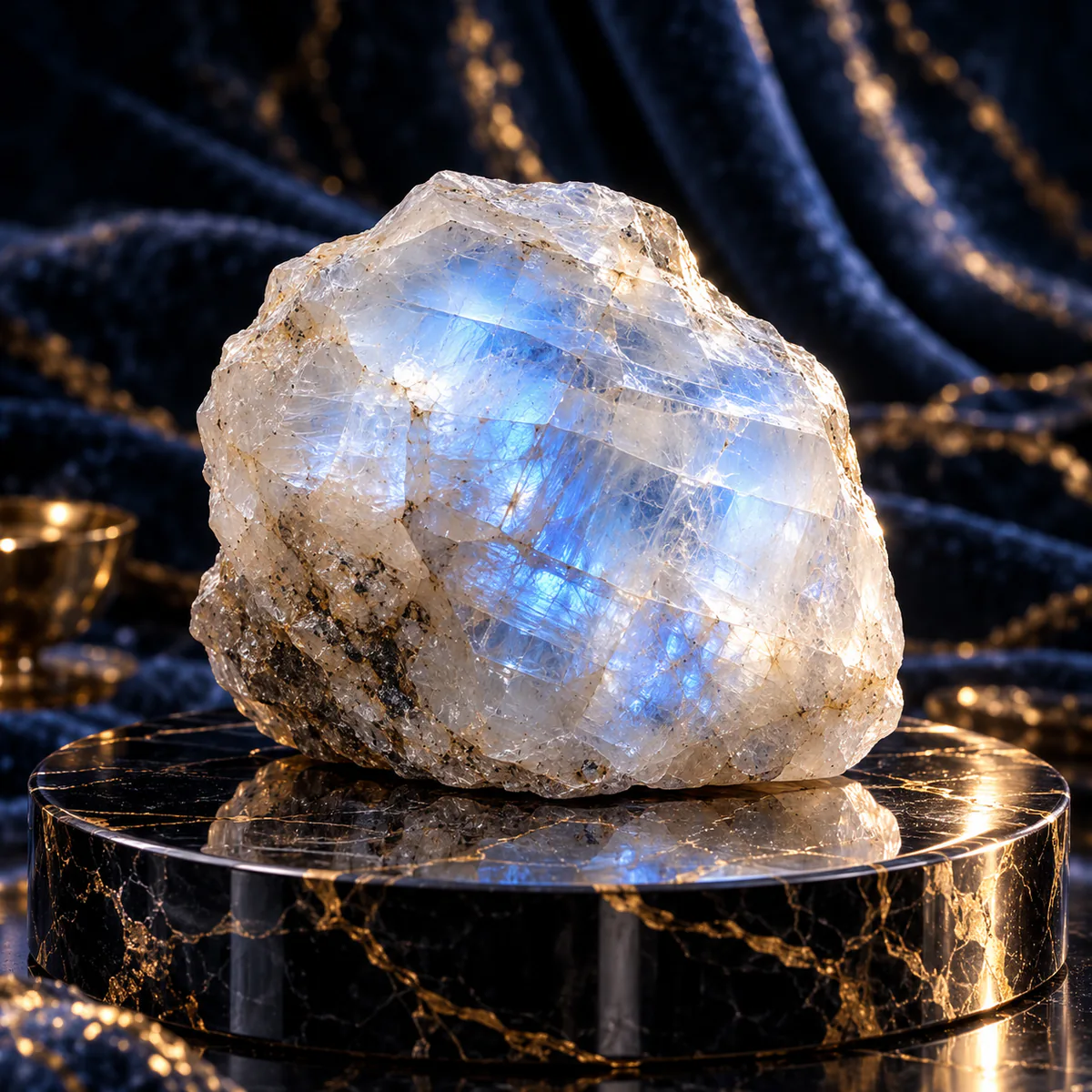
The cabochon is round, meaning its dome is an even cap rather than a stretched oval. That shape has an optical peculiarity: adularescence organizes itself into a disc of light at the center of the dome, instead of stretching into a band as it does on an oval. When the hand moves, the disc travels without changing shape. That is exactly what you see in the sky, and it is what makes the pairing with the engraved crescent beside it far less decorative than it looks.
The crescent is openwork: a blade of silver cut into an arc, soldered flat onto the band, the point turned toward the knuckle. It is not placed in perfect symmetry with the stone. It follows it a millimeter behind, the way the moon follows a phase. That offset is deliberate, and it is the only compositional detail of this ring. Without it the two shapes would answer each other too neatly and the piece would lose its movement.
The silver is oxidized, then the crests are rubbed back with a cloth. The crescent therefore keeps a dark ground in its concavity and a bright edge on its outer rim, which separates it from the band instead of letting it merge. On a piece this size that contrast is not a styling effect: without it, the crescent would vanish at arm’s length.
The mount is a bezel setting, no prongs and no glue. The band is two millimeters wide, the ring barely rises off the finger, and it sits happily on the little finger or the index, alone or against a plain band. Moonstone chips on impact, and a small bezel set cabochon is the best thing that can happen to it. The other rings are here, and if it is a gift, what a moonstone ring says was written for that question.
- Real moonstone, round cabochon, a disc of light centered on the dome.
- 925 sterling silver hallmarked S925, openwork crescent moon soldered beside the stone.
- Bezel set with no glue, slim 2 mm band. Nothing catches.
- US sizes 4 1/2 to 10, that is 48 to 62 mm. Shipped in two weeks.
The specifications
- Stone
- Real moonstone (adularia), round cabochon
- Origin
- India
- Metal
- 925 sterling silver, S925 hallmark
- Setting
- Bezel set, no glue
- Decoration
- Openwork crescent moon, soldered flat
- Finish
- Oxidized silver, crests rubbed back with a cloth
- Sizes
- US 4 1/2 to 10 (48 to 62 mm)
- Gender
- Women
- Brand
- Melissa Moon
Why a crescent rather than a full moon
A full moon, in silver, is a disc. Next to a round cabochon that gives two discs, one matte and one bright, and the piece looks like a manufacturing error. The crescent solves the problem in a single decision: it brings a hollow shape against a solid one, it introduces a point into a drawing that had none, and it says something truer. A phase is not a less complete object than another, it is the same object at another moment.
What you should know, on the other hand, is that the point of the crescent is the part of the piece that will lighten fastest. It rubs against the neighboring finger, the oxidation holds there less well than elsewhere, and after two years it will be noticeably brighter than the rest. I do not consider that a flaw, but it is better said beforehand.
I made a version with the moon on the other side, symmetrical, perfectly balanced. It was boring. The one millimeter offset is the whole ring.
No salt, no ultrasonic tank, no hot water: moonstone is a feldspar, and all three damage it for good. Lukewarm water, a soft cloth, and the ring comes off before the shower and the housework. No paste and no silver polishing cloth on the crescent: those products strip the black, and it is the black that makes the motif exist. The detail is in cleaning a moonstone piece, and the safe methods in caring for it without harming it.