


Description
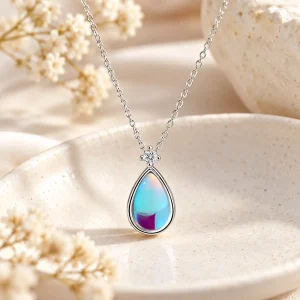
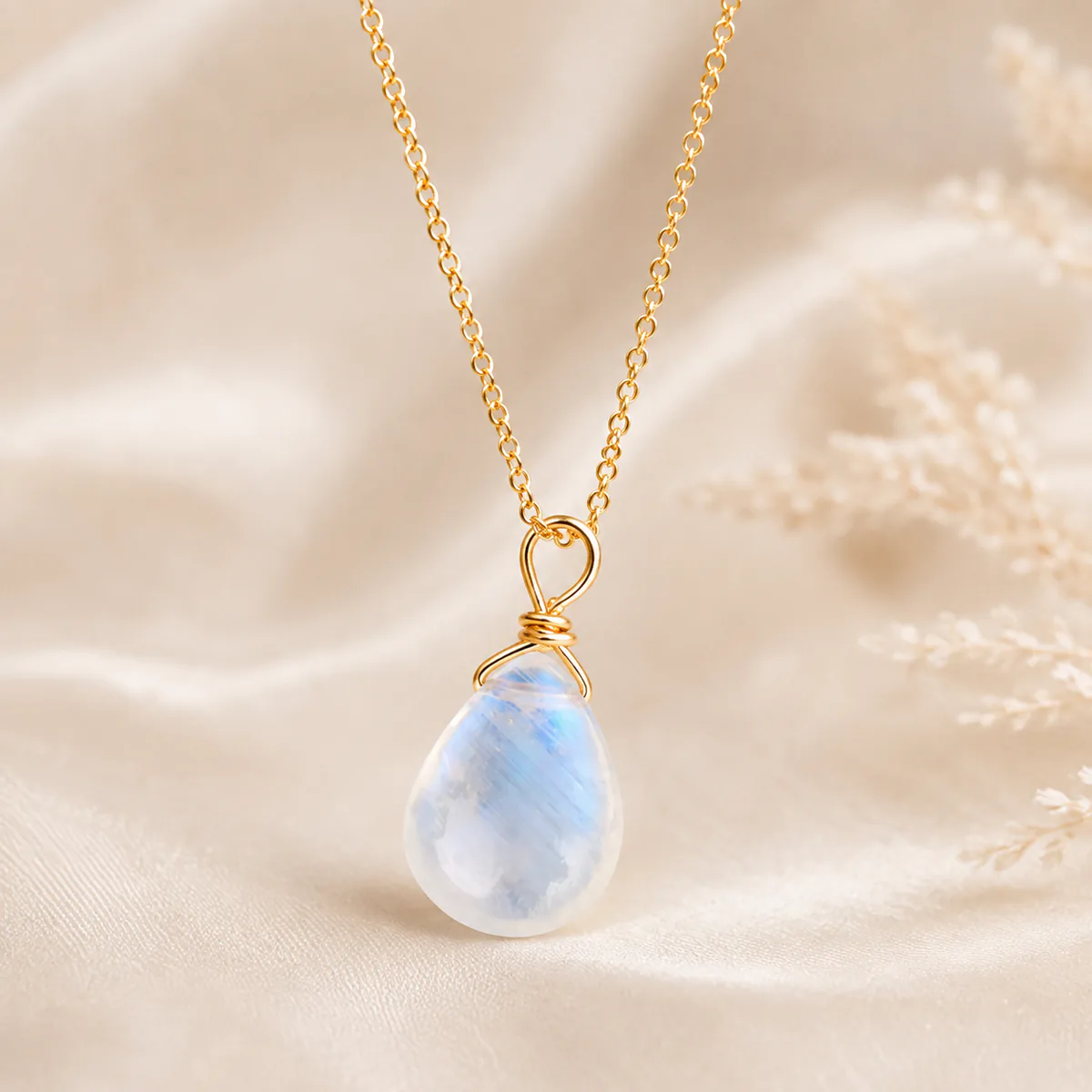
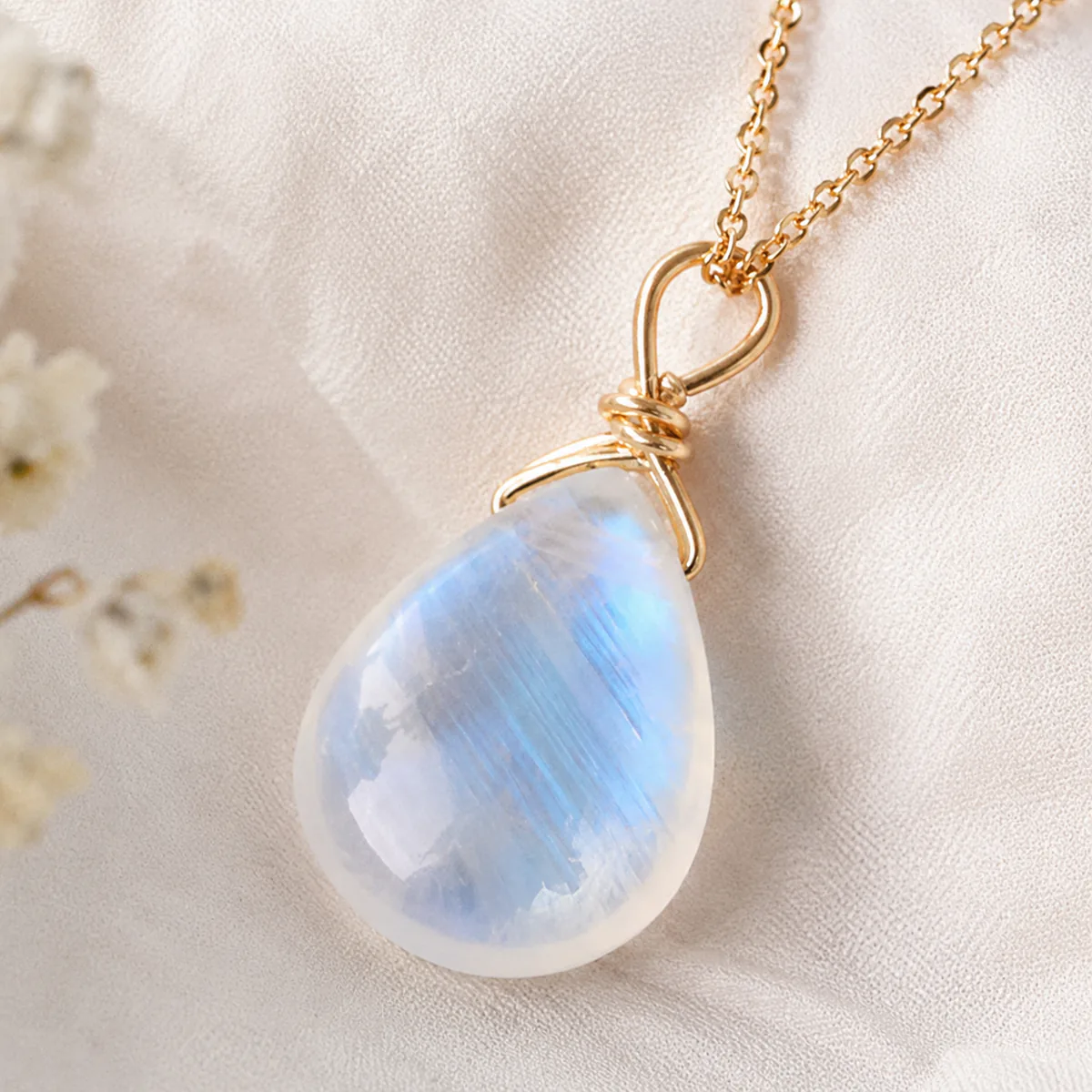
A polished moonstone teardrop, crossed by blue bands running diagonally, drilled straight through and held by a gold-toned wire coiled around itself. No setting, no metal around the stone: this is the only pendant in the catalogue where you see the gem on all six sides.
A drilled stone, and what that changes
This pendant rests on no setting at all. The teardrop is drilled straight through from the top, a wire runs through the hole, and that is it. It is the oldest way in the world to hang a stone, and the most sparing of metal, but you should know what it implies, because it is the exact opposite of a closed bezel.
The point that matters first: a hole in a feldspar is the most fragile point of the piece. This family of stones has perfect cleavage, meaning internal planes along which it separates cleanly when it takes a knock, and drilling necessarily leaves micro-tensions around its wall. A drilled teardrop that falls on tile usually cracks from the hole outward. Moonstone chips without scratching, and here nothing protects it.
Second point, following from the same principle: no metal covers its edge at all. On a closed-bezel cabochon, the ring protects the whole rim, the exact zone where a stone chips; here, the rim is bare, top to bottom. The closed-bezel version is here if you want the most protective setting.
In exchange, you get something no setting can offer: the stone is visible in full, on every face, and light hits it from all sides at once. On a material whose whole appeal is an internal sheen, this is the most generous presentation there is, and it is this model’s real reason for being.
A coiled wire is mechanics, not solder
Look at the top of the teardrop: the wire loops, comes back down, then wraps around itself several times, tightening. Nothing is soldered, nothing is glued. It is an entirely mechanical construction, and it has two virtues and one flaw, all three worth knowing.
The virtues first. There is no glue to age, unlike settings where a stone sits in a cup; and above all, it can be redone. A damaged wire is replaced in a few minutes by any jeweller, even by a handy amateur, without touching the stone. Few pieces of jewellery repair this simply.
The flaw, now: metal wire hardens when bent. It is a property of work-hardened metal, and it works against itself here. From constant swinging, the teardrop keeps stressing the wire at the same spot, just under the loop, until it eventually becomes brittle. That is where, and nowhere else, a pendant of this kind fails. Run a fingernail over it now and then: if the coils have shifted, if the loop has opened, if the wire looks marked at its base, have it redone before it breaks rather than after. And do not try to tighten it yourself with pliers: every handling hardens the metal a little more.
A word on colour, finally: the wire and the chain are gold-toned metal, and gold plate cannot be repolished without stripping the layer that gives it its colour. No jewellery paste, no brush, no abrasive cloth. A soft dry cloth, and the piece goes on last, after cream and perfume.
A teardrop rotates, and its sheen is not everywhere
Here is this model’s particularity, and it explains a disappointment that actually has nothing to do with the stone’s quality. A pendant suspended from a single point spins freely, far more than a cabochon held by a flat bail. Yours will spend a good part of the day three-quarters turned, or even facing away.
And a moonstone’s sheen is directional. It is born of internal layers stacked in one direction, and it shows clearly when light strikes the face parallel to them: on this teardrop, the blue bands actually follow a visible diagonal. In other words, there is a face where the blue shows and angles where it disappears completely, and a spinning teardrop alternates between the two all day. The phenomenon is explained here, and the quality criteria are detailed there.
This is not a flaw, it is the price of movement, and many people prefer this flicker to a sheen that never changes. To see it at its best, stand facing a window, light behind you, and let the teardrop settle on its own. The shop’s other necklaces are here, and the size guide explains how to choose a length.
- Drilled teardrop held by a coiled gold-toned wire, no setting or glue.
- The hole is the weak point: a drilled teardrop cracks from its hole. Nothing protects the edge.
- The wire hardens from bending: that is what breaks, and it is replaced in minutes.
- Delivered in two weeks with a cotton pouch, a handwritten note and a care card.
The specifications
- Stone
- Moonstone cut as a teardrop, drilled
- Look
- Translucent white, diagonal blue banding
- Metal
- Gold-toned wire and chain
- Construction
- Coiled wire, no solder or glue
- Chain
- Oval link
- Gender
- Women
- Brand
- Melissa Moon
Why I drill as little as possible
Drilling a stone is the simplest and cheapest way to hang it, and also the least protective. Whenever I can avoid it, I do, and the catalogue leans heavily toward set cabochons. A drilled stone is a stone deliberately weakened to save metal, and there is no reason to hide that.
So why does this model exist. Because a teardrop cannot be set without stripping away exactly what makes it a teardrop: the moment you enclose it in a ring, all that remains is an ordinary cabochon and the shape vanishes. Here the compromise runs the other way: the drilling is accepted in order to keep the silhouette and the bare stone. It is a choice, not an obvious one, and you deserve to know which of the two you are buying. The rest of the shop is here.
A hole is a saving in metal paid for in fragility. Saying so costs three lines.
No salt, no ultrasonic tank, no hot water: moonstone is a feldspar, and all three damage it for good. The ultrasonic tank is especially forbidden here, since it vibrates the material around the drilling, already its most stressed zone. Lukewarm water, a soft cloth, careful drying, never letting water sit in the hole, where it later seeps out leaving a clear trace. For the gold-toned metal, nothing abrasive: no paste, no brush, no jewellery product, all of which strip the plating. Take the necklace off before the shower, the pool and sport. The detail is in cleaning a moonstone piece, and the safe methods in caring for it without harming it.