Black moonstone
An anthracite-grey ground, and a silvery sheen that glides across it as the light turns. Black moonstone is the most graphic variety of the family, and it is not adularia: it is a feldspar from the other branch, the labradorite one. I say so on every listing.
Showing all 2 results
-
-20 %

Black moonstone bracelet
Original price was: 34,90 €.27,90 €Current price is: 27,90 €. Choose options -
-20 %
Black moonstone pendant
Original price was: 57,90 €.45,90 €Current price is: 45,90 €. Add to cart
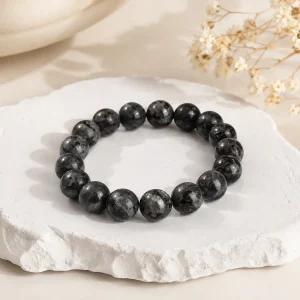
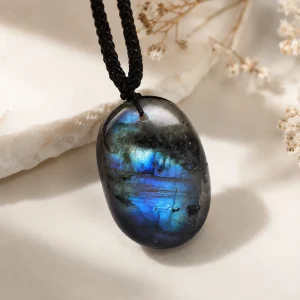
Is it really a moonstone?
It is the first question I am asked, and the answer comes in two parts.
“Black moonstone” is a trade name, not a species name. The GIA, Mindat and the International Mineralogical Association do not recognise the term: they class on one side orthoclase, the adularia of classic moonstone, and on the other the plagioclases, the labradorite branch. Black belongs to the second.
Second part, less flattering to the trade: at least three materials circulate under the same label. A dark feldspar from India or Madagascar, a Norwegian rock called larvikite, and sometimes a dyed stone. I only set the first.
The sheen is not the same either. Adularia gives an adularescence, a continuous bluish veil; plagioclase gives a labradorescence, patches that light up zone by zone. The full sorting is here.
Telling a stone that is worth its price
It is the variety easiest to imitate, because a dark stone with flashes can be made several ways.
The test that settles it needs no equipment: tilt the stone slowly under a lamp. On a real feldspar, the flash moves and goes out with the angle, because it is born of lamellae caught in the crystal. On an imitation, the shine is stuck to the surface and follows your eye without moving. The six tests hold for every variety.
The three traps, in order of frequency: black opalite, dyed glass with too regular a sheen; dyed onyx or agate, with no play of light at all; coated quartz under an iridescent film. Then comes quality: the spread of the flash over the dome, its liveliness, the cleanness of the ground. A jeweller’s six criteria and what makes the price are in the blog.
Which black moonstone piece to choose
Almost no page on this stone tackles the question, and yet it is what decides the life of the piece. The rule fits on one line: the more the piece knocks about, the more cleavage counts.
That leaves the earrings, which touch nothing and so come just behind the pendant. And a more pleasant consequence of the dark ground: it is the only variety of the family that passes effortlessly as a man’s piece.
Wearing it without damaging it
Every moonstone, black included, shares the same constraint: 6 to 6.5 on the Mohs scale, and perfect cleavage. It does not scratch easily, it splits clean under a knock, along internal planes. Hardness and toughness are not the same thing, and it is the second that counts here.
So you take your jewellery off for sport, housework and gardening, you store it separately rather than in a heap, and you keep it out of the shower and the pool. On care: never salt, never a long soak, never ultrasound, whose vibrations find the cleavage planes and open the stone. Cleaning a piece and cleansing without risk set out the rest.
One advantage of the black, all the same. Its dark ground forgives micro-scratches and marks of use far better than a milky white stone. At equal use, it ages better to the eye, and it is the only advantage of this variety that is not symbolic.
What tradition lends it
A change of register. What comes before can be measured. What follows belongs to crystal healing, an approach founded on traditions and beliefs, and is written in the conditional.
It would be lent grounding and protection, where white would be tied to beginnings. None of these correspondences belongs to it in its own right, and the argument needs room: it is traced attribution by attribution to its source in the benefits of moonstone.
What is decided here is more down to earth: when to choose black over white. Those who come back to this variety rarely speak to me of powers, but of a milestone passed, and they find that a dark ground crossed with light resembles them more. It also makes a less expected gift.
These correspondences are not properties. They belong to crystal healing, an approach founded on traditions and beliefs. They are not a medical claim and never replace the advice of a health professional. Read the full disclaimer.
What you will not find here
No stone sold under a name that is not its own. I use “black moonstone” because that is how it is searched for, and I name the species every time.
No black opalite. It is dyed glass, sold everywhere under this name. It is not a stone, and I do not set it, not even at entry level.
No coated quartz, no dyed agate. A good part of the dark flashing stones on the market are one or the other.
No promise. A piece heals nothing and acts on no one. What tradition tells is above, presented as a tradition.
A question before you order? Write to me, I reply within 48 working hours, and you have fourteen days to change your mind. If the dark ground is not what you are after, the same stone is worn differently:
Every stone is unique, and its sheen depends on the angle you view it from. On request I send a profile photo of the exact piece you will receive. The workshop, in a few words.