

Description
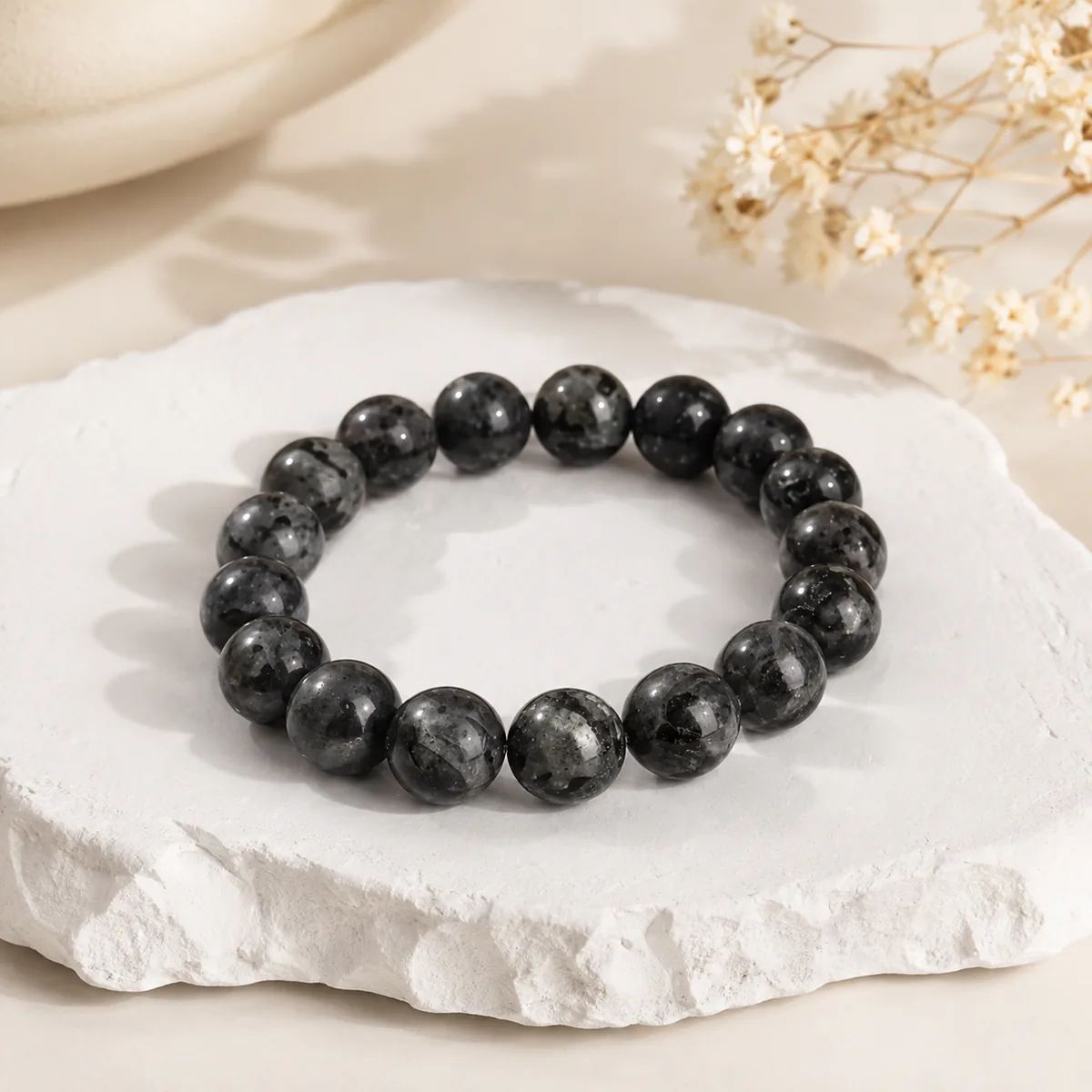
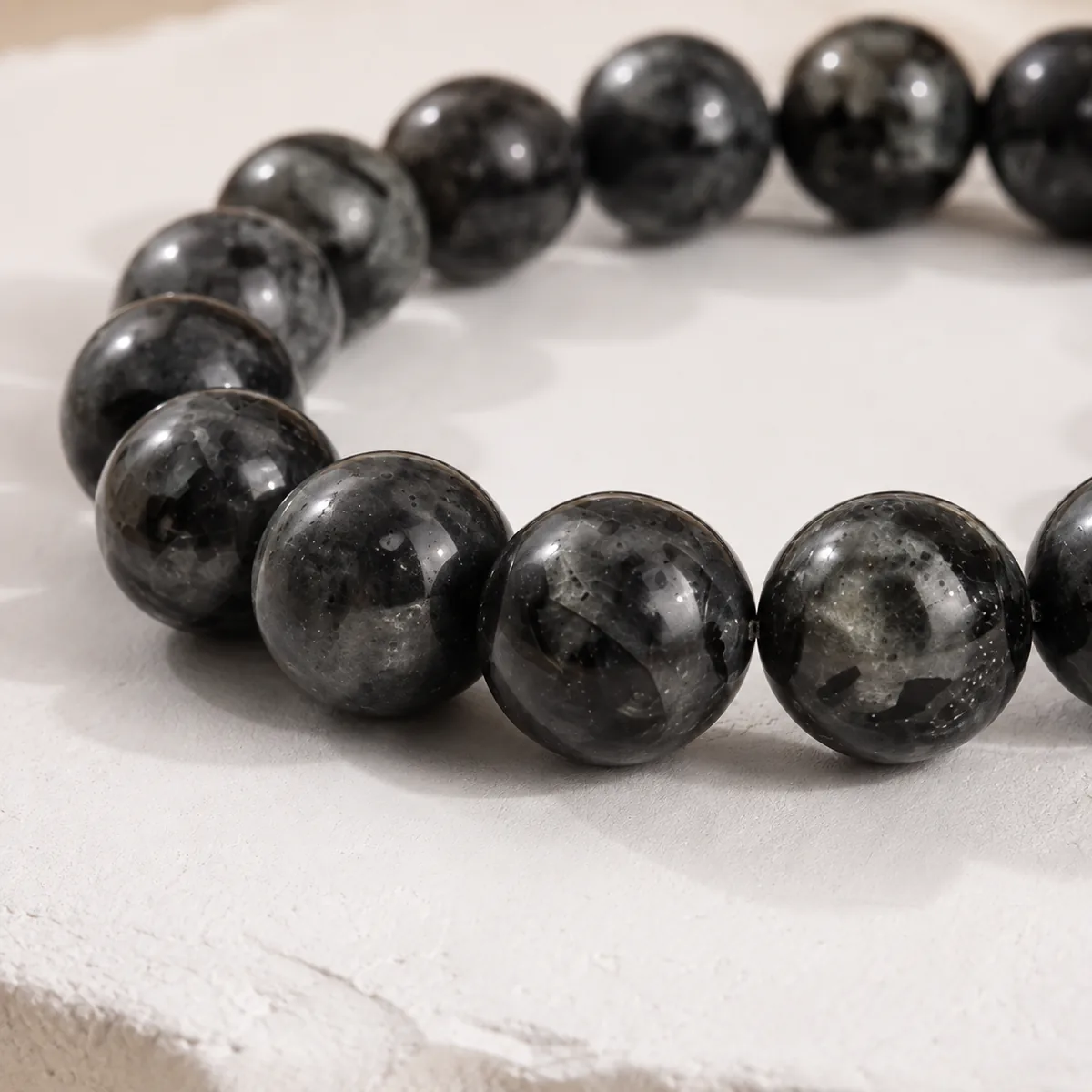
Anthracite grey beads, flecked with paler patches, where a bluish flash passes here and there when the light falls right. It is the only dark piece in the beaded catalogue, and the only one whose material is not a stone in the strict sense.
This is not a mineral, it is a rock
Look at a bead close up: you will see spots, paler patches, grains clearly distinct from one another. It is neither a fault nor an impurity. What the trade calls black moonstone in beads is most often a rock, and not a single mineral. It is made of feldspar crystals joined together, welded by the slow cooling of magma, and every spot you see is a crystal.
That is what sets it apart from the other stones in the catalogue. An adularia or a labradorite are minerals: one composition, one structure, a single crystal per bead. Here, each bead contains several dozen different crystals, which explains both the flecking and the fact that no two beads ever look alike, even from a distance. On a white moonstone bracelet, the irregularity reads in the sheen; here it reads in the drawing.
The feldspars that compose it belong to the same family as those in the shop’s other pieces, which justifies the trade name even if it is approximate. The question of names is detailed here, and everything the shop offers in black is there.
The sheen, more capricious still than elsewhere
On a pale moonstone, the blue veil covers a good part of the dome. Here, the flash can only appear on the crystals whose orientation is favourable, and there are only one or two per bead. Result: you will see isolated bluish flashes, in different places on each bead, and never the whole bracelet lit at once.
You also need daylight. Under a ceiling light, this bracelet is simply dark grey, and that is the first disappointment on arrival if you unpack the parcel in the evening. Take it out near a window, tilt the wrist slowly, and the flashes will appear one by one. If nothing moves at any angle, in any light, then the material is not what it claims to be: it is the one criterion no imitation knows how to fake.
A dark material heats up
Here is this model’s particularity, and I have seen it written nowhere. Black beads absorb light instead of returning it, so they heat up. A pale bracelet forgotten on a windowsill or in a car in summer stays lukewarm; this one becomes frankly hot, and it can be unpleasant to put back on the wrist.
It is not only a matter of comfort. A rock made of several minerals expands unevenly, each crystal having its own coefficient: abrupt temperature swings strain it more than they would a homogeneous stone. So avoid running the bracelet under cold water when it comes out of the sun, and do not leave it in a car in summer. Add to that the perfect cleavage of feldspars, which means they chip on impact without scratching for all that.
The stretch cord remains a wear part: one to three years before restringing, and it wears above all if you stretch it to full width instead of rolling the bracelet over the hand. The shop’s other bracelets are here.
Crystal healing tradition lends dark stones correspondences different from those of the pale varieties, turned more toward grounding than toward intuition. I have put them apart further down. I will go no further: none of it is demonstrated and no piece of jewellery heals anything. Separately, I have gathered what tradition lends this stone, what each colour changes and what is said about which wrist to choose.
- Anthracite grey flecked beads: every spot is a distinct feldspar crystal.
- The sheen appears as isolated flashes, in different places on each bead, and only in daylight.
- A dark material heats up in the sun. No car in summer, no cold water after exposure.
- Stretch cord, no clasp. Delivered in two weeks with a cotton pouch and a care card.
The specifications
- Material
- Black moonstone, a rock of feldspar crystals
- Look
- Flecked anthracite grey, isolated bluish flashes
- Assembly
- Stretch cord, no clasp and no spacers
- Number of beads
- Varies with wrist size
- Wrist sizes
- 14 to 20 cm
- Gender
- Women and men
- Brand
- Melissa Moon
Why I state that this is a rock
Because it changes what you should expect of it. When you buy a white moonstone, you expect a blue veil and you get it. When you buy this one believing you are buying the same thing in a dark shade, you are disappointed, because it is not the same object: it is an assembly of crystals of which only a few light up. Saying so avoids exactly that misunderstanding, and it costs only three lines.
It is also the only model in the catalogue where I sort not on the sheen but on the drawing. A batch of well-contrasted black beads, with real pale patches and readable grains, is worth more than a uniformly dark batch where nothing can be made out. It is an aesthetic criterion, not a gemmological one, and I own it as such. The rest of the shop is here.
A rock is looked at like a landscape. A mineral, like a window. It is not the same pleasure.
No salt, no ultrasonic tank, no hot water: the feldspars that compose this rock react like those in the rest of the catalogue. Add here a precaution peculiar to dark, composite materials: no abrupt temperature swings, so no cold water on a bracelet that comes out of the sun, and no car in high summer. Lukewarm water, a soft cloth, careful drying. On polished dark beads, fingerprints show more than on pale ones: a pass with a dry cloth gives them their depth back. The detail is in cleaning a moonstone piece, and the safe methods in caring for it without harming it.