


Description
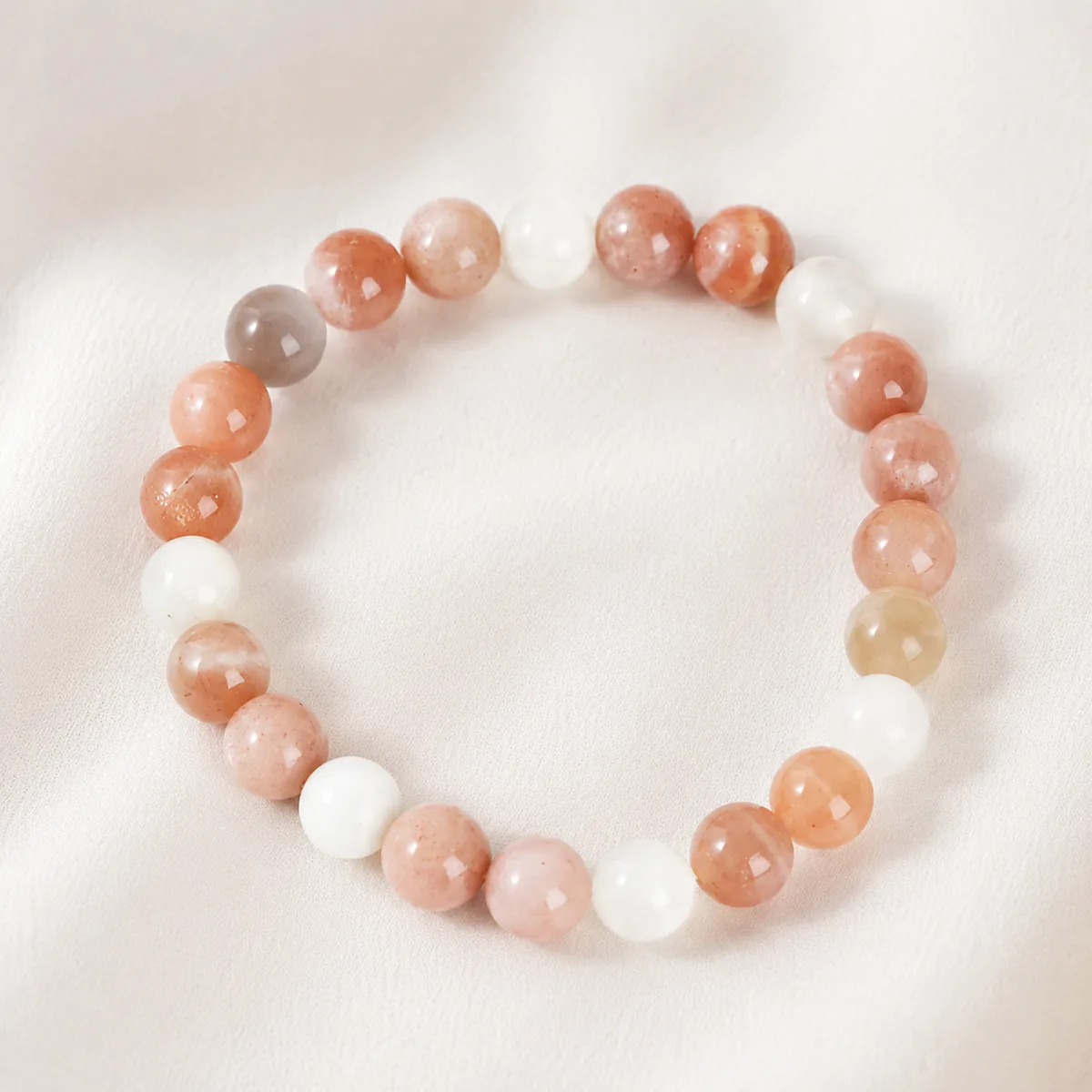
The warmest bracelet in the shop. Orange beads, from apricot to brick depending on the stone, alternating with milky white, with no metal separating them. Two mineral families that have nothing in common, placed side by side because the colours call to each other.
Two stones from different families
Moonstone is a feldspar, a layered aluminium silicate whose sheen comes from light trapped between its internal layers. Carnelian is a chalcedony, meaning microcrystalline quartz: no layers, no sheen, a straightforward colour spread through the whole mass. One works through an optical effect, the other through pigment.
That is what makes the pairing so legible. On duos where the two stones resemble each other, you sometimes hesitate over what you are actually looking at. Here there is no ambiguity: milky cool on one side, opaque warm on the other, and the contrast does all the work. Carnelian’s shades vary from bead to bead too, some lighter, others more marbled, which is normal on a natural stone. The shop’s other bracelets are here.
Carnelian goes through fire, and it needs to be said
This is the point most sellers leave out. Nearly all carnelian on the market is heat-treated. The process turns pale, yellowish or greyish iron oxides into the deep orange this stone is expected to show. It is not fraud, and it is not recent: the practice is documented for over four thousand years, the Egyptians and Mesopotamians already mastered it.
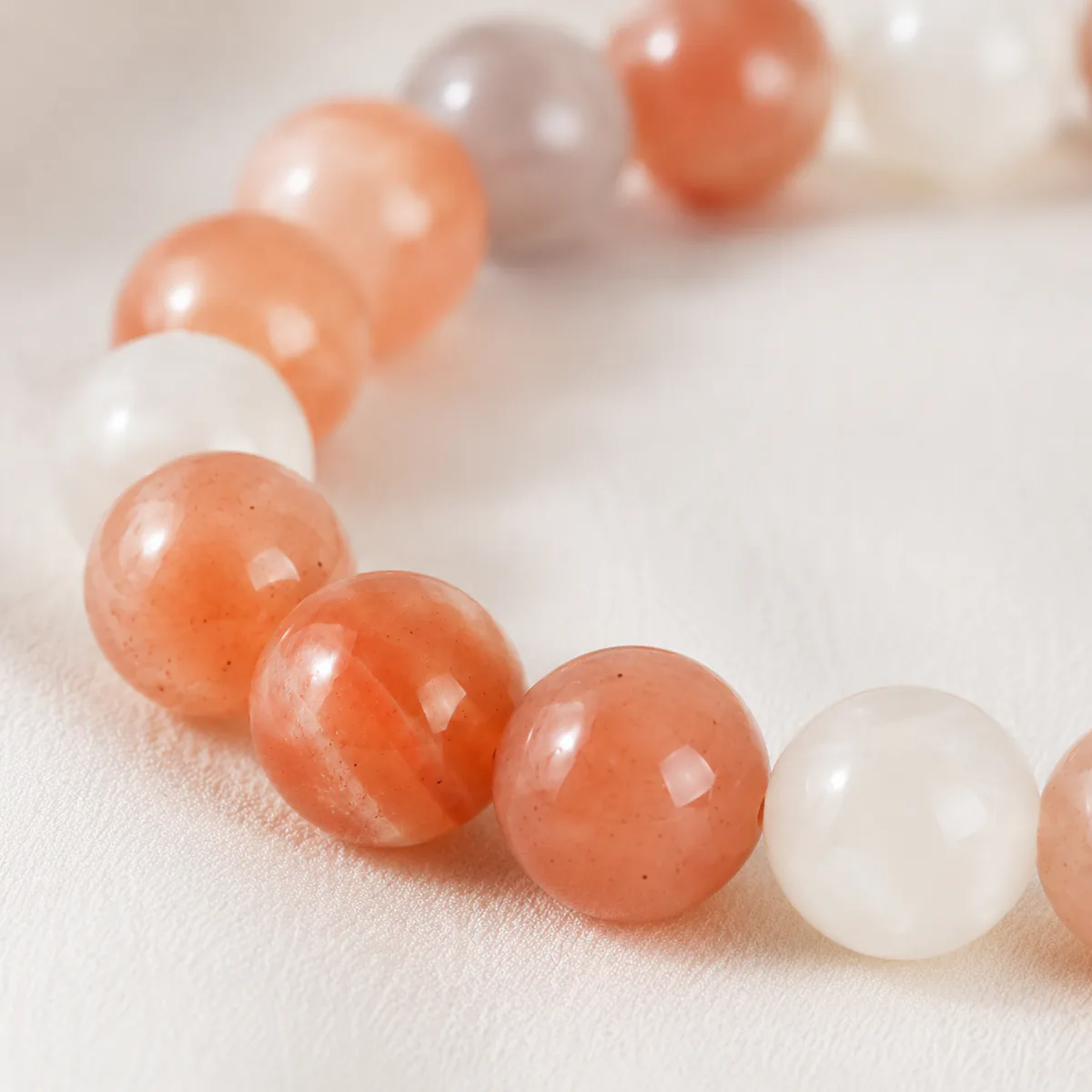
What is worth knowing, though, is that some of what sells under the name carnelian is actually dyed agate, which is not the same thing. A chemically dyed agate usually shows overly sharp banding and an overly uniform colour from bead to bead. A heat-treated carnelian keeps tonal variation and paler zones, as seen on this bracelet. It is the same reasoning as with moonstone: irregularity is a sign of natural origin, perfection is a sign of manufacture.
Seven against six, and nothing in between
Here is the technical reservation, and on this model it matters more than on the shop’s other duos. Carnelian is harder than moonstone: being a quartz, it sits around 7 on the Mohs scale, against 6 to 6.5 for a feldspar.
And this bracelet has no spacers at all. Where other pieces in the shop insert silver balls or rondelles between materials, here the beads touch directly, orange against white, along the whole cord. It is a design choice, the line reads purer without metal, but it has a consequence: over several years of daily wear, it is the carnelian beads that will end up marking the moonstone beads, never the reverse.
Nothing dramatic, and it takes time. If you want to slow it down, the one thing that matters is avoiding activities where the bracelet rubs constantly against a benchtop or a keyboard. I have gathered elsewhere the pairings that work and the ones to avoid, where hardness comes up every time.
- Carnelian beads, from apricot to brick, alternating with white moonstone.
- No spacers: the beads touch directly, the line is purer.
- Carnelian is harder than moonstone. Over time, it is the one that marks the other.
- Stretch cord, no clasp. Delivered in two weeks with a cotton pouch and a care card.
The specifications
- Stones
- White moonstone and carnelian
- Mineral families
- Feldspar and chalcedony, two distinct families
- Treatment
- Carnelian is heat-treated, like nearly all of it on the market
- Construction
- Stretch cord, no clasp or spacers
- Hardness
- Carnelian around 7, moonstone 6 to 6.5
- Wrist size
- 14 to 20 cm
- Gender
- Women and men
- Brand
- Melissa Moon
Why I write that a stone is heat-treated
Because the question always comes up eventually, and it is better it finds an answer on my listing than on a forum. Carnelian’s heat treatment has nothing to be ashamed of: it predates most civilisations that left us jewellery, and it only reveals a colour already present in the stone. Staying silent about it would still give the impression there is something to hide, and that is exactly the effect I want to avoid.
For me, the real line lies elsewhere: between what reveals and what replaces. Heating a carnelian reveals. Dyeing an agate replaces. Coating a quartz with an iridescent film to sell it as moonstone also replaces. The first I sell while saying so, the other two I do not sell. The rest of the shop is here.
A heated stone stays a stone. A dyed stone stays a dyed stone, whatever name you give it.
No salt, no ultrasonic tank, no hot water: moonstone is a feldspar, and all three damage it for good. A bracelet is treated according to its most fragile stone, never its toughest. Carnelian adds a precaution of its own: it dislikes prolonged direct light, which can fade its colour over several years. Do not leave it on a windowsill. Lukewarm water, a soft cloth, careful drying between the beads, and take it off before the shower: soap does not attack the stones but it wears the cord. The detail is in cleaning a moonstone piece, and the safe methods in caring for it without harming it.