


Description
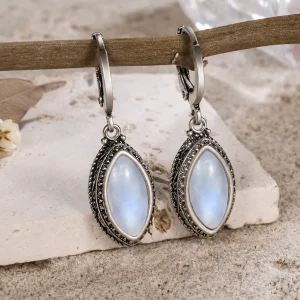
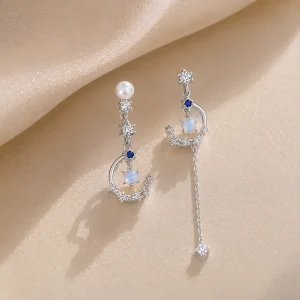
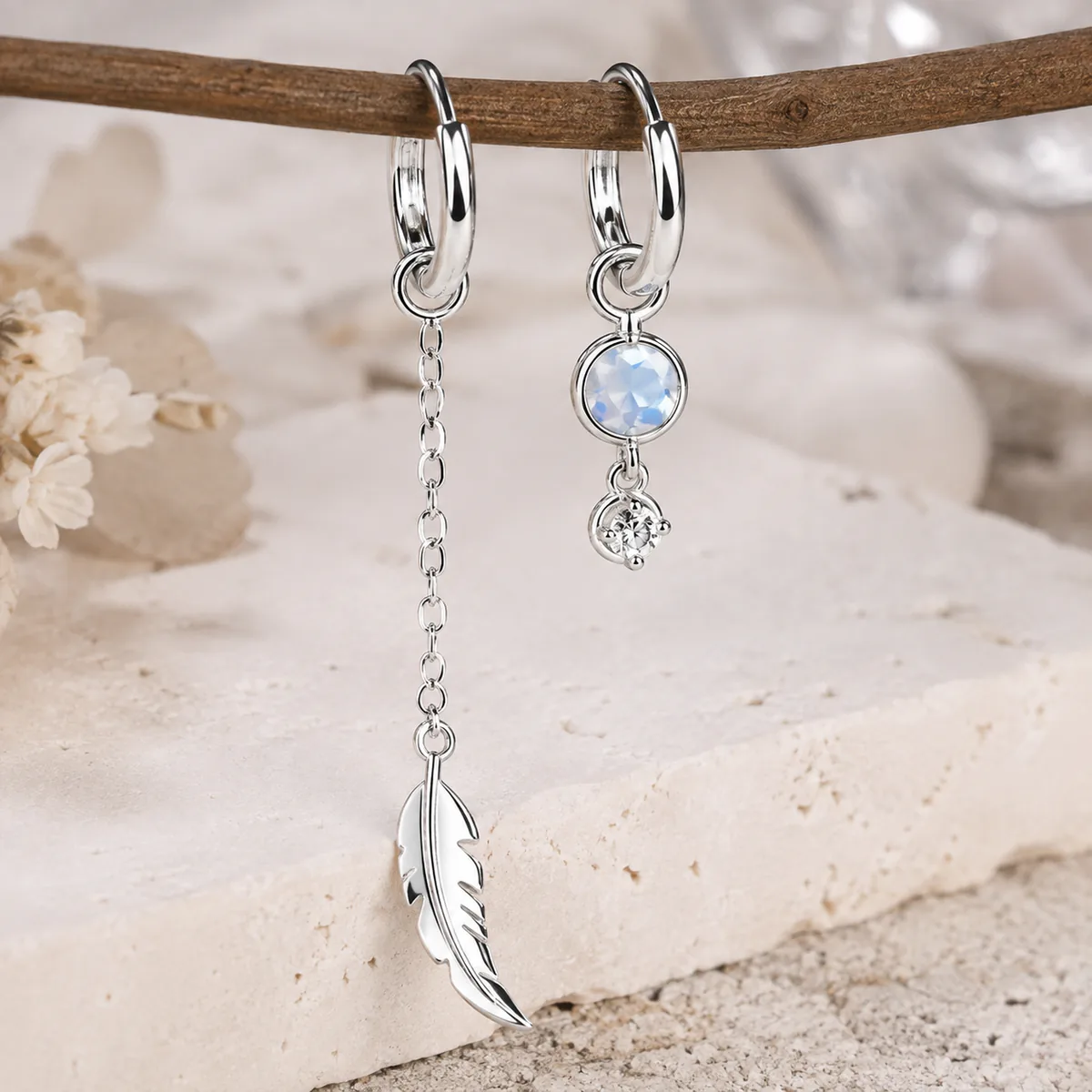
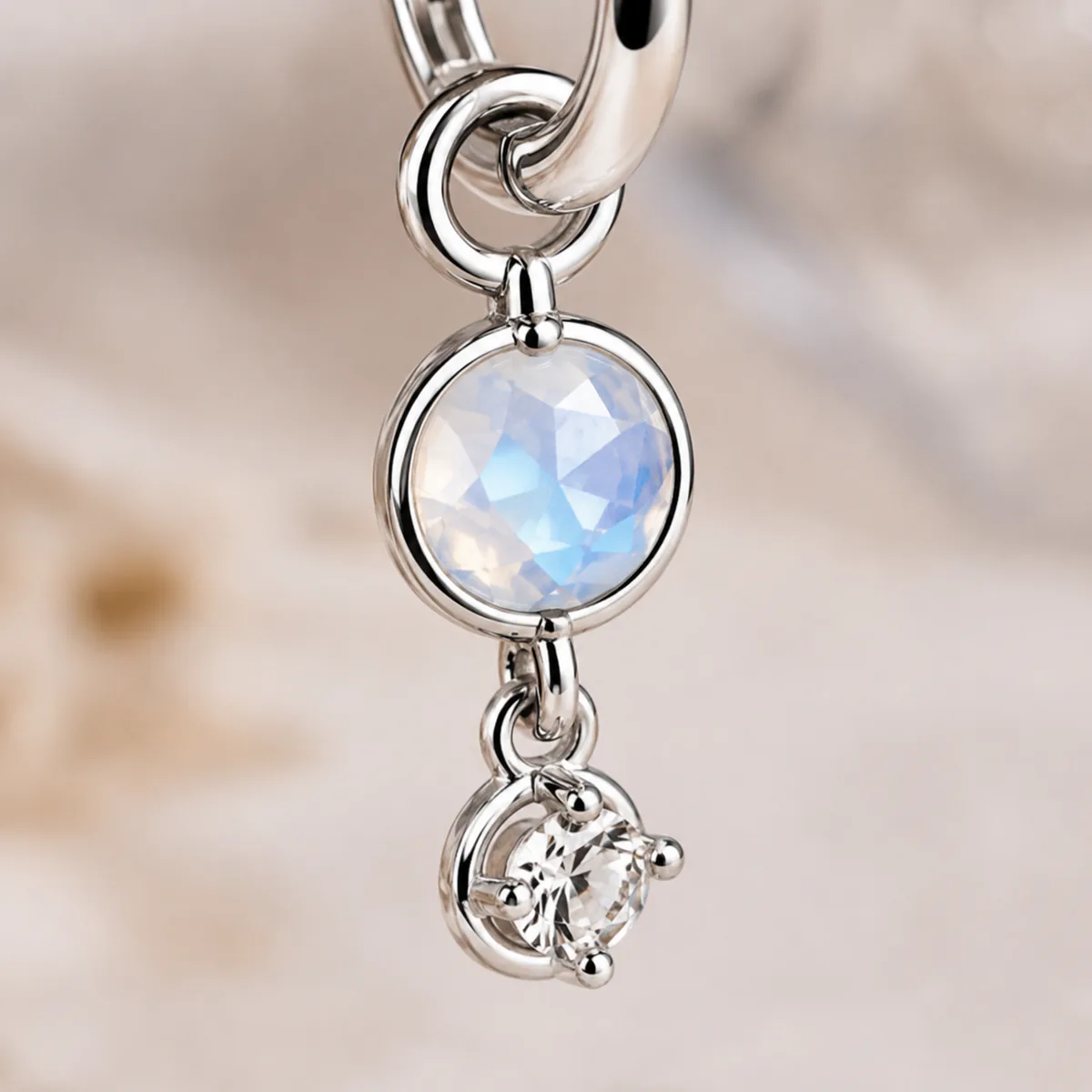
Two small polished silver hoops, and under each something different: on one side a long thin chain ending in a feather, on the other a round moonstone followed by a small clear stone. It is not a mismatched pair by mistake, it is deliberately mismatched, and it is the only piece in the catalogue designed that way.
A mismatched pair, and what that means
Might as well start with what surprises people when they open the box: the two earrings are not identical, and that is intentional. One hangs long and light, the other stays short and bright. Worn together, they give the impression of an effortlessly styled face, as if you had several piercings when only one on each side is needed.
Three things worth knowing before choosing. There is no rule about which side goes where. The chain on the left or the right changes the whole look, and both work: try both ways in a mirror before deciding, the answer depends on your haircut and which side of you people see most.
Losing one earring cannot be fixed the same way as with a symmetrical pair. On a matched pair, you still have one usable earring left; here, each piece was designed for the other, and one will visibly be missing. That is not a reason to skip these, it is a reason to close the jump rings carefully, which is good practice for any ear jewellery anyway.
And it takes a day or two to get used to. Many people find the set unbalanced the first time they wear it, simply because the eye expects symmetry. That impression almost always passes, but it explains a lot of premature returns: wear them a full day before judging. The shop’s other earrings are here.
A chain that dangles into your hair
Here is this model’s particularity, and it concerns only the long side. A fine dangling chain is about the most efficient thing there is for catching hair, and it is the number one source of annoyance with this type of earring. It also catches on scarves, coat collars, and above all a jumper pulled off over the head, a motion that can rip the earring out without you noticing.
Hence two habits that solve almost everything. Wear the long side on whichever side your hair is pulled back, or tie it up: that is the only solid criterion for deciding which side to use. And take that side off before pulling a garment on or off over your head, the same way you would take off a ring before putting on gloves.
The chain is also the thinnest part of the piece, so the first to give. It can be repaired: a link replaces for almost nothing, provided you notice it is missing before the feather does. A glance now and then at the two connecting rings, the top one and the one on the feather, is enough to catch a crack forming.
Two earrings that do not carry the same load
It is a direct consequence of the mismatch, and I have not seen it written anywhere. Your two lobes do not carry the same load. The chain-and-feather side hangs lower and works harder, the stone side stays close against the ear. The difference is small, but it applies every single day, always on the same side.
The fix is one gesture: switch sides now and then, a month on one, a month on the other. You spread the wear across both lobes, and you discover along the way that the piece looks quite different depending on the orientation. I explain on the Sterling Silver Moonstone Earrings listing why an earring’s weight deserves more attention than a pendant’s.
A word on the closure, finally: these hoops close with a hinge that clips into a notch. It is a secure system, on one condition: you open a hoop earring by pushing the pin, never by pulling the ring apart. Pulling it apart deforms the circle permanently, and a deformed ring no longer clips shut. As with all spring closures, the click should stay crisp; a click gone soft signals a tired hinge. The stones themselves are faceted and bezel set: they chip on impact rather than scratching, and a facet edge is always more exposed than a dome.
- Mismatched pair: a feather chain on one side, a moonstone and a clear stone on the other.
- Wear the long side on your clear side: a fine chain catches hair and collars.
- Switch sides now and then, the two lobes do not carry the same load.
- Delivered in two weeks with a cotton pouch, a handwritten note and a care card.
The specifications
- Stone
- Round moonstone, faceted cut
- Second stone
- Colourless cubic zirconia
- Metal
- Polished 925 sterling silver
- Composition
- Mismatched pair: feather chain on one side, stones on the other
- Closure
- Hinged hoops
- Gender
- Women
- Brand
- Melissa Moon
What you gain and lose by mismatching
A symmetrical pair is a neutral object: it says nothing in particular, it goes with everything, and it moves through decades without ever looking dated. That is its strength and its limit, it does not get noticed. A mismatched pair does the exact opposite: it catches the eye, it gives a face character with no other effort, and it visibly belongs to an era.
So it should be bought knowingly. This design will be identifiable in twenty years as belonging to the twenty-twenties, whereas a pair of studs never will be. That is not a flaw, it is the price of taking a position, and I would rather say so than sell character while pretending to sell timelessness. The rest of the shop is here.
A symmetrical pair never goes out of style. A mismatched pair does, and that is exactly the price of its character.
No salt, no ultrasonic tank, no hot water: moonstone is a feldspar, and all three damage it for good. The ultrasonic tank would also fatigue the hinges and jump rings. Lukewarm water, a drop of mild soap, a soft cloth, a complete drying, drying the inside of the hinges, where moisture settles and eventually seizes the closure. On faceted stones, a dry-cloth pass is enough to restore their sparkle, since fingerprints settle into the facet edges. Store them flat and separated: a fine chain left loose tangles with anything nearby, and bends as you untangle it. Take them off before the shower, the pool, sport and at night. The detail is in cleaning a moonstone piece, and the safe methods in caring for it without harming it.