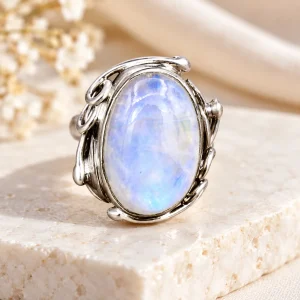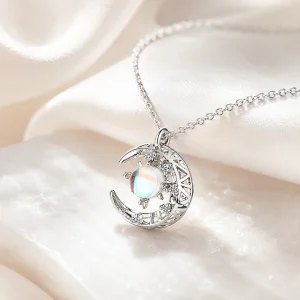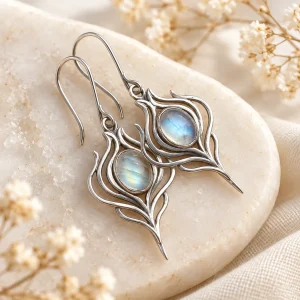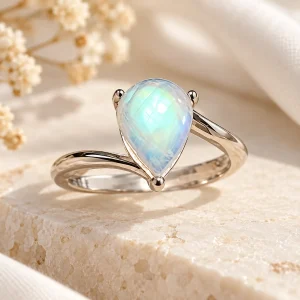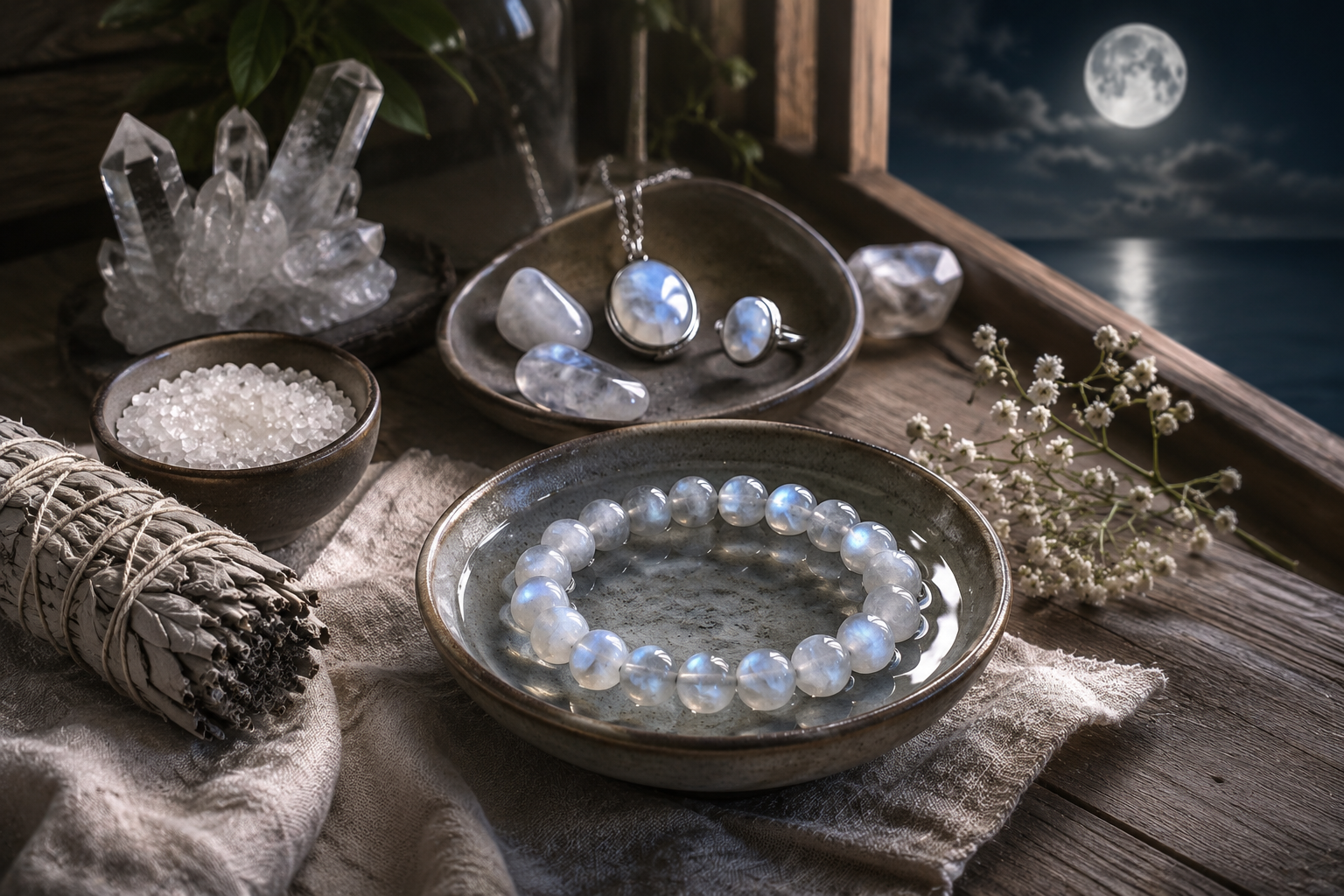
How to Cleanse and Charge Moonstone
No salt, no ultrasonic cleaner, no hot water, no soaking. Here are the four things to never do to this particular stone, the material reason behind each one, and the only cleaning method the GIA actually recommends. Plus something nobody tells you: the most common cleansing rituals are exactly the ones that damage it.
This is the article I wish I had read before I broke my first stone. The danger isn't spiritual, it's perfectly material: people apply gestures meant for quartz to a feldspar, and the result shows up a few months later. For all seven methods across every stone, see the other article; here, the specific case.
The essentials, if you're in a hurry
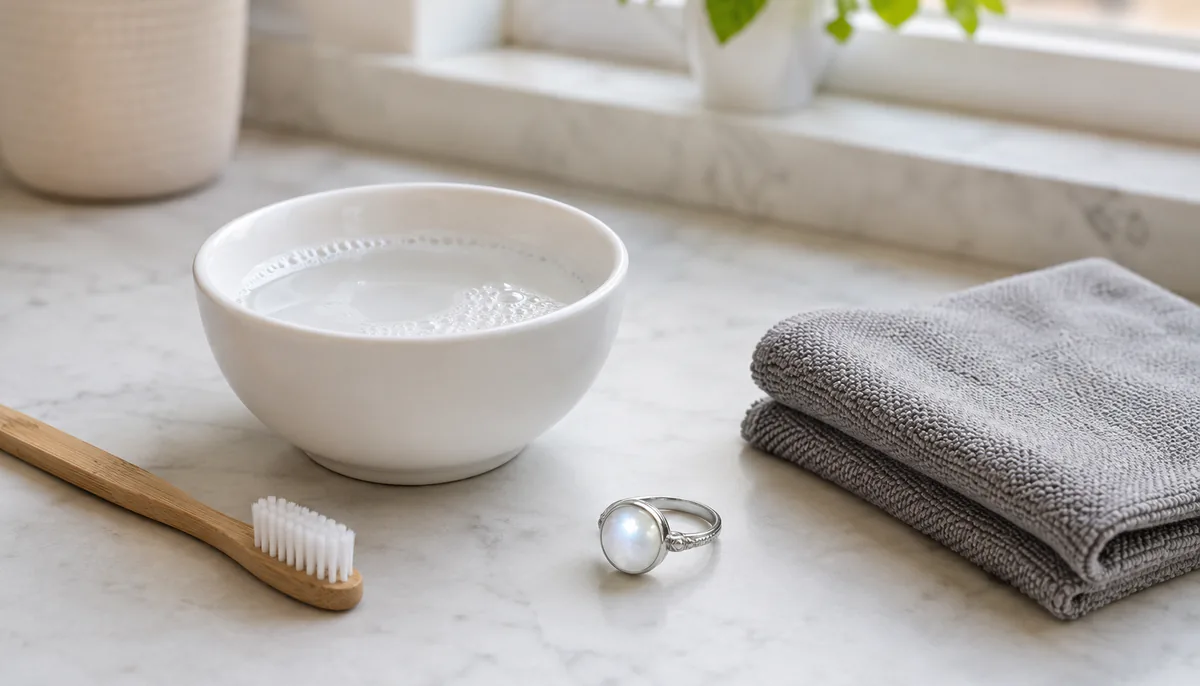
- Warm soapy water and a soft cloth. It's the only method the GIA recommends for moonstone, and it's enough.
- Never ultrasonic or steam. The GIA writes that they are never recommended: the vibrations follow the cleavage planes.
- Never salt, dry or dissolved. It corrodes the setting and lodges in cracks and under prongs.
- Never hot water or a sudden temperature swing. A feldspar handles thermal shock badly.
- No prolonged soaking. The stone isn't what suffers first, it's the setting, the glue and the elastic cord.
- Cleaning and cleansing are not the same thing. One can be verified, the other belongs to belief, and it's the second one that breaks stones.
- Moonlight costs the stone nothing. If you care about a ritual, it's the only one with zero material risk.
Cleaning and cleansing, two gestures people mix up
Almost every article on this topic blends two things that have nothing to do with each other. Separating them is the only way not to damage your stone.
Cleaning is a physical operation. You remove lotion, soap, skin oil and dust. It's verifiable: the stone is clean or it isn't, and you can see the difference. It's mechanics, and it's written in the indicative.
Cleansing and charging belong to a completely different register. They're symbolic gestures, drawn from contemporary crystal healing, that assume a stone fills up and then empties out. Nothing demonstrates this, and I write about it in the conditional.
The problem isn't that this second register exists. The problem is applying physical means to it. Burying a stone in coarse salt for twenty-four hours, soaking it overnight, running it under hot water: these are symbolic protocols with very real consequences on a feldspar. That's why this article starts with what to avoid.
The four things to avoid, and why each one matters
Let's start with the facts, in the indicative, because they can be checked.
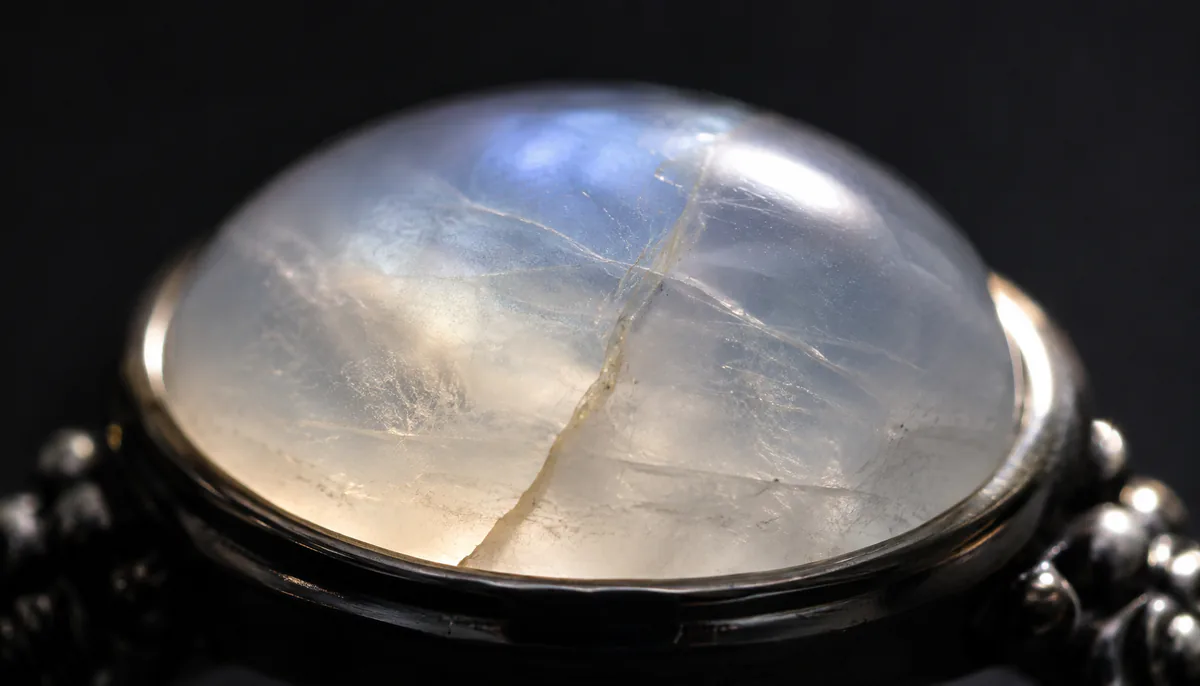
Moonstone is a feldspar, hardness 6 to 6.5 on the Mohs scale. The GIA also describes it as having poor toughness and two cleavage directions, something it shares with the whole feldspar family. Cleavage is a direction of atomic weakness: the crystal splits cleanly along it. So it doesn't scratch easily, it cracks. The difference between the two is explained in the properties of moonstone and is moonstone fragile.
| To avoid | What actually happens | Risk |
|---|---|---|
| Ultrasonic cleaner | Vibrations follow the cleavage planes | High |
| Steam | Thermal shock and micro-fractures | High |
| Salt, dry or dissolved | Corrodes the setting, lodges in cracks | High |
| Hot water | Sudden temperature swing on a feldspar | Medium |
| Prolonged soaking | Attacks glue, elastic cord and setting | Medium |
| Household products | Attack the polish and the metal | Medium |
| Stiff brush | Scratches the polish and the edges of the setting | Low |
The first three rows are the ones that break stones. The rest just dull them, which is fixable. I go into the two most misunderstood ones below.
Salt, the most dangerous piece of common advice
It's the most recommended method online, and the worst possible one for this stone. It deserves an explanation of why, because "salt damages it" isn't enough to convince someone who's read the opposite ten times elsewhere.
Salt doesn't scratch the stone. Rock salt sits at 2 to 2.5 on the Mohs scale, far below a feldspar's 6 to 6.5. That's not where the problem is, and sites that invoke scratching have the wrong mechanism.
The real problem has three parts. First, dissolved salt is an electrolyte: it accelerates the corrosion of metals, especially sterling silver, which is alloyed with copper. A setting that tarnishes black, solder joints that weaken, prongs that loosen, and eventually the stone falls out. Second, salt crystals lodge in micro-cracks and under the setting, where nobody thinks to look, and keep working there. Third, salt is hygroscopic: it attracts and holds moisture against the metal.
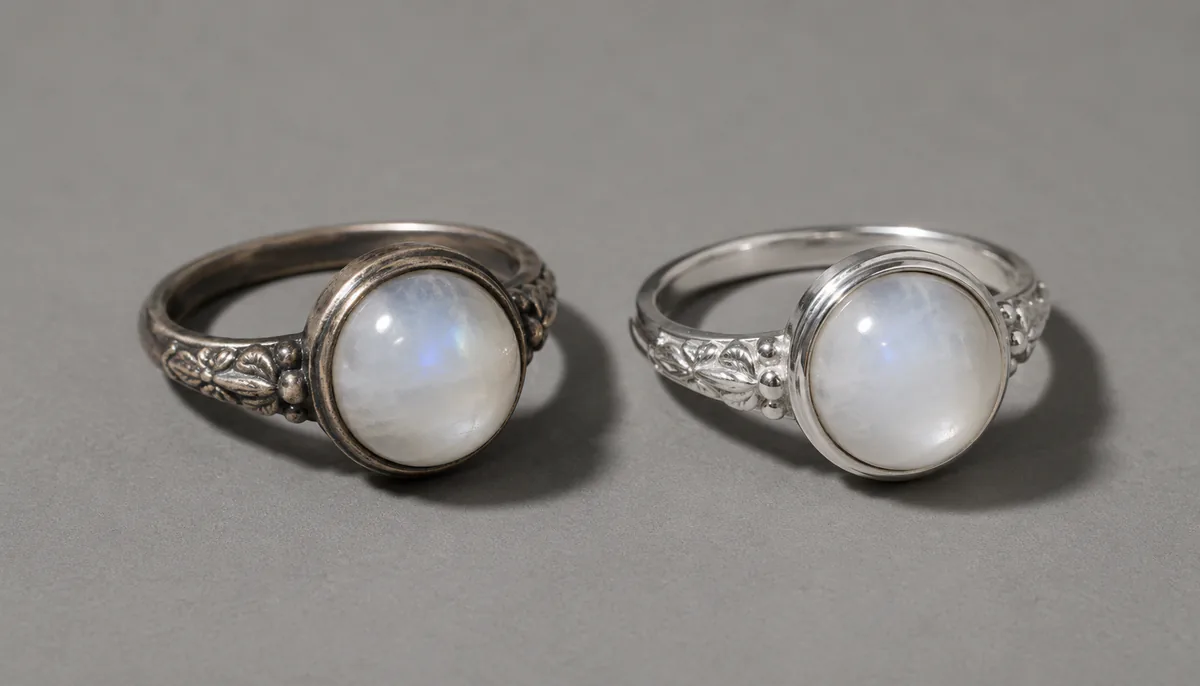
The conclusion is clear and without nuance: no coarse salt, no salt-water bath, no burying it. Not for any set stone, and especially not for a feldspar. Yet salt is the number one method in cleansing rituals, which is exactly the topic of this article.
Ultrasonic cleaners, and why the GIA rules them out
Here I don't need to argue: the reference authority spells it out in black and white.
In its care sheet dedicated to moonstone, the GIA states that warm soapy water is the only recommended substance, and that ultrasonic and steam cleaners are never recommended. That's an unqualified statement, which is rare in a care sheet.
The mechanism is simple. An ultrasonic tank vibrates the liquid at very high frequency to loosen dirt. On a crystal with two cleavage directions, those vibrations travel along the planes of weakness. A stone that had an invisible micro-crack comes out clouded, milky in patches, sometimes split. The damage is irreversible: you can't glue a cleavage back together.
Steam raises a different problem, a thermal one. A feldspar handles a sudden temperature swing badly, and a jet of steam is exactly that.
A word for jewelers: if you drop off a moonstone piece for restringing or repair, say explicitly that the stone should not go through an ultrasonic cleaner. It's the default cleaning method at most workshops, and nobody will ask your opinion.
Water, what it actually tolerates
The question keeps coming back, and the answer is more nuanced than the "yes" or "no" you read everywhere.
The stone itself doesn't fear water. A feldspar isn't soluble, it isn't porous like turquoise, and a rinse in warm water does nothing to it. Anyone who writes that moonstone "dissolves" or "loses its energy in water" has the wrong mineral.
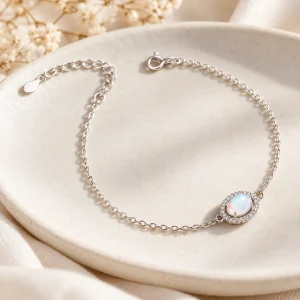
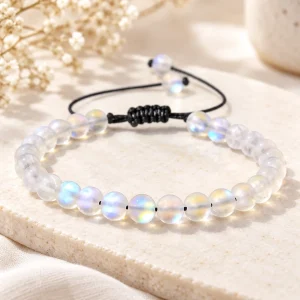
What does fear water is everything else. Prolonged soaking attacks the glue in some settings, wears the elastic cord in beaded bracelets, makes silver tarnish faster and leaves water sitting under the stone, inside a closed bezel, where it never fully dries.
Three concrete cases, since people ask me about them. The shower: avoid it, less for the water than for the soap and shampoo, which leave a film on the polish. The pool: avoid it completely, chlorine attacks the metal. The sea: that's salt, so it's a no, for all the reasons in the previous section. The topic has its own full article, can moonstone go in water.
And on temperature, while we're at it: lukewarm, never hot. No boiling water, no sudden switch from cold to hot, no hair dryer to speed up drying.
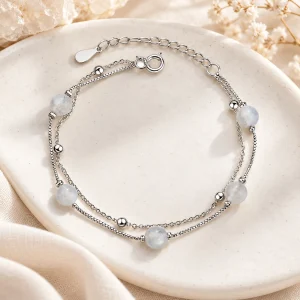
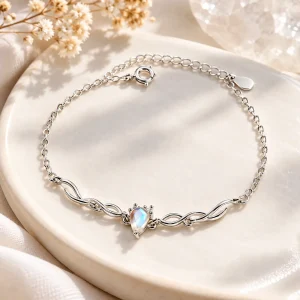
The wire-strung bracelets, the ones that fear soaking the most
The method, in four minutes
Here's what I do, and what I recommend to anyone who writes to me. There's nothing else to know.
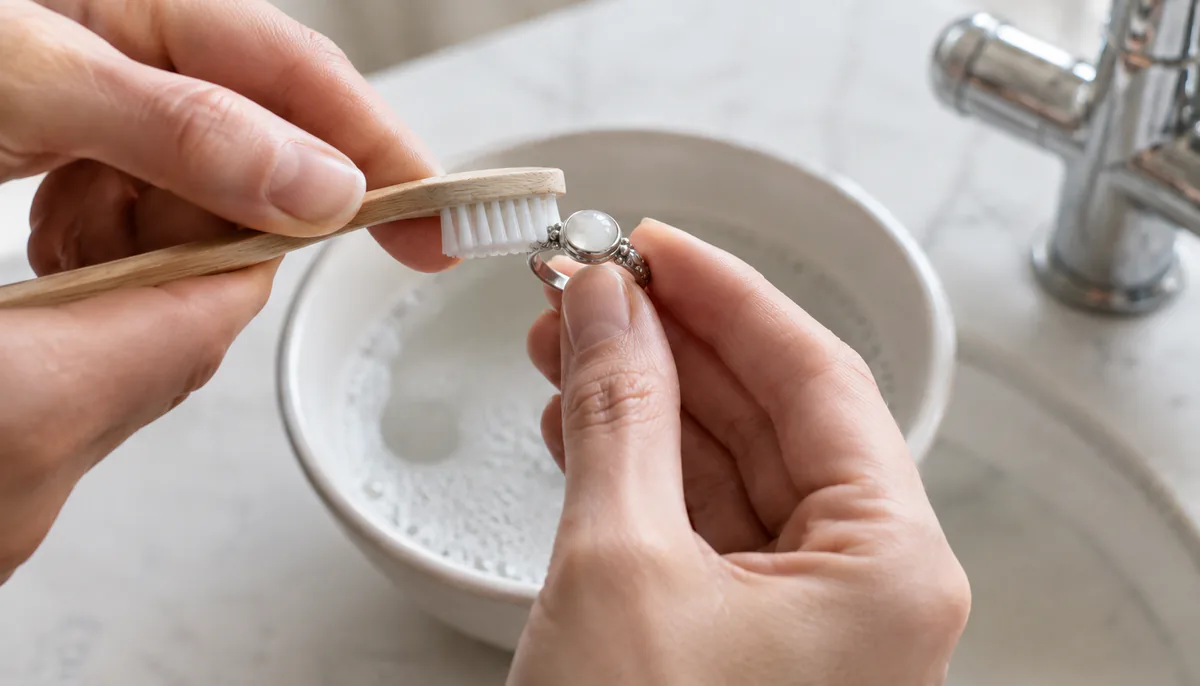
A bowl of lukewarm water, a drop of mild soap, castile soap or unscented dish liquid. No jewelry cleaner, no alcohol, no vinegar, no baking soda.
Thirty seconds of soaking, not overnight. Just enough time for the oily film to loosen.
A soft toothbrush, and only on the setting. Brush the metal, the back of the bezel, the corners where soap builds up. Don't scrub the dome of the stone, it doesn't need it.
A rinse in clean lukewarm water, with the sink plugged, which avoids the one truly avoidable disaster on this page.
A complete dry with a soft cloth, microfiber preferably, working carefully between beads or under the setting. A piece stored damp corrodes. Let it air out for an hour before putting it back in its pouch.
That's all. The detail by jewelry type, ring, bracelet, necklace, and by setting type, is in how to clean a moonstone piece.
The rings, the ones that get dirty fastest




Charging: what tradition says, what it costs
Change of register, and I'm flagging it rather than sliding into it.
Contemporary crystal healing holds that a stone fills up with use and then needs to be emptied and recharged. It's a recent construction, from manuals published between 1985 and 2003, whose publication I date in the properties of moonstone. Nothing demonstrates it, and I write it in the conditional.
What interests me here isn't settling the belief, it's sorting the methods by what they physically do to the stone. On that ground, there are real answers.
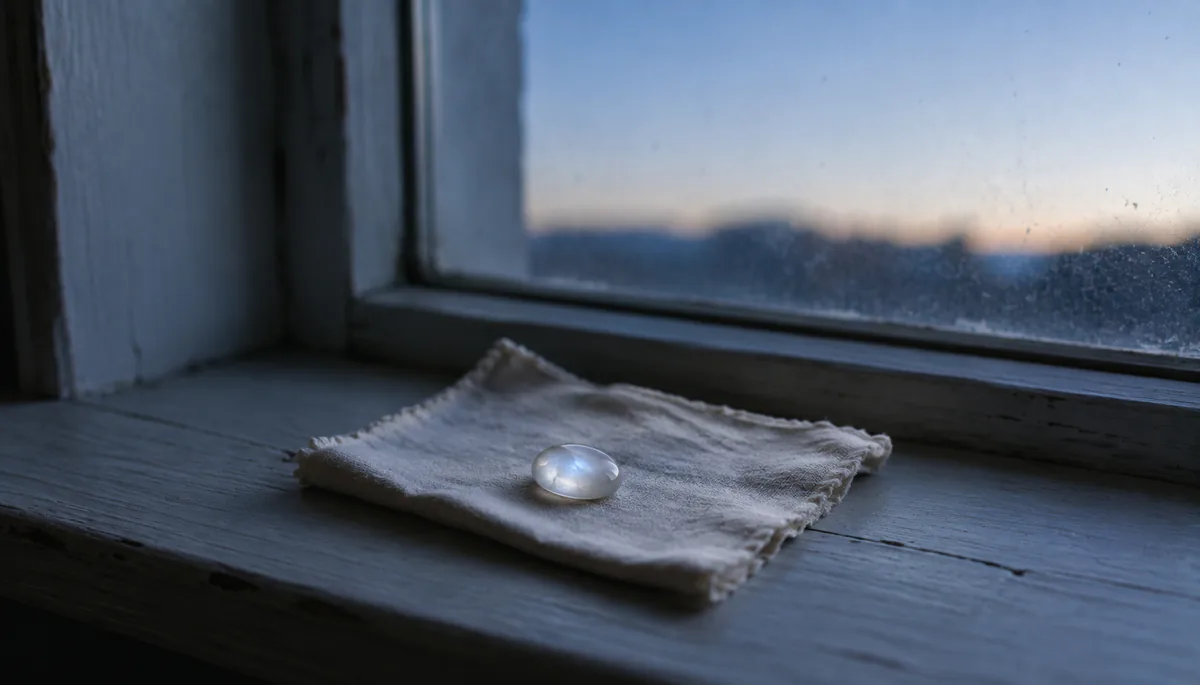
- Moonlight. Setting the stone on a windowsill overnight: zero material risk, as long as it's inside and not right on the edge. It's the only method that costs the object nothing, and it's the one I mention when people ask. The calendar is in when to charge your stones with the moon.
- Sunlight. Harmless to moonstone itself, but be careful if it's sitting next to an amethyst or a rose quartz, which fade in light. And never behind a window in full summer, for the temperature issue.
- A quartz cluster. No risk, with one caveat: quartz sits at 7 on the Mohs scale, so it's harder. Set the stone on the cluster, don't wedge it between the points.
- Incense and smoke. No risk to the stone, but the oily residue shows on a polished surface and comes off with a cloth.
- Earth. Avoid it: prolonged moisture against the metal, and dirt in the setting.
- Salt. No, for all the reasons in the section above.
In other words: out of the six most cited methods, only one is genuinely worth ruling out, and it's the most recommended of all. The full comparison, across every stone, is in cleansing, charging and cleaning your stones.
The notions of cleansing and charging belong to crystal healing, an approach based on tradition and belief. They do not constitute a medical claim and never replace the advice of a health professional. Read the full disclaimer.
How often, honestly
You'll read very precise schedules elsewhere. Here's my answer, which is shorter.
For cleaning: when it's dirty. A ring worn daily, about once a month. A beaded bracelet, a bit less often, because brushing wears the cord. A pendant worn under clothing, two or three times a year. The signal is visual: when the sheen looks dull even though the light is good, that's an oily film, not a change in the stone.
For cleansing: at your own pace, and none is more correct than another. Protocols that impose a frequency, every month, every full moon, after every session, have no more grounding than each other. If the gesture feels good to you, do it whenever you feel like it.
One material constraint worth knowing: the more you handle a piece of jewelry, the more you drop it. A weekly protocol multiplies the chances of an impact fivefold over a year, on a stone that cracks on impact. It's the only argument I raise against frequent rituals, and it isn't a philosophical one.
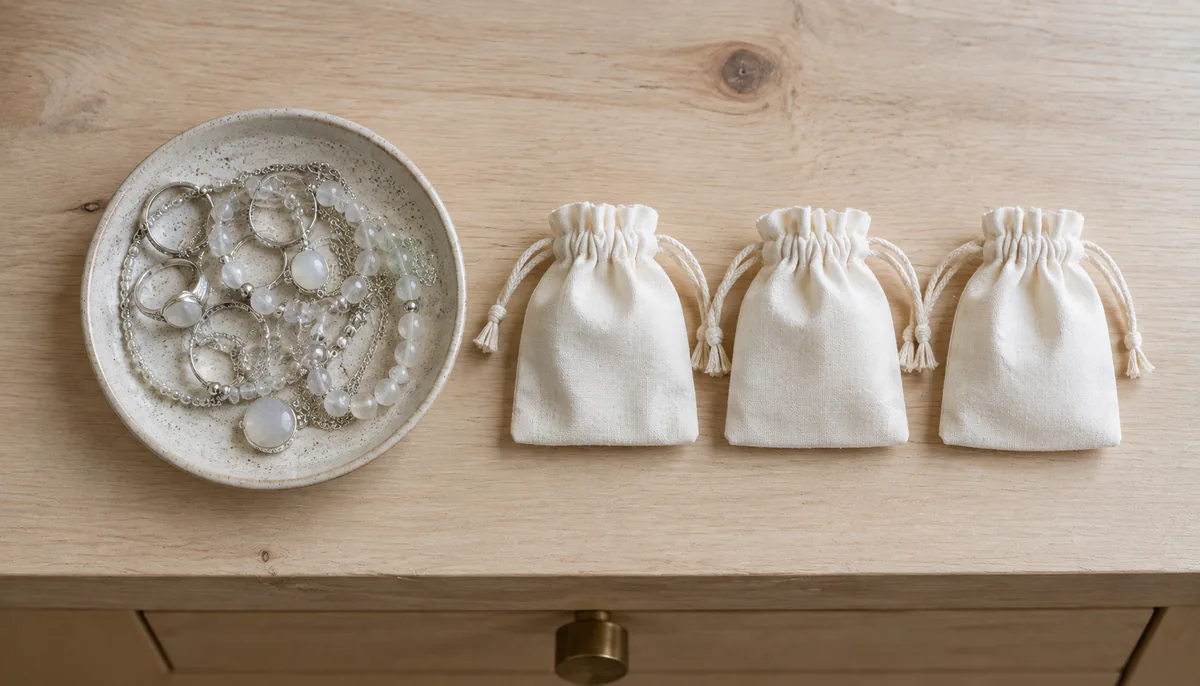
The gesture that matters most, by the way, is neither cleaning nor cleansing, it's storage: one pouch per piece, not a pile in a dish. Scratches happen there, at night, not while wearing it.
The care advice I won't give
Four sentences, all of them very common.
"Cleanse it as soon as you buy it, it has absorbed the seller's energy." No. What I can say is that a new stone sometimes carries a residue of polishing compound, and a pass through soapy water removes it. That part is true, and it shows.
"It runs empty, you need to empty it out." The idea that a stone fills up and then empties out is a recent construction. What actually fills up are the corners of the setting, and a soft brush takes care of that.
"Salt absorbs bad energy." Maybe, I have no idea. What I do know is that it corrodes silver and lodges under prongs, and that's enough for me to say no.
"A scheduled moon-water bath." I stop at the point where prolonged water damages the setting. The rest isn't my concern, but overnight soaking is.
The rest of what I refuse to do is in the complete guide. And if this is your first stone, getting started with crystal healing covers everything from the beginning.
Frequently asked questions
How do you cleanse moonstone without damaging it?
Warm soapy water, thirty seconds, a soft brush on the setting only, a lukewarm rinse and a complete dry with a soft cloth. It's the only method the GIA recommends. Never salt, never ultrasonic, never steam, never hot water.
Why no salt?
Not because of scratching: salt is much softer than the stone. Dissolved salt corrodes silver and weakens solder joints, and the crystals lodge in micro-cracks and under the setting, where they hold moisture. It's the setting that fails before the stone does.
Can you put moonstone in an ultrasonic cleaner?
No, never. The GIA writes that ultrasonic and steam cleaners are never recommended for this stone. The vibrations travel along the two cleavage directions and turn an invisible micro-crack into a milky haze, sometimes a break. Remember to tell a jeweler explicitly.
Does moonstone fear water?
The stone itself doesn't: a feldspar is neither soluble nor porous. It's everything else that fears it, the glue in some settings, the elastic cord, silver that tarnishes and water that sits under a closed bezel. A quick rinse, yes; soaking overnight, no.
Can you charge moonstone in sunlight?
No risk to the stone itself. Be careful, though, if it's sitting next to an amethyst or a rose quartz, which fade in light, and avoid full sun behind a window in summer, for the temperature issue.
Do you need to cleanse it as soon as you buy it?
Nothing requires it. What is useful, though, is a pass through soapy water: a new stone sometimes carries a residue of polishing compound, and that part shows and comes off.
How often should you clean a moonstone piece?
When it's dirty. A ring worn daily, about once a month. A pendant worn under clothing, two or three times a year. The tell: the sheen looks dull even though the light is good.
Is a full moon required for charging?
No frequency has more grounding than another. Materially, the only thing I can say is that a weekly protocol multiplies handling, hence the chances of dropping a stone that cracks on impact. The traditional calendar is in when to charge your stones with the moon.
Can you use a store-bought jewelry cleaner?
No. These products are formulated for hard stones and metal, and many contain ammonia or harsh surfactants. Warm water and mild soap are enough, and that's what the GIA recommends.
My stone's sheen disappeared, is it dead?
Almost always, it's a film of lotion or soap on the polish, and cleaning fixes it. If the haze is inside the stone and milky, that's something else: an open cleavage, usually after an impact or an ultrasonic pass, and there's nothing to be done there.
Where to go next
- Care in detail: the seven methods, every stone, the moon calendar, cleaning a piece, the water question.
- Why it's so sensitive: is it fragile, the mineral profile, adularescence.
- Wearing it: how to wear it, which wrist, pairings, and hardness.
- The belief framework: the properties, getting started with crystal healing.
- The full picture: the complete moonstone guide.
The jewelry is in the shop. And if you have a piece that's gone hazy after an ultrasonic pass, send me a photo: I'll tell you honestly whether it can be saved, and most often it can't.
My sources
For care: the GIA's Moonstone Care and Cleaning sheet, which gives warm soapy water as the only recommended substance, rules out ultrasonic and steam cleaners without qualification, places the stone between 6 and 6.5 on the Mohs scale, and assigns it poor toughness along with two cleavage directions common to the feldspar family.
For the action of salt: the electrolytic corrosion of silver alloys in the presence of chloride is a documented mechanism, and it's why jewelers advise against sea water on settings. Salt's hygroscopic nature and its hardness of 2 to 2.5 on the Mohs scale are standard mineralogy facts.
For dating the notions of cleansing and charging, the crystal healing manuals published between 1985 and 2003, whose list is in the properties of moonstone.
Two things that come from the workshop and that I flag as such: the cleaning frequencies I give are rough estimates drawn from what I see on pieces sent back to me, not published recommendations. And the observation that a frequent protocol multiplies drops is a common-sense remark, not a statistic.
Last updated: August 19, 2026. If you find an error in this article, let me know: I'll fix it and note it.
✦ À porter, à offrir
Découvrez mes créations