

Description
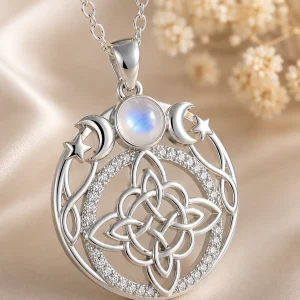
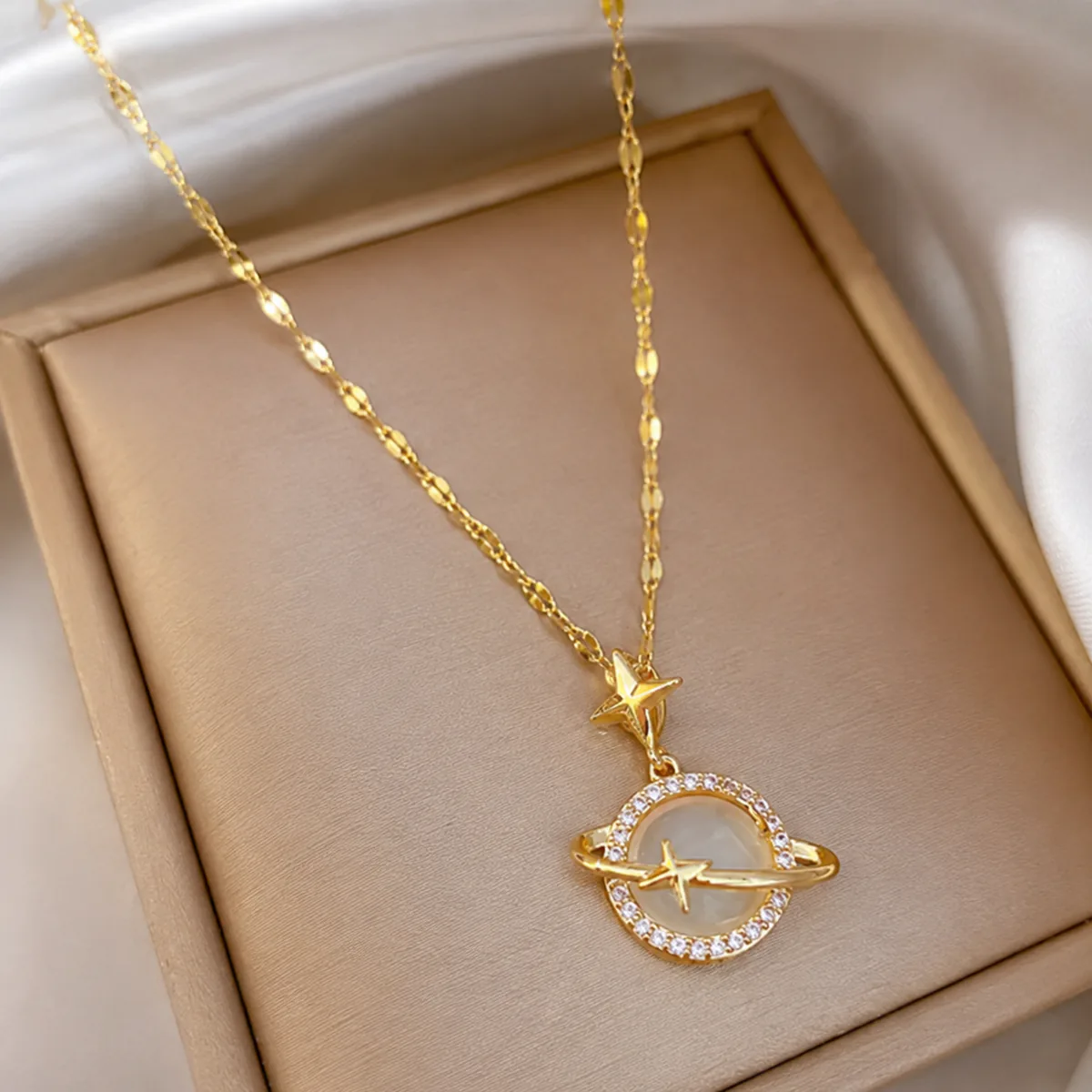
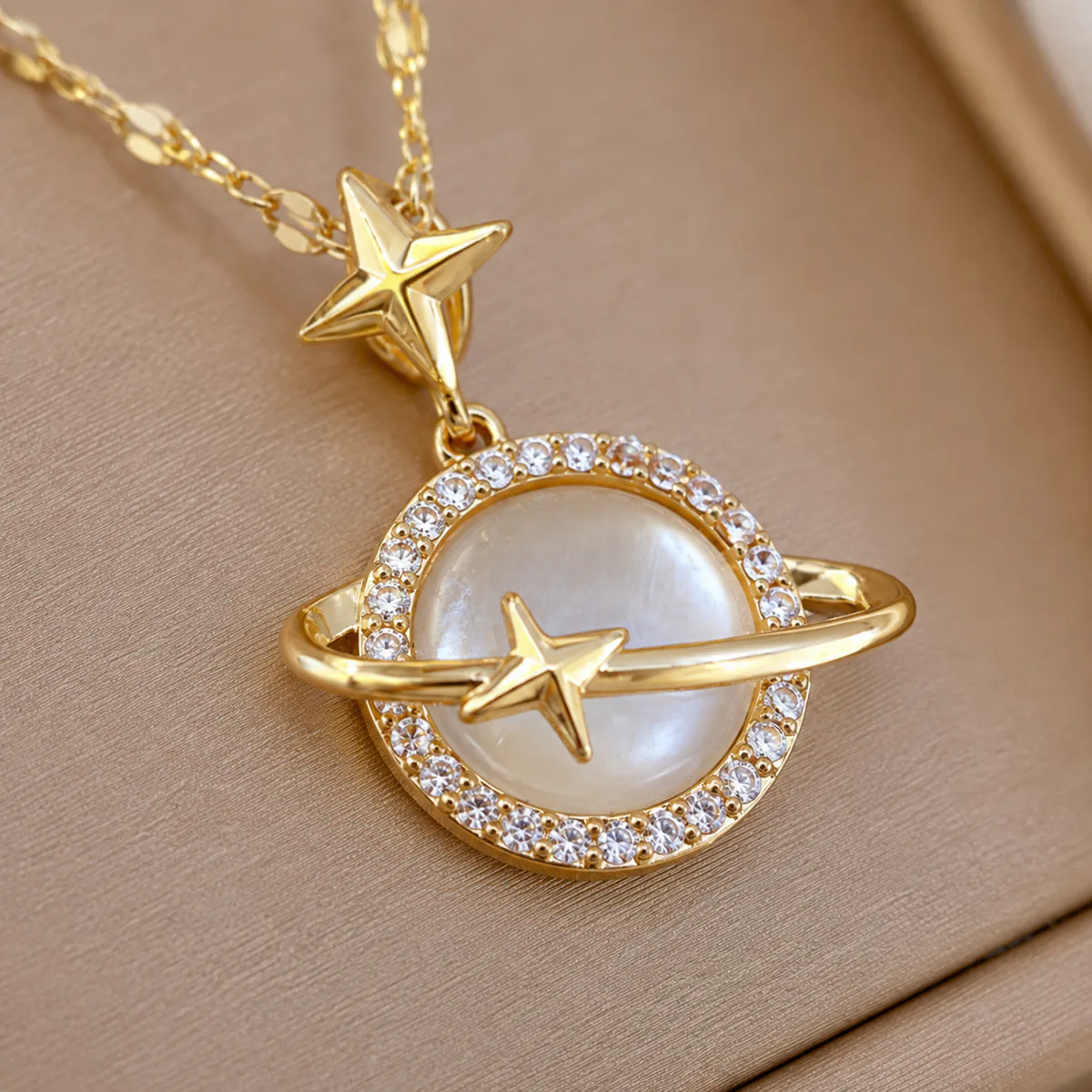
A round, pale stone at the centre of a circle paved with small clear stones, a golden ring crossing it like a planet’s, a four-pointed star set on top and a second one serving as the bail. All of it on a flattened-link chain that catches the light like a row of small mirrors.
A chain built to shine
Let us start with the chain, because it resembles none of the others in the catalogue. Its links are not round: they have been flattened, pressed into small oval plates that lie flat one after another. Each then behaves like a tiny mirror, and the chain returns light as a run of flashes rather than as a continuous line.
It is a remarkably efficient link, and for a reason worth knowing: it gives the maximum effect for the minimum of metal. Flattening a wire means spreading it: you gain in visible surface what you lose in thickness. Two real advantages follow, a light chain and a chain that barely twists, since flat links settle back flat on their own, unlike a round-link chain that screws itself up.
The trade-off is of the same order: a flattened link is finer than it looks. It does not tolerate being pulled, it deforms where a round chain would hold, and a bent link never really straightens out. You take it off by opening the clasp, never by forcing it over your head. The shop’s other pendants are here.
A gold-plated pave wears out exactly where it shows
Here is this model’s particularity. The circle around the stone is paved with small clear stones, each held by tiny beads of metal pushed up over its edge. Those beads are the finest part of the whole piece, and on a plated item, that is where the gold layer goes first.
The result is ungracious, and nobody warns you: the plating does not fade in discreet zones as it would on a smooth surface, it disappears between the sparkling stones, which is to say precisely where the eye lands. An aged gold pave is recognised by that contrast, intact flashes on a background gone dull.
Nothing can be done once it has happened, since polishing a plated piece amounts to removing what gives it its colour, and no cloth reaches the bottom of a pave anyway. Everything therefore plays out beforehand, and three habits are enough: the jewellery last, after cream and perfume, taken off before the shower, the pool and sport, and stored on its own in its pouch. Add the ban specific to fine settings: no ultrasonic tank, no alcohol, no jewellery dip, which tire the beads and attack the plated layer at the same time.
The central cabochon, for its part, is enclosed in its bezel, so protected all around: the stone chips on impact rather than scratching, and here it is the metal that takes the knocks.
Solid gold or gold plated, how to tell
The word gold appears in this product’s name because that is what people type to find it. In the body of this page I write plated, and the distinction is not a matter of vocabulary: these terms cover precise, regulated realities.
A solid gold piece carries a fineness mark, struck somewhere on the item: 18ct, or 750, meaning 750 parts of gold per thousand, and lower figures for lower titles. A gold filled piece carries a bonded layer whose weight is a regulated fraction of the whole. A gold plated piece, finally, means a thinner deposit still. Three distinct categories, and only the first has a price per gram.
Three checks anyone can make. The weight: gold is a very dense metal, and a solid gold piece always surprises by how heavy it sits in the palm. The stamp: look for it with a loupe on the bail or the clasp tag, its absence is already an answer. The edges: on a piece worn for a few years, look at the corners and the rubbing points, a worn layer lets a greyer or pinker metal show through underneath. The rest of the shop is here.
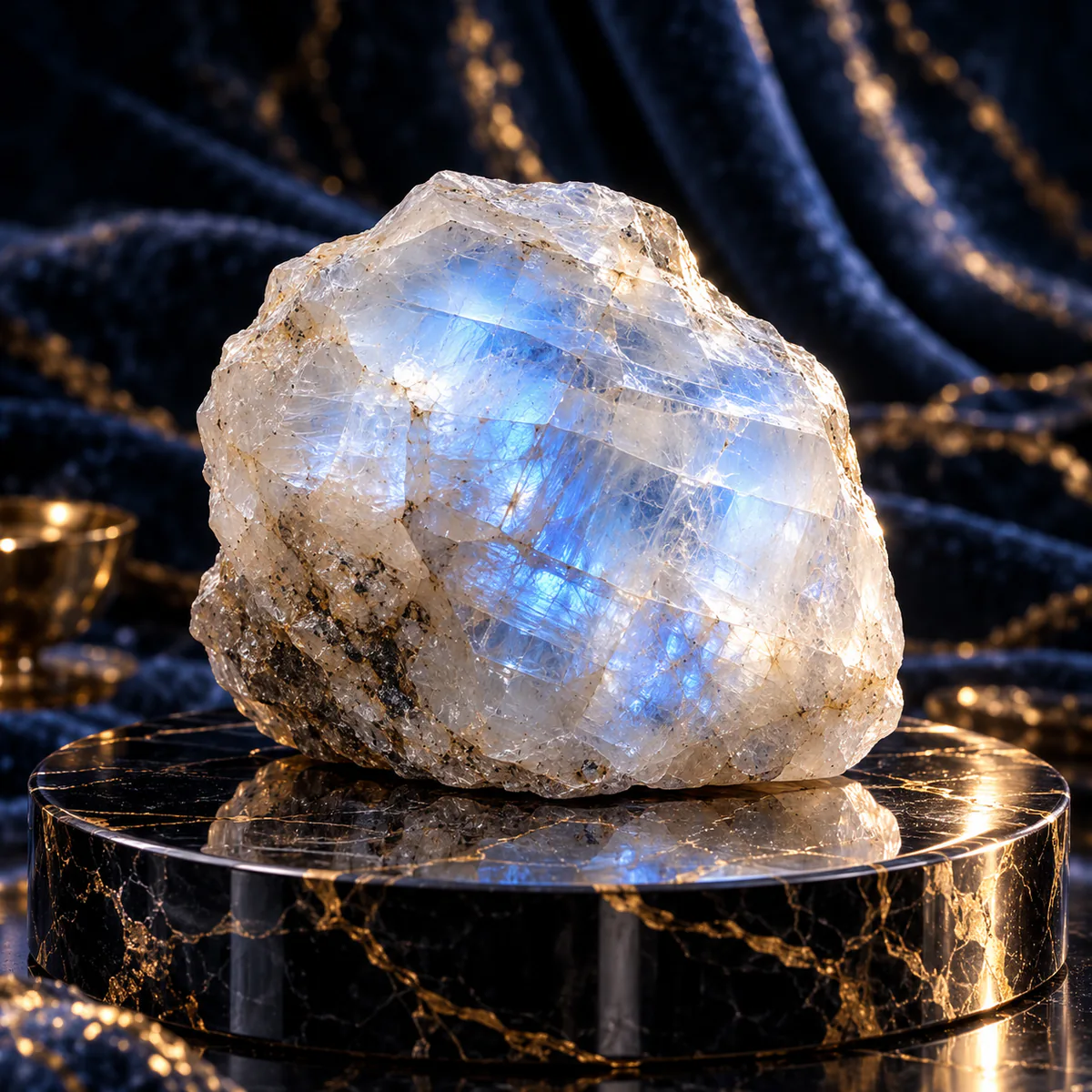
Crystal healing tradition lends moonstone correspondences tied to cycles and intuition, and the ringed-planet motif drags others along with it, which I have looked at more closely further down. I will go no further: none of it is demonstrated and no piece of jewellery heals anything. Separately, I have gathered what tradition lends this stone and what each colour changes.
- Gold-plated planet pendant, bezel-set cabochon at the centre of a paved circle, on a flattened-link chain.
- The plating on a pave goes between the stones, where the eye lands. It is all a matter of prevention.
- No ultrasound, no alcohol, no jewellery dip, no polishing cloth.
- Delivered in two weeks with a cotton pouch, a handwritten note and a care card.
The specifications
- Stone
- Moonstone, round cabochon
- Look
- Translucent white, moving sheen
- Accent stones
- Colourless cubic zirconia, bead set
- Metal
- Gold-plated metal
- Chain
- Flattened-link chain
- Gender
- Women
- Brand
- Melissa Moon
Why the title says gold and the page says plated
This is not coyness, it is a compromise I own. Nobody searches for a gold-plated pendant: people search for a gold pendant, and if I do not use that word in the product name, this page exists for no one. So the title is written in the language of the person searching, and I explain myself here rather than leave a profitable ambiguity floating.
The rule I hold myself to is simple: the word gold may serve to bring you here, it will never serve to make you believe. In the description, in the specifications and on the care card, you will read plated, because that is what you will receive and because caring for plating has nothing in common with caring for solid gold. A seller who leaves the word gold lying around in the technical specifications is not doing search optimisation, they are doing something else.
The word gold in a title is search optimisation. In a specification table, it is a lie.
No salt, no ultrasonic tank, no hot water: all three damage the stone for good, and ultrasound would also tire the beads holding the pave. On a plated piece, nothing abrasive: no paste, no hard brush, no polishing cloth, all of which remove the gold layer instead of cleaning it. A soft dry cloth is almost always enough. If a cleaning is needed, lukewarm water, a drop of mild soap, a very soft brush run between the stones, a short rinse and immediate drying, without letting water sit in the pave. Take the necklace off before the shower, the pool and sport. The detail is in cleaning a moonstone piece, and the safe methods in caring for it without harming it.