

Description
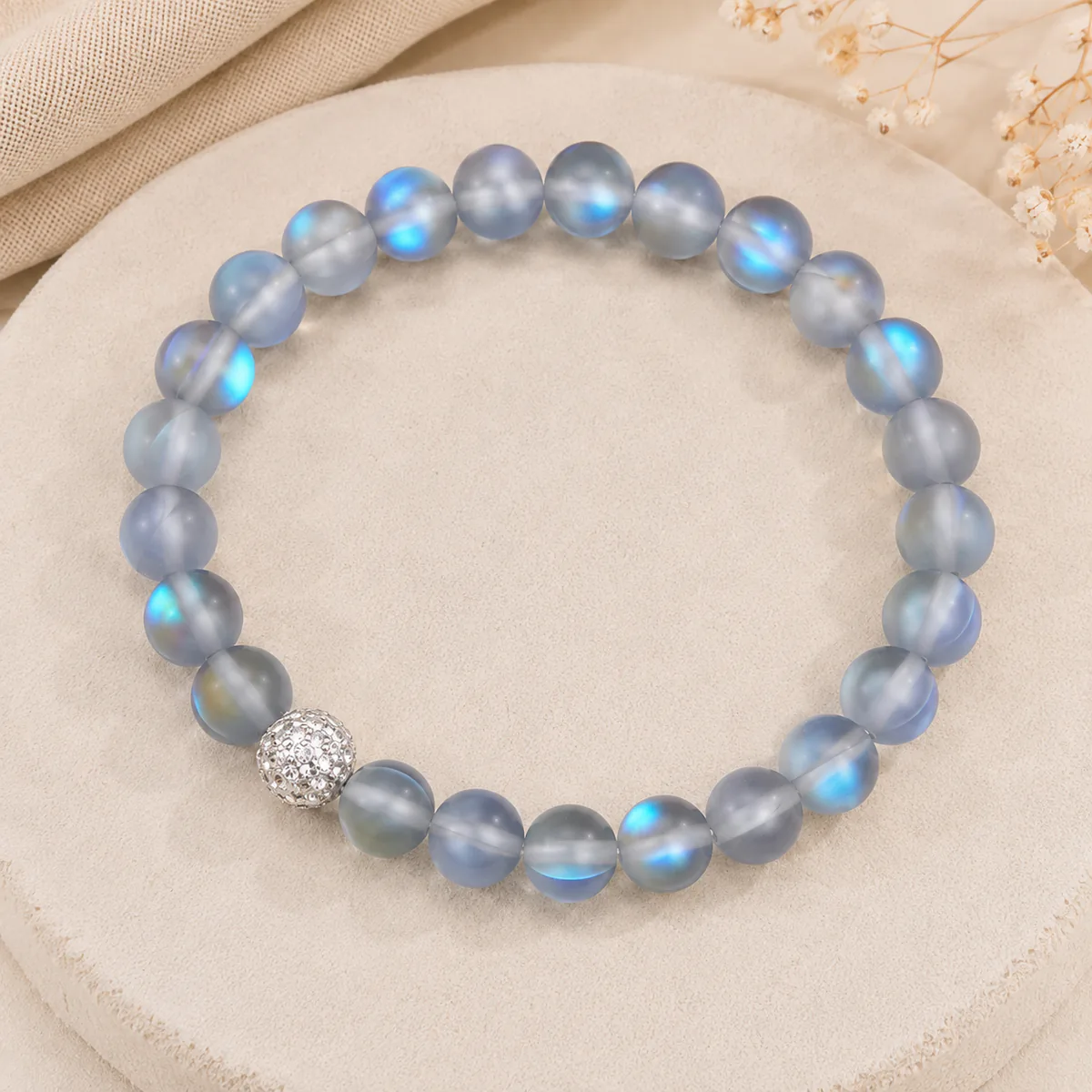
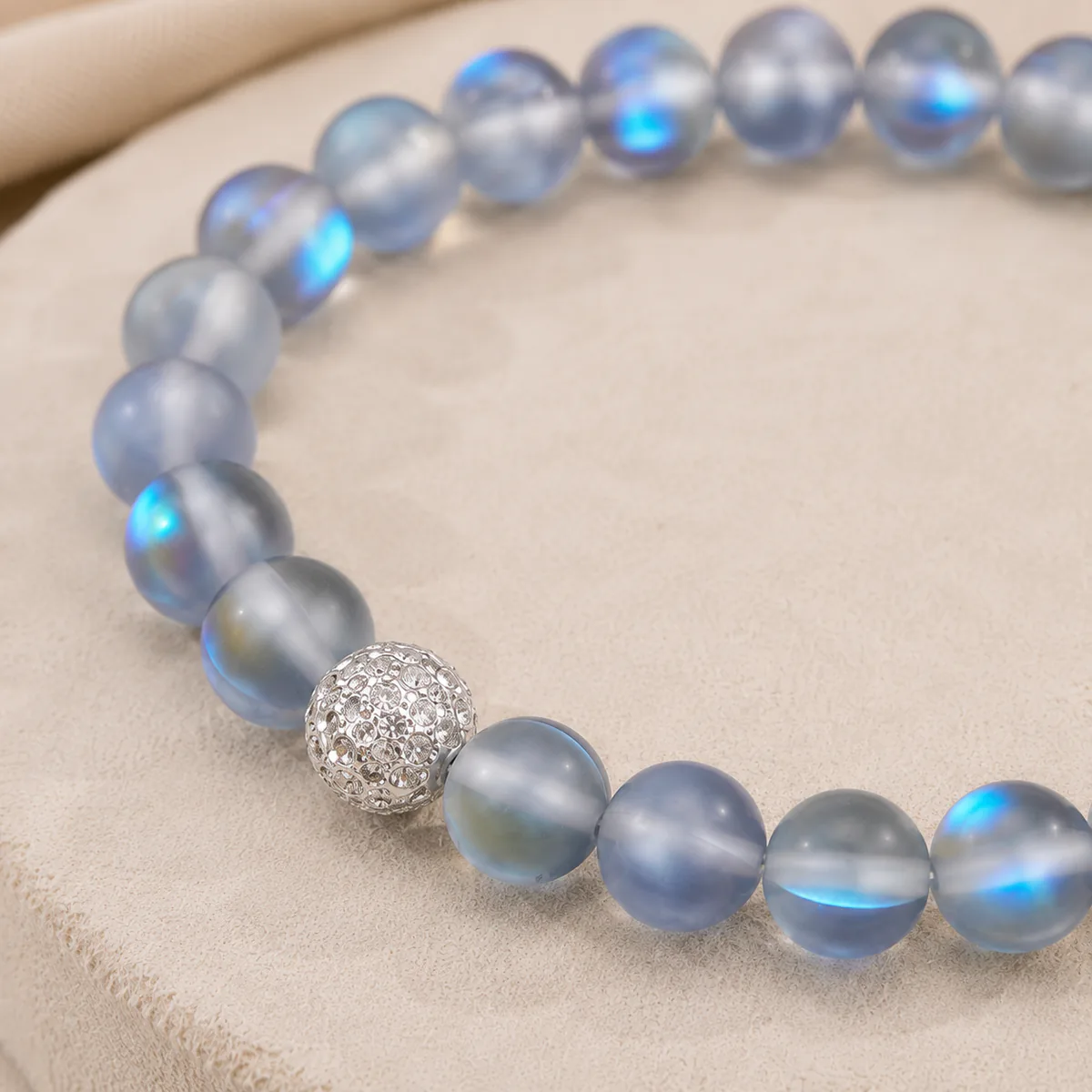
Round grey-blue beads with a matte finish, each crossed by a frank blue line, and a single bead paved with clear stones to break the row. It is the only unpolished bracelet in the catalogue, and the one whose blue is seen from furthest away.
The one model that does not shine
Every other bead in the shop is mirror polished. These are matte, and that changes the way you see them before colour even comes into it. A polished surface sends back the room around it: window reflections, points of light, your own hand. A matte surface sends back nothing at all, it diffuses, and the bracelet becomes a material rather than a shiny object.
The blue, as a result, does not sit on the bead: it seems to come from underneath, through a veil. It is gentler than a sharp flash, it produces no sparkle at all, and it gives this model a character markedly more sober than its intensity of colour would suggest. It is also what makes it unisex: without shine, a bracelet of blue beads is worn without any jewellery effect.
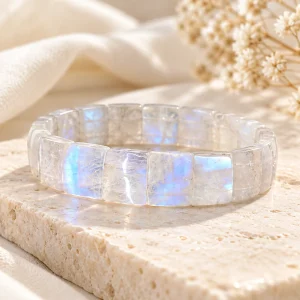
Blue is the most sought-after sheen in moonstone, and this tone is seen from a distance, which is not the case with a pale veil. Compare it with the classic polished beads to see the gap: same diameter, two different objects.
A matte piece polishes itself
Here is what is particular about this model, and nobody writes it because it shows up after several months. A matte surface is not a stable state: it is a micro-roughness, and friction erases it. At the points of contact, against the wrist, against the sleeve, against the table, the beads gradually turn satiny, then shiny. Your bracelet will therefore not wear evenly, it will develop lustred zones where it touches most.
Some people find that very good, because it is a patina and it tells of the wearing. But you have to know it beforehand, because it is irreversible: a piece can be repolished, it cannot be un-polished at home. The move that slows things down most is simple, and it is the same one as for creams: a matte material drinks grease, and greasy substances darken the finish by making it translucent in places. Put the bracelet on last, after creaming your hands, and take it off to cook.
On these beads, a dull look is in fact almost never wear: it is a greasy film blocking the micro-texture. Lukewarm water, a drop of mild soap, a rinse, thorough drying, and the matte finds its depth again.
The paved bead is the part to watch
The bracelet holds one element that is not a bead: that bead paved with small clear stones set on a metal mount. It is pretty, it gives the row a landmark, and it is by far the most fragile part of the whole thing. Paving of this kind is glued, not clawed: each small stone is held by a point of glue, and glue ages.
What kills it: heat, hot water, alcohol, perfumes, jewellery products, and above all the ultrasonic tank, which lifts a pavé in a matter of minutes. The stones then leave one by one, with holes nobody can match cleanly. Run a finger over it once a month: if a stone moves, it gets re-glued by a jeweller, whereas a lost stone cannot be replaced identically.
That bead is also the only part that catches: its relief grabs the loops of jumpers and tights. Wear it towards the inside of the wrist if you care about your knitwear. The stretch cord remains an ordinary wearing part, one to three years before restringing: put the bracelet on by rolling it over the hand rather than stretching it to full width. The shop’s other bracelets are here, and the sizing guide is there.
The beads remain sensitive to impact like every one in the catalogue: moonstone chips rather than scratches, and on a matte finish a fresh chip is spotted at once, because it is shiny. Crystal healing tradition lends blue correspondences different from those of the pale varieties. I have put them apart below. I will go no further: none of it is demonstrated and no piece of jewellery heals anything. Separately, I have gathered what tradition lends this stone, what each colour changes and what is said about which wrist to choose.
- Round grey-blue beads with a matte finish and a frank blue line. The only unpolished model in the catalogue.
- The matte lustres at the friction points, and there is no going back. It is a patina, to accept before buying.
- The paved bead is glued: no ultrasonics, no alcohol, no perfume, no hot water.
- Stretch cord, no clasp. Delivered in two weeks, with a cotton pouch and a care card.
The specifications
- Stone
- Blue moonstone, round beads with a matte finish
- Appearance
- Unpolished grey-blue, a frank blue line on each bead
- Central element
- One bead paved with clear stones on a metal mount
- Construction
- Stretch cord, no clasp
- Number of beads
- Varies with wrist size
- Wrist size
- 14 to 20 cm
- Gender
- Women and men
- Brand
- Melissa Moon
Why a paved bead on a bracelet this sober
It is the question I am asked most about this model, and it is a fair one: everything else is matte, muted, without shine, and there in the middle sits an element that sparkles. The reason is a silly one and it is visual. A row of rigorously identical beads has neither beginning nor end; the eye goes round it without ever settling. This bead gives the bracelet a front, and it is the one you bring to the top of the wrist as you dress.
That said, it is also the element I remove first if asked, because it is the only one that is not a stone and the only one that can be damaged beyond clean repair. A bracelet without it is more austere, longer to look at, and probably more durable. Both versions hold up, and I would rather say so than let it seem obvious. The rest of the shop is here.
A perfectly regular row bores the eye. It needs somewhere to stop, however small.
Three prohibitions on this model, and they hold above all for the paved bead: no ultrasonic tank, no alcohol or jewellery product, no hot water, all of which lift the pavé. No salt on the beads either. Lukewarm water, a drop of mild soap, a rinse, thorough drying with a cloth, with attention around the bead where water lingers between the stones. On a matte finish, never rub with an abrasive cloth or a brush: it lustres the surface and creates a permanently shiny zone. The detail is in cleaning a moonstone piece, and the safe methods in caring for it without harming it.