When to Charge Crystals With the Moon
Full moon, new moon, exposure time, when to bring them out: here's the calendar as tradition sets it, and the astronomical benchmarks that let you actually follow it. Plus something I've never read anywhere, and it damages more stones than anything else: the clearest night is also the one with the most dew.
A shop called Melissa Moon doesn't get to write this page halfway. So I treat it fully, separating what tradition prescribes from what astronomy lets you verify. For the other six methods, see the article on the seven methods.
The essentials, if you're in a hurry
- Tradition says the full moon, one night, outside or behind a window. It's by far the most widespread protocol.
- The full moon is a moment, not a night. The two nights around it work just as well, and no one will see the difference.
- The cycle lasts 29 days, 12 hours and 44 minutes. One occasion per month, shifting by about 50 minutes each day.
- It's the only night the Moon is visible from evening to morning, because it rises at sunset and sets at sunrise.
- Moonlight is reflected sunlight, roughly 400,000 times less intense. One minute of daylight brings more than a whole night of it.
- The clearest night is the one with the most dew. That's the real danger of this method, and nobody talks about it.
- Indoors, it costs the stone nothing. Outdoors, it can cost dearly.
The short answer, and its nuance
You're looking for a date. Here it is, before anything else.
Tradition says: the night of the full moon. You bring the stone out at sunset, bring it back in the morning. It's the protocol nearly every source gives, and if you only want one answer, that's it.
The nuance comes in two points, and they're useful. First, the full moon is a precise moment, not a night: it's when the Moon sits exactly opposite the Sun. Almanacs give it to the minute. In practice, the Moon looks full for about three nights, and the two surrounding the exact moment work just as well.
Second, it isn't the only date tradition offers. The new moon has its supporters, for different reasons, and the quarters show up in some protocols too. The table below sums them up.
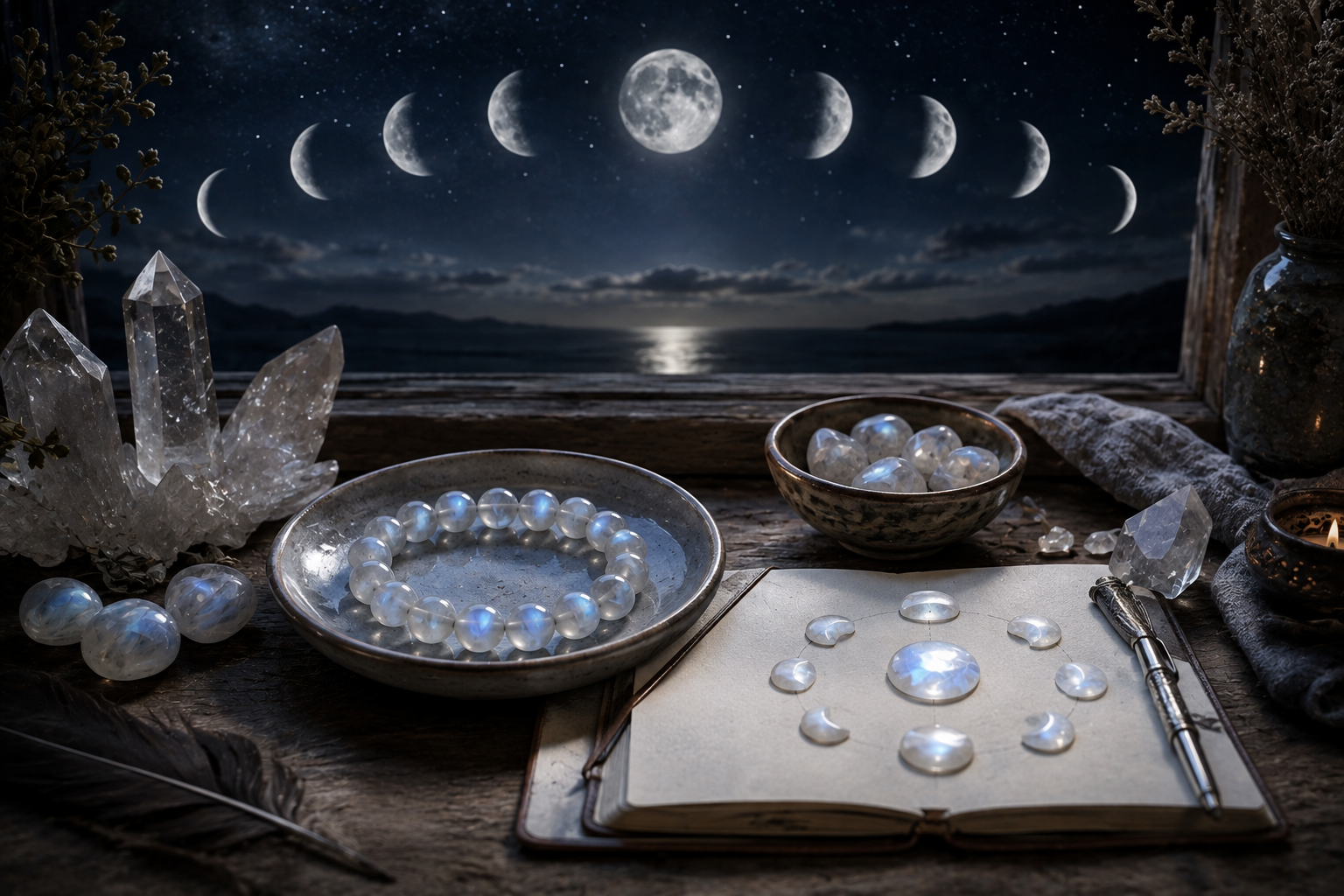
The eight phases, and what gets attributed to them
The full cycle, in order, with what contemporary crystal healing associates with each stage. I report, I don't prescribe.
| Phase | What tradition attributes to it | Usage |
|---|---|---|
| New moon | Starting over, setting an intention | Common |
| Waxing crescent | What's starting, what's growing | Rare |
| First quarter | Momentum, the decision | Rare |
| Waxing gibbous | Building up before the peak | Very rare |
| Full moon | Charging par excellence | Majority |
| Waning gibbous | Letting go | Very rare |
| Last quarter | Sorting, what you leave behind | Rare |
| Waning crescent | The end of the cycle, rest | Rare |
Read the right-hand column: two phases out of eight account for almost all the use. The rest of the calendar exists in books and barely in practice.
The logic behind these attributions is the same everywhere, and it's consistent within its own system: what grows accompanies what you want to grow, what shrinks accompanies what you want to let go of. It's reasoning by analogy, like almost everything in crystal healing, and I dated these correspondences in the properties of moonstone.
The full moon, and the real window
Here are the astronomical benchmarks that make the protocol workable, and that are rarely given.
The cycle lasts 29 days, 12 hours and 44 minutes. That's the synodic month, the interval between two new moons. So you get one occasion per month, and it slides by about a day and a half against the civil calendar, which is why the full moon falls on a different date each month.
The Moon rises about 50 minutes later each day. That shift is what drives the whole calendar, and it's also what makes most phases unusable for a nighttime ritual: at first quarter, the Moon sets around midnight. If you set a stone out at ten p.m., it spends most of the night with no Moon at all.
The full moon is the one exception. At that moment, the Moon sits exactly opposite the Sun: it rises when the Sun sets, and sets when the Sun rises. So it's the only night of the month it's visible from evening to morning, and that's a perfectly material reason tradition settled on it rather than another phase.
I like this detail, because it shows the protocol isn't arbitrary at all: someone, a long time ago, noticed that only one night in twenty-nine let you leave an object under the Moon from dusk to dawn.
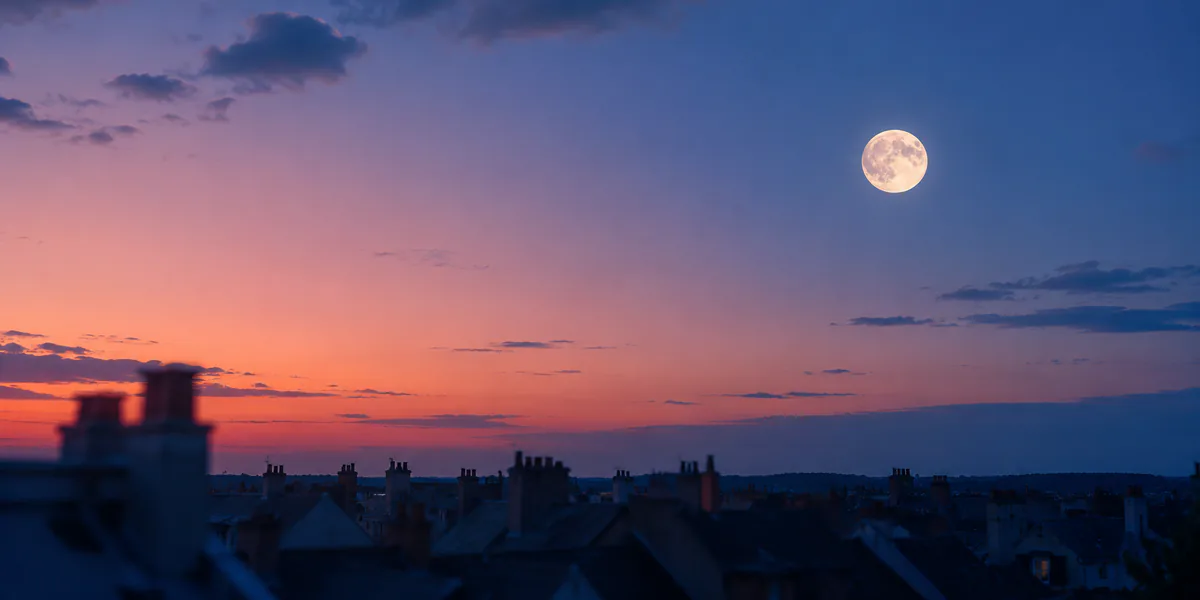
The new moon, the other half of the calendar
It comes up more and more often in protocols, and it's worth knowing what it actually is.
At the new moon, the Moon isn't visible. It sits between the Earth and the Sun, its lit face turned away from us, and it rises and sets at roughly the same time as the Sun. So that night, there's no moonlight at all.
Which means that if the supposed mechanism were light, the new moon couldn't do anything. The protocols that recommend it don't actually talk about light, though: they talk about starting over, setting an intention, a blank page. It's an openly symbolic use, and I find it more consistent than the full moon's, which often invokes a light without saying what it would do.
On the material side, the new moon has a real, slightly amusing advantage: since there's nothing to see, nobody has a reason to take their stones outside. They stay indoors, and they don't catch dew.
How long, and at what time
Three questions always come up, and I answer all three.
How long? Tradition says a full night. Some protocols say four hours, others sunset to sunrise, others three nights in a row. None gives a reason, and none of these durations has more grounding than another.
What time should you put the stone out? If you're following the full protocol, at sunset, since that's when the Moon rises that evening. In practice, before you go to bed is plenty.
What time should you bring it back in? And here, I have a real recommendation: before sunrise, and especially before morning. Not for energy reasons, for reasons of dew and temperature. That's the subject of the next section, once light is dealt with.
What moonlight actually is
This section is in the indicative, because these are measurements. It doesn't say the ritual is pointless; it says what the light actually is.
The Moon produces no light of its own. It reflects the Sun's, and poorly: its albedo is about 12%, which makes it roughly as reflective as worn asphalt. What we call moonlight is therefore secondhand sunlight.
The orders of magnitude are striking. Full moonlight illuminates the ground at roughly 0.1 to 0.3 lux. Full sunlight, at roughly 100,000 lux. The ratio is about 400,000.
Translated into duration: a stone left on a windowsill gets more light in one minute of daylight than in an entire night of full moonlight. If the charging mechanism were light-based, the rational protocol would be to leave stones in the sun, which tradition specifically advises against. The two prescriptions can't both be true at once.
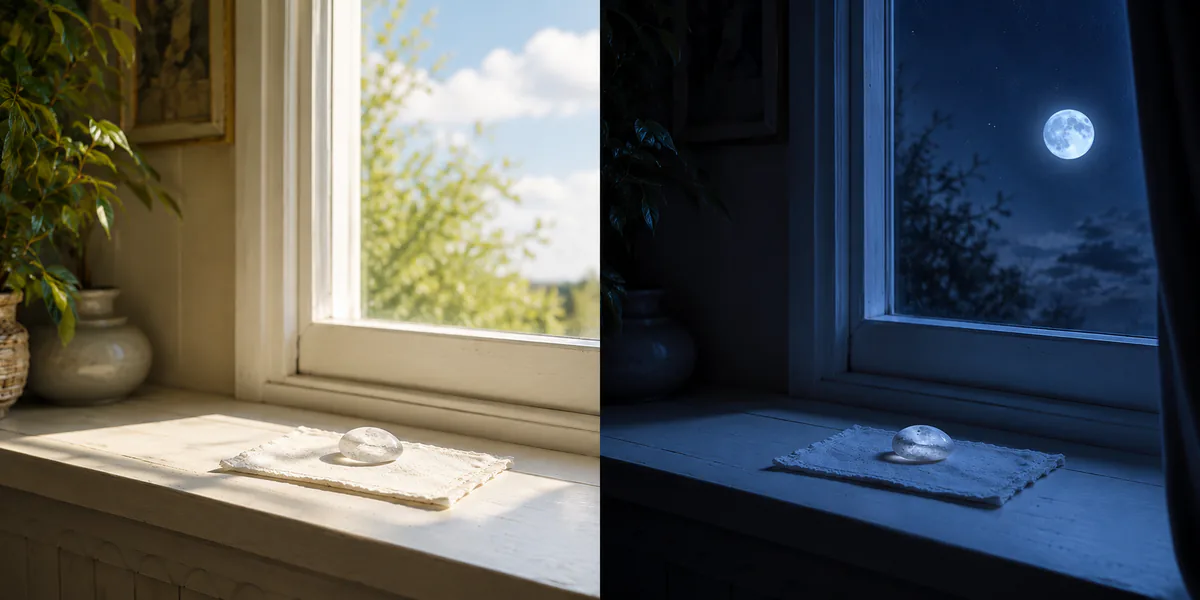
What I take from these numbers isn't that the gesture is useless. It's that what it brings isn't light. A monthly appointment, a date you remember, a few minutes of attention paid to an object you care about: that's real, and it doesn't need 400,000 lux. I develop this idea in the properties of moonstone.
Dew, the trap of the clearest night
Here's the useful part of this article, the one I've never read anywhere, and it causes damage every month.
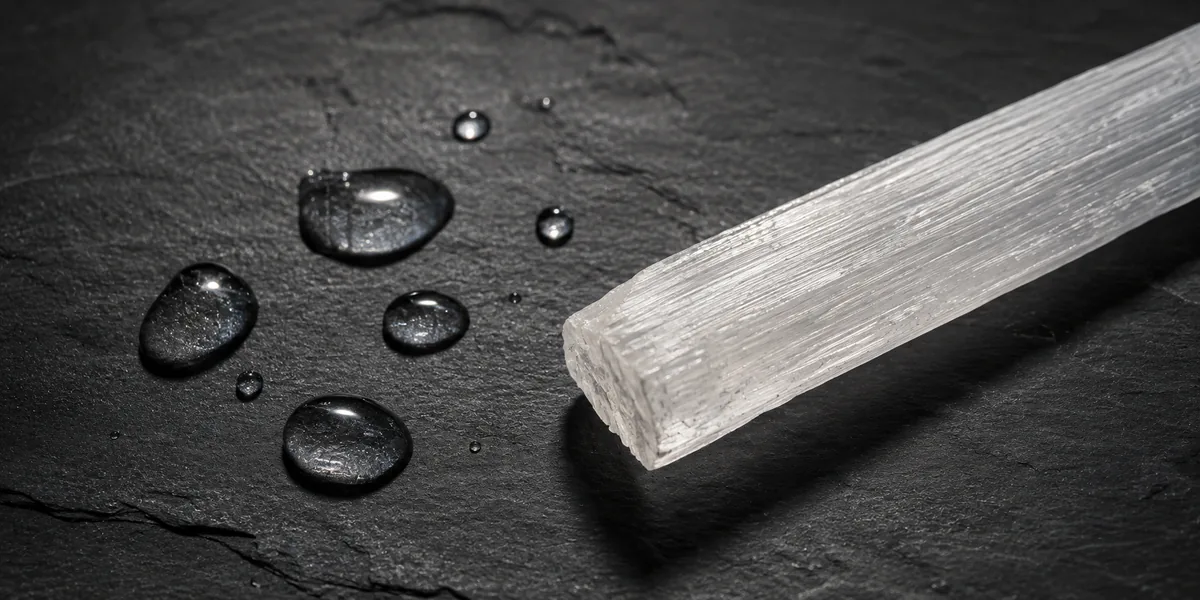
To see the Moon well, you need a clear sky and no wind. Those happen to be exactly the conditions that produce the most dew. Without clouds, heat escapes from the ground into the sky unobstructed: that's radiative cooling. Surfaces drop below the dew point, and water vapor in the air condenses on them into droplets. Without wind, nothing stirs the air, and the effect intensifies.
In other words: the best night for moonlight is the worst night to leave an object outside. A stone left on an outdoor sill, a garden table or a ledge will be wet by morning, reliably, and all the more surely the more beautiful the night was.
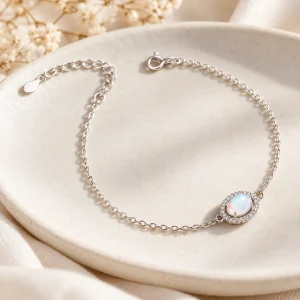
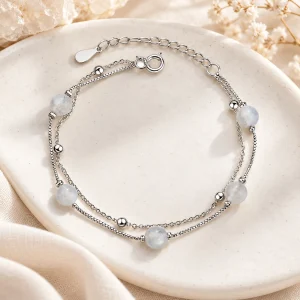
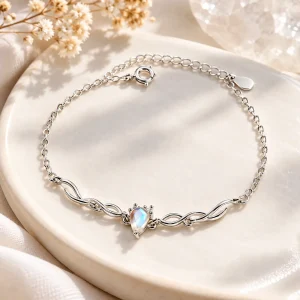
The consequences depend on what you left out there, and they're in the table of sensitive stones. A selenite left wet all night degrades, since it's gypsum. A pyrite rusts. A silver setting tarnishes. A bracelet on elastic cord takes days to dry between the beads. And moonstone on top of that takes a temperature swing of several degrees between midnight and dawn.
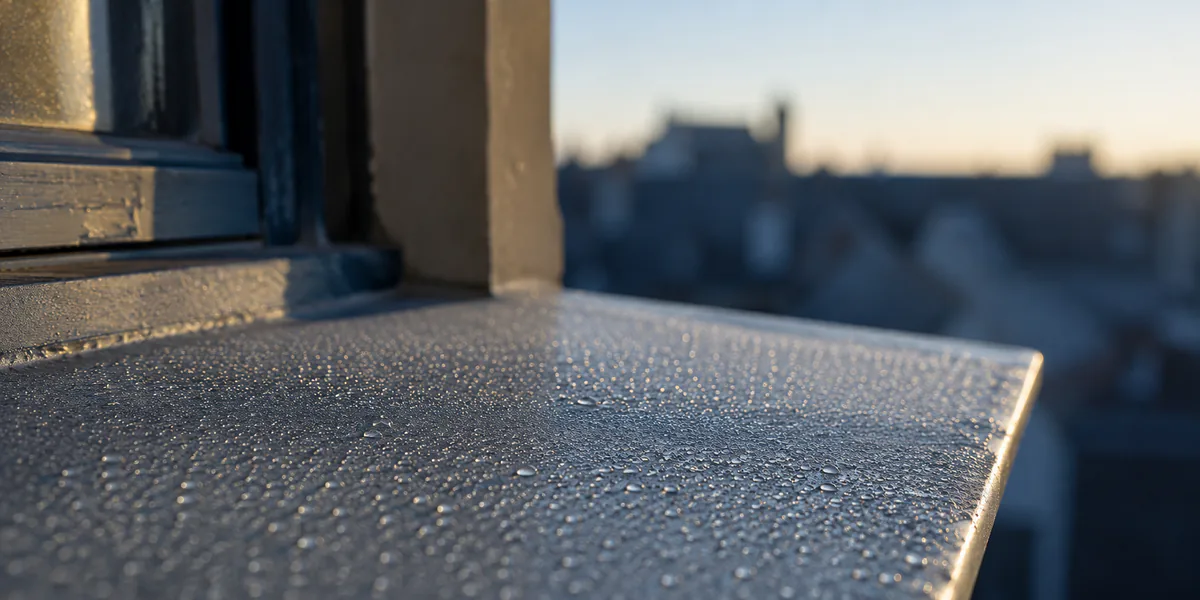
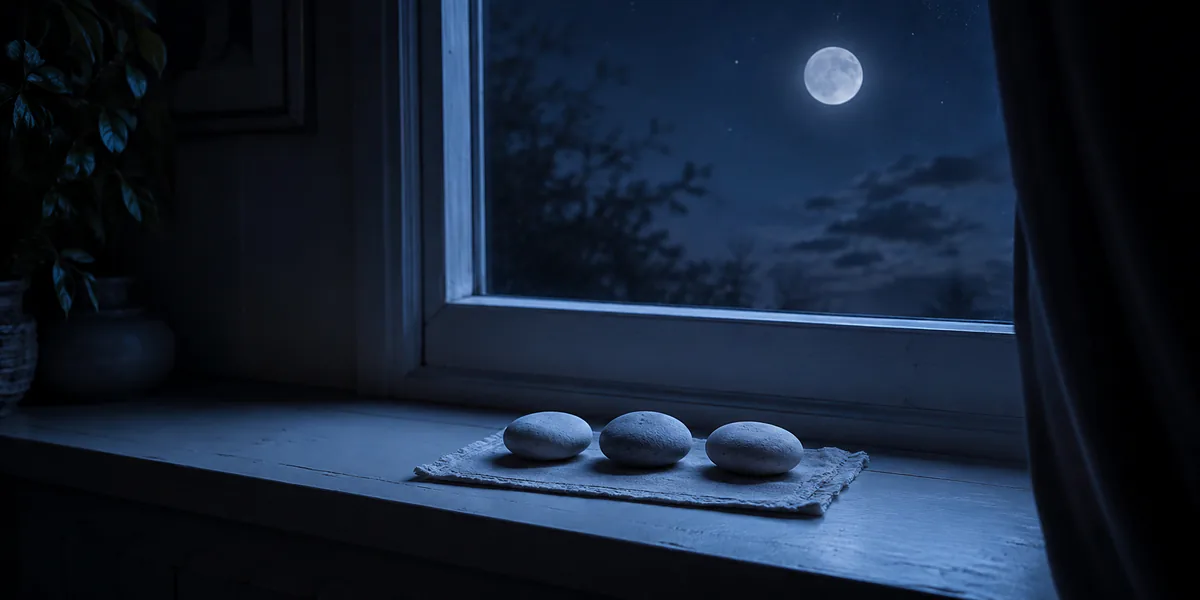
The solution is simple and it costs the ritual nothing: bring the stone in, or leave it indoors. Behind a closed window, it sees exactly the same Moon, doesn't catch dew, and doesn't fall off a ledge.
How to do it without losing a stone
The protocol I give when people ask me. It fits in five lines.
Indoors, on a windowsill. Not outside, because of dew. Not on a balcony, because of wind and falls.
Away from the edge, never right at it. The one real accident with this method is a stone falling onto tile, and a cleavable stone doesn't recover from that. It's explained in is moonstone fragile.
On a dry cloth, not directly on the sill. It cushions, prevents sliding, and absorbs the condensation that sometimes forms on the inside of a cold window.
Jewelry kept apart, not in a pile. A moonstone against an amethyst is 6.5 against 7, and eight motionless hours are enough if the pieces shift against each other. The hardness chart is in which stone to pair moonstone with.
Brought in by morning, wiped down if they feel cold to the touch, put back in their pouch. Actual cleaning is a different matter, and it's in how to clean a moonstone piece.
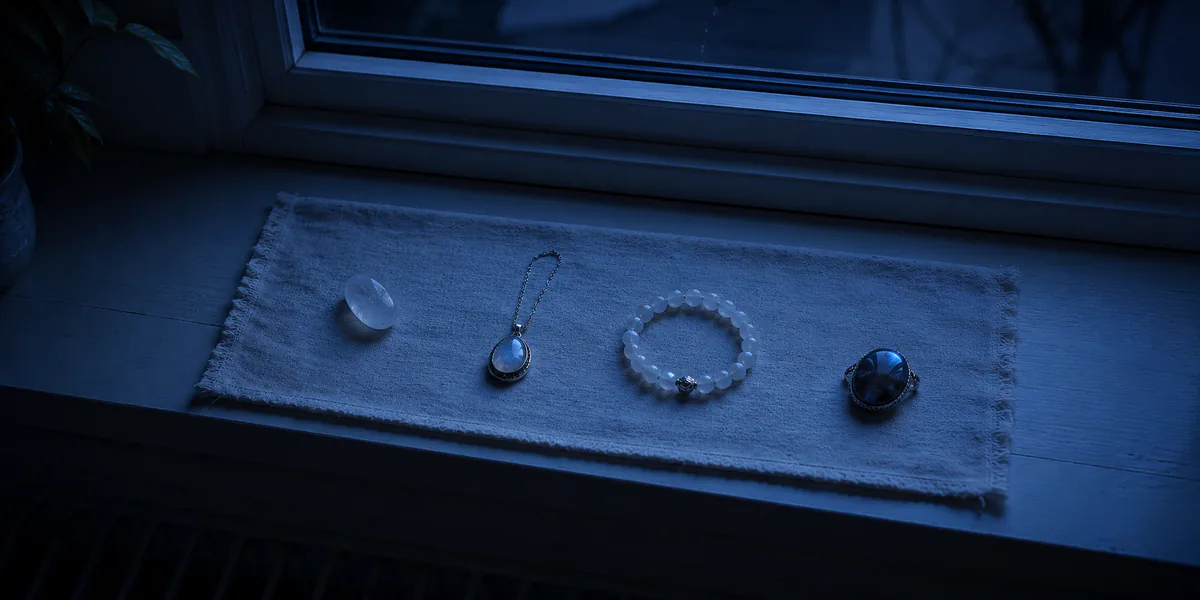
The wire-strung bracelets, the ones that dry the worst

Stones you shouldn't leave outside
If you still insist on outdoors, here are the ones that shouldn't go there.
- Selenite. It's gypsum, soluble. A single night of dew is enough to dull it, and repeated exposure damages it for good.
- Pyrite and hematite. They contain iron and rust with prolonged exposure to moisture.
- Malachite. Soft, and sensitive to water and acids.
- Turquoise and lapis lazuli. Porous, they absorb moisture and stain.
- Anything set in silver. It isn't the stone that suffers, it's the setting that tarnishes and the glue that gives way.
- Any bracelet on elastic cord. The cord takes days to dry between the beads, and it's a wear part.
Which doesn't leave much, and that's exactly my point: the indoor version suits everything, the outdoor version suits almost nothing.
The workshop's rings, keep them dry and warm




The notions of cleansing and charging belong to crystal healing, an approach based on tradition and belief. They do not constitute a medical claim and never replace the advice of a health professional. Read the full disclaimer.
What I won't claim
Four things, since this is the page where my shop's name would make it easy for me to be dishonest.
I won't say the Moon charges anything at all. I sell moonstone, I have an obvious interest in letting people believe it, and that's exactly why I'm spelling it out plainly.
I won't say one phase is better than another. The table above reports what the books say. None of these attributions rest on anything but an analogy.
I won't sell a lunar calendar. Full moon dates are public, free, and calculated to the minute by almanacs and astronomical ephemerides. Charging for them would be selling the time of day.
I won't say bringing your stones in is a matter of energy. It's a matter of dew, temperature and falls. Those are the only arguments I can prove, and they're also the only ones that actually save stones.
Frequently asked questions
When should you charge crystals with the moon?
Tradition says the night of the full moon, from sunset to sunrise. It's also the only night of the month the Moon is visible start to finish, since it rises as the Sun sets. The two nights surrounding the exact moment work just as well.
How long should you leave the stones out?
One night, according to tradition. No duration has more grounding than another, and protocols contradict each other, from four hours to three nights running. What matters materially is bringing them in before morning.
Do you need to put them outside?
No, and I advise against it. A beautiful full-moon night is a clear, windless one, which is exactly the kind that produces the most dew. Your stones will be wet by morning. Behind a closed window, they see the same Moon without that risk.
Does it work behind a window?
According to tradition, yes, most protocols accept it. And materially, the difference in light is negligible against the orders of magnitude involved: full moonlight is about 0.2 lux, against 100,000 in full sunlight.
What about the new moon?
Some protocols prefer it, for setting an intention rather than for charging. Note that on that night, the Moon isn't visible at all, rising and setting with the Sun. So there's no moonlight whatsoever, which makes the use plainly symbolic.
How long does a lunar cycle last?
29 days, 12 hours and 44 minutes, the synodic month. That's why the full moon falls on a different date each month, and why the Moon rises about 50 minutes later each day.
Does moonlight have a measurable effect?
It's sunlight reflected off a surface with an albedo of roughly 12%, or about 400,000 times less intense than direct sunlight. A stone gets more light in one minute of daylight than in an entire night of full moonlight.
Can you charge every stone with the moon?
Indoors, yes: the method poses no material risk to any stone. Outdoors, no: selenite, pyrite, hematite, malachite, turquoise and anything set in silver suffer from dew.
Do you need a paid lunar calendar?
No. Full moon dates and times are public and calculated to the minute by astronomical ephemerides and almanacs. Nothing justifies charging for them.
What if the sky is overcast?
According to tradition, most protocols consider that it doesn't hinder anything. And materially, an overcast night even has an advantage: clouds limit radiative cooling, hence dew.
Where to go next
- The other methods: the seven methods, every stone, the case of moonstone.
- Cleaning, which is a different matter: cleaning a piece, the water question, is it fragile.
- The Moon and the stone: piece of the Moon or moonstone, myths and legends, the gods and goddesses of the Moon.
- The belief framework: the properties and their dating, astrology, getting started with crystal healing.
- The full picture: the complete moonstone guide.
The jewelry is in the shop. And if you left a stone out one night too many, send me a photo: on a tarnished setting there's often something to be done, on a dulled selenite much less so.
My sources
For the astronomy: the synodic month lasts 29.53059 days, or 29 days, 12 hours, 44 minutes and 3 seconds. At full moon, the Moon is in opposition, rising roughly as the Sun sets and setting roughly as it rises, which makes it the only night it's visible start to finish. These are standard ephemeris figures.
For the light intensities: the lunar albedo is roughly 12%, full moon ground illumination is on the order of 0.1 to 0.3 lux, and full sunlight is about 100,000 lux, a ratio of roughly 400,000.
For dew: it forms through radiative cooling, when a surface drops below the ambient dew point. Clear, windless nights favor it most, since the absence of clouds lets heat escape into the sky. This is elementary meteorology, and it's what makes the ideal night for observation the worst one to leave an object outside.
For moisture-sensitive stones, the properties noted on Mindat and in GIA care sheets: gypsum is soluble, pyrite oxidizes, turquoise and lapis are porous.
One limitation I'll flag: the "usage" column in the phase table is my own estimate, drawn from what I observe in circulating protocols and in the messages I receive. It isn't a measurement, and I present it as a rough order of magnitude.
Last updated: August 19, 2026. If you find an error in this article, let me know: I'll fix it and note it.
✦ À porter, à offrir
Découvrez mes créations