


Description
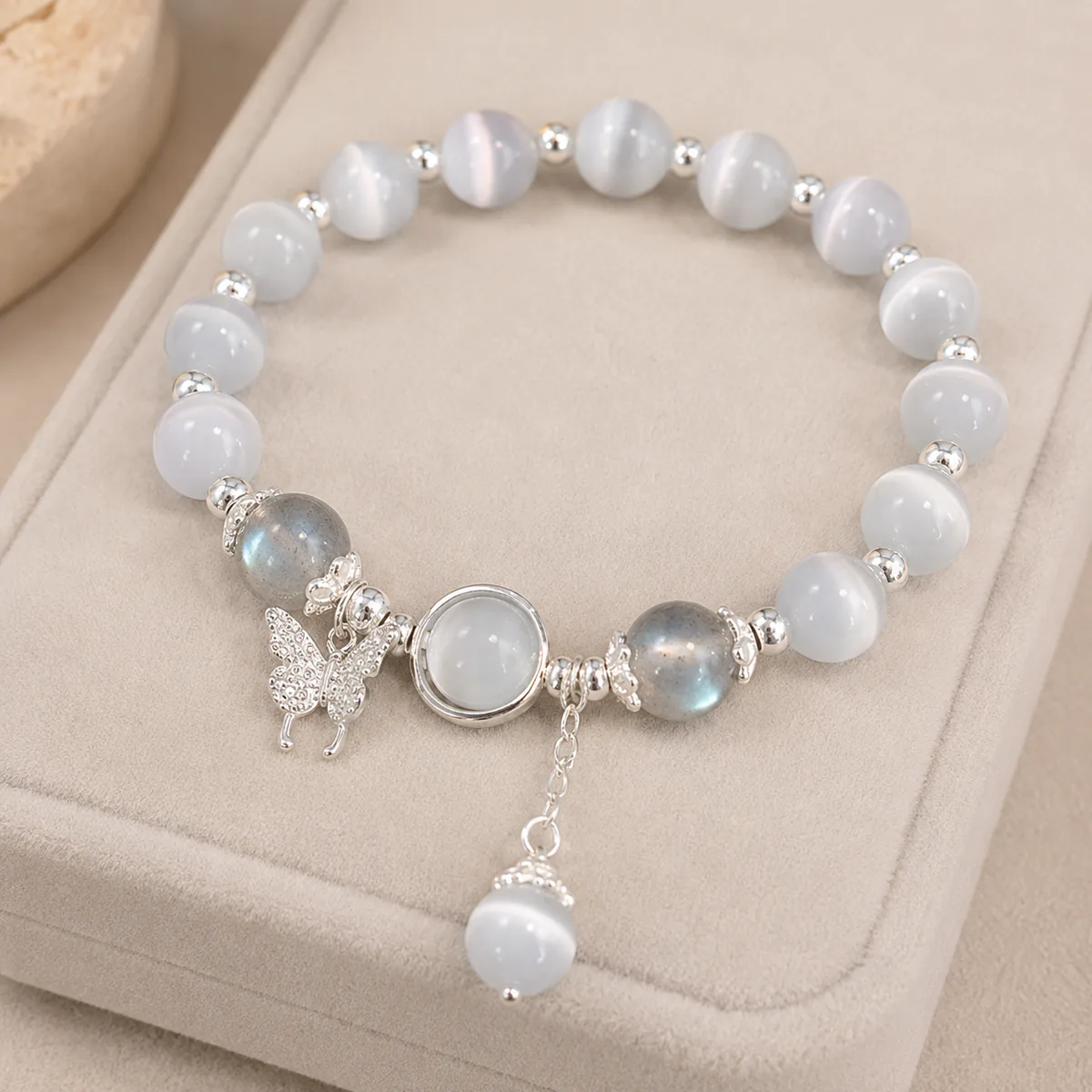
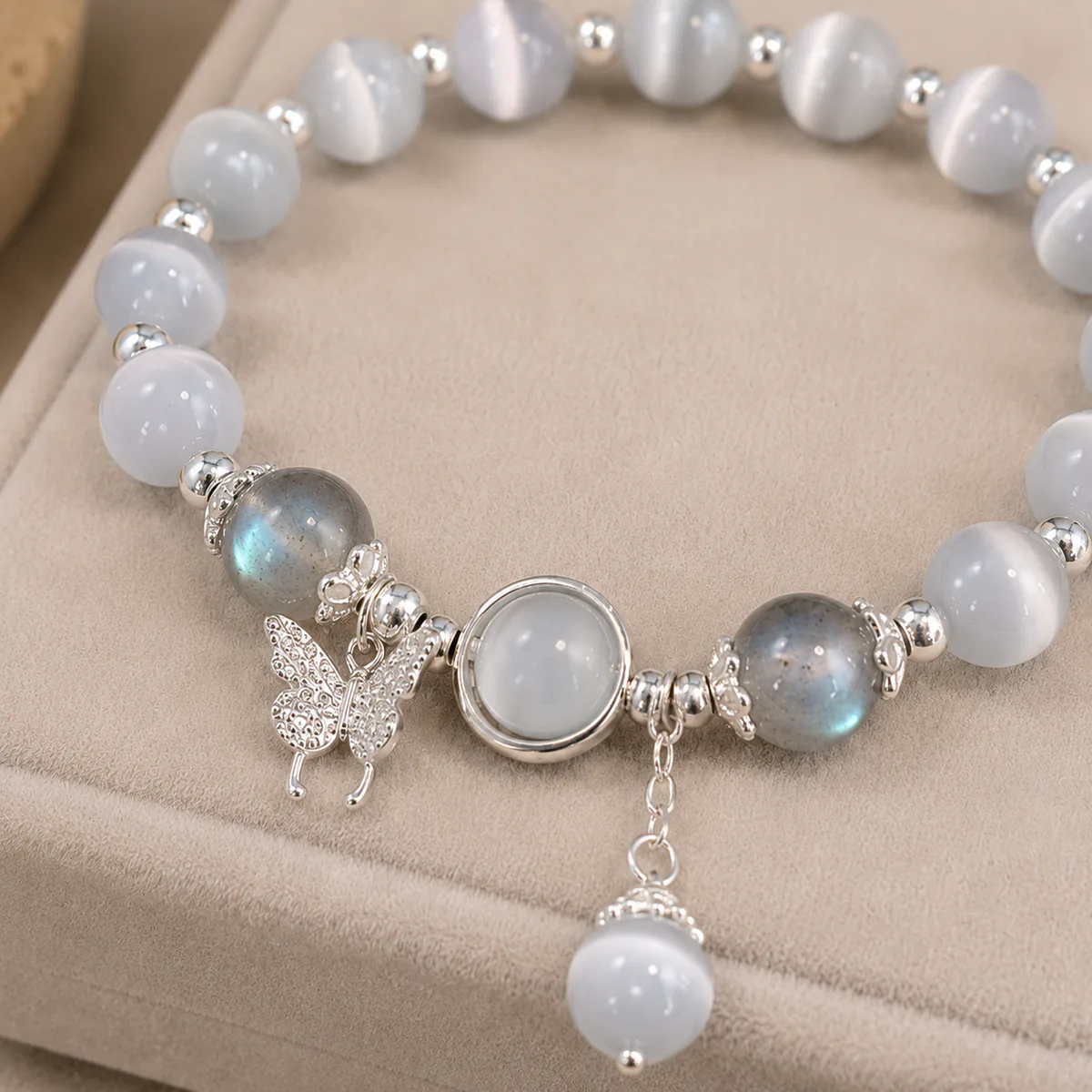
Large white beads crossed by a band of light, two grey beads with a blue flash, a cabochon set in a silver circle, a paved butterfly and a charm that hangs. It is the most composed bracelet in the catalogue, the one that gathers the most different elements on a single cord.
Two different lights on the same row
This bracelet puts side by side two optical effects that are often confused, and it is the occasion to separate them once and for all. The large white beads show a band: a clean line of light running across the top of the bead and moving as one block when you turn the wrist. That is what is called a cat’s eye effect, or chatoyancy. It is born of a multitude of parallel fibres aligned in the material, which send light back in a line perpendicular to their direction.
The two grey beads show no line but a flash, blue, wide, lighting up all at once at a certain angle and gone at the next. That is the behaviour of feldspars with a sheen, and it has nothing to do with the first: where the band stays visible at all times and merely glides, the flash either exists or does not.
One thing is worth knowing, because it serves well beyond this piece: a classic moonstone produces neither of the two but a third effect, a diffuse veil without an outline, seeming to float beneath the surface instead of sitting on it. Band, flash, veil: three phenomena, three causes. I have written a whole article on telling them apart, and I really do encourage you to read it before buying white beads elsewhere. The quality criteria are set out here.
A composite bracelet ages at the speed of its weakest part
Here is what is particular about this model, and it holds for every piece of the same kind. A bracelet of plain beads has only one weak point, its cord. This one has four: the stretch cord, the charm’s jump ring, the glued cap that tops it, and the butterfly’s pavé, each small stone of which is held by a point of glue. Its lifespan is not the average of those four, it is that of the first to give way.
That is no reason to distrust it, it is a reason to know where to look. Once a month, three ten-second moves: pull gently on the charm to check that its ring is properly closed, run a fingernail over the butterfly to feel whether a stone has moved, and look at the elastic between two beads, which whitens and frays before it snaps. A ring is tightened with pliers, a stone that moves is re-glued, an elastic is replaced. All three are repairable, provided you see them coming.
Two prohibitions follow, stricter than on the rest of the catalogue: no ultrasonic tank and no alcohol, which lift a pavé in a matter of minutes, and no hot water, which softens the glues. It is also the bracelet to take off before the shower, because soap works on the elastic and settles under the charm’s cap.
The hanging charm is not only an ornament
It gives the bracelet its movement and its lively side, and that is what you are buying. But a hanging charm behaves in a particular way that is better anticipated. It swings, so it rubs: against the neighbouring beads when you move your arm, against the desk when you write, against the keyboard when you type. Of the whole bracelet it is the element that will mark first, and that is normal.
It also catches, more than the rest: its ring grabs the loops of jumpers and the threads of scarves. The useful reflex is to wear it towards the inside of the wrist, under the hand, where it is sheltered from knitwear and table corners. The bracelet keeps its look, and the charm stops acting as a hook.
The stretch cord, finally, remains an ordinary wearing part: one to three years, longer if you put the bracelet on by rolling it over the hand rather than stretching it to full width. On a loaded model like this one, the weight of the metal elements works the elastic a little faster than on a row of bare beads. The shop’s other bracelets are here, and the sizing guide is there.
Crystal healing tradition lends moonstone correspondences tied to cycles and intuition, and the butterfly a symbolism of transformation. I have put them apart below. I will go no further: none of it is demonstrated and no piece of jewellery heals anything. Separately, I have gathered what tradition lends this stone, what each colour changes and what is said about which wrist to choose.
- White beads with a band of light, two grey beads with a blue flash, set cabochon, paved butterfly and hanging charm.
- Four weak points to watch: the cord, the charm’s ring, its glued cap, the butterfly’s pavé.
- No ultrasonics, no alcohol, no hot water. The glues do not survive them.
- Stretch cord, no clasp. Delivered in two weeks, with a cotton pouch and a care card.
The specifications
- Main beads
- Round white beads with a cat’s eye effect
- Accent beads
- Two grey beads with a blue flash
- Elements
- Set cabochon, paved butterfly, charm hanging on a fine chain
- Metal
- Silver-tone balls, rondelles and mountings
- Construction
- Stretch cord, no clasp
- Wrist size
- 14 to 20 cm
- Gender
- Women
- Brand
- Melissa Moon
Why I sell a charm bracelet when I do not care for them
I may as well write it plainly: my taste runs to bare rows, one material, with nothing hanging. Composed bracelets are the ones that come back for repair most often, because they multiply the parts liable to give way, and a jeweller tends to be wary of them for that reason.
Except that they are also the ones people actually wear, every day, for months. A row of identical beads is perfect and a little cold; this one has a front, a weight, a small sound, and you put it back on in the morning without thinking. A piece that gets worn is worth more than a piece admired in a box. So I sell it for what it is: a generous piece to keep an eye on, not an object to hand down. The rest of the shop is here.
A composed bracelet is a chain of links. Its lifespan is that of the weakest, never that of the stones.
No salt, no ultrasonic tank, no hot water, and on this model no alcohol and no jewellery product: the glues of the butterfly and of the cap give way long before the stones do. Lukewarm water, a drop of mild soap, a soft cloth, and above all thorough drying, dabbing under the charm and around the cabochon where water stays trapped. Never let the bracelet dry flat on a radiator: heat slackens the elastic and softens the glued joints. The detail is in cleaning a moonstone piece, and the safe methods in caring for it without harming it.