

Description
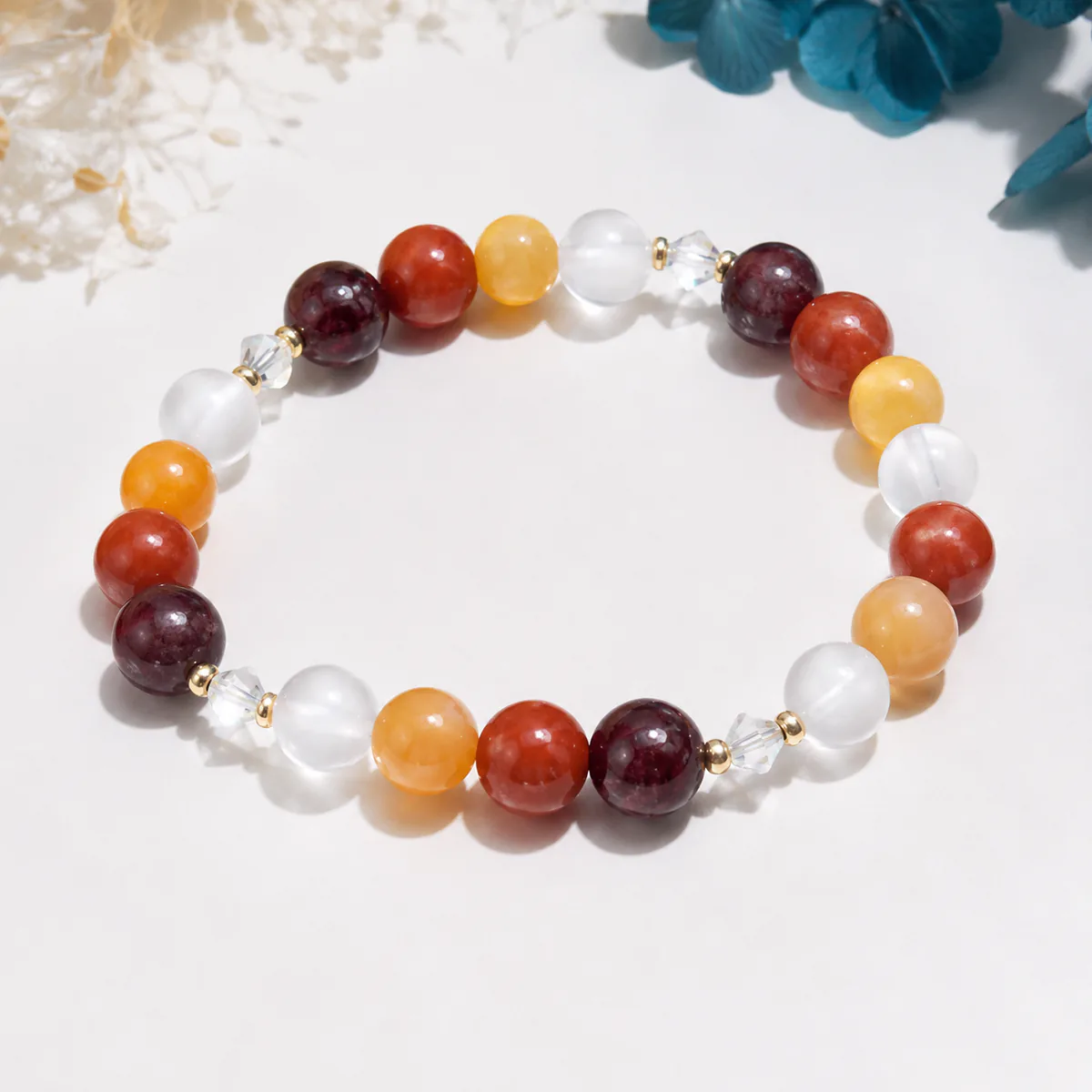
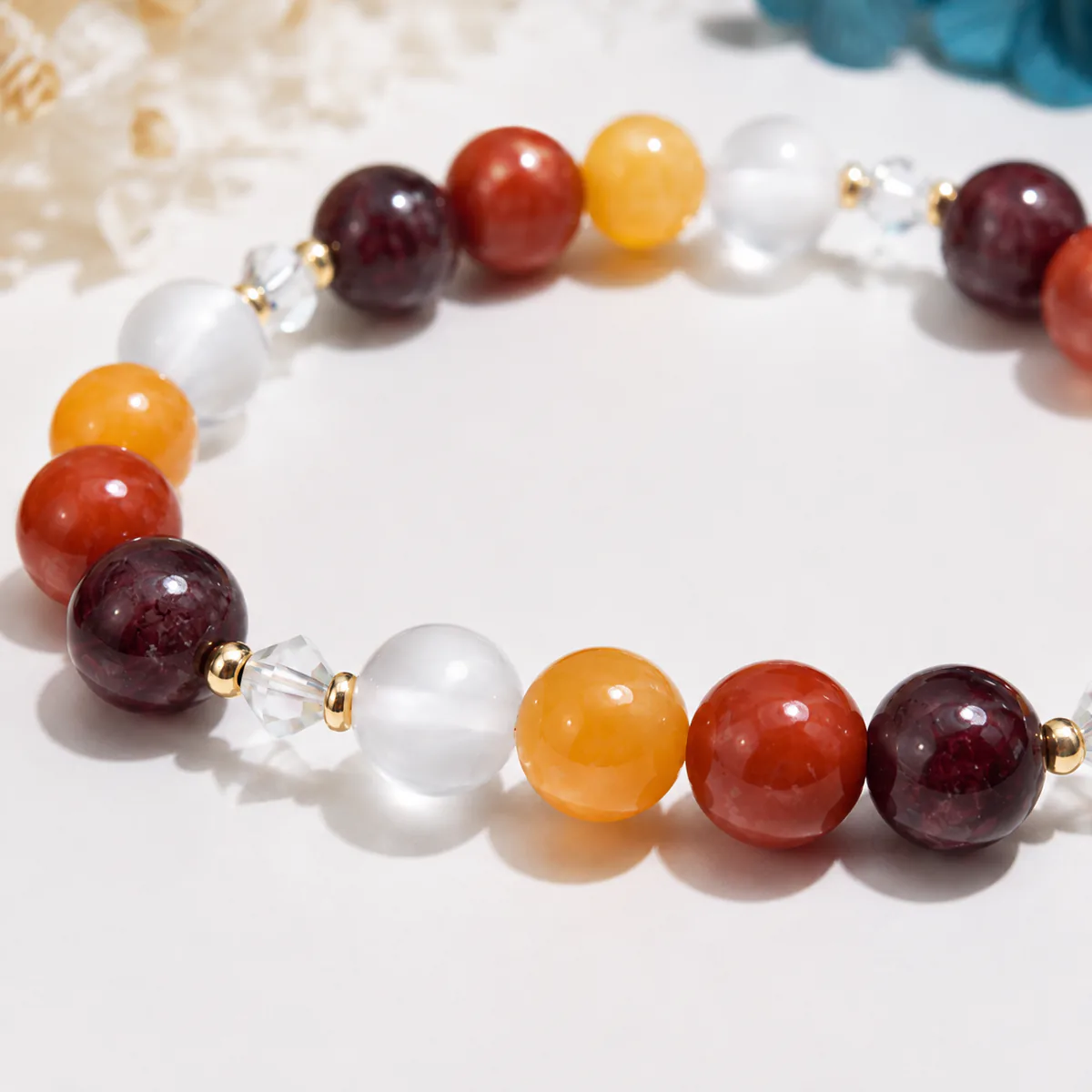
Brick red, a dark almost purplish red, honey yellow and translucent white, in an order that repeats all around the wrist, punctuated by small clear bicones and gilt balls. It is the most colourful bracelet in the catalogue, and the only one gathering four stones instead of two.
A gradient, not an assortment
The first thing to see on this bracelet is not a stone, it is the order. The beads are not mixed at random: they follow a progression running from darkest to lightest, from deep red to white, and that sequence repeats identically all the way round. That is what holds a four-colour bracelet together; the same beads threaded at random would give a motley object looking like a holiday souvenir.
Hence a piece of advice I have read nowhere and which will serve you in a few years. Photograph your bracelet before having it restrung. A stretch cord is replaced after one to three years, that is normal, and the jeweller doing it has no reason to know the original order: on a row of identical beads it makes no difference, on this one it changes the piece. One sharp photograph from the front is enough to rebuild it exactly.
The same reasoning holds if a bead breaks. Keep the pieces and note its position: on a sequenced assembly, a bead replaced by another colour shows from three metres away. The shop’s other bracelets are here.
On a four-stone bracelet, the most fragile one gives the orders
Here is what is particular about this model, and it holds for every multi-stone bracelet. Each material has its tolerances: one takes lukewarm water, another hates acids, a third fears heat. But you do not clean four stones separately, you clean a bracelet. The care rule for the whole is therefore that of its most delicate element, and not the average of the four.
That is what makes this kind of piece more demanding than it looks, and why the care card that comes with it is deliberately strict. No ultrasonic tank, no salt, no hot water, no jewellery cleaner, even if one or another of these stones would take them without flinching. On an assembly, you apply the strictest rule to everyone.
On hardness, the balance is unusual in this shop: red jasper is a quartz, so around 7 on the hardness scale, when feldspars sit between 6 and 6.5. Moonstone is here the softest of the large beads, and it is the one that will mark on contact with its neighbours. Nothing alarming on round polished beads rolling against one another, but it decides the question of stacking: this bracelet is worn on its own, or with fabric, never jammed against another row of quartz.
The little bicones are not stones
Between the large beads, minute transparent faceted elements catch the light. They are cut crystal bicones, which is to say glass, and I would rather write it than let anyone believe in a fifth stone. They have a precise role: they separate the colours and keep the row from turning into a heavy bead necklace, by slipping a little brilliance between materials that are all opaque or milky.
Two practical consequences. Glass is softer than quartz: those small elements are the ones that will lose their sparkle first, before any of the stones, and a bracelet that looks tired after two years is often a bracelet whose bicones alone have gone dull. And since they are angular where everything else is round, they are the ones that catch fine knits.
The stretch cord, finally, works harder here than elsewhere, because the beads are large and heavy: put the bracelet on by rolling it over the hand rather than stretching it to full width, and it will last toward the upper end of the one-to-three-year bracket. The stones, for their part, stay sensitive to impact: moonstone chips without scratching, and the quality criteria are set out here.
Crystal healing tradition associates these colours with different centres, and the question deserves a place of its own: I have dealt with it below. I will go no further: none of it is demonstrated and no piece of jewellery heals anything. Separately, I have gathered what tradition lends this stone, what each colour changes and what is said about which wrist to choose.
- Four colours in a repeated sequence, from dark red to white.
- Photograph it before a restringing: the order of the beads cannot be guessed.
- Care set by the most delicate stone: no salt, no ultrasonics, no hot water, no cleaner.
- Stretch cord, no clasp. Delivered in two weeks, with a cotton pouch and a care card.
The specifications
- Stones
- White moonstone, red jasper, and two accent stones in dark red and honey yellow
- Appearance
- Round polished beads, repeated sequence from dark to light
- Elements
- Cut crystal bicones and gilt-tone balls
- Construction
- Stretch cord, no clasp
- Wrist size
- 14 to 20 cm
- Gender
- Women and men
- Brand
- Melissa Moon
Why I do not make a seven-chakra bracelet
I am often asked, because this model comes close to those colours and the market is saturated with them. My answer has two parts. The first is technical: gathering seven stones chosen for their hue means putting on one elastic materials whose hardnesses vary threefold, and guaranteeing that the softest will be scratched by their neighbours within months. A well-made piece chooses compatible materials first, and colour afterwards.
The second matters more to me: a colour chart is not knowledge. Lining up seven colours in the order of the spectrum gives an object that is coherent to look at, not an object that does anything. This bracelet stops at four stones, chosen because they hold together well and because they take the same care. It is a choice of assembly, and I would rather own it as such. The rest of the shop is here.
A bracelet is not a colour chart. Colours are chosen after materials, never before.
No salt, no ultrasonic tank, no hot water, no jewellery cleaner: on an assembly of four stones, you apply the rule of the most delicate one to the whole bracelet. Lukewarm water, a drop of mild soap, a soft cloth, thorough drying with attention around the bicones where water lingers between the facets. Take it off before the shower and before sport: soap wears the elastic and perspiration settles between tightly packed beads. The detail is in cleaning a moonstone piece, and the safe methods in caring for it without harming it.