What Crystals Not to Pair With Moonstone
There are two ways to pair a moonstone badly, and only one of them can be demonstrated. Tradition talks about energies that cancel each other out; mineralogy talks about hardness, and it has numbers. Here are the stones that genuinely ruin a cabochon, the ones moonstone ruins in return, and what the prohibitions you read everywhere are actually worth.
I am going to do something uncomfortable for a shop: tell you that I sell pairings some crystal healing charts advise against, and explain why I stand by them. You can judge afterward.
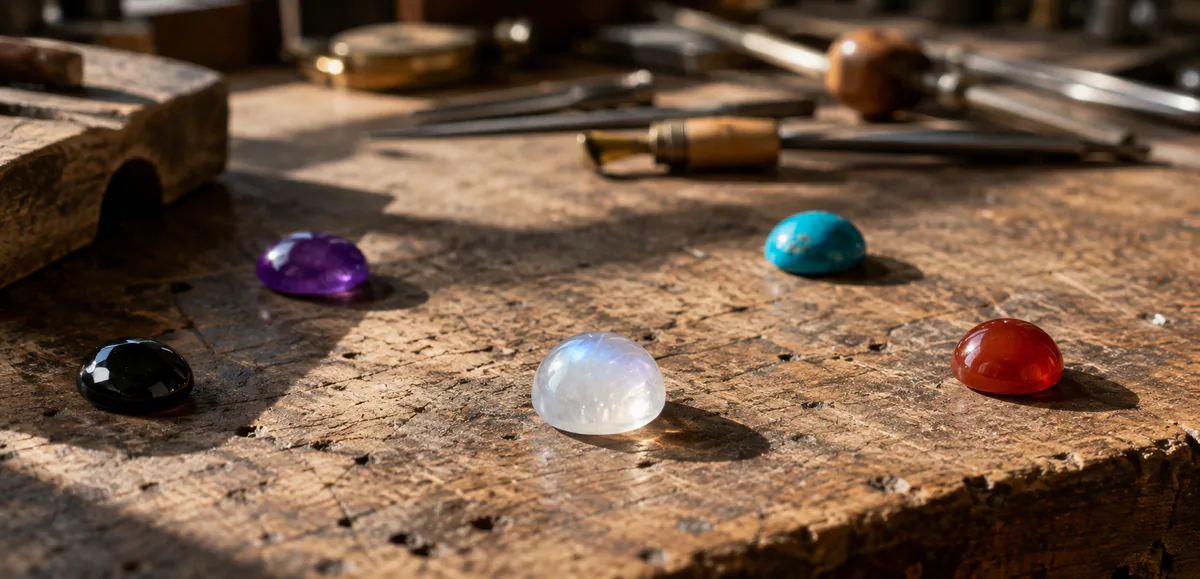
The short version, if you are in a hurry
- The only measurable incompatibility is hardness. Anything above 6.5 on the Mohs scale scratches a moonstone by simple rubbing.
- The worst neighbours are garnet, tourmaline, tiger's eye, amethyst, rose quartz, citrine and clear quartz.
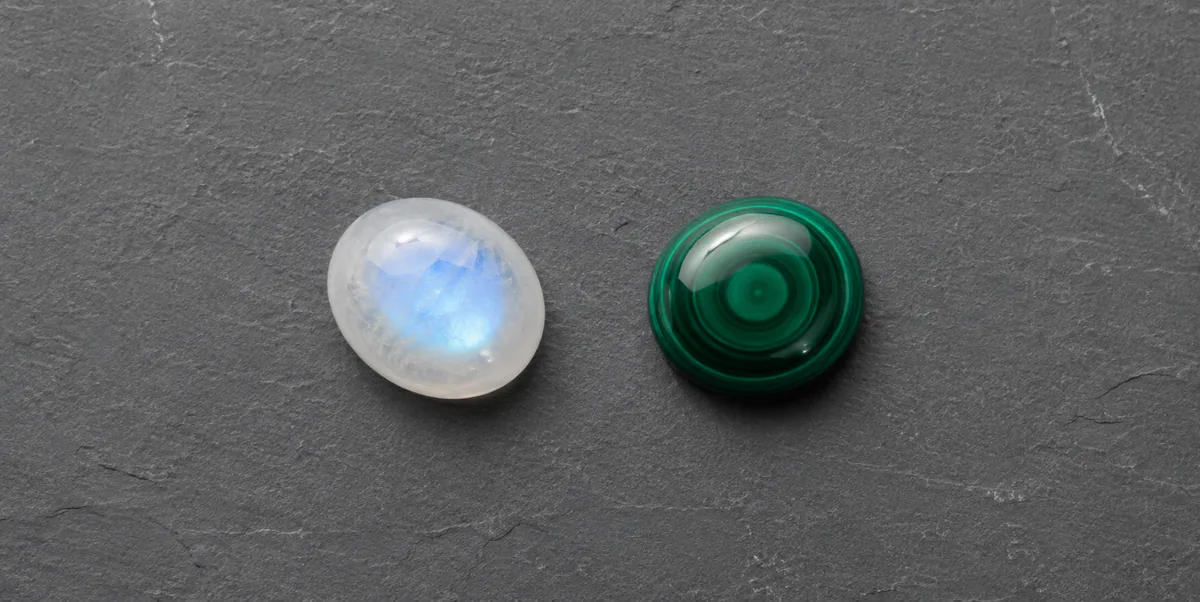
- Moonstone does damage too: it scratches malachite, apatite, turquoise, amber and pearls. Nobody ever writes that down.
- The worst neighbour is not a stone, it is a sapphire watch crystal, at 9 on the scale.
- The symbolic prohibitions do not agree with one another. The same pairing is advised against here and recommended there.
- A soft metal spacer between two stones settles 90 percent of the real problem.
- Care matters more than energy: do not mix a stone that gets cleansed in salt with a stone that cannot take it.
Two reasons not to pair, only one demonstrable
When you look for which stone not to pair with moonstone, you land on lists of energy incompatibilities. They exist, and I will report them. But they answer a different question from the one that actually ruins jewellery.
The physical reason. Two stones worn side by side rub against each other hundreds of times a day. The harder one wears the softer one down. It is measurable, it is repeatable, and it shows up to the naked eye within a few months.
The symbolic reason. Crystal healing charts assign stones polarities, elements and temperaments, and advise against certain mixtures. It is a recent construction, nothing demonstrates it, and above all it contradicts itself from one source to the next.
This site always separates those two registers, and this page is no exception: first what breaks, then what gets told. The positive side is covered in which stone to pair with moonstone.
The stones that scratch moonstone
Moonstone sits at 6 or 6.5 on the Mohs scale. Anything above that scratches it, and the result is worse than a simple loss of shine: the veil is read through the polished surface, so a micro-scratched surface puts the adularescence out.
| Stone | Hardness (Mohs) | Effect on moonstone |
|---|---|---|
| Garnet, tourmaline | 7 to 7.5 | Scratches outright |
| Amethyst, rose quartz, citrine, clear quartz, tiger's eye | 7 | Scratches |
| Carnelian, agate, jasper | 6.5 to 7 | Scratches lightly |
| Labradorite, sunstone, amazonite | 6 to 6.5 | Neutral, same hardness |
| Hematite, lapis lazuli, turquoise, obsidian | 5 to 6 | No risk to it |
| Apatite, malachite, amber, pearl | 2.5 to 5 | No risk, but see below |
Look at the third row: carnelian, agate and jasper are chalcedonies, which means microcrystalline quartz. People think of them as gentle because they are opaque and matte, and they scratch all the same.
Watch out for tiger's eye too, very common in the multi-stone bracelets sold everywhere: it is quartz, at 7, and its fibrous surface rubs like a file.
The ones moonstone scratches
Here is the half of the question nobody ever writes about. A pairing always damages somebody, and it is not necessarily the moonstone.
At 6 or 6.5, it is harder than plenty of the stones people happily pair it with.
- Malachite, at 3.5 or 4, is by far the most vulnerable. It scratches on contact with just about anything, and it also fears prolonged water and acids.
- Apatite, at 5, marks very quickly. A bracelet mixing apatite and moonstone wears out on the apatite side.
- Turquoise, between 5 and 6, and often porous, takes both scratches and greasy residue.
- Amber, at 2 or 2.5, scratches with a fingernail. It has no business sitting against a feldspar cabochon.
- Pearls, between 2.5 and 4, with a very thin layer of nacre: a scratch on one is permanent.
In other words, a pairing is not judged from the moonstone, it is judged from the softer of the two. That is the only reasoning that always gives the right answer.
Metal, watches and clasps
The most destructive neighbour a moonstone has is not a stone.
The watch crystal. Mineral crystals sit around 6 or 7, and sapphire crystals go up to 9. A watch and a moonstone bracelet on the same wrist means a hard surface sliding against a cabochon hundreds of times a day. Never on the same wrist, no exceptions.
Technical wedding bands. Tungsten carbide and zirconia ceramic, common in men's rings, sit around 8 or 9. Worn on the neighbouring finger, or simply stored in the same dish, they scratch.
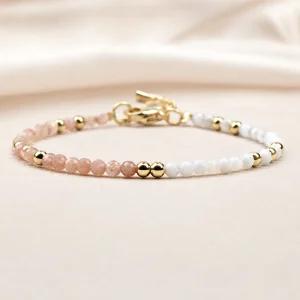
Gold and silver, on the other hand, are around 2.5 or 3: they scratch nothing. That is why a soft metal spacer slipped between two stones settles most of the problem. On my multi-stone bracelets, those spacers sit exactly where the hardnesses meet.
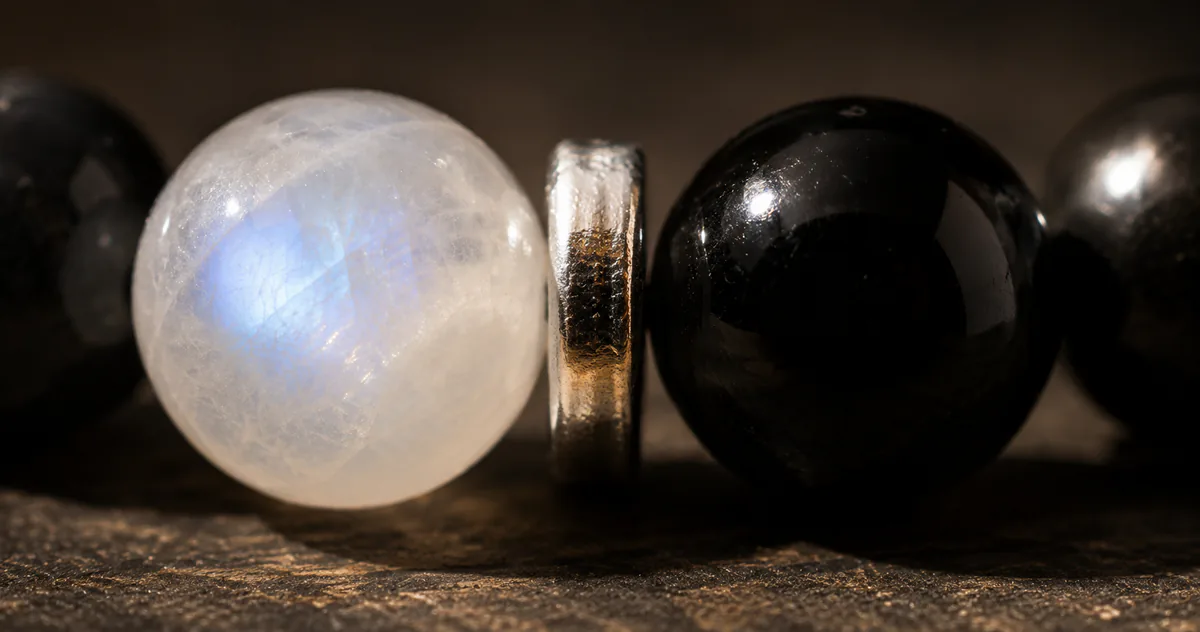
Clasps and charms. A steel lobster clasp knocking against the beads does the same work as a hard stone, only more locally. Check that the clasp falls on the underside of the wrist and not on top. The subject is covered in detail in which wrist to wear a moonstone bracelet on.
What tradition advises against
On to the symbolic side. I report, I do not endorse, and I date.
The pairings most often advised against with moonstone, in the common crystal healing sources:
- Fire stones: carnelian, garnet, ruby, red jasper, tiger's eye. The reasoning is an analogy of elements, fire against water.
- Stones described as very active: citrine, pyrite, hematite, said to be too stimulating for a stone presented as calming.
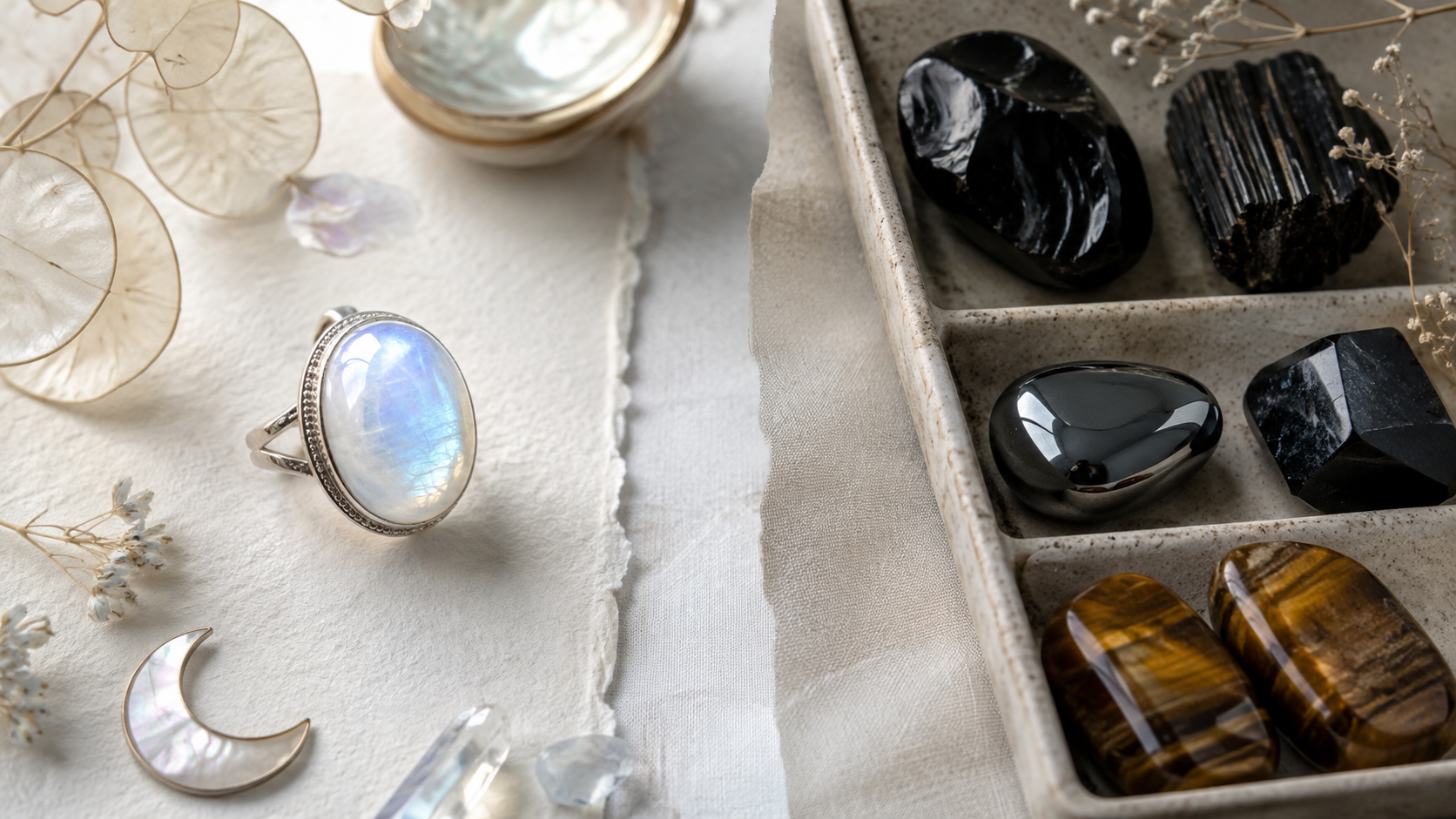
- Black protection stones: obsidian, black tourmaline, sometimes onyx, on the grounds of an opposite polarity.
- Malachite, described as an amplifier, therefore not to be mixed with a stone you want to keep gentle.
- Lapis lazuli, cited by some sources as too intellectual next to a stone called intuitive.
Take that list as information about what gets said, not about what is. What follows explains why.
The "fire and water" pairing, the most quoted prohibition
This is the argument you will meet most often, and it deserves examining rather than copying.
The reasoning fits in one sentence: moonstone is filed on the side of water and the Moon; carnelian, garnet or red jasper on the side of fire; water puts fire out, so the two would cancel each other.
Three honest remarks. First, this is an analogy, not an observation: it reasons about words, not about measurements. Second, that classification by elements is recent in its current form, spread by modern crystal healing from the 1970s onward. Third, and this is the awkward part, other sources just as widely circulated present exactly this pairing as a sought-after balance, the warm stone tempering the cold one.
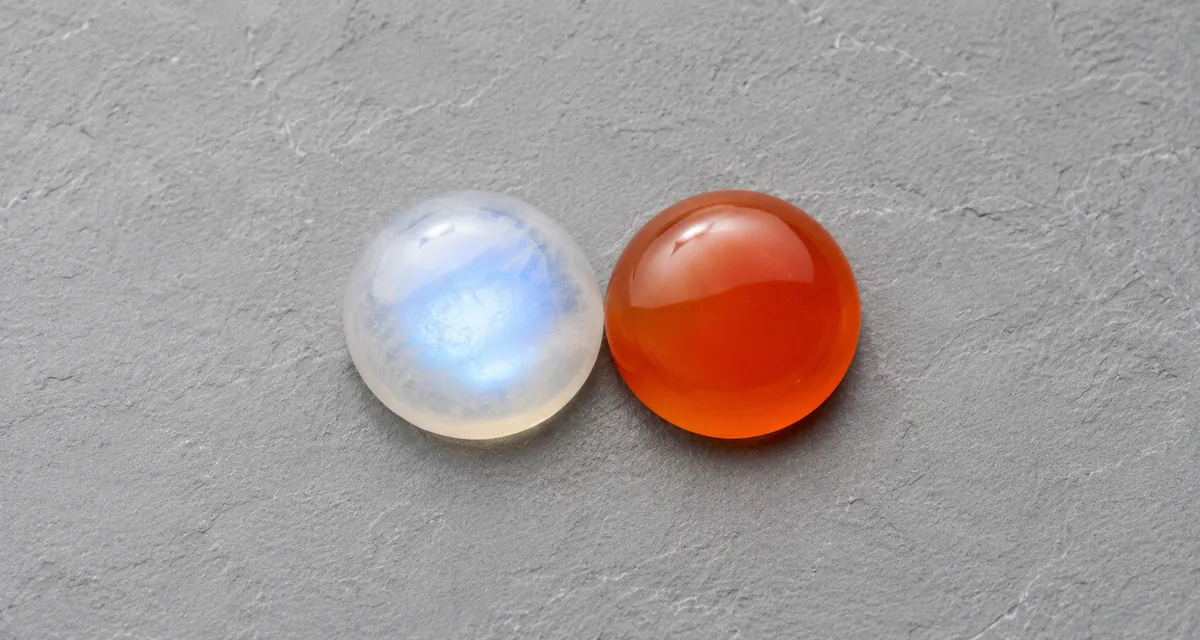
What is true, on the other hand, and verifiable: carnelian and red jasper are chalcedonies at 6.5 or 7, so they scratch the cabochon. The symbolic prohibition and the real risk point to the same pairing here, for two reasons that have nothing to do with each other.
Black stones and protection stones
The second most quoted prohibition, and this one overlaps with no physical risk at all.
Obsidian sits between 5 and 5.5, black tourmaline at 7 or 7.5. The first presents no danger whatsoever to a moonstone cabochon; the second scratches it outright. In other words, tradition lumps the two together where mechanics separates them cleanly.
If you follow the symbolic reading, the warning concerns an opposition of polarity, a stone that receives against a stone that repels. If you follow mechanics, remember tourmaline and nothing else.
You can also follow neither and trust your eyes: a milky cabochon next to a matte black stone gives a contrast plenty of people find very successful, whatever the colour chart says.
Why these charts do not agree
Here is the point that should reassure everyone.
If you consult five sources on stone pairings, you will get five different lists. Carnelian is advised against here, recommended there. Lapis lazuli appears in both columns depending on the author. Amethyst, almost never advised against, is nevertheless one of the few that presents a real risk.
That variability is not a detail: it is the proof that these charts are recent. A genuinely old and transmitted tradition would not have that instability. These were built in the twentieth century, spread with modern crystal healing, then frozen by copying across the internet.
Practical conclusion: if a pairing appeals to you and neither of the two stones damages the other, wear it. No old rule forbids it, and the one that might be invoked has its opposite inside the same body of writing. The same sorting is done in the myths and legends of moonstone.
These correspondences belong to crystal healing, an approach founded on traditions and beliefs. They are not a medical claim and never replace the advice of a healthcare professional. Read the full disclaimer.
Why I sell pairings some charts forbid
Better to say it plainly than to let someone discover it on a product page.
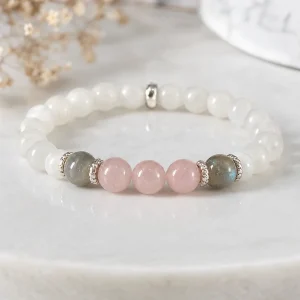
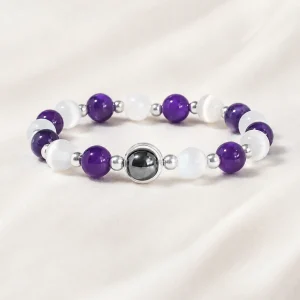
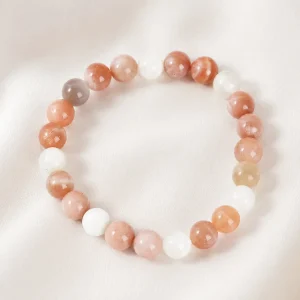
I make bracelets that mix moonstone with carnelian, with sunstone, with red jasper, with amethyst and with rose quartz. Several of those pairings appear in the prohibition lists in the previous section, in particular everything belonging to the fire register.
My position comes down to three points. I do not treat those prohibitions as facts, since they contradict one another. I do treat hardness as a fact, and that is why silver spacers sit at every junction where a stone at 7 meets the cabochon. And I say so on the product page, rather than selling a harmony I cannot demonstrate.
If the symbolic charts matter to you, choose a single-stone bracelet: that is the one case where the question does not arise.
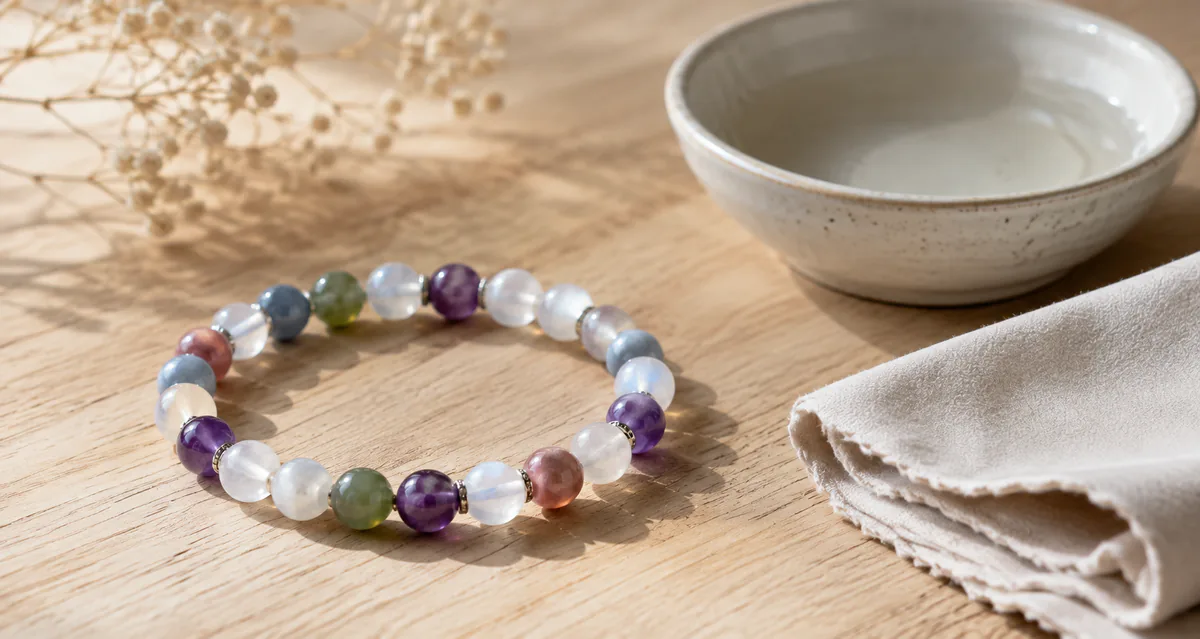
My multi-stone bracelets, and where the spacers sit
Care incompatibilities, the ones people forget
Here is the third incompatibility, never quoted, and yet the most destructive over the long run: two stones that are not cleaned the same way.
Salt. Many cleansing methods use dry salt or salt water. Moonstone cannot take it: salt works its way into the microfractures and attacks the settings. If one stone on your bracelet is normally cleansed in salt, the whole bracelet can no longer be.
Prolonged water. Malachite, turquoise, lapis lazuli, selenite and amber all handle water badly. So does moonstone, when soaked. A bracelet mixing those stones is cleaned with a damp cloth, never by immersion.
Ultrasound. Forbidden for moonstone, whose cleavage propagates under vibration. A jeweller who offers to clean a multi-stone piece in an ultrasonic tank should be told no.
Sunlight. Amethyst and citrine fade under prolonged light. Charging a bracelet in full sun for the sake of the amethyst amounts to bleaching it. The timing and the methods are in cleansing and recharging your moonstone.
The three rules that are enough
If you take only three things away from this page, take these.
One. Look at hardness before energy. Anything above 6.5 scratches your cabochon, whatever the colour, whatever the symbol. And always judge from the softer of the two stones.
Two. Slip in a soft metal spacer. A silver or gold spacer between two stones removes the direct contact. It is the workshop answer, it costs a few cents and it settles the essentials.
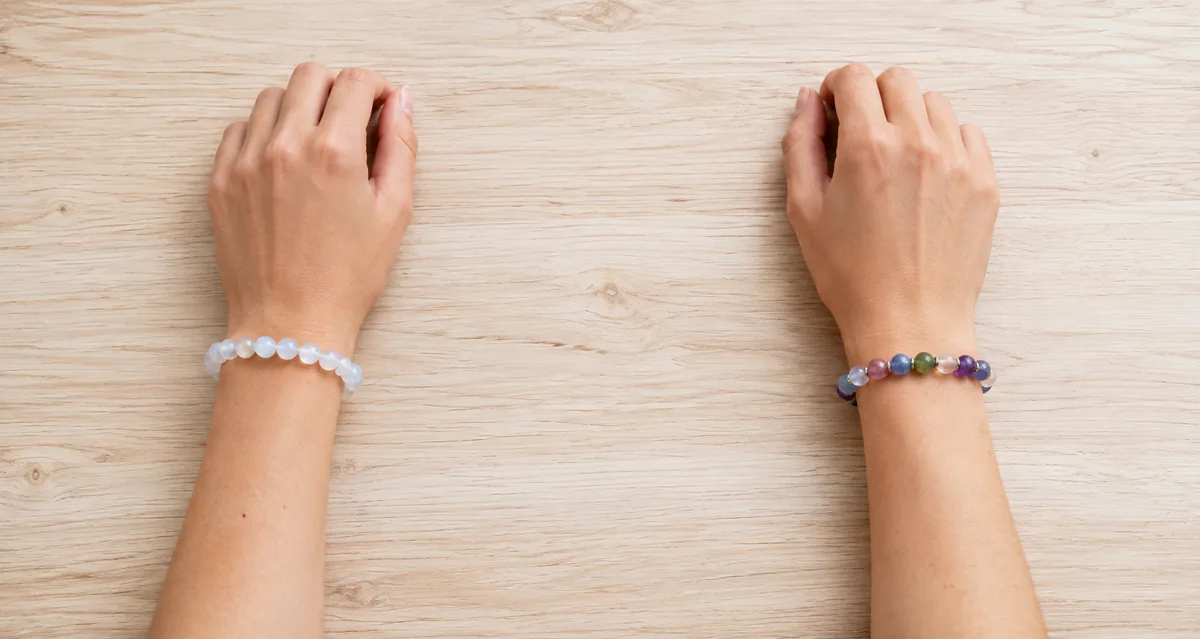
Three. Separate rather than arbitrate. One wrist for the moonstone, the other for the rest. No symbolic rule survives a cabochon that has gone out, and this solution has no downside at all.
The rest is a matter of taste, and taste needs no mineral justification.
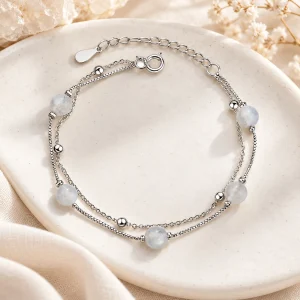
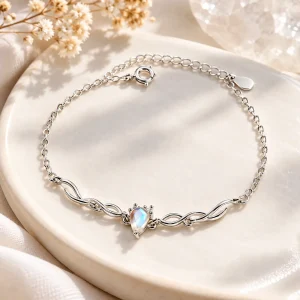
The single-stone bracelets, where the question never arises
Frequently asked questions
What stone should not be paired with moonstone?
Physically, anything above 6.5 on the Mohs scale: garnet, tourmaline, tiger's eye, amethyst, rose quartz, citrine, clear quartz, carnelian and jasper. Symbolically, sources mostly cite fire stones and black protection stones, but they contradict one another.
Does amethyst damage moonstone?
Yes, by rubbing: it is quartz, at 7 on the Mohs scale. It is in fact one of the few pairings almost never advised against by the symbolic charts, while it presents a real risk. A metal spacer between the two is enough to avoid it.
Can moonstone damage another stone?
Yes, and it is rarely said. At 6 or 6.5, it scratches malachite, apatite, turquoise, amber and pearls. A pairing is always judged from the softer of the two stones, not from the one you prefer.
Can moonstone be worn with a watch?
Not on the same wrist. A mineral crystal sits around 6 or 7 and a sapphire crystal at 9, against 6.5 at most for moonstone. Continuous rubbing puts the veil out within a few months. It is the most destructive neighbour, and it is not even a stone.
Are energy pairing prohibitions well founded?
Nothing demonstrates them and they do not agree with one another: the same pairing is advised against by one source and recommended by another. That instability points to a recent construction, spread by modern crystal healing and frozen by copying.
How do I protect a multi-stone bracelet?
By slipping soft metal spacers, silver or gold, at every junction where a harder stone touches the cabochon. Gold and silver are around 2.5 or 3 on the Mohs scale and scratch nothing. It is the workshop answer, and it is almost invisible.
Can a bracelet containing moonstone be cleansed in salt?
No. Salt works its way into the microfractures and attacks the settings. If another stone on the bracelet is normally cleansed in salt, it is the whole bracelet that can no longer be. A damp cloth and careful drying are enough.
Should I give up a pairing I like?
No, provided neither of the two stones damages the other, or you separate them with metal or across two different wrists. No old rule forbids it, and the one that might be invoked has its opposite inside the same body of writing.
Where to go next
This page is the negative counterpart of pairings. For the rest:
- The pairings that work: which stone to pair with moonstone.
- Wearing without damaging: how to wear it day to day, which wrist, the ring, the necklace and the pendant.
- Care: cleaning it, cleansing and recharging it, can it go in water.
- The material: the mineral data sheet, is it fragile, moonstone or labradorite.
- The big picture: the complete guide.
My bracelets are in the bracelet collection, with the full composition on every listing. Unsure about a bracelet you already wear? Send me a photo, I will tell you which stone is wearing the other one down.
My sources
The hardnesses quoted, those of moonstone, of quartzes and chalcedonies, of malachite, apatite, turquoise, amber, pearls, watch crystals and precious metals, follow the Mohs scale as published by the GIA, Mindat and the International Gem Society. The perfect cleavage of feldspar and the ban on ultrasound come from the same data sheets.
The symbolic incompatibilities are reported from the most widely circulated crystal healing sources, with their disagreements flagged as such. None has scientific validation and I do not present it as such.
The separating spacers, the wear observations and the diagnosis of multi-stone bracelets come from my workshop and from the pieces people bring me to rework.
Last updated: 19 August 2026. If you find an error in this article, let me know: I correct it and I note it.
✦ À porter, à offrir
Découvrez mes créations