Sri Lankan Moonstone: A Deposit Running Dry
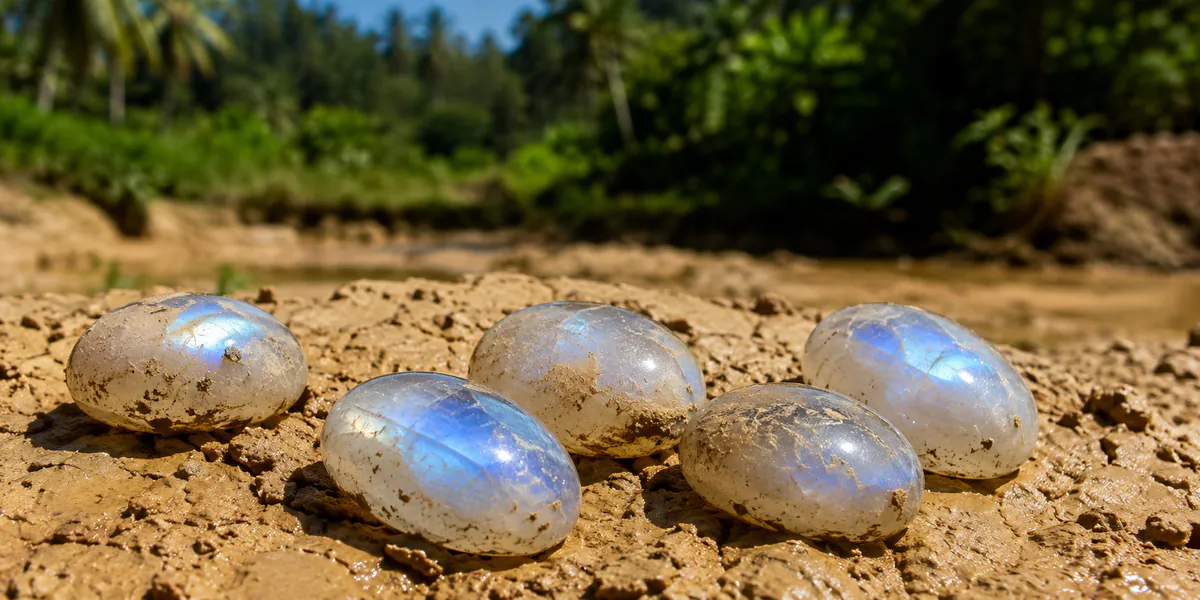
Almost all the blue moonstone in the world has come out of one small area, around Meetiyagoda in the south of Sri Lanka. The shafts there go deeper than they used to, top material is getting scarce, and the price follows. Here is how the stone is dug out, why the deposit is running dry, and what that changes when you buy.
I have never been there, and I am going to stick to what I can establish. This page contains no production figures, for one simple reason: none exist that are both public and reliable. What I can describe is the geology, the way it is mined, and what the trade has been seeing for fifteen years.
The short version, if you are in a hurry
- Almost all the benchmark blue comes from one area, around Meetiyagoda, in the Galle district, in the southwest of Sri Lanka.
- The mining is artisanal: narrow shafts dug by hand, timbered, and pumped out continuously.
- Regulation bars most mechanization. That protects the resource and limits the volume.
- The easy ground is worked out. The shafts go deeper, for the same yield or less.
- The price of strong blue has risen sharply, while white and the warm shades have barely moved.
- No origin can be verified on a moonstone cabochon: it is a trade statement, not a piece of data.
- The gap is being filled by something else: Indian material, and Madagascan labradorite sold under moonstone names.
Meetiyagoda, and why there
Sri Lanka is one of the oldest gem grounds in the world. It yields sapphires, rubies, spinels, garnets and chrysoberyls, and that production is traditionally associated with the Ratnapura region, inland.
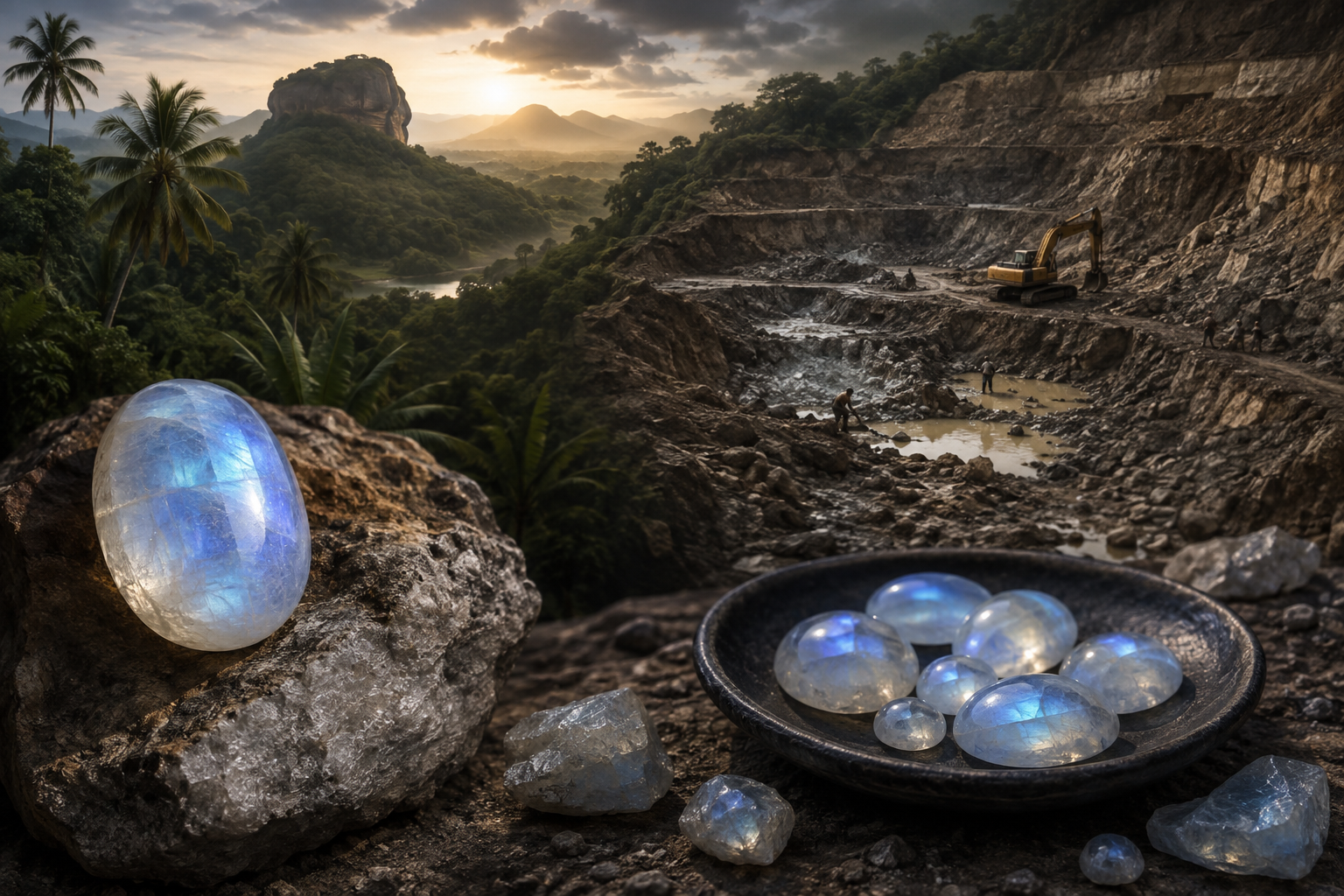
Moonstone does not come from there. It is concentrated in a quite different area: the southwestern coastal belt, around the village of Meetiyagoda, in the Galle district, between Ambalangoda and Hikkaduwa.
That concentration is striking. A gem known the world over comes essentially from a perimeter of a few square kilometres, worked by family shafts. That is not unique in the gem world, but it is always a fragility: when the resource gets scarce, there is no equivalent second source.
The survey of the other origins is in the moonstone deposits.
The geology of the area
Why that particular corner and not another: it is a matter of rocks and of climate.
At the origin there are pegmatites, those igneous rocks with very large crystals that form during the slow cooling of a granitic body. It is in that context that feldspars grow big enough to give cabochons, and that the exsolution into lamellae which makes the veil takes place. The full mechanism is in how moonstone forms.
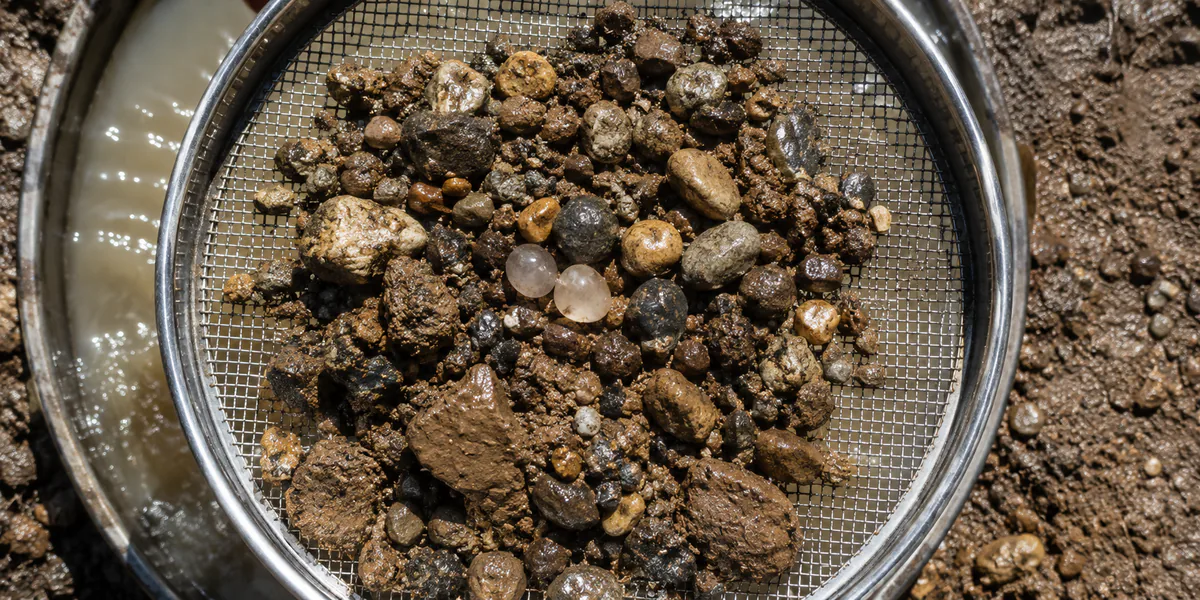
Then the tropical climate comes in. Under heavy rain and constant heat, the rock breaks down in place and to depth, turning into a mantle of pale clays. The fragile minerals disappear, the resistant feldspars stay, caught in that clay.
The result: the stone is not looked for in a hard rock that would have to be broken, but in a clay layer that gets dug. That explains the way it is mined, and it also explains the water, which is the permanent problem of these workings.
How it is actually mined
It is artisanal mining, and the word is not decorative.
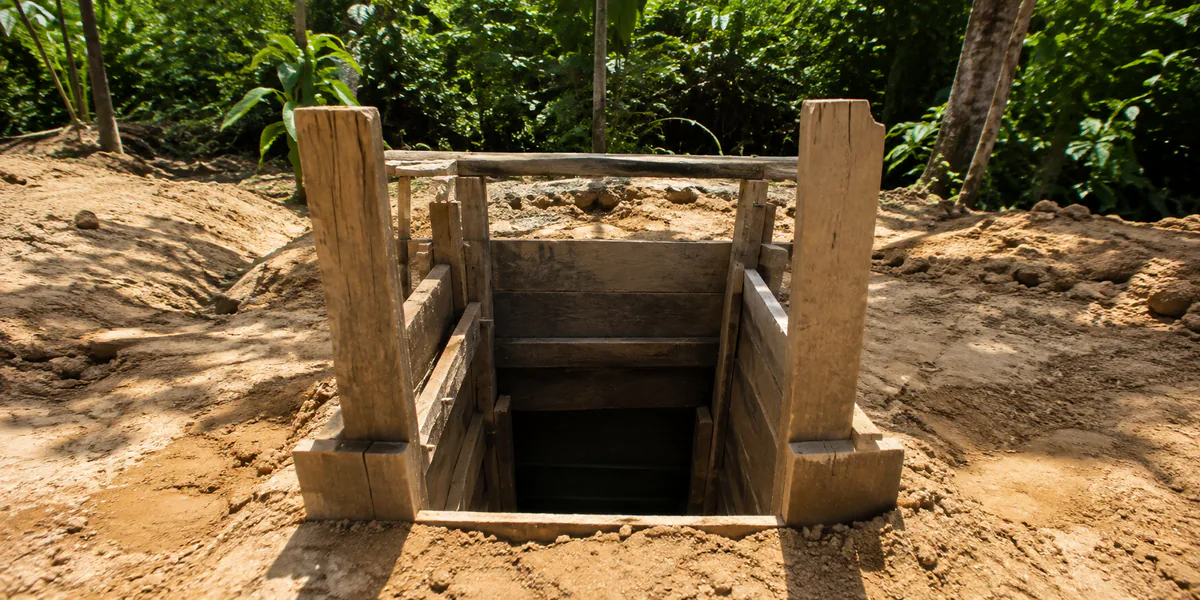
The principle is a narrow vertical shaft, dug by hand, often barely wider than a man, taken down to the productive layer. The walls are timbered, because the clay will not stand on its own. Once the layer is reached, side galleries are opened to follow it.
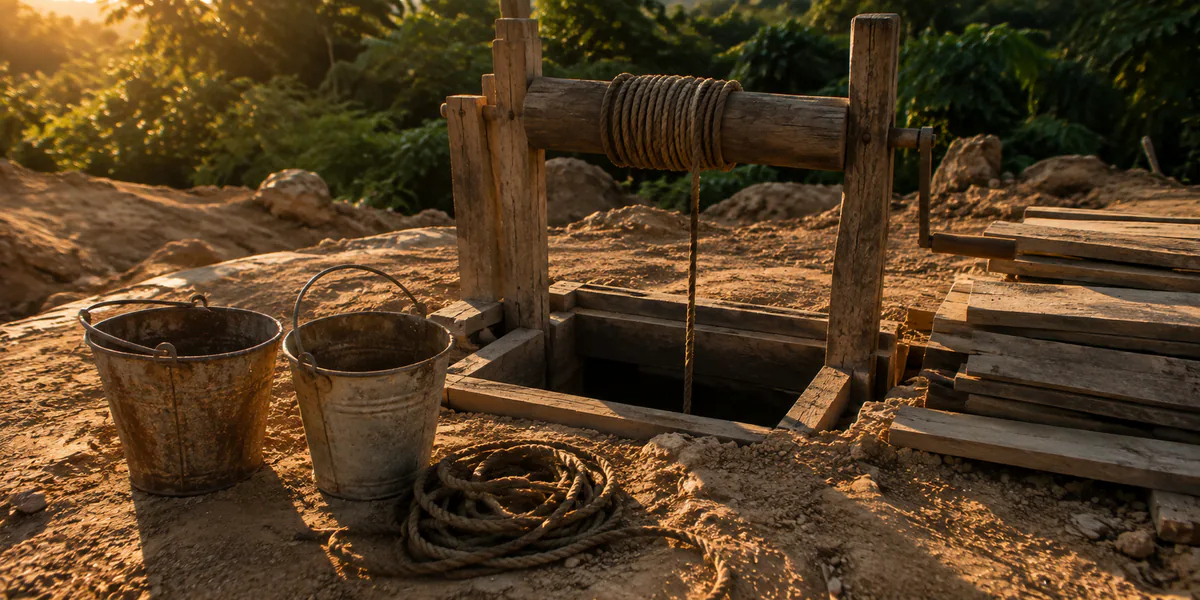
The material comes up in baskets or buckets, on a rope or a winch. It is then washed and sorted by hand, in tanks or sieves, exactly as for the gem gravels of the rest of the island.
The crux of it is the water. At that latitude and at that depth, a shaft fills up continuously, and it has to be pumped without a break for anyone to work. One pump breaks down, one monsoon comes too hard, and the shaft is lost for a while.
These are small workings, often family run, with a handful of men to a shaft. There is no open pit, no heavy plant, no conveyor.
What Sri Lankan regulation changes
Here is a point that gets systematically forgotten when people talk about scarcity, and it is nonetheless decisive.
The gem sector in Sri Lanka is regulated by the state, through a national authority that issues mining licenses. And that framework points in one particular direction: it strongly limits mechanization. No widespread heavy plant, no explosives, methods that have stayed manual.
That choice has two opposite effects, and both have to be held together.
It protects the resource and the country. Hand mining does not empty a deposit in ten years, does not wreck the water table and does not leave a gutted landscape. Sri Lanka has chosen duration over volume.
It caps production. Quantities cannot be raised to meet world demand, which has exploded with online selling. A restricted supply against climbing demand gives a rising price, mechanically.
In other words, part of the scarcity you are paying for is not geological: it is regulatory, and that is rather good news.
Why the deposit is running dry
The word running dry needs qualifying, because it does not mean there is nothing left.
What is running out is the easy ground. The most accessible, shallowest and richest zones were worked first, often generations ago. What is left calls for going deeper, with more timbering, more pumping, and for a yield that is no better.
What is running out above all is the top material. A productive layer gives a great deal of mediocre stuff, milky, fractured or too small, and a minute fraction of cabochons with a strong blue veil in a transparent body. It is that fraction that is missing, not moonstone in general.
And the cost of production is rising. More depth, more timber, more fuel for the pumps, more time per shaft. Even at constant production, the cost price goes up.
Add world demand, driven by online selling, and you have the whole equation: a scarce material that costs more to get out, facing a public far wider than it was twenty years ago.
What I cannot tell you
This section exists on no other page about this subject, and that is precisely why I am writing it.
You will read figures everywhere: such and such a percentage drop, such and such an announced year of exhaustion, such and such an annual volume. I have found no public, verifiable source that would support them for this particular deposit.
The reasons are understandable. The mining is artisanal and split among many small operators. Part of the trade is done hand to hand. And export statistics, where they exist, group gems into broad families without isolating moonstone.
What I can state, on the other hand, comes down to one sentence: strong blue transparent material is visibly harder to find and more expensive than it was ten years ago, and that is the unanimous view of the dealers and lapidaries I work with. It is a market observation, not a measurement, and I would rather present it as such.
A page that gives you a precise percentage on this subject either has a source I have not found, or made the number up. When in doubt, ask for the source.
What that changes about the price
The consequence is very uneven depending on what you are buying, and that is what surprises people.
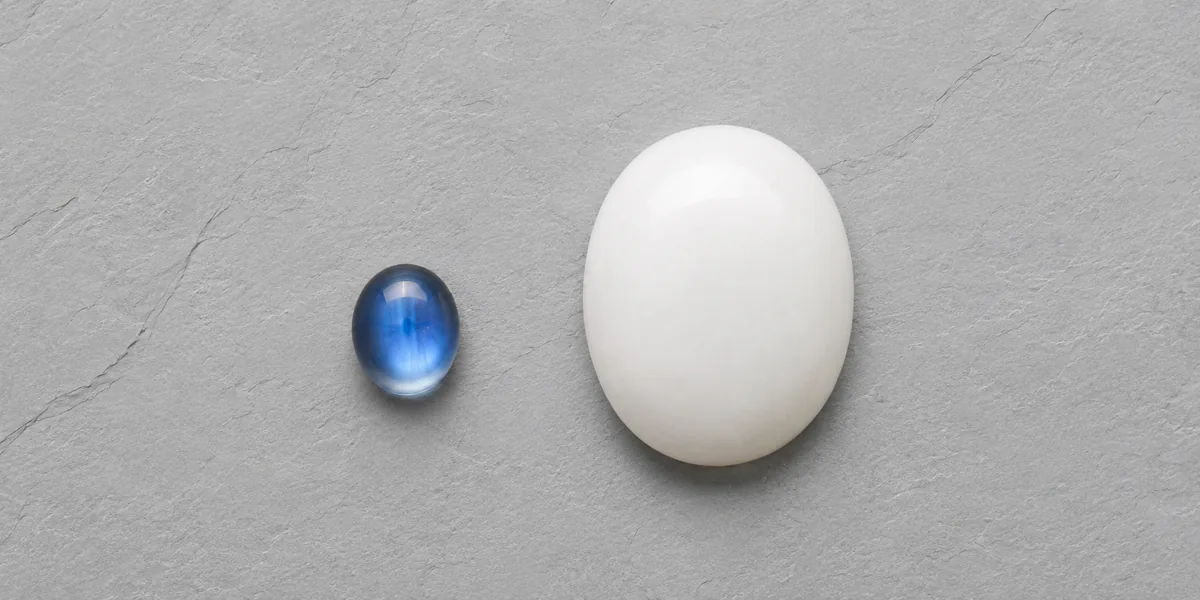
Strong blue has risen sharply. It is the material directly affected by the scarcity, and its price per carat climbs all the faster as the size goes up, big clean cabochons being the rarest of all.
White and the warm shades have barely moved. They come largely from elsewhere, notably from India, and do not depend on this deposit. A white or peach moonstone remains perfectly affordable, and that is what explains the considerable price gap between varieties.
Hold on to the practical consequence: if your budget is tight, do not go looking for a cheap strong blue, it does not exist. Take a fine white or a fine peach rather than a doubtful blue at the same price. The criteria are in the price of moonstone and judging the quality.
Cabochons chosen one by one, whatever their origin
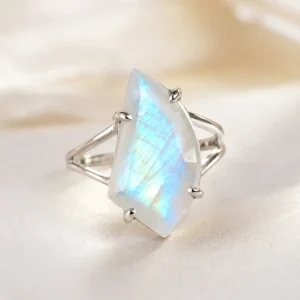
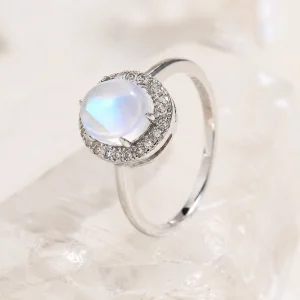
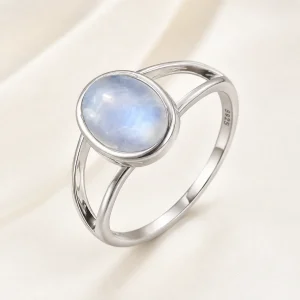
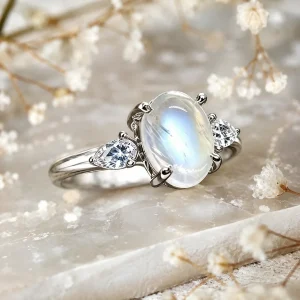
What fills the gap
When a material gets scarce, the market does not simply raise prices: it substitutes. And that is where the buyer has to pay attention.
Indian material takes over on white, grey and the warm shades. It is real moonstone, often the same species, simply less often blue. Nothing to object to, provided it is said.
Madagascan labradorite arrives in quantity under the names rainbow moonstone and black moonstone. Those are trade names the trade accepts, but they are plagioclases, not orthoclase, and their optical phenomenon is not the same. See moonstone or labradorite.
Glass, finally, under the name opalite, at the lowest end of the market. It is the one case that plainly amounts to deception when the name of the gem is used without a qualifier. See moonstone or opalite.
So the running down of a deposit does not only produce a price rise: it produces a confusion of names, and it is that confusion which costs the buyer most.
Can an origin be verified?
Short answer: no, and I would rather say so than stamp my own listings.
For a few very high value gems, sapphire and emerald in particular, laboratories offer origin determination, based on fine analysis and on comparison databases. It is expensive, it is argued over, and in practice it does not exist for moonstone, whose unit value would not justify it.
The consequence: when a seller writes "Sri Lanka" on a listing, that is a trade statement. It may be perfectly sincere, and it is unverifiable. That applies to me too.
What does remain verifiable is the chain: who did the seller buy from, for how long, can they name them. A buyer who goes to the Tucson or Bangkok shows and has worked with the same suppliers for ten years has an answer. A reseller has none. The six questions to ask are in where to buy moonstone jewellery.
The other origins, and what they are worth
Sri Lanka has no monopoly, and it would be dishonest to let anyone believe the rest is worthless.
India supplies the bulk of world volume: white, grey, peach, apricot, in large quantities and at accessible prices. It is the material most widely found in everyday jewellery, and it can be very fine.
Madagascar supplies mostly plagioclases, among them the labradorites sold under moonstone names. Fine material, different species.
Tanzania arrived more recently, with varied material.
Myanmar has a historic and irregular production, on which I will not venture: the situation in the country makes any traceability illusory, and that is reason enough not to make an argument of it.
The rule I apply: origin is not a criterion of quality. A fine Indian cabochon is worth more than a mediocre Sri Lankan one, and it is the stone that has to be judged, not its passport.
What that changes about your purchase
Four practical consequences, and every one of them can be checked by you.
A cheap strong blue is a warning sign. The material exists in limited quantity and it gets paid for. A large, very blue cabochon at a modest price is almost always something else: a labradorite, a glass, or a retouched photo.
Judge the stone, not the origin label. It cannot be verified. Look at the veil, its cleanness, its position on the dome and the transparency of the body.
Accept the white and the warm shades. They are the ones that give the best ratio between what you see and what you pay, and they do not depend on a deposit under strain.
Ask about the supply chain. Not the country, the supplier. The question separates immediately those who buy their stones from those who resell them.
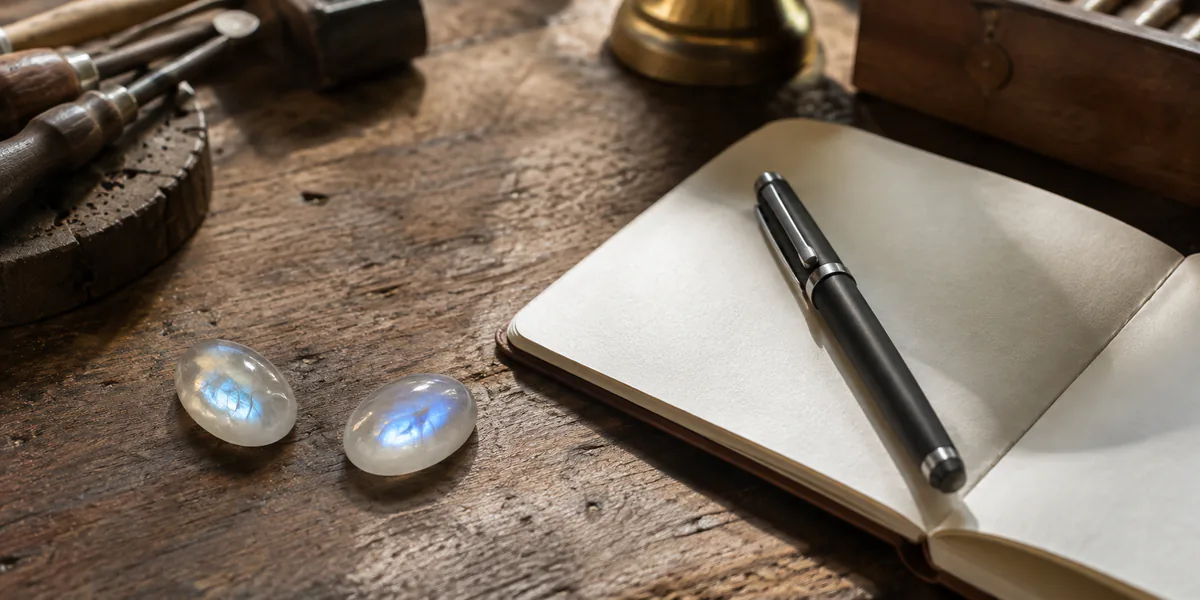
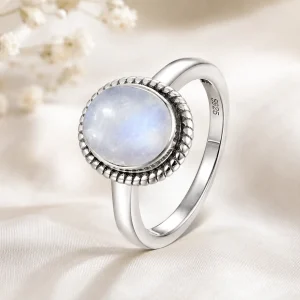
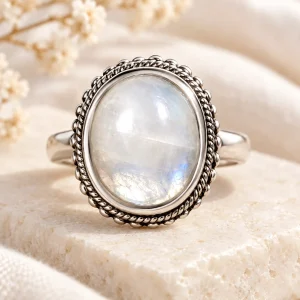
The workshop rings, species named on every listing




Frequently asked questions
Where does Sri Lankan moonstone come from?
Essentially from the Meetiyagoda area, in the Galle district, in the southwest of the island, between Ambalangoda and Hikkaduwa. It is a very restricted zone, distinct from the Ratnapura region the sapphires and the other Sri Lankan gems come from.
Is the deposit really exhausted?
No, but the easy ground is. The shallow, rich zones were worked first; from now on you have to go deeper, with more timbering and more pumping. What is missing above all is the top material, strong blue in a transparent body.
How is the stone mined there?
By narrow vertical shafts dug by hand, timbered, taken down to a productive clay layer, with side galleries. The material comes up by the bucket, then gets washed and sorted by hand. The water has to be pumped continuously.
Why is it not mechanized?
Because Sri Lankan regulation strongly limits mechanization in the gem sector. That choice protects the resource and the landscape, but it caps production, which contributes to the rise in prices against a world demand growing fast.
By how much have prices gone up?
I will not give a figure, because there is no reliable public statistic isolating moonstone. What dealers and lapidaries observe unanimously is that strong blue transparent material is markedly rarer and dearer than it was ten years ago, while white and the warm shades have barely moved.
Can it be proved that a stone comes from Sri Lanka?
No. Laboratory origin determination exists for a few very high value gems, not for moonstone. A mention of origin is a trade statement, sincere or not, but unverifiable. Ask the seller about their supply chain instead.
Is an Indian stone inferior?
Not at all. India supplies the bulk of world volume, in white, grey and the warm shades, and the material can be excellent. Origin is not a criterion of quality: judge the veil, its cleanness, its centring and the transparency of the body.
Should you buy now before prices go up?
No, and be wary of anyone who tells you so. A piece of jewellery is not bought like an investment, and moonstone is not one. Buy a piece because you like it, at a price you judge fair, and not because a seller is waving a shortage at you.
Where to go next
This page deals with the deposit. For the rest:
- The origins and the material: the moonstone deposits, how it forms, the mineral file.
- The colour: blue moonstone, the colours and varieties, pink moonstone.
- Buying without getting it wrong: the price, judging the quality, where to buy it, recognising a real stone.
- The confusions of name: moonstone or labradorite, moonstone or opalite.
- The whole picture: the complete guide.
I do not certify the origin of any of my stones, because nobody can on this gem. What I can tell you is what I see on each cabochon, and that is what goes on the listings in the shop. A question about a stone advertised as Sri Lankan somewhere else? Send me the photo.
My sources
The location of the Meetiyagoda area in the Galle district, its distinction from the Ratnapura gem region, and the geological context of pegmatites weathered into clays under a tropical climate belong to the ordinary gemmological and geological literature on Sri Lanka.
The method of mining by narrow timbered shafts, the manual washing and sorting, and the framing of the sector by a national authority limiting mechanization, are described consistently by the professional publications on Sri Lankan gems.
No production figure is cited on this page, and that is deliberate: I have found no public statistic that isolates moonstone reliably. The observation that top blue material has become scarce is a market observation, reported by the dealers and lapidaries I work with, and presented as such.
On the impossibility of determining origin in a laboratory for this gem, I rely on the fact that the service is offered only for a few very high value gems, which the laboratories that provide it confirm.
Last updated: 19 August 2026. If you find an error in this article, let me know: I correct it and I note it.
✦ À porter, à offrir
Découvrez mes créations